

How Do You Find a Trusted REALTOR® in Another State? Start With Someone You Already Know
You don’t have to know a REALTOR® in every city. You just need to know someone who does. Whether you're relocating, helping an aging parent downsize, or assisting a friend with an inherited home, Beth Green can help connect you with experienced real estate professionals across the country. Learn how her nationwide REALTOR® referral service works, why it’s completely free to you, and how one phone call can make finding the right agent a little easier.
Whether you're moving across the country, helping an aging parent, or trying to find a good real estate agent for someone you care about, you don't have to figure it out alone.

Your daughter just accepted a job in a city where she doesn't know anyone.
She's excited, but there's a lot to figure out. Where should she live? Should she rent first or consider buying? How does she know which areas might fit her budget and daily routine?
You want to help, but you've never lived there either.
Or maybe a friend has inherited a home in Florida. They live in Ohio, have a demanding job, and can't keep traveling back and forth to figure out what to do with the property.
They need someone local who understands the market and can explain the next steps.
Where do they begin?
Most people would start searching online, reading reviews, and hoping they choose the right person.
But there's another option that many people don't realize exists.
You don't have to know a REALTOR® in every city. You just need to know someone who does.
And that someone can be me.
Although I work with buyers and sellers in Louisville, Kentucky, my professional relationships extend throughout the country. Through those connections, I can often help you find an experienced real estate agent in another city or state.
You don't have to be my client. You don't have to live in Kentucky. And you don't even have to be the person buying or selling.
Sometimes you're simply trying to help someone you care about.
And my help finding and connecting you with a REALTOR® is completely free to you.
Is There a Cost to Have Me Find a REALTOR® for You?
No. My real estate referral service is FREE to you.
If you call me because you need a real estate agent in another city, I don't charge you to help find someone or make the introduction.
You may be wondering how that works.
It's actually pretty simple.
When I refer someone to another real estate agent and that introduction results in a completed transaction, the receiving agent pays a referral fee from their commission through our respective brokerages.
You don't pay me for the referral. The receiving agent compensates me.
There's no separate charge to you for my referral assistance.
The agent I introduce you to will discuss your real estate needs, explain how they work, and help you understand the process and any costs involved in buying or selling.
And what if you speak with that agent and don't feel comfortable?
Call me back.
We'll talk about what wasn't working and look for someone else.
You're not obligated to hire someone simply because I recommended them.
I want the introduction to be helpful, not another decision that makes you feel pressured.
It costs you nothing to ask for my help, and there's no charge from me to you for making the connection.
Why is Finding a REALTOR® in an Unfamiliar City So Difficult?
When you're buying or selling close to home, you may already know several real estate agents. You might have worked with someone before or have friends who can share their experiences.
But what happens when the property is 500 miles away?
You can search online, of course.
You'll find agents with attractive websites, excellent reviews, impressive sales numbers, and plenty of promises about their service.
The challenge isn't necessarily finding an agent.
It's knowing which agent is right for your particular situation.
An agent who does an excellent job helping buyers purchase homes in a competitive market may not have much experience selling inherited properties.
Someone who specializes in luxury homes may not be the best fit for a first-time buyer trying to understand an unfamiliar city.
And an agent who knows the broader metropolitan area may not work regularly in the particular community where you're considering a purchase.
Those differences matter.
There are also questions you may not think to ask until you're already working together.
Will the agent explain unfamiliar local practices?
Can they accommodate the fact that you're several states away?
Will they communicate regularly without making you chase them for information?
Do they understand the circumstances behind the move?
These are the kinds of considerations I think about when someone asks me to help find a real estate professional.
How Can a REALTOR® Help You Find Another Agent?
A real estate referral is a professional introduction between someone who needs real estate assistance and an agent who works in the appropriate market.
Rather than choosing an unfamiliar agent entirely on your own, you begin with someone you already know.
For example, you might call me and say:
"My son is moving to Charlotte for work. He doesn't know anything about the housing market there. Do you know someone who could help him?"
Or:
"My mother has a house in Nevada that we need to sell, but none of us live nearby. I'm not sure where to start."
We would begin by talking about the situation.
I'd want to understand where help is needed, what kind of property or transaction is involved, and whether there are circumstances that require particular experience.
Then I can use my nationwide professional relationships to help identify an agent who may be a good fit.
I've invested considerable time in professional training and building relationships with real estate professionals across the country. I'm also a member of a White Hat professional network, which provides another avenue for connecting with agents outside my local market.
Those relationships can help me look beyond an online profile when considering whom to recommend.
But my involvement doesn't end with giving you a name.
I help facilitate the introduction so you and the receiving agent can begin the conversation.
That agent can then explain the local market, discuss your needs, and guide you through the decisions ahead.
I won't be representing you in a transaction outside my licensed market. My role is to help you connect with an appropriately licensed professional who can.
And if the first introduction doesn't work out, you can come back to me.
What If You're Trying to Help Someone Else?
This may be the most important part of the article.
You don't have to be the person buying or selling to call me.
Maybe you're a parent trying to help your adult child get established in a new city.
Maybe your sister is going through a divorce and needs to sell a home in another state.
Perhaps your friend has inherited property and doesn't know whether to sell it, keep it, or make repairs before listing.
Or someone you work with is relocating because of a new job.
You may want to help, but you don't know the market, the local real estate practices, or anyone who works there.
You also don't want to recommend a stranger and later discover that the person wasn't a good fit.
That's understandable.
A personal referral gives you another place to begin.
You can tell me what's happening, and I'll see whether I can connect the person with an experienced agent in the appropriate location.
Of course, the person buying or selling will ultimately decide whom to work with. But you may be able to help them get past one of the first obstacles: figuring out whom to call.
Sometimes that's a meaningful way to support someone, especially when they're already managing a difficult situation.
When an Aging Parent Needs to Move, the Real Estate Decisions Can Become Complicated
Consider a situation involving an aging parent who lives in another state.
A mother in North Carolina has decided it's time to move into assisted living.
Her daughter lives elsewhere and wants to move closer so she can help.
Now there may be several decisions happening at once.
The mother's home may need to be sold. The daughter may need to sell her current home. She may also need to purchase another property near her mother.
And all of this is happening while the family is working through an emotional transition.
The daughter may be wondering:
Who can help sell Mom's home?
How do we handle the sale when we don't live nearby?
Should I sell my home before buying another?
What if the timing doesn't work out?
Who can help us understand the real estate process in each location?
These are reasonable concerns. There may be multiple markets, different timelines, and several professionals involved.
Sometimes the first question isn't how to sell a home, but whether a move is necessary. I've written more about when it may be time to help a parent downsize in Louisville for families beginning that conversation.
You shouldn't have to become an expert in three different housing markets just to help someone you love.
In a situation like this, I can often help connect the family with experienced real estate professionals in the locations where assistance is needed.
The agents can explain their respective markets, help the family evaluate real estate options, and guide the transactions they handle.
Other professionals may be needed for legal, financial, or senior-living decisions, depending on the circumstances.
I wouldn't be managing every part of the transition. But I can help with an important piece of it by identifying real estate professionals and making those introductions.
Having someone knowledgeable to call in each location can make the decisions ahead feel more manageable.
And for families already carrying a lot, that matters.
Selling an Inherited Home From Another State? Start With Local Guidance
An inherited property can present a different set of challenges.
Perhaps you've inherited a home in a city you haven't visited in years.
You don't know what homes are selling for in that neighborhood.
You aren't sure whether the property needs repairs before listing.
Maybe it's full of belongings, and you don't know whom to contact about clearing it out.
You may also be trying to coordinate decisions with siblings or other family members.
Meanwhile, you have your own responsibilities at home.
It's a lot.
An experienced local real estate agent can help you understand the property's market position, discuss its condition, and explain what may be involved in preparing it for sale.
They may also be able to suggest local service providers when appropriate.
If the property is part of an estate, legal questions about ownership or authority to sell should be addressed with the appropriate attorney or estate professional.
If you're working through a similar situation here in Kentucky, my article on what to do with an inherited home in Louisville explains some of the decisions families may face.
But you don't have to solve every issue before finding an agent.
Sometimes the first helpful step is simply speaking with someone who knows the local market and can explain what information is needed.
If you don't know whom to call, I can help look for that person.
What If You're Relocating for Work and Don't Know the Area?
A job relocation brings its own uncertainties.
You may have a start date approaching, but you're still trying to understand the city.
You might be wondering whether to rent first, how long a home search could take, or how to evaluate neighborhoods when you've never lived there.
And if you're moving with a spouse or partner, you're probably balancing more than one person's needs.
Online listings can tell you about bedrooms, bathrooms, square footage, and asking prices. But they can't always help you understand what day-to-day life in a particular location might look like.
If Louisville happens to be your destination, I've also written about how to buy a home in Louisville when you're moving from out of state, including the questions and decisions that matter when you can't be here for every step.
A knowledgeable local agent can help you explore the housing options available, understand market conditions, and think through practical considerations such as commute times, property characteristics, and your budget.
That doesn't mean you have to make a buying decision immediately.
Sometimes the most useful first conversation is about whether buying makes sense at all.
If you're moving to a new city and aren't sure whom to contact, I can help you look for an agent who can begin answering those questions.
What Should You Look for in a REALTOR® Referral?
Even when an agent comes recommended, you should feel comfortable asking questions.
I encourage people to pay attention to a few things.
Experience with your particular situation
If you're selling an inherited property, ask whether the agent has handled similar transactions.
If you're relocating, ask how they work with buyers who can't attend every showing in person.
If you're helping an aging parent, ask how they approach situations where several people may be involved in the decision-making.
Knowledge of the specific market
Real estate is local.
An agent should be familiar with the community where you're buying or selling and be able to explain the market conditions affecting your decisions.
Communication
Ask how the agent prefers to communicate and what you can expect throughout the process.
If you're managing a transaction from another state, consistent communication may be especially important.
A willingness to explain
You shouldn't feel embarrassed asking questions about a process you haven't experienced before.
A good working relationship allows room for questions, explanations, and thoughtful decisions.
Personal fit
Experience matters, but so does the way someone works with you.
Do you feel heard?
Does the agent understand your priorities?
Are they giving you information you can use to make decisions?
A referral is a starting point, not a requirement.
If the person I introduce you to doesn't feel like the right fit, tell me. We'll look for another option.
What Happens After You Contact Me?
You don't need to prepare anything elaborate before reaching out.
A phone call, text, or email is enough to begin.
Here's how I generally approach it.
First, we'll talk about what you need.
Tell me where the property is located or where someone is planning to move. Let me know whether the situation involves buying, selling, an inherited home, downsizing, or something else.
If you're calling on behalf of someone else, that's fine too.
Next, I'll look for an appropriate professional.
I'll use my professional relationships and available referral networks to see whom I can connect you with.
I won't always have an established relationship in every town, but I can often find a promising connection.
Then I'll help make the introduction.
The receiving agent can learn more about the situation, answer questions, and explain how they would approach the work.
Finally, you decide whether it's a good fit.
You're free to ask questions and determine whether you want to move forward.
And if you'd prefer to speak with someone else, you can contact me again.
There's no separate charge from me for this assistance.
The purpose is simple: to help you find a knowledgeable person in the right location without having to start entirely on your own.
Frequently Asked Questions About REALTOR® Referrals
Can my REALTOR® in Louisville help me find an agent anywhere in the United States?
Often, yes. Through nationwide professional relationships and referral networks, I can help look for experienced real estate agents in many markets across the country. Availability depends on the location and the type of assistance needed.
Do I have to live in Louisville to ask Beth Green for a REALTOR® referral?
No. You don't have to live in Louisville, Kentucky, or even be an existing client. If you need help finding a real estate professional in another market, you're welcome to contact me.
Is your real estate referral service really free?
Yes. I don't charge you to help find an agent or make the introduction. If the referral leads to a completed transaction, I receive compensation through a referral arrangement with the receiving agent's brokerage. The agent you choose will explain their services and how they are compensated, just as they would in any other real estate transaction.
Do I have to use the agent you recommend?
No. You're under no obligation to hire an agent simply because I introduced you. If the agent doesn't feel like a good fit, let me know and we can explore another connection.
Can you help my adult child find a REALTOR® in another state?
Yes. This is a great reason to call. Whether your child is relocating for work, considering a first home, or trying to understand a new housing market, I can often help connect them with a local agent.
Can you help me find a REALTOR® to sell an inherited property?
Often, yes. I can help look for an agent who understands the local market and has relevant experience. If estate or probate issues are involved, an attorney or other appropriate professional may also be needed.
Can you help us find real estate agents in two different states?
Yes. If a transition involves selling in one market and buying in another, I can often help facilitate introductions in both locations.
What if I don't know exactly what kind of help I need?
That's okay. You can start by telling me what's happening. We can talk through the situation and identify what kind of real estate professional may be helpful.
You Don't Have to Know Someone Everywhere
Over the years, I've learned that helping someone doesn't always mean being the person who handles the transaction.
Sometimes it means knowing whom to call.
It might be a young adult moving away for a first job.
A friend dealing with an inherited home.
A family trying to make thoughtful decisions about an aging parent's next move.
Or someone relocating to a city they've never visited.
These situations can involve uncertainty, difficult decisions, and a lot of moving parts.
I can't promise to remove every complication.
But I can help take one important piece off your plate by connecting you with someone who has the local knowledge and experience to guide you.
And I want you to remember something:
You don't have to know a REALTOR® in every city. You just need to know someone who does.
If you or someone you care about needs real estate help somewhere outside Louisville, call me.
Tell me what's going on and where help is needed. I'll see who I can connect you with and help you take that first step.
There's absolutely no charge to you for my referral assistance.
Sometimes knowing whom to call is the hardest part. I'm happy to help with that.
Beth Green, REALTOR®
RE Solutions LLC
The Louisville Transitions Specialist
Because Your Move Deserves Care, Not Chaos.
Phone: (502) 836-3027
Email: Beth@REsolutions.realtor
How to Buy a Home in Louisville When You’re Moving From Out of State
Buying a Louisville home while living somewhere else takes more than virtual tours. Learn how to choose an area, evaluate homes remotely, handle inspections and plan for closing from a distance..
Buying a home in Louisville while you still live somewhere else is absolutely possible. The harder part is knowing how to make a good decision when you cannot personally be here for every showing, inspection or step along the way.
That changes the way I approach a relocation search.
An out-of-state buyer needs more than listings and video tours. You need context. You need to understand how Louisville is laid out, what your daily routine might look like, what a house feels like beyond the listing photos, and which decisions really require you to be here.
The goal is not to make distance disappear. It is to make sure distance does not leave you making an important decision without enough information.

Can you buy a Louisville home while living in another state?
Yes. Much of the home-buying process can be coordinated from a distance. Buyers can review listings, tour homes by video, communicate with lenders and inspectors, sign many documents electronically and, depending on the transaction and closing arrangements, may be able to complete parts of the closing process remotely.
But I would not begin with the technology.
I would begin by getting very clear about the move.
For an out-of-state buyer, the first question usually should not be “Which house should I buy?” It should be “What does my life in Louisville need to look like?”
Once we know that, the houses become much easier to evaluate.
If you are still deciding whether Louisville itself is the right fit, my Moving to Louisville, Kentucky guide is the better place to begin.
Before we look at houses, I want to understand your life here
Relocation buyers often arrive with a list of home features.
Three bedrooms. Two baths. A certain price range. Maybe a basement, garage or home office.
Those things matter, but they are only part of the search.
I also want to know what is bringing you to Louisville and what your ordinary week will look like once you are here.
Where will you be working? How often will you make that drive? Is being near family important? Do you travel frequently? How much maintenance do you want? Are you looking for something temporary while you learn the city, or a home you expect to keep for years?
Those answers can change the search dramatically.
A beautiful house can become much less appealing when you realize its location makes your everyday life harder.
When you are relocating, you are not really choosing a house from a distance. You are choosing a daily life you have not lived yet.
That is why I want to understand the life first.
How do you choose an area of Louisville when you don’t live here?
Start with geography and routine rather than somebody else's list of the “best” neighborhoods.
Louisville covers a broad area, and two homes that both have a Louisville mailing address can offer very different commutes, housing styles and day-to-day experiences.
I would narrow the search using practical questions:
Where do you need to go regularly?
What commute are you comfortable making?
What home styles fit the way you want to live?
How much yard and exterior maintenance do you want?
Are you interested in an established neighborhood, newer construction, a condo, patio home or something else?
What are you willing to trade for location?
Which matters more if you have to choose: house size, condition, lot, price or proximity?
Those questions give us something useful to work with.
I can explain Louisville geography, housing options, commute considerations and objective property characteristics. I will not tell you where someone “like you” should live or steer you toward or away from an area based on the people who live there.
My Louisville Neighborhood Guide can help you start comparing areas based on the things that actually affect your daily life.
Should you visit Louisville before buying?
If you can, I think an in-person visit is valuable.
There are things you understand differently when you drive an area yourself. You notice traffic, road access, topography, distances, the relationship between homes and how a floor plan actually feels when you walk through it.
But relocation does not always give people that luxury.
Sometimes a new job is starting quickly. Sometimes buyers live too far away to fly in every time a promising property appears. Sometimes the right home becomes available between planned visits.
I have no interest in pretending that a video tour is identical to standing in the house yourself. It isn't.
What I can do is make a remote showing as useful and candid as possible.
What should a virtual home tour actually show you?
A good virtual showing should not feel like another listing video.
Listing photography is designed to present a property well. My job during a virtual showing is different. I want you to understand the property.
That means I may show you:
the drive toward the property
the street and immediate surroundings
driveway and parking
steps and entrances
how rooms connect to one another
storage and closets
views through windows
mechanical areas when accessible
basement access
visible exterior conditions
yard layout and slope
things that look different from the listing photos
anything I notice that I would want you to see if you were standing beside me
Sometimes the most useful part of a virtual showing is something that would never appear in a marketing photograph.
Maybe a room is smaller than the wide-angle image made it seem. Maybe there is a steep step at an entrance. Maybe the backyard slope is difficult to appreciate online. Maybe the road is busier than expected.
I would rather show you something awkward than have you discover it after closing.
A remote buyer does not need a prettier view of the house. A remote buyer needs a more complete one.
How can you evaluate a house you have never personally walked through?
This is where roles matter.
I can observe. I can take additional video and photographs. I can compare the property with others we have seen. I can point out something visible that deserves a closer look. I can help you ask better questions.
What I cannot do is replace the people whose expertise is different from mine.
A REALTOR® is not the home inspector, structural engineer, electrician, plumber, appraiser, lender or attorney.
My background as a physical therapist also makes me naturally attentive to how people move through a space. I tend to notice things such as steps, floor-plan flow, entrances and how a home may function in everyday life. That perspective can be useful, particularly for someone thinking about long-term livability, but it is not a medical or professional home-safety evaluation.
When you are buying from another state, knowing who should answer which question becomes especially important.
How does the home inspection work if you are out of state?
You may not have to be physically present for the inspection, although you should discuss the inspector's process with both the inspector and your REALTOR®.
If you cannot attend, I would ask in advance:
How will the findings be explained?
Will you receive photographs with the report?
Can you speak directly with the inspector afterward?
Is a phone or video conversation available for questions?
Are there findings that warrant evaluation by another qualified professional?
Your inspection rights and deadlines are governed by your contract, so distance does not give us extra time.
That is one reason I pay close attention to deadlines for relocation clients. You may be managing a job, movers, travel and another residence at the same time. The real estate timeline keeps moving anyway.
Should you get preapproved before you come to Louisville?
Yes, I would talk with a lender before beginning a serious home search.
That matters for any buyer, but relocation can add another layer.
If you are changing jobs as part of the move, discuss your employment situation, start date and compensation with your lender early. Do not assume that a job offer or new position will be treated a certain way for mortgage qualification.
That is the lender's area of expertise.
Getting those questions answered before you find a house gives you a much clearer search and reduces the chance of discovering a financing issue while you are trying to write an offer.
The Consumer Financial Protection Bureau also recommends comparing lenders and Loan Estimates as part of the mortgage process rather than assuming every loan offer will have the same costs or terms. Chase
Do you need a Louisville lender?
Not necessarily.
A lender does not have to be based in Louisville simply because you are purchasing here.
What matters to me is whether your lender understands the transaction, communicates well, can meet contract deadlines and is available when questions arise.
Relocation creates enough moving pieces already. Poor communication between the buyer, agent and lender can make a manageable transaction unnecessarily difficult.
Choose the lender based on the financing and service they provide, not simply their ZIP code.
What if you need to sell your current home before buying in Louisville?
Then we need to look at the two transactions together before you make an offer.
The important questions include when funds from the first sale will be available, whether your Louisville purchase depends on that sale, how financing will work, when you need possession, and where you will live if the dates do not line up perfectly.
This is one of those situations where the calendar can matter almost as much as the price.
If the property you need to sell is in Louisville while you already live somewhere else, I have a separate guide on selling a Louisville home when you live out of state.
That is a different problem, and it deserves its own plan.
Can you sign documents and close from another state?
Many documents throughout a real estate transaction can be signed electronically.
Closing deserves a separate conversation.
The exact procedure depends on your lender, title or closing professional, the documents involved and the circumstances of the transaction. Kentucky has a legal framework for online notarization, but that does not mean every document or every closing can automatically be completed remotely.
If you expect to be outside Louisville at closing, bring that up early.
Do not wait until closing week to discover that a particular document needs a different signing or notarization arrangement.
What happens if you cannot attend the final walk-through?
The final walk-through is an important part of the purchase, particularly when you have spent much of the transaction somewhere else.
It is not another home inspection.
It is an opportunity to look at the property's condition close to closing and address the things your contract says should be verified.
If you cannot attend personally, we should decide in advance how the walk-through will be handled and what you need to see.
This is not the moment for a quick, cheerful video call because everyone is excited about closing.
I am still looking at the house.
Closing and possession are not always the same thing
This catches buyers by surprise.
Closing is when the transaction is completed. Possession is when the contract says the buyer gets the property. Those moments are not necessarily identical.
That distinction matters even more when you are relocating.
Before scheduling movers, deliveries or travel around your new house, make sure you understand when possession is actually supposed to occur.
I explain this, the final walk-through and what buyers can expect at the closing table in What Happens at a Real Estate Closing in Louisville, Kentucky?.
Be especially careful with wiring instructions
Relocation buyers often handle nearly everything digitally, which makes this worth saying plainly.
Never rely on emailed wiring instructions without independently verifying them using trusted contact information.
The FBI has repeatedly warned that business email compromise and real-estate transaction fraud can involve criminals impersonating trusted parties and sending fraudulent payment instructions. If wiring money is part of your closing, follow the verification instructions provided by your closing and financial professionals and be suspicious of unexpected changes.
This is one place where slowing down is worth it.
What makes buying from out of state difficult?
Usually it is not one enormous problem.
It is the accumulation of small decisions.
You are learning a city while evaluating houses. You may be starting a new job. Your lender needs documents. An inspection deadline is approaching. Movers want a date. Your current home may be selling. You are deciding whether another flight to Louisville is necessary.
None of those things is unusual.
Together, they can become overwhelming.
The best relocation plan does not eliminate every unknown. It reduces the number of important decisions you have to make at the same time.
That is where preparation pays off.
What should you do before seriously looking at Louisville homes?
If you called me today and said, “Beth, we're moving to Louisville. Where do we start?” this is the order I would suggest:
Clarify your timing. When do you actually need to be in Louisville?
Talk with a lender. Understand your financing and any issues related to employment or relocation.
Map your real life. Identify work, family and other places you expect to visit regularly.
Define your housing priorities. Know what you need, what you want and what you are willing to trade.
Learn Louisville geographically. Do this before trying to choose individual houses.
Plan your visit, if you can make one. Use your time here deliberately.
Decide how remote showings will work. Know what you expect to see beyond listing photographs.
Talk through inspections and contract deadlines. Understand the process before you are under pressure.
Discuss closing and possession early. Especially if travel or movers depend on the dates.
Only then would I want the home search to become the center of the conversation.
Frequently Asked Questions About Buying a Louisville Home From Out of State
Can I buy a house in Louisville without seeing it in person?
Yes. A buyer can make an offer on a property without personally touring it. That does not make an in-person showing and a virtual showing equivalent. If you are considering purchasing remotely, use video, inspections, professional evaluations and additional property information deliberately so you understand what you know and what you do not.
How do I choose where to live in Louisville if I am new to the city?
Start with your routine rather than a list of supposedly “best” neighborhoods. Consider where you need to go regularly, commute preferences, housing style, maintenance, budget and the tradeoffs you are willing to make. Then compare areas that fit those criteria. My Louisville Neighborhood Guide is designed to help with that process.
Should I rent before buying in Louisville?
For some people, renting first makes sense because they want time to experience the city before purchasing. Other buyers have a clear timeline, understand what they need and are comfortable buying as part of the relocation. There is no universal answer. The better question is whether you have enough information to make a purchase decision you are comfortable with.
Do I need to travel to Louisville for the home inspection?
Not necessarily. Ask the inspector how they work with an absent buyer and how findings and questions will be handled. Your contractual inspection deadlines still apply even when you are out of state.
Can I close on a Louisville home without coming to Kentucky?
Sometimes. Electronic signatures are common during a transaction, and remote closing arrangements may be possible depending on your lender, closing professional, documents and circumstances. Ask about this early rather than assuming the entire closing can be completed remotely.
When should I contact a Louisville REALTOR® if I am relocating?
Earlier than many people think. You do not have to wait until you are ready to tour houses. An early conversation can help you understand Louisville geography, determine what information you still need, plan a productive visit and avoid spending weeks looking at homes in areas that do not fit your actual routine.
You Don't Have to Know Louisville Yet
That is the part I wish more relocation buyers understood.
You are allowed to be new here.
You do not need to know every neighborhood, understand every route or arrive with a perfectly defined search. Part of my job is helping you build that context.
What I do want is for you to understand the decisions you are making.
When I work with someone who is buying from another state, I am not trying to make Louisville look perfect on a video call. I am trying to help that person see enough of the real picture to decide whether a particular home and location work for them.
Sometimes that means showing the beautiful kitchen.
Sometimes it means turning the camera around and showing you the thing just outside the frame.
Both matter.
If you are beginning a Louisville relocation, these resources can help you continue:
Moving to Louisville, Kentucky: What It's Really Like
Cost of Living in Louisville, Kentucky
Buying a Home in Louisville, KY
If you are planning a move to Louisville and want to talk through what buying from a distance would actually look like, you can contact me here.
Beth Green, REALTOR® | RE Solutions
Louisville, Kentucky
(502) 836-3027
Beth@REsolutions.realtor
This article provides general real estate information and is not legal, lending, tax, inspection or title advice. Contract terms, financing requirements and closing procedures vary. Consult the appropriate qualified professionals about your particular situation.
What Happens at a Real Estate Closing in Louisville, Kentucky?
If you are buying or selling a home in Louisville, closing is the point when the sale is completed, the required documents are signed, funds are handled, and ownership transfers according to the contract.
That sounds fairly simple. Getting there is the complicated part.
By the time my clients reach closing day, we may have spent weeks working through inspections, financing, appraisal, title work, repairs, documents, final figures and moving plans. Several people are usually working on different pieces at the same time.
A good closing should feel almost uneventful. Most of the important work has already happened.
Here is what buyers and sellers can expect along the way.

What does it mean to close on a house?
Closing is the final stage of the real estate transaction.
For a buyer using mortgage financing, it includes signing the documents connected with the loan. These commonly include the promissory note and mortgage or security instrument. The seller signs the deed that transfers ownership of the property.
There is one distinction I make sure my clients understand well before we get there:
Closing and possession are not always the same thing.
Sometimes the buyer receives possession at closing. Sometimes the seller has possession for an agreed period afterward.
That matters more than it may seem. It affects movers, utilities, keys, deliveries and where everyone is sleeping that night.
Before anyone schedules a moving truck, we need to know what the contract actually says.
What happens after the offer is accepted and before closing?
Once a contract is accepted, several parts of the transaction begin moving at once.
Depending on the terms of the sale, that may include:
inspections and any agreed follow-up
mortgage processing and underwriting
appraisal
title work
satisfying contract contingencies
completing agreed repairs or credits
providing documents requested by the lender or closing professional
preparing final closing figures
scheduling the buyer's final walk-through
coordinating closing and possession
This is also where two transactions that look similar on the surface can become very different.
A cash purchase does not move through the same financing process as a mortgage purchase. A condominium may require additional association documents. One buyer may have an inspection contingency while another contract is written differently.
The contract is our road map. I keep track of the dates and obligations on the real estate side while the lender, closing professional and other people involved handle their respective parts.
What should a Louisville buyer expect before closing?
As closing gets closer, I want a buyer to know the answers to a few basic questions:
Is the loan on track? Are there any outstanding lender requirements? When is the final walk-through? How much money will be needed for closing? How should those funds be delivered? And exactly when does the buyer receive possession?
For most mortgage transactions covered by federal disclosure rules, the lender must provide the buyer with a Closing Disclosure at least three business days before closing.
The Closing Disclosure includes important information about the loan and transaction, including the interest rate, projected monthly payment, closing costs and the amount the buyer is expected to bring to closing.
This is worth slowing down for.
Compare the Closing Disclosure with the most recent Loan Estimate. If the payment, interest rate, loan amount or closing figures are different from what you expected, ask why before you arrive at closing. The Consumer Financial Protection Bureau recommends using this review period to resolve questions before signing.
Buyers can also ask for other important closing documents in advance. I would much rather have a client ask a question the day before closing than sit quietly at the table because everyone else seems ready to sign.
What happens at the final walk-through?
The final walk-through is the buyer's opportunity to see the property shortly before closing and make sure it is in the condition expected under the contract.
It is not another full home inspection.
We are looking at practical things. Is the property in the expected condition? Are items that were supposed to remain still there? Have agreed repairs been completed? Has something changed since the buyer last saw the house?
Federal consumer guidance also recommends inspecting the home before signing closing documents and confirming that agreed repairs have been completed.
If we find a significant problem, I want to know about it before closing. That gives the people involved time to determine how it should be handled rather than discovering it after the transaction is complete.
What should a Louisville seller do before closing?
For sellers, the last few days can be deceptively busy.
There may be documents to answer, final figures to review and loose ends to finish at the property while the seller is also trying to move.
I usually want sellers focused on a fairly practical list:
Complete anything required under the contract.
Remove belongings that are not staying with the property.
Gather keys, garage remotes and anything else that needs to be transferred.
Respond quickly if the closing professional needs information.
Review the final seller figures.
Know exactly when possession must be delivered.
That last one deserves attention.
Your closing time is not automatically your moving deadline.
If possession is at closing, the house needs to be ready accordingly. If the contract provides possession after closing, the timing is different.
I would rather work that out early than have a seller loading the last boxes while a buyer is expecting keys.
What actually happens on closing day?
The exact closing appointment depends on the transaction, but this is when the documents needed to complete the sale are signed and the financial pieces of the transaction are finalized.
A financed buyer will have a number of documents to sign. Common mortgage-closing documents include the Closing Disclosure, promissory note, mortgage or security instrument, along with documents related to the transfer of the property.
The seller also signs documents necessary to complete the transfer.
The closing or settlement professional handles the settlement process and coordinates the funds associated with the transaction.
There can be a lot of paper.
What I do not want is a lot of new information.
By this point, my client should understand the important terms of the transaction, know the possession plan and have had an opportunity to ask questions about anything that does not look right.
And if something does not look right at closing, ask.
Signing a stack of papers quickly is not the goal. Completing the transaction correctly is.
How much money does a buyer need at closing?
There is no standard amount.
The buyer's final amount depends on the purchase, financing, down payment, deposits already paid, closing costs, credits and other adjustments.
For most covered mortgage transactions, the Closing Disclosure provides the final loan and closing-cost information the buyer needs to review.
The lender or closing professional will provide instructions for delivering any funds needed for closing.
This is one area where I tell clients to be particularly careful. Wire fraud is a real concern in real estate transactions. If wiring instructions arrive by email or appear to change unexpectedly, do not assume they are legitimate. Independently verify the instructions through a trusted contact before sending money. The CFPB specifically warns consumers about scammers impersonating real estate and settlement professionals to redirect closing funds.
When does the buyer get the keys?
It depends on the possession agreement in the contract.
If possession is at closing, the buyer may receive keys as part of the closing process once the transaction requirements have been satisfied.
If the seller has possession after closing, ownership may have transferred while the seller is still entitled to occupy the property for the agreed period.
This is why I don't like leaving the possession conversation until the day before closing. A few lines in the contract can determine everyone's moving schedule.
What can delay a real estate closing?
Closings sometimes move.
I have seen transactions need more time because of lender requirements, appraisal matters, title issues, missing documents, unfinished contract obligations or another transaction that has to close first.
A delayed closing does not automatically mean a failed transaction.
The useful questions are much more specific:
What is still outstanding? Who is handling it? What has to happen before we can close? Does the contract need to be addressed?
That is where communication becomes especially important.
During the last week, I may be communicating with the other agent, lender, closing professional and my client about different pieces of the same transaction. My job is not to do the lender's or attorney's work. My job is to stay on top of the real estate transaction, know where we are in the contract and make sure my client understands what is happening.
What if I am selling one Louisville home and buying another?
Then we are not planning one closing. We are coordinating two transactions.
That changes the conversation.
You may need proceeds from the first sale for the next purchase. The timing of one closing may affect the other. Possession can affect the movers. A delay on one side can create a problem on the other.
This is something I want to identify at the beginning of the process, not during the final week.
I explain that situation in more detail in How to Coordinate Selling and Buying a Home at the Same Time in Louisville.
What happens after closing?
Keep your paperwork.
Buyers should keep their closing and loan documents somewhere secure and follow the lender's instructions regarding future mortgage payments.
Sellers should keep their closing records as well. They may be needed later when working with a tax or financial professional.
Then everyone can turn their attention to the part that tends to feel much more real than signing documents: moving out, moving in and getting settled.
For many of my clients, that is when the transaction ends but the transition is still very much underway.
Frequently Asked Questions About Louisville Real Estate Closings
How long does a closing appointment take in Louisville?
There is no single amount of time that applies to every closing. A financed buyer will generally have more documents to review and sign than a cash buyer.
I would not plan an important appointment immediately afterward. Give yourself enough time to read what you are signing and ask questions without watching the clock.
Do the buyer and seller have to sign at the same time?
Not necessarily. Signing arrangements can vary by transaction and closing professional. Your agent and closing professional should tell you where and when you need to sign.
Does the buyer get the house immediately after closing?
Not necessarily. The contract determines possession. A buyer may take possession at closing or at another agreed time.
What should I bring to closing?
Follow the instructions from your closing professional rather than relying on a generic online checklist. What is required can vary by transaction.
If you are unsure about identification, funds or anything else you have been asked to bring, confirm it before closing day.
What should a buyer review before closing?
For most covered mortgage transactions, review the Closing Disclosure carefully and compare it with your most recent Loan Estimate. Pay particular attention to the interest rate, loan amount, projected monthly payment, closing costs and amount needed at closing.
Can the final closing numbers change?
Yes, some figures can change. Federal mortgage rules govern which costs can change and when certain significant loan changes require another three-business-day review period.
If a number changes and you do not understand why, ask your lender or closing professional to explain it.
A Good Closing Should Feel Like the End of a Well-Managed Process
Closing gets a lot of attention because it is the finish line.
But when I am working with a buyer or seller, I am thinking about closing long before we get there.
Are the deadlines being met? Is the lender waiting for something? Did we complete what the contract required? Does everyone understand possession? Are the moving plans consistent with the agreement? Is there something that needs attention now rather than three days from now?
Those small questions are often what keep the final week from becoming unnecessarily stressful.
My role is to keep the real estate side organized, communicate with the people involved, watch the contractual timeline and help my client understand what comes next. I am not there to replace the lender, attorney, title professional or tax adviser. I am there to make sure my client does not feel as though they have to figure out the real estate process on their own.
If you are thinking about selling, my Selling a Home in Louisville, KY guide explains the larger selling process.
If you are preparing to buy, my Buying a Home in Louisville, KY guide walks through what to expect before you ever reach closing.
And if you are trying to understand how a Louisville move would work in your particular situation, you are welcome to contact me.
Beth Green, REALTOR® | RE Solutions
Louisville, Kentucky
(502) 836-3027
This article provides general real estate information and is not legal, tax, lending or title advice. Contract terms, loan requirements and closing procedures vary. Consult the appropriate attorney, lender, title or tax professional about your specific situation.
I Have a Great Mortgage Rate. Does It Still Make Sense to Move?
A low mortgage rate has real value, but it shouldn't make the entire decision. If your Louisville home no longer fits your life, here's how to compare the real costs of staying, waiting and moving before assuming you can't afford your next home.
If you have a 2% or 3% mortgage, giving it up can feel almost irresponsible. I understand that. A low mortgage rate has real financial value, especially when today's rates are considerably higher.
But a good mortgage rate and the right home are not necessarily the same thing.
If your home no longer fits your family, your lifestyle, your location needs or the way you want to live, the better question isn't simply, “Why would I ever give up this rate?”
It's this:
What is staying costing me, and what would moving actually give me?
Sometimes the answer is that staying makes perfect sense. But before deciding that you cannot afford to move, it's worth finding out whether that's actually true.

Can You Afford to Move If You Have a Low Mortgage Rate?
Possibly. Your current interest rate alone doesn't determine whether you can afford another home.
Your home's current value, remaining mortgage balance, equity, expected proceeds from a sale, income, debts, the price of the next home and the amount you actually need to finance all matter.
This is where homeowners can surprise themselves. Someone selling a $500,000 home and buying a $600,000 home doesn't automatically need a $600,000 mortgage. Years of accumulated equity may substantially change what needs to be financed.
There can also be more than one way to structure the financing. Depending on your circumstances, a lender may discuss different loan terms, fixed or adjustable rates, discount points, lender credits or other loan programs. Each comes with its own qualifications, costs and tradeoffs.
That doesn't mean there is a clever mortgage that suddenly makes an unaffordable house affordable. It does mean you shouldn't decide what you can afford from a mortgage-rate headline or an online calculator.
“I can't afford to move” should be something you know, not something you assume.
If you don't know what your current home might realistically sell for or what you could walk away with, my Selling a Home in Louisville guide is a good place to start.
Are Mortgage Rates Really That High?
As of September 17, 2026, Freddie Mac reported an average 30-year fixed mortgage rate of 6.95%. That is substantially higher than a 3% mortgage, but historically it isn't an extraordinary mortgage rate. What was extraordinary was the period when buyers were able to borrow at exceptionally low rates.
That perspective doesn't make a higher payment disappear. It does help explain why waiting for rates to return to 3% may not be a practical moving strategy.
Rates also change over time. If rates decline in the future and a homeowner qualifies, refinancing may be possible. But I would never build today's purchase around the assumption that you will be able to refinance later. The home and payment should work with the financing available when you buy it.
If a good refinancing opportunity comes later, that's a separate decision you can make then.
The Price of a Home and the Interest Rate Are Not the Same Thing
This is an important distinction when you're considering waiting.
The purchase price establishes what you pay for the property. Your mortgage rate affects the cost of borrowing the money.
Interest rates can change. You may potentially refinance a mortgage later if circumstances allow. You cannot go back several years later and purchase a house at yesterday's price.
That doesn't mean Louisville home prices will simply keep going up. Real estate markets change, individual neighborhoods behave differently, and no one can guarantee future appreciation.
What we can say is that waiting for one variable, such as mortgage rates, doesn't freeze everything else.
In August 2026, Louisville's median sold price was $285,500, up 5.74% from a year earlier and 14.2% from three years earlier, according to Realtor.com. Those are broad market figures, not a prediction for an individual property, but they illustrate why price and interest rate need to be considered together.
Moving May Cost More. But Staying Isn't Free.
When people compare staying with moving, the new mortgage payment tends to get all the attention.
That's understandable because it's an easy number to see. A move may also involve closing costs, moving expenses, different taxes and insurance, an HOA fee, furnishings or other expenses.
Staying doesn't produce a closing statement, so its costs can be easier to overlook.
Your current home is still aging. If a roof, HVAC system, windows, driveway, deck or other major work is approaching, include those expenses in the calculation. The same is true if you're considering a substantial renovation to make the house work better.
Sometimes renovating is the best answer. If you love your location and a reasonable project solves the problem, keeping your existing mortgage and improving the house can make excellent sense.
But first make sure you're solving the right problem.
A renovated bathroom doesn't move you closer to family. A beautiful kitchen doesn't eliminate a floor plan that doesn't work. Finishing more space doesn't help if your problem is already having too much house to maintain.
Before investing heavily in making your current home fit differently, compare that cost with what it would take to purchase a home that already fits.
What Would a Different Home Actually Change for You?
This is where affordability becomes more personal.
Perhaps your current home has bedrooms you no longer use, but you're still heating, cooling, cleaning and maintaining all of that space. Maybe the yard takes more time than you want to give it. Perhaps stairs are becoming something you think about more than you used to.
For another household, the problem is exactly the opposite. The house may be too small. Adult children come home and there's nowhere comfortable for everyone to stay. Two people are working from spaces that were never intended as offices. There isn't enough storage, privacy or gathering space.
Location can become a problem too. You may spend a surprising amount of time driving across Louisville to work, family, grandchildren, appointments or the activities that have become important to you.
Sometimes nothing is particularly wrong with the house. It simply belongs to an earlier version of your life.
That's difficult to put into a mortgage calculator, but it still has value.
If your home isn't fitting your life anymore, how much discomfort are you willing to accept simply to keep the mortgage rate?
Could a More Expensive Home Also Build More Equity?
Potentially, but this needs to be understood carefully.
Imagine a $350,000 home and a $550,000 home. If both experienced a hypothetical 4% increase in value, the first would increase by $14,000 and the second by $22,000.
That doesn't mean the more expensive house is automatically the better investment. Appreciation isn't guaranteed, properties and neighborhoods perform differently, and a more expensive home also carries greater expenses and greater potential dollar losses if values decline.
The example simply illustrates something that's easy to miss when focusing entirely on the mortgage payment: the home you're buying is also an asset you own.
While you're waiting, don't think only about what might happen to the value of your current house. Consider what might happen to the price of the type of home you eventually want as well.
What Is the Cost of Waiting to Move?
Waiting can absolutely be the right decision. But waiting isn't financially or personally neutral.
You may spend money repairing and maintaining a house you already expect to leave. You may renovate it only to discover that the renovation didn't solve the underlying problem. The type of home you eventually want may become more or less expensive, and mortgage rates may move in either direction.
Then there is time.
If you've already been saying for several years that you'd like to live closer to family, have less property to maintain, find a first-floor primary bedroom or finally have enough room for everyone to gather, another three years is still three years.
There should be a reason for waiting beyond simply hoping that every part of the housing market eventually lines up perfectly.
Could Buying While Other Buyers Are Waiting Be an Advantage?
It can be, depending on the property and price range.
Louisville had approximately 3,667 active listings in August 2026, nearly 20% more than a year earlier. Median days on market was 39 days, also higher than a year earlier.
More inventory doesn't mean every buyer will get a bargain. A desirable home that is priced well can still attract multiple offers.
What additional inventory can provide is choice.
A buyer may have several suitable homes to compare rather than feeling pressure to grab the first acceptable property. Some sellers may be more open to conversations about price, repairs, possession, allowable closing-cost contributions or other contract terms.
That can be valuable.
And there is another side to waiting for lower rates. If rates fall enough to make buyers feel substantially more comfortable, some people who have been waiting may return to the market too.
That could mean more competition for desirable properties.
Nobody knows whether that will happen or exactly how prices, rates and inventory will interact. But it illustrates why a lower mortgage rate doesn't automatically create a better buying opportunity.
Buying power and negotiating power aren't the same thing.
Sometimes a quieter market gives a prepared buyer an advantage that doesn't show up in the interest rate.
Why Can an Urgent Move Cost More?
Because urgency reduces choices.
When you are considering a move well before you have to make one, you can explore neighborhoods, compare homes, investigate financing and wait for a property that genuinely works. You can prepare your current home thoughtfully, deal with belongings gradually and make strategic decisions about repairs.
Most importantly, you can walk away from a house that isn't right.
An urgent move can look very different. A job change, family need, health event, major home issue or other unexpected circumstance can turn “we'll probably move eventually” into “we need to figure this out now.”
At that point, you may be limited to the inventory available at that moment. You might need storage or temporary housing, have overlapping housing expenses, hire more help, or prepare your existing home more quickly than you would have chosen.
Urgency can be expensive financially, but it can also cost you flexibility.
For homeowners who already know a transition is likely, there is real value in planning while there is still time to make decisions thoughtfully.
If coordinating two transactions is part of what makes moving feel overwhelming, I explain the options in How to Sell and Buy a Home at the Same Time in Louisville.
Should You Stay or Move?
Sometimes staying is the better answer.
Your home may still fit beautifully. The location may be exactly where you want to be. A reasonable renovation may solve the only real problem, and your low mortgage payment may provide financial flexibility that you value more than having a different house.
Or you may run the numbers and discover that the next payment would put more pressure on your budget than you're comfortable accepting.
That's useful information.
Talking about a possible move doesn't obligate you to make one. Sometimes the value of the conversation is confirming that staying is the right choice.
Five Questions to Ask Before Saying “I Can't Afford to Move”
1. What is my current home realistically worth?
Look beyond an automated estimate. Condition, location, recent comparable sales and the homes you're currently competing against all matter.
2. What would I actually walk away with after selling?
Your estimated net proceeds are more useful than simply knowing your home's value. Mortgage payoff and selling expenses need to be considered before determining how much equity could go toward another property.
3. What could I comfortably afford to buy?
This isn't necessarily the maximum amount a lender says you qualify for. The important number is the payment that works comfortably with the rest of your life.
4. What financing options are actually available to me?
Ask a lender to show you realistic scenarios. There may be different ways to balance the interest rate, upfront costs and monthly payment depending on your circumstances.
5. What am I paying to stay where I am?
Include repairs, maintenance, utilities and renovations. Then consider the less obvious things: your time, commute, unused space, distance from family, property maintenance and whether the house still works for the way you actually live.
Frequently Asked Questions About Moving With a Low Mortgage Rate
Is it a bad idea to give up a 3% mortgage?
Not necessarily, but a 3% mortgage has significant value and deserves careful consideration. Compare that value with your equity, remaining mortgage balance, expected costs of staying, the amount you would need to finance on another property and what the move would improve.
Should I wait for mortgage rates to fall before buying another home?
Possibly, but lower future rates aren't guaranteed. Home prices, inventory, buyer competition and your personal circumstances can also change while you wait. Start by determining whether the move works with today's numbers rather than assuming a future market will necessarily be better.
Can I refinance later if mortgage rates go down?
Possibly. Refinancing depends on future rates, qualification, property value, your financial circumstances and the cost of refinancing. A purchase should make sense based on the financing available when you buy rather than depending on a future refinance.
Can my home equity make a higher mortgage rate more manageable?
It may. A homeowner with substantial equity may need to finance considerably less than the purchase price of the next property. The useful calculation is your estimated net proceeds from selling compared with the amount you would actually need to borrow.
Does downsizing always lower your monthly housing cost?
No. A less expensive home can still produce a higher monthly payment when a homeowner gives up a very low mortgage rate. Taxes, insurance and HOA fees also matter.
However, equity, lower maintenance costs, fewer upcoming repairs and a property that requires less ongoing work can change the overall calculation.
If this is part of your decision, read Could Downsizing Your Home Create More Possibilities for Your Family?.
Should I renovate my current house instead of moving?
Sometimes. If you like the location and the problem can be solved reasonably through renovation, staying may make more sense. If the underlying issue is location, excessive property, an unsuitable floor plan or another characteristic that renovation can't realistically change, compare both options before investing heavily in the current home.
What if a lender says I can afford more than I want to spend?
Then you don't have to spend it.
Loan qualification and personal comfort are different things. The purpose of talking with a lender is to understand your options, not to establish a spending target.
Do I have to be ready to sell before talking with a REALTOR®?
No. In fact, talking earlier can give you more choices.
You can learn what your home may realistically sell for, estimate potential proceeds and explore what another move might look like without putting your house on the market.
Maybe You Can't Afford to Move. But Maybe You Can.
A great mortgage rate deserves to be protected when protecting it continues to serve you.
But I don't want someone to spend another five years in a home that isn't working because they've already decided, without looking at the numbers, that there is no other choice.
Find out what your home is worth. Look at the equity you've built and what you would likely net. Consider the repairs and expenses coming if you stay. Explore the homes that would actually solve the problem you're trying to solve, and have a lender show you what financing those options could look like.
Then compare all of it with the life you're living in your current home.
Sometimes the numbers will tell you to stay. Sometimes they may show you that a move is much more possible than you thought.
Either answer is useful.
But “I can't afford to move” should be something you know, not something you assume.
If you're wondering whether staying or moving makes more sense for you, contact me here and we can start with a conversation about your options.
How to Sell a Louisville Home When You Live Out of State
Selling a Louisville home from another state does not have to mean constant travel. Learn how local guidance, trusted vendors, clear communication, and concierge support can make the process easier.
Most people who call me about selling a Louisville home from another state are not worried about whether they can sign documents electronically.
They are wondering who will meet the contractor, check on the house, arrange the clean-out, notice if the lawn needs attention, and make sure nothing important is being overlooked.
Sometimes the owner has already relocated for work or family. In other situations, an adult child is helping a parent move, relatives have inherited a house, or several family members are trying to manage a property after someone has died.
Yes, a Louisville home can often be sold while the owner lives somewhere else. The real question is how to manage the property, people, decisions, and deadlines without making repeated trips to Kentucky.
That is where my concierge approach becomes especially valuable. I provide the local presence, communication, vendor connections, and real estate guidance needed to keep the process moving. You remain in control of the decisions, but you are not left trying to manage every detail from hundreds of miles away.
Can You Sell a Louisville Home Without Being in Kentucky?
In many cases, yes.
Much of the communication and paperwork involved in a home sale can be handled remotely. The property still needs local attention, however. Someone must understand its condition, provide appropriate access, coordinate the preparation, and keep the sale moving.
The plan will depend on the home and the circumstances surrounding it. An occupied, well-maintained property requires a different approach from a vacant house filled with belongings. An inherited home may involve legal authority and several family members. A house needing substantial repairs may require a choice between preparing it for the traditional market and selling it as is.
My first step is to understand the situation before recommending a solution.
What Should You Do First?
Before emptying the house, ordering repairs, or signing a listing agreement, clarify who has the authority to sell and what the family needs from the sale.
Important questions may include:
Who owns the property?
Who has the authority to make decisions and sign documents?
Is anyone currently living in the home?
Are there belongings family members want to keep?
Are several relatives involved in the decisions?
Does the property need to be sold by a particular date?
Is the priority maximizing the sale price, simplifying the process, or balancing both?
Will the home be prepared for the traditional market or considered for an as-is sale?
Is another purchase, move, or home sale taking place in a different state?
If the property is part of an estate, trust, divorce, bankruptcy, guardianship, or another legal matter, an attorney or other qualified professional may need to confirm who can act on behalf of the owner. A REALTOR® can coordinate the real estate process but cannot provide legal or tax advice.
If you are dealing with an inherited property, begin with my guide to selling an inherited house in Louisville.
How Can the Home Be Evaluated From a Distance?
An out-of-state seller needs more than an automated home-value estimate.
I evaluate the property itself and the market surrounding it. That may include an in-person visit, photographs or video, a review of visible condition concerns, and a comparative market analysis based on recent sales and current competition.
I want to understand what a buyer will see when arriving at the home:
Its overall condition
Visible repairs or deferred maintenance
Curb appeal and exterior condition
Cleanliness, odors, lighting, and presentation
The apparent age and condition of major systems
Belongings that may need to be removed
Features that could help the property stand out
Limitations that may affect its value or marketability
From there, I can help the seller understand the home’s likely market position, possible preparation costs, and which improvements may influence a buyer’s decision.
An online estimate cannot walk through the property, notice an unusual layout, understand the effect of deferred maintenance, or compare the home’s actual condition with the homes buyers are considering.
Does Everything Need to Be Removed Before the Home Is Sold?
Not always, but belongings should be handled deliberately.
If the property contains furniture, household items, photographs, important papers, medications, valuables, or sentimental belongings, the first step should not be ordering a dumpster.
A thoughtful clean-out process may include:
Identifying important documents, photographs, valuables, and personal records.
Separating items family members want to keep.
Deciding what can be sold or donated.
Arranging shipping, storage, or delivery when needed.
Removing the remaining items appropriately.
Cleaning and reassessing the property once it is empty.
Some homes require only a few appointments. Others may need help from movers, estate-sale professionals, donation services, clean-out companies, cleaners, storage facilities, or several different providers.
I help families think through the order in which those steps should happen. That can prevent unnecessary work, protect important belongings, and make the process feel less overwhelming.
Should You Make Repairs or Sell the Home As Is?
Both can be reasonable choices.
An as-is sale may make sense when the property needs substantial work, the seller has a limited timeline, the estate has little available cash, or reducing the number of decisions is more important than preparing the home for a broader group of buyers.
Selling as is does not mean the property should be placed on the market without a strategy. It still needs appropriate pricing, disclosures, presentation, and marketing.
For many homes, some preparation is worthwhile. The goal is usually to present the property in its best reasonable condition without asking the seller to overspend.
That could mean cleaning, removing excess belongings, improving lighting, addressing odors, completing minor repairs, correcting visible maintenance problems, or refreshing areas that have an outsized effect on a buyer’s first impression.
Large renovations require more caution. Sellers do not always recover the full cost, and construction can add delays and further decisions. I consider the likely buyer, current competition, the condition of the property, and the probable effect of the work before recommending an improvement.
If you are trying to decide where preparation money is most likely to matter, my guide to what to fix before selling a Louisville home explains which projects may influence buyers and which ones are often better left alone.
The useful question is not, “How do we make this house perfect?”
It is, “Which work is likely to help this particular home sell, and which expenses are unlikely to be recovered?”
What Does Full-Service, Concierge Real Estate Support Mean?
Full-service support means I help manage the entire real estate process, not only the listing and contract.
I am a Certified Full-Service Professional™ through Buffini & Company. The CFSP™ training focuses on creating a more complete and professional experience for buyers and sellers, including communication, marketing, negotiation, and client care throughout the transaction.
I am also a Seniors Real Estate Specialist®. The SRES® designation is for REALTORS® who have additional preparation to address the needs of mature homeowners when buying, selling, relocating, or making other housing decisions.
Those credentials support the areas in which I have chosen to concentrate much of my work: relocation, downsizing, senior transitions, and home sales that require more coordination than usual.
For an out-of-state seller, my support may include:
Evaluating the Louisville property in person
Providing photographs, video, and clear observations about its condition
Helping determine what should be repaired and what can be left alone
Introducing appropriate local service providers
Coordinating access for estimates and approved work
Helping organize clean-outs, donations, moving, cleaning, or preparation
Developing the pricing and marketing strategy
Monitoring the property, showings, feedback, and market activity
Reviewing offers, estimated proceeds, and contract terms
Coordinating with the professionals involved through closing
Concierge service does not mean that I make decisions without you, hire contractors on your behalf, or supervise work for which another professional is responsible.
It means you have a local point of contact who understands the entire plan, helps keep the right people connected, and pays attention to what needs to happen next. You approve the work, select the providers, and remain in control of the sale.
The purpose of this support is simple: to make your life easier while you navigate a property from a distance.
What Kind of Local Vendor Support Is Available?
Preparing a Louisville home from another state may require several kinds of help. The right resources depend on the property, its condition, the belongings inside, and what the seller wants to accomplish.
My vendor network includes local professionals who may be able to assist with needs such as:
Home clean-outs
Estate sales and personal-property decisions
Donations and item removal
Packing, moving, and storage
Cleaning
Lawn care and exterior maintenance
Repairs and improvements
Painting and flooring
Licensed trade work when needed
Staging and photography
Other practical needs that arise before listing or closing
I have built this network through years of local relationships and firsthand experience. Many of the professionals in my network have completed work in my own home or have helped people I know. That experience has allowed me to see how they communicate, whether they follow through, and how they treat the people who rely on them.
A vendor referral is still a starting point rather than a guarantee. Sellers should review estimates, qualifications, insurance, contracts, and references before hiring anyone. You decide whom to hire and what work to approve.
My role is to help identify the kind of assistance needed, make introductions, coordinate property access when appropriate, and help keep the preparation moving. This can be especially valuable when the seller cannot meet every contractor or service provider in person.
What If the Home Belongs to an Aging Parent?
Helping a parent move from another state can be particularly complicated because the home sale is only one part of a much larger transition.
The family may also be managing health concerns, a move to senior living, decades of belongings, financial questions, safety issues, and different opinions among relatives. Trying to handle all of that while traveling back and forth can quickly become exhausting.
My Louisville downsizing and senior-transition guide provides a broader look at the housing, safety, family, and logistical decisions that may be involved.
As an SRES® and former physical therapist, I understand that these decisions require patience and practical planning. The goal should not be to rush an older adult through the process or remove control unnecessarily. It is to determine what needs to happen, identify who can help, and divide the transition into manageable steps.
Some families are ready for a complete sale plan. Others need an initial conversation to understand the property’s value, condition, and possible options before making any decisions.
Both are reasonable places to begin.
What If Your Move Involves Another State Too?
Some clients need help with more than the Louisville property.
You may be selling a home in Louisville after moving elsewhere. You may need to sell here and purchase in another state. You may live in Louisville but need help with a parent’s property across the country. Sometimes several family members, two homes, and two different markets are involved.
If Louisville is the destination rather than the property being sold, my Louisville relocation guide can help you begin comparing areas, housing choices, and the practical details of moving here.
When another market is involved, I can help connect you with a carefully selected REALTOR® in the area where you need assistance.
I am part of a nationwide professional referral network that includes agents committed to a high level of communication, professionalism, and client care. I know many of these agents personally or through long-standing professional relationships.
I do not simply enter a ZIP code and send back the first available name. I look for someone I would feel comfortable having help a member of my own family.
When I need to identify an agent in a market where I do not already have a direct connection, I look beyond location. I consider the agent’s experience, knowledge of the relevant market, communication style, responsiveness, professional reputation, and ability to handle the particular type of move involved.
The right match depends on the client, too. An agent who is well suited to investment property may not be the right person to help an older adult leave a longtime home. A relocating family may need someone who understands commute patterns, neighborhood differences, school considerations, and the practical details of arriving in an unfamiliar area.
Many of my referral partners share my belief that clients deserve honest guidance, responsive communication, and service that continues after the introduction is made.
I take the responsibility of making a referral seriously. My goal is to create a thoughtful match, make a personal introduction, and help establish clear communication from the beginning, and these referrals cost you nothing at all.
How Does a REALTOR® Referral Work When Two States Are Involved?
Each property is handled by a real estate professional licensed in that state. When appropriate and authorized by the client, the agents can communicate to help the larger move stay coordinated.
Here are three common situations.
You Live Out of State and Need to Sell a Louisville Home
I manage the Louisville side of the process. I evaluate the property, help organize preparation, coordinate local resources, market the home, negotiate according to your instructions, and guide the Kentucky transaction through closing.
You Are Leaving Louisville and Need to Buy or Sell Somewhere Else
I can help identify and introduce you to a trusted real estate professional in the destination market. That agent provides the local knowledge and representation needed there. My referrals are free to you, just a service I provide.
You Need to Sell in Louisville and Purchase in Another State
I handle the Louisville sale while the referral partner handles the purchase in the other market. With your permission, we can communicate about timelines and important milestones so that each agent understands the larger plan.
The referral partner represents you in that agent’s licensed market. I do not attempt to advise you about property values, contracts, or local practices in a state where I am not licensed.
You are also never required to work with the agent I recommend. You should speak with the agent, ask questions, and decide whether the relationship feels right before proceeding.
How Is the Louisville Home Prepared and Marketed?
Once we agree on the preparation plan, I begin building the listing strategy.
That includes confirming property information, studying recent comparable sales, reviewing competing homes, and determining where the property fits within its neighborhood and price range.
Pricing is part of that preparation. My guide to pricing a home in Louisville explains how recent sales, current competition, condition, and buyer behavior work together.
When the home is ready, the listing preparation may include professional photography, a carefully written description, accurate MLS information, and marketing through appropriate online, agent, database, and professional-network channels.
The first few days on the market are important, but my work does not stop once the listing is active. I monitor showing activity, available online engagement, buyer and agent feedback, new listings, price changes, pending sales, and recent closings.
If the home receives less interest than expected, we look at the evidence together. The answer may be a presentation change, additional marketing, more time, or a price adjustment.
My guide, Your Louisville Home Is Sitting: What Should You Do Before Cutting the Price?, explains what I examine before recommending a change.
How Are Showings Managed When the Seller Lives Out of State?
Showings can usually be managed without the seller being present.
The process depends on whether the home is occupied, vacant, or undergoing work. Before the listing becomes active, we establish the access plan, showing instructions, security expectations, and any limitations.
After showings, I follow up for feedback and look for patterns. I also keep the seller informed about the activity surrounding the property rather than simply reporting the number of appointments.
One showing and one strong offer may be enough. If similar homes are receiving much more attention, however, that difference may tell us something about pricing, presentation, condition, or competition.
The number of showings matters less than what those showings reveal.
How Are Offers Reviewed From Another State?
An offer is more than its purchase price.
I help sellers compare the buyer’s financing, contingencies, requested concessions, inspection terms, appraisal considerations, proposed closing date, possession terms, and apparent ability to complete the purchase.
A higher offer is not always the strongest offer if its terms create more risk or reduce the seller’s likely proceeds.
When an offer arrives, we can review it by phone or video while looking at the same documents. I explain the strengths, concerns, and possible responses so that the seller can make an informed decision.
You provide the instructions. I handle the negotiation according to those instructions and keep the conversation moving.
Can the Inspection, Appraisal, and Closing Be Managed Remotely?
Many parts of the transaction can be coordinated while the seller remains out of state.
After an offer is accepted, I track the contractual deadlines and communicate with the buyer’s agent, inspectors, appraiser, title company, lender, attorneys, vendors, and other professionals as appropriate.
If an inspection identifies a concern, we review the request, contract, condition of the property, and available choices. When estimates or additional professional opinions are needed, I can help coordinate access and gather information for the seller.
The title or closing company will explain the available signing and closing arrangements for the particular transaction. Requirements can vary, so this should be confirmed early rather than assumed.
My responsibility is to keep you informed and help prevent distance from becoming the reason an important detail is missed.
How Long Does It Take to Sell a Louisville Home From Out of State?
The distance itself does not determine the timeline.
The preparation period depends on the amount of work required, the belongings in the home, vendor availability, legal or estate considerations, and the seller’s priorities. Once the property is listed, market time depends on its location, price range, condition, competition, and current buyer demand.
A clean, well-positioned home may attract interest quickly. A unique property, an as-is sale, or a home with a smaller buyer pool may need more time.
At the beginning, I establish a practical sequence based on what we know. I then update the seller as circumstances change. This provides a clearer understanding of what is happening now, what comes next, and which decisions remain ahead.
What Should an Out-of-State Seller Look for in a Louisville REALTOR®?
Look for someone who can do more than place the home in the MLS.
An out-of-state sale requires local presence, clear communication, practical judgment, vendor relationships, organization, and a willingness to manage details that might otherwise fall back on the seller.
Ask prospective agents how they will:
Evaluate the property when you cannot be there
Communicate with everyone involved
Help prioritize repairs and preparation
Coordinate property access
Keep you informed about approved work
Monitor market activity and competing homes
Review offers and estimated proceeds
Manage the transaction through closing
Help if another home or state is involved in the move
You should know who is paying attention to the property, how decisions will be communicated, and what support will be available when something unexpected happens.
Frequently Asked Questions
Can I Sell My Louisville Home Without Traveling to Kentucky?
In many situations, yes. I can evaluate the property locally, help coordinate access and preparation, market the home, communicate with you remotely, and manage the Louisville real estate transaction. The title company and other professionals involved will confirm which documents and closing arrangements can be handled remotely in your situation.
Can You Help Me Find a REALTOR® in Another State?
Yes. I have access to a nationwide network of professional referral partners and know many of these agents through personal or established professional relationships. I consider the client’s needs, type of property, location, and the agent’s experience and service approach before making an introduction. This service is completely free to you.
Can You Coordinate Both Sides of a Relocation?
I can represent the Louisville side of the move and connect you with a carefully selected agent in the other market. Each agent handles the transaction in the state where that person is licensed. With your permission, communication between the agents can help everyone understand the timing and larger transition.
Does Concierge Service Mean You Choose and Hire the Vendors?
No. I can introduce local resources, help arrange access, and assist with coordination, but the seller chooses whom to hire and approves the work and expense. This keeps you in control while giving you local support.
Can You Help With a Home Clean-Out?
I can help you think through the order of the process and introduce local service providers who may assist with estate sales, donations, removal, moving, storage, or cleaning. The exact plan depends on the belongings, property condition, family’s wishes, and available timeline.
Can You Help If I Am Not Ready to List the Home Yet?
Yes. You do not need to have the house emptied or know exactly what you want to do before contacting me. An early conversation and property evaluation can help you understand the likely work, value, timing, and available choices before committing to a sale.
You Do Not Have to Figure Out the Whole Move Before Calling
If you live outside Kentucky and are responsible for a Louisville-area home, you do not need to empty the property, hire contractors, or decide what to repair before contacting me.
In fact, it is often helpful to talk before any work begins. I can visit the home, help you understand its condition and likely market position, and identify which decisions should come first. From there, we can build a plan around the property, your family, your timeline, and how involved you want or are able to be from a distance.
If the Louisville property is only one part of a larger move, I can also help. I can manage the Louisville real estate process and connect you with a carefully selected REALTOR® in another state when you need help buying or selling there.
You remain in charge. My role is to make your life easier by providing reliable local guidance, a strong network of service professionals, clear communication, and someone who is paying attention to the details here in Louisville.
Talk with me about your Louisville property or upcoming move.
Because Your Move Deserves Care, Not Chaos.
Your Louisville Home Is Sitting. What Should You Do Before Cutting the Price?
A quiet first week does not always mean your price is wrong, but it should lead to a closer look. Here is how to understand what buyers and the market are telling you before deciding what to change.
The first few days after a home goes on the market are critical. Buyers with saved searches receive notifications, agents begin sharing the listing, and people who have been waiting for the right home decide whether they want to see it.
There is usually a sense of anticipation during those first days. When showing requests begin, that anticipation builds. When they do not, the silence can become uncomfortable very quickly.
If you are selling a Louisville home and it has been sitting longer than expected, you may assume the price needs to be reduced. Sometimes that is the right response, but I do not believe in changing the price simply because everyone is getting nervous. First, we need to understand what buyers are telling us.
A home can sit because of price, presentation, condition, limited showing access, or competition from homes that appear to offer more. Sometimes it needs greater exposure. Sometimes it needs more time. And sometimes the market is telling us that the price and the property are not quite in sync.
The job is to determine which of those things is happening while the seller still has good options.

Why Are the First Few Days So Important?
A new listing usually receives its greatest concentration of attention when it first appears. Buyers who are already looking are watching for new choices, and agents know which clients may be ready to act.
Not every home should be expected to sell during its first weekend. A distinctive property, an unusual floor plan, a higher-priced home, or a property in a location with a smaller buyer pool may naturally take longer. A holiday, severe weather, or another major distraction can also affect activity.
I generally prefer not to launch a listing during a predictably difficult period, but sometimes a seller’s circumstances make that necessary. If you are deciding when to begin, Best Time to Sell a Home in Louisville, KY: What Actually Matters explains why timing involves more than simply choosing a season.
Even with those exceptions, I pay close attention to the opening days.
As a general guideline, if a home receives fewer than a few showings during its first week and no offer, I want to know why. We do not need to panic, but we should not dismiss a quiet opening without investigating it.
That early response gives us our first real information from the market. Before the home is listed, we have comparable sales, current competition, property condition, and professional judgment. Once the listing is live, we also have something we did not have before: the behavior of actual buyers toward this particular home at this particular price.
The market will often show us what we missed or what needs to be reconsidered.
Pricing a Home Is Both a Science and an Art
Pricing begins with evidence. Recent comparable sales, current listings, pending properties, location, size, condition, updates, and market conditions all help us estimate where a home should be positioned.
That is the science.
The art lies in understanding how buyers will compare one home with another. Two properties can have similar square footage and still feel very different. One may be beautifully prepared but have an unusual layout. Another may need updating but sit on a better lot. A third may offer features that matter greatly to a particular buyer but add little value for someone else.
No pricing analysis can predict every reaction before the home reaches the market. That is why I do not consider the pricing work finished on listing day. I continue watching the competition, following new pending sales, reviewing buyer activity, and listening for patterns in the feedback.
For a closer look at the work that goes into the original price, read How to Price Your Home in Louisville, KY: What Actually Works.
How Does the Competition Affect Your Price?
Your home is not competing only with properties that have already sold. It is also competing with every home a buyer can choose today.
That competition can change throughout the listing period. A new home may enter the market at a lower price. Another seller may make a significant reduction. A nearby property may offer more updates, better condition, or a feature buyers value. If several homes within the same search range begin to look like a better deal, your home may receive less attention even though nothing about the property itself has changed.
That is why I regularly review the homes competing for the same buyers. I look at new listings, price changes, pending sales, recent closings, and properties that have been withdrawn or returned to the market. I also consider what buyers can purchase just above or below the current price.
If a buyer searching within a particular range sees several attractive homes priced below yours, that comparison matters. We may need to improve how your home is presented, make a condition adjustment, allow more time, or reconsider the price.
Your home should not be priced in a vacuum. It needs to remain well positioned among the choices buyers have today, not only the choices they had when we first listed it.
One Showing Can Still Be Enough
A successful sale does not require dozens of showings or multiple offers.
Sometimes one buyer sees the home, recognizes its value, and writes an excellent offer. That single offer may be stronger than any of five offers that could have arrived at the same time. The quality of the offer matters more than the number of people who walked through the door.
Showing volume is not a grade assigned to you or your home. It is information that must be considered in context.
If your home receives one showing and that showing produces a strong offer, the marketing reached the buyer it needed to reach. If your home receives one showing while similar nearby properties receive many showings and begin going under contract, the same number tells us something different. We may need to examine the price, presentation, showing access, or how the home compares with those competing properties.
The goal is not to collect the most showings or create the appearance of a busy listing. It is to sell the home at the best price and terms we can reasonably achieve, with as little unnecessary hassle for the seller as possible, and successfully reach the closing table.
That is also why the highest offer is not always the best offer. Financing, contingencies, requested concessions, inspection terms, appraisal risk, closing timing, and the buyer’s ability to perform can all affect how likely an offer is to close and how well it serves the seller.
One showing that produces a strong, dependable offer may be all we need. What matters is not the volume of activity, but whether the strategy produces the right result for the seller.
What Is the Showing Activity Telling You?
When a home has not received an offer, the pattern of showing activity can help us understand where buyers are stopping.
If very few buyers are scheduling appointments, the problem is probably happening before they enter the home. The price may appear high compared with competing properties. The main photograph may not be drawing people in, the description may not communicate what makes the home worth seeing, or showing restrictions may be making other homes easier to visit.
If the home receives plenty of showings but no offers, we are looking at a different situation. The online presentation is creating enough interest to bring people through the door, but something changes when they experience the property in person.
Perhaps the home needs more work than the photographs suggested. The rooms may feel darker or smaller than expected. Buyers may repeatedly notice an older roof, unfinished project, unusual layout, road noise, or another concern. They may like the home but believe its condition and price do not line up.
I follow up after showings because this is where useful information begins to emerge. Not every agent will respond, and not every response should cause us to change course. One buyer may dislike a perfectly good paint color or want a floor plan the home simply does not have.
But when several people independently identify the same concern, I pay attention.
One comment is an opinion. A repeated pattern can tell us where interest is being lost.
Could the Listing Need a Refresh Instead of a Price Reduction?
Sometimes the value is there, but the online presentation is not bringing it forward clearly enough.
The order of the photographs matters. Buyers may decide within the first few images whether they want to keep looking. If the opening sequence emphasizes less important spaces or makes the layout difficult to understand, rearranging the photographs can change the way someone experiences the listing.
The main image deserves another look too. The photograph selected before the launch may not be the one attracting the most attention once we see the listing alongside its competition. A different exterior angle, an inviting kitchen, a beautiful living area, or a special outdoor feature may tell the home’s story more effectively.
The description may also need adjustment. A list of rooms and finishes does not necessarily explain why a home is worth seeing. Sometimes the strongest detail is buried halfway through the description. Sometimes the wording could apply to almost any house. Other times an unusual feature needs a clearer explanation so buyers understand how the space can be used.
Reordering the photographs, selecting a better opening image, improving a few weaker pictures, or revising the description can renew interest without reducing the seller’s proceeds. In the right situation, those changes can do as much as a price adjustment.
But they need to respond to a real issue. Changing the photographs just to make the listing look busy will not help if buyers have already seen the home and consistently believe it is overpriced.
The question I ask is simple: Are buyers rejecting the home’s value, or are we failing to show that value clearly?
Should You Improve the Home, Sell It As Is, or Adjust the Price?
Most of the time, I want a home presented in its best reasonable condition without asking the seller to overspend.
That does not mean renovating every room. It may mean cleaning thoroughly, reducing clutter, improving lighting, addressing an odor, finishing an incomplete repair, refreshing a tired space, or correcting visible maintenance issues that distract buyers from everything else the home offers.
Large projects require more caution. The seller may not recover the full cost, and construction can delay the sale or uncover additional problems. Before recommending substantial work, I consider what it will cost, how long it will take, whether buyers are likely to recognize its value, and how the home compares with its competition.
Some conditions cannot be changed. We cannot move a house away from a busy road, enlarge the yard, or easily change an awkward floor plan. When an unchangeable feature repeatedly affects buyer interest, price may be the most practical way to restore the balance.
Selling as is can also make sense for some properties. A seller may not have the time, resources, or ability to manage repairs. The home may need extensive work, or convenience and certainty may matter more than preparing it for the broadest possible audience.
An as-is sale does not make condition irrelevant. Buyers will still consider the work when deciding what they are willing to pay, and the specific rights and responsibilities of each party depend on the purchase contract. The price and marketing should honestly reflect the approach the seller has chosen.
If condition appears to be limiting buyer interest, What to Fix Before Selling a Home in Louisville explains how to prioritize improvements without spending money simply for the sake of making changes.
When Is More Marketing the Answer?
Additional marketing can help when the right buyers have not seen or understood the property.
That may involve improving the photography, adjusting the description, highlighting an overlooked feature, correcting listing information, creating stronger supporting content, or reaching agents who may have an appropriate buyer.
But more exposure is only useful when the home gives buyers a reason to respond.
If qualified buyers are already seeing the listing and consistently choosing homes that offer more for the same price, repeating the same message will not change their comparison. Marketing can help someone discover and understand the home. It cannot permanently overcome a value gap.
Before deciding that a listing simply needs more marketing, I want to know what buyers have already seen and why they have not acted.
What If the Whole Market Suddenly Slows Down?
Even when a home is priced carefully, prepared well, and marketed properly, something outside the property can change the market.
An economic announcement may affect interest rates or consumer confidence. A major local employer could announce a closing or relocation, leaving some households uncertain about their jobs while adding more homes for sale. Changes to property taxes can affect the anticipated monthly cost of ownership, while a school attendance-boundary change may alter the geographic area some buyers have included in their search.
A new ordinance, insurance concern, severe weather event, or natural disaster can affect a particular area or create broader consequences for financing, inventory, and buyer confidence. National and political events may also cause people to pause while they try to understand what a sudden change means for their employment, finances, or plans.
There are many possibilities, and not all of them can be predicted.
The important thing is to determine whether the slowdown is specific to your home or happening across the surrounding market. Are comparable properties also receiving fewer showings? Has new inventory entered the same area or price range? Are homes taking longer to go under contract? Are buyers raising concerns that were not part of the conversation a few weeks earlier?
When similar homes are being affected, immediately reducing the price may not solve the problem. We may need to keep the property well positioned, adjust the marketing where it can help, watch the developing data, and allow the market time to settle.
Unexpected changes are part of real estate. Sellers cannot control all of them, and neither can their agent. What I can do is monitor what is happening, explain how it may be affecting the property, and help the seller separate a temporary market disruption from a problem with the listing itself.
Then we make the decision together, using the best information available instead of reacting out of fear.
When Does a Home Simply Need More Time?
Sometimes a home is priced appropriately and presented well, but there are fewer buyers looking for that particular kind of property.
The home may be unique. It may be in a location where sales happen less frequently, fall within a price range with a smaller buyer pool, or have features that will matter deeply to the right person but not to everyone. None of that means something is wrong with the property.
It simply means finding the right match may take more time.
In that situation, reducing the price too quickly could be the wrong response. If the pricing is supported by comparable sales, the marketing is strong, and the activity is reasonable for that segment of the market, patience may serve the seller better than reacting to a timeline that belongs to a different kind of home.
We still need to pay attention. I continue watching online activity, showing feedback, new competition, pending sales, and recent closings. I also look for signs that buyers understand the home’s value, even if the number of potential buyers is smaller.
There is an important difference between a home that is being overlooked and one that needs time to reach a limited audience. Part of good listing strategy is knowing which situation we are in.
Time is not a failure of the plan when the plan is supported by the evidence. Sometimes fewer buyers simply means a longer search for the right one.
How Much Should You Reduce the Price?
If the evidence tells us the price needs to change, the adjustment should be meaningful enough to improve the home’s position.
A very small reduction may generate a new notification without changing how buyers see the property. It may not move the home into a different search range or make it more competitive with the alternatives.
The right adjustment is not automatically large. It should be based on updated comparable sales, the current competition, buyer feedback, the home’s condition, and the search ranges buyers commonly use.
The goal is not to reduce the price merely to show that something is being done. It is to correct the relationship between the home and the market.
Timing matters as well. Waiting through several weeks of declining interest and then making a series of small reductions can weaken a seller’s position. When the evidence becomes clear, a thoughtful and decisive response may protect the seller better than a hesitant one.
Could a Price Change or Fresh Launch Create New Attention?
Sometimes a thoughtful price adjustment is enough to give a listing new momentum. The change may generate notifications for buyers and agents watching the property, and it may place the home within a different search range.
In other situations, the seller and agent may decide to pause the listing and prepare for a stronger relaunch. This is a strategy agents sometimes use, but it should have a clear purpose. Perhaps the price has been repositioned, repairs have been completed, the photographs or description have changed, or the timing of the original launch worked against the property.
A relaunch may help the home appear again among recently added or changed listings, depending on how buyers, agents, and individual websites sort their results. It should not be assumed, however, that canceling and relisting will erase the property’s market history or cumulative days on market. Prior listing information may remain visible or carry forward under the applicable MLS rules.
The useful question is not simply, “Can we make the listing look new again?”
It is, “What will be meaningfully better when the home returns?”
If the home comes back with a more accurate price, stronger photographs, clearer marketing, improved condition, or better showing access, buyers have a reason to reconsider it. If nothing has changed except the listing number or date, the market may respond exactly as it did before.
What Should Your REALTOR® Be Watching While the Home Is Listed?
Once a home is on the market, there is more information available than many sellers realize.
Depending on the systems being used, a REALTOR® may be able to monitor how often the listing is being viewed, saved, shared, included in buyer searches, or opened by agents. That information can be considered alongside showing requests, feedback, new competing listings, price changes, pending sales, and recent closings.
Because the competition can change quickly, I do not rely only on the comparable sales we reviewed before listing. I continue watching what enters the market, what reduces its price, what goes under contract, and what buyers can purchase within the same search range.
No single number tells the whole story. Online views without showings may mean buyers are noticing the property but not seeing enough value to visit. Showings without offers may point toward condition, presentation, or price. Lower activity may be entirely reasonable for a unique home, a particular location, or a price range with fewer buyers.
My job is to watch these signals, look for patterns, and explain what they may mean for the seller. I also follow up after showings whenever possible so we are not relying only on online activity. The response from agents and buyers can help us understand whether we missed the mark in the presentation or whether the home simply needs more time.
Sellers should not be left to stare at the days-on-market number and wonder what is happening. They deserve regular communication about how their home is performing, what has changed in the competition, and whether the original strategy still makes sense.
We make the important decisions together. My role is to bring the seller reliable information, honest interpretation, and a clear recommendation based on feedback, available data, and the market’s response. The seller’s role is to decide which path best fits their priorities and circumstances.
Sometimes the right decision is to wait. Sometimes it is to rearrange the photographs, revise the description, improve showing access, address a condition concern, add another layer of marketing, adjust the price, or prepare for a stronger relaunch.
The purpose of monitoring the listing is not to create constant activity. It is to recognize when a change is needed and avoid making one when it is not.
Before You Cut the Price, Start With the Evidence
When a Louisville home is not receiving the response we expected, the answer is not automatically a price reduction. We first need to understand what is happening.
The first few days give us an early reading of buyer interest. Very few showings and no offer may point toward price, marketing, showing access, or new competition. A steady number of showings without an offer may indicate that the condition, presentation, and price are not quite in sync.
But the number of showings is never the goal by itself. One showing and one excellent offer can be a successful outcome. A unique home or a property in a price range with fewer buyers may simply need more time. If similar homes are also experiencing a slowdown, something larger may be affecting the market.
Once we understand the cause, we can choose the response that fits. That might mean rearranging the photographs, revising the description, improving showing access, completing a targeted repair, adding thoughtful marketing, allowing more time, adjusting the price, or preparing for a stronger relaunch.
The goal is to sell at the best price and terms we can reasonably achieve, with as little unnecessary hassle as possible, and successfully reach the closing table.
That takes more than putting a home online and waiting. It requires careful preparation, regular review, honest communication, and an agent who knows what to watch once the listing is live.
Not Sure What Your Listing Is Telling You?
If your Louisville home is receiving fewer showings than expected, has had several showings without an offer, or has been on the market longer than you anticipated, I would be glad to help you take a closer look.
We can review the pricing, presentation, buyer feedback, current competition, and available listing data together. From there, I can give you a clear assessment of what may be holding the home back and which changes are most likely to matter.
You do not need to make a rushed price decision or try to interpret the market alone. Sometimes a small adjustment can change the response. Sometimes patience is the right strategy. The important thing is knowing why.
Contact me to schedule a conversation about your Louisville home.
Beth Green, REALTOR®
RE Solutions LLC
The Louisville Transitions Specialist
Because Your Move Deserves Care, Not Chaos.
Selling an Inherited House in Louisville, KY: What Should You Do First?
belongings. Learn what Louisville families should address before emptying the house, making repairs or placing it on the market.

Inheriting a house is rarely as simple as receiving an asset. The home often comes with grief, legal questions, family responsibilities and rooms filled with a lifetime of belongings. Even when everyone agrees the property should be sold, deciding where to begin can feel overwhelming.
Should you call an attorney? Empty the house? Hire an estate-sale company? Make repairs? Find out what the home is worth?
All of those questions matter. The order matters more.
What should you do first with an inherited house in Louisville?
First, secure the property and confirm who has legal authority to act. Then speak with a Kentucky estate or probate attorney and a Louisville REALTOR® experienced with inherited and transition properties before removing belongings, making repairs or signing real estate documents.
The attorney addresses ownership, authority and probate. The REALTOR® evaluates the property and helps the family compare its practical selling options. Starting with both perspectives can prevent unnecessary expense, duplicated work and decisions that later have to be reversed.
Why inherited-home sales need more than a checklist
Families handling an inherited home are often given a list of tasks when what they really need is help understanding which decision comes first.
Over time, I have learned that inherited-home sales need a clear starting point, but not a rigid checklist. Every sale I have helped with has been different, and people come to me at very different stages. Some have already begun and feel overwhelmed by what remains. Others have no idea where to start and feel almost paralyzed by the number of decisions in front of them.
With direction and the work divided into manageable pieces, the process begins to feel lighter. This is where my approach is most useful. I can help the family identify what needs attention now, what can wait and which professionals should be involved, then adjust the property plan as the circumstances change.
One family may be selling most of what they own before moving in with an adult child. Another may be facing an unexpected illness and a move to assisted living. A family dealing with a sudden death may need to coordinate with an estate attorney before anyone can determine who has authority to act. If relatives live outside Kentucky, even simple property decisions may require photographs, video walkthroughs, estimates and carefully organized communication.
One woman I helped was living in a small home in the country and had very limited mobility. She wanted to move out of state and live with her sister, but she could not see how to get from where she was to where she wanted to be. The house, the belongings and the move all felt like one enormous problem.
We did not try to solve everything at once. We worked through it one decision at a time. She chose what mattered enough to take with her. The remaining belongings were sorted for sale or donation, and the home was prepared and sold. The proceeds gave her financial support for the move, but just as important, she was able to leave with confidence in what she had chosen and where she was going.
That experience is one reason I do not believe a transition like this can be reduced to a standard checklist. What she needed was not simply a home sale. She needed a practical way to move forward when the whole process felt physically and emotionally beyond her reach.
No two families are the same, so a measured approach matters. We may begin by protecting the home and clarifying the legal questions, then look carefully at the belongings, the property’s condition and its place in the Louisville market. From there, we can decide whether an estate sale makes sense, what should be removed, whether any repairs are worth completing and how the home should be priced and sold.
The plan gives us a place to begin. It is expected to change as we learn more. The value is not in forcing every family through the same steps. It is in keeping the whole situation in view while breaking the work into pieces people can manage.
An inherited home does not need to be solved in a weekend. It needs thoughtful direction, room for the unexpected and someone who can help the family take the next right step without losing sight of the whole picture.
Secure and protect the property
While the family works through the legal questions, the house still needs attention.
Confirm that doors and windows are secure, gather the keys and arrange for someone to check the property regularly. Look for active leaks, plumbing problems, storm damage, pest activity or anything else that could become more serious while the home is unoccupied.
Do not automatically disconnect the utilities. Heat, air conditioning, electricity, water, sump pumps and security systems may still be needed to protect the home.
Contact the insurance company promptly and explain the circumstances accurately. A vacant or unoccupied property may have different coverage requirements from an owner-occupied home. The insurance professional should advise the family about the coverage needed.
Take general photographs of the home and its contents before belongings are removed or work begins. This first step is about documenting and protecting the property, not transforming it.
Confirm who has legal authority to sell the home
Before anyone signs a listing agreement or makes commitments involving the property, an experienced Kentucky estate or probate attorney should review the specific circumstances.
Being named in a will, having served as someone’s power of attorney or being the relative everyone relies on does not, by itself, answer who currently has authority to sell the home. Wills, trusts, powers of attorney, deeds and court appointments serve different purposes. Death, incapacity and the way title is held may also affect what happens next.
The attorney should advise the family about questions such as:
Who owns the property now?
Who may make decisions and sign documents?
Is probate or another court process required?
Must other people or the court approve the sale?
What must happen before title can transfer to a buyer?
Kentucky’s official probate guide explains that settling an estate may include collecting and protecting assets, paying debts and distributing what remains. It also explains that a fiduciary cannot act until the court appointment is complete. The guide is a helpful overview, but it expressly does not replace legal advice. See the Kentucky Court of Justice Guide to Basic Kentucky Probate Procedures.
A REALTOR® should not interpret the family’s legal documents. My role is to recognize when legal guidance is needed, help the family connect with an appropriate attorney and coordinate the property work around that advice.
Can an inherited house be sold before probate is complete?
Possibly, but the answer depends on the estate and the attorney’s guidance.
Some evaluation, maintenance or preparation may be possible while probate is underway. The family should not assume, however, that the home may be listed, placed under contract or transferred before the authorized person and required process are clear.
The legal process and the property process can sometimes move at the same time, but they should not move independently. The attorney guides the legal timeline. The REALTOR® develops the property and sale plan within it.
Can a power of attorney be used to sell the house?
Only an attorney who has reviewed the actual document and circumstances should answer that question.
Families should not assume that every power of attorney grants the same authority or remains effective in every situation. Have the document reviewed before anyone signs a listing agreement, contract or deed.
If the homeowner is still living and able to participate in planning, early conversations with an estate-planning or elder-law attorney may prevent later confusion. A will is important, but families should not assume it avoids probate or gives someone immediate authority to sell a home.
If the larger question is whether an older parent’s home still fits their needs, my article about when it may be time to help a parent downsize offers a gentle place to begin. My Louisville Senior Downsizing and Transition Guide explains the property and moving side of that transition.
Separate legal authority from family involvement
One person may have authority to sign while several relatives want to be consulted about belongings, timing, repairs or price. Those are different roles, and naming them early can prevent a great deal of confusion.
The attorney should determine legal authority. The family can then decide how practical updates and decisions will be shared.
In most cases, it helps to choose one primary contact for the attorney, REALTOR®, title company and property professionals. That person can collect questions, communicate decisions and send consistent updates to the rest of the family.
For some families, a weekly email is enough. Others may need scheduled calls, photographs, estimates or video walkthroughs, especially when relatives live outside Louisville. A simple communication plan reduces conflicting instructions and keeps one person from carrying the entire burden alone.
Call an experienced REALTOR® before emptying the house
Many families assume the REALTOR® comes in after the house has been emptied, cleaned and repaired. With an inherited property, that may be too late.
The first real estate consultation is not about rushing the home onto the market. It is about understanding the property before the family removes its contents or spends money preparing it for sale.
An experienced transition-focused REALTOR® can help answer practical questions:
Who is the likely buyer for this home?
Does its present condition support an as-is sale?
Which problems could affect safety, insurance or buyer confidence?
Would limited preparation improve the likely net proceeds?
Could the contents support an estate sale?
What work is unlikely to return what it costs?
A dated kitchen may not need to be replaced. Worn carpet may be hiding hardwood floors. A home filled with belongings may call for an estate-sale evaluation before a clean-out. Another property may need only a deep cleaning, better lighting and a few visible repairs.
Without a market-informed plan, a family can spend thousands improving things buyers would have changed anyway.
My complete guide to selling a home in Louisville explains how preparation, pricing, marketing, inspections and closing fit together. An inherited property adds legal and family considerations, but the early decisions still shape the result.
Protect documents and belongings before clearing the home
The contents of an inherited home can be harder to manage than the house itself. One person may be ready to begin immediately. Another may need time. Someone sees crowded closets; someone else sees a lifetime of memories.
Before removing anything, look for documents and small items that may be important. Check desks, filing cabinets, safes, drawers, closets and labeled boxes for:
Wills, trusts and other estate-planning documents
Deeds, mortgage papers and insurance information
Tax records and vehicle titles
Family photographs and correspondence
Jewelry, collections and specifically gifted items
Follow the attorney’s guidance about who may authorize the removal or distribution of personal property. When several people are involved, photographs and a simple record of significant items leaving the home may prevent misunderstandings.
After important documents and personal belongings have been addressed, the remaining contents usually fall into four groups: keep, sell, donate and remove. The family does not have to make every decision at once.
Should you call an estate-sale company or a clean-out company first?
If the home may contain marketable furniture, collectibles, tools or household goods, call a reputable estate-sale professional before hiring a clean-out company.
A clean-out company is paid to remove items. An estate-sale company first evaluates whether some of those items can be sold. Reversing that order can mean paying to remove property that might have produced money for the estate.
Not every home has enough marketable property for a formal estate sale. Ask the company to explain its fees, how it decides whether a sale is feasible, what happens to unsold items and whether donation or final clean-out services are included.
The right plan may be an estate sale followed by donation and clean-out. Another property may call for an auction, organizer, consignment service or direct clean-out. The home, its contents and the family’s capacity should determine the answer.
Should you sell an inherited house as-is or make repairs?
The right choice depends on the home’s condition, the likely buyer, the estate’s available time and funds, and whether the expected return justifies the work. Inherited homes are often older or have not been updated recently, but that does not automatically mean they need renovation.
Before hiring contractors, compare the home’s likely value, condition, competition and buyer pool under three possible approaches.
Option 1: Sell the home in its present condition
An as-is sale may make sense when the property needs substantial work, the estate has limited funds or the family values a simpler and faster process.
Selling as-is does not automatically mean accepting the first investor offer. The home can still be professionally presented, priced for its condition and exposed to the broader market. Before accepting a direct cash offer, compare its net proceeds and convenience with the home’s likely as-is result on the open market.
Option 2: Complete limited preparation
For many inherited homes, selected preparation offers the best balance. That might include removing contents, deep cleaning, improving lighting, correcting an active leak or safety concern and completing a few visible repairs.
The goal is not to make the home look new. It is to help buyers see it clearly and reduce avoidable concerns.
Option 3: Complete larger repairs or improvements
More extensive work may make sense when the expected return justifies the cost and the family has the time, funds and legal authority to manage it.
Compare the probable sale price, preparation costs, carrying expenses, timeline and risk. A $25,000 renovation that raises the sale price by $25,000 has not created a $25,000 benefit. The estate also carried the property longer and accepted the risk of delays and cost overruns.
My guide to what to fix before selling a home in Louisville explains why safety concerns, active defects and visible maintenance often matter more than expensive cosmetic updates.
Price the inherited home for its condition and current market
An inherited home should not be priced from an online estimate, tax assessment or one nearby sale considered in isolation.
Pricing should reflect recent comparable sales, current competition, location, condition and how buyers are responding now. This is especially important when the family is comparing an as-is sale, limited preparation and larger improvements.
A useful market analysis should estimate both the probable sale price and the likely net proceeds under the realistic options. The highest sale price is not always the best estate result after preparation costs, carrying expenses, time and risk are considered.
My guide to pricing a home in Louisville explains how condition, comparable sales, competing listings and buyer behavior work together.
Account for carrying costs, title issues and inspections
An inherited house continues to cost money while the family handles legal questions, belongings and preparation. Expenses may include insurance, utilities, taxes, mortgage payments, lawn care, maintenance and cleaning.
Understanding those costs does not mean the family should rush into a poor decision. It means the cost of waiting should be compared with the likely benefit of additional preparation. My guide to the cost of selling a home in Louisville reviews common expenses that may affect sale proceeds.
Open title work early. Inherited properties may reveal an old mortgage, a deceased co-owner still shown on the deed, liens, unpaid taxes or more than one estate. A signed purchase contract does not cure unclear ownership. It merely puts the problem on a deadline.
The family should also expect a buyer’s inspection to uncover items that were not obvious at the beginning. That does not mean every requested repair must be accepted. My article about what happens when a home inspection finds problems explains how buyers and sellers can separate ordinary maintenance from concerns that need further evaluation.
The legally authorized person should make decisions involving repair work, credits or estate funds, with legal guidance when needed.
Build one coordinated professional team
An inherited-home sale may involve an estate or elder-law attorney, title professional, tax adviser, REALTOR®, estate-sale company, organizer, cleaner, contractor, mover and clean-out crew. Each has a separate role.
The attorney handles legal questions. The title professional identifies what is needed to transfer ownership. A qualified tax professional addresses tax matters. The REALTOR® evaluates the market, creates the property plan and coordinates the real estate work.
Some families also benefit from a professional move manager or transition coordinator, especially when the home is large, relatives live far away or the belongings are unusually complicated. Others may already receive much of the needed property coordination from a REALTOR® who regularly handles inherited and life-transition homes.
Ask what the REALTOR® coordinates, which outside services are likely to be needed and what those providers charge separately. The goal is not to avoid qualified help. It is to avoid overlapping services and hiring people before the family understands what the property needs.
How do you choose the right REALTOR® for an inherited-home sale?
Look for an agent who can explain the process before discussing the listing.
Ask:
How often do you work with inherited, estate or life-transition properties?
What should happen before the home goes on the market?
Can you help compare an as-is sale with different levels of preparation?
How do you coordinate estate sales, clean-outs, contractors and other services?
How will you communicate with relatives who live outside Louisville?
How will the property timeline coordinate with the attorney and title company?
Listen for a clear process, realistic boundaries and respect for the family’s pace. The right REALTOR® will not pressure the family to list before the authority, property and decision-makers are ready. The agent will help them get ready.
Frequently asked questions about selling an inherited house in Louisville
Should we empty the house before calling a REALTOR®?
No. Have the home evaluated first. A REALTOR® experienced with inherited properties can help determine whether an estate sale may be appropriate, whether anything should remain temporarily and which preparation is likely to be worthwhile.
Can an inherited home be sold as-is?
Yes, many inherited homes are sold in their present condition. Selling as-is does not require accepting an investor offer or giving up open-market exposure. The right choice depends on the property, the estate’s goals and the legally authorized person’s decision.
Should we repair an inherited home before selling it?
Not until the property has been evaluated. Some work may protect the house or improve buyer confidence. Other projects may cost more than they add to the estate’s net proceeds.
What if family members disagree about the house?
Ask the attorney to clarify ownership and legal authority first. Then create a communication plan for the practical decisions. If the disagreement affects authority, belongings or the ability to sell, return to the attorney rather than trying to resolve a legal dispute through the sale process.
Can one family member buy the inherited home?
Possibly, but the family should obtain legal and tax advice and establish a defensible market value. A REALTOR® or appraiser can help with valuation but should not structure the family’s legal or tax arrangement.
How long does it take to sell an inherited home?
The sale itself may move quickly after the property is ready and the proper person has authority. The complete timeline can be longer when probate, title, belongings, repairs or family decisions remain unresolved. Think of it as three related timelines: legal authority, property preparation, and the real estate sale.
A calmer first step
If you are responsible for an inherited property, you do not need to begin with a dumpster, a contractor or a list of everything that looks outdated.
Begin with the right conversations.
Ask an experienced Kentucky estate or probate attorney to explain the legal situation and confirm who may act. Bring in a Louisville REALTOR® who understands inherited and transition properties before the home is emptied or money is spent.
That early property consultation should help the family understand what the home may be worth, which preparation may be worthwhile, which professionals may be needed and what a realistic path to market could look like. My role is to help the family see the whole situation clearly, place the decisions in a manageable order and coordinate the real estate work around the legal guidance they receive.
Some families will choose an as-is sale. Some will complete limited preparation. Others will need an estate sale, clean-out and more extensive work. You do not have to know which path is right before you call. Finding the right path is part of the process.
If you are handling an inherited home in Louisville, I can help you understand the real estate side, connect you with experienced professionals and create a coordinated property plan around the legal guidance you receive.
You do not have to empty the house or know what needs to be repaired before we talk. We can begin by looking at the property, identifying the questions and putting the next steps in the right order.
Because your move deserves care, not chaos.
This article provides general real estate information only. It is not legal, tax, financial or insurance advice. Questions involving estate planning, probate, ownership, authority or legal documents should be directed to an experienced Kentucky estate, probate or elder-law attorney. Tax and insurance questions should be reviewed with appropriately qualified professionals familiar with the estate and property.
When a Home Inspection Finds Problems: Should You Negotiate, Fix Them, or Walk Away?
When a home inspection finds problems, the next step is not always obvious. Learn how Louisville buyers and sellers can separate routine maintenance from more serious concerns, decide when another expert is needed, and approach repairs, negotiations, or walking away with better information.
I’ve seen home inspections go in all kinds of directions over the years, but two transactions that happened around the same time ended very differently.
In one, the inspection raised concerns the buyer ultimately couldn’t get comfortable with, and the purchase did not move forward. In the other, there were concerning findings too, but we brought in the right professionals, gathered more information, obtained estimates, and found a solution everyone could live with.
That probably tells you more about home inspections than a list of the “10 biggest inspection red flags” ever could.
An inspection report doesn’t tell you whether you should buy a house. It gives you more information about the house you are considering buying. What matters is what you do with that information.
And sometimes, at first glance, it can look pretty scary.
Inspection reports can be long. They include photographs, maintenance items, recommendations, safety concerns, aging components, and terminology most homeowners don’t use every day. Put all of that into one document and even a well-maintained house can suddenly look like it has a hundred things wrong with it.
That’s why I don’t want my buyers making decisions based on the length of the report or their first reaction to it. I want to know what we’re actually dealing with.
Is this normal home maintenance? Is it something we should investigate further? Do we need an electrician, roofer, structural engineer, plumber, HVAC professional, or another expert to help us understand it? What might it reasonably cost to address? And once we know those things, does it change how the buyer feels about owning this particular house?
The seller needs good information too. An inspection request can be frustrating, especially when you’ve lived in the home for years without experiencing the problems a buyer is suddenly worried about. But reacting defensively before understanding the concern can make a solvable problem much harder to solve.
I’ve represented both sides of these conversations, and I’ve learned that the inspection itself is rarely the hardest part. The hard part is figuring out what the information actually means.
A home inspection isn’t a pass-or-fail test for a house, and the inspection report isn’t the decision. It gives us information that helps us make the decision.
What Does a Home Inspection Actually Tell You?
In Kentucky, licensed home inspectors work under Standards of Practice that define the scope of their inspections and reports. The inspection is intended to evaluate the property within that scope, but it does not make an inspector the final expert on every system or every possible condition in a house.
That distinction is important because buyers sometimes expect an inspection to uncover everything that is, or ever could be, wrong with a home.
It can’t.
Inspectors are evaluating a lot of accessible components and systems during a limited period of time. Some problems may be hidden behind walls, under flooring, underground, inside equipment, or simply not visible on the day of the inspection. An inspector can miss something too.
Most of the time, experienced inspectors do a very good job of identifying conditions that deserve attention. But inspectors, like professionals in any field, can differ in experience, thoroughness, communication style, and familiarity with different types and ages of homes. That’s one reason I encourage buyers to choose a qualified, experienced inspector rather than assuming every inspection experience will be identical.
It is also important to understand what happens when an inspector does find something.
The inspector may identify a condition that deserves attention, but that doesn’t necessarily mean we know its full cause, significance, appropriate repair, or eventual cost.
Sometimes the report gives us what we need. Other times, it tells us what we need to investigate next.

When Should You Get Another Expert Involved After a Home Inspection?
Suppose an inspector notes moisture in a basement and discoloration on a wall.
I don’t want to tell my buyer, “That’s nothing.” I also don’t want to jump immediately to, “This house has a major water problem.”
We don’t know enough yet.
Where is the moisture coming from? Is it active? Was there a previous water event? Could exterior drainage be contributing to it? What does an appropriately qualified professional think is happening, what do they recommend, and what might the solution actually cost?
Now compare that with an inspector noting a loose cabinet hinge. That is useful information too, but we’re generally talking about an ordinary maintenance item and a relatively inexpensive repair. Those two findings shouldn’t carry the same weight simply because they both appear in the inspection report.
When an inspection raises questions involving a roof, foundation or structural component, major mechanical system, electrical or plumbing concern, evidence of water intrusion, or another potentially significant condition, I generally want my client to get enough information to understand it before making a major decision.
Depending on the concern, that could mean an electrician, plumber, HVAC professional, roofer, structural engineer, foundation professional, drainage expert, or another appropriately qualified specialist.
My role as the real estate agent isn’t to diagnose the problem either. I’m not an electrician, engineer, roofer, or home inspector.
My job is to help my client recognize which findings deserve more investigation, help gather information and appropriate professionals when needed, and then help the client consider the options within the transaction.
I don’t want a buyer making a six-figure decision because one frightening sentence appeared in an inspection report. I want us to understand what we’re actually dealing with first.
The Best Inspection Negotiations Often Begin Before the Inspection
I actually begin talking about inspections long before we have an inspection report in our hands.
When I first sit down with buyers and explain the buying process, we talk about what the inspection phase may look like. I do much the same thing with sellers when we prepare a home for the market.
I would much rather prepare someone for the reality of homeownership beforehand than try to undo panic afterward.
Even a well-maintained home is likely to have something an inspector can note. Homes require maintenance. Systems age. Small repairs accumulate. Sometimes an inspection uncovers something no one knew was there.
And despite how much we talk about a “typical real estate transaction,” nothing is ever entirely typical. There are usually bumps somewhere along the way.
That’s what I’m there for. My client should absolutely be involved in the decisions, but they shouldn’t have to shoulder all the heavy lifting of figuring out what matters, who to call, what information we still need, and how to navigate the negotiation.
Real estate is emotional enough without asking someone to become an expert in roofing, foundations, HVAC systems, contracts, and repair negotiations overnight.
If You’re the Buyer: How Do You Know What Really Matters?
The sheer number of items in an inspection report can make a buyer feel as though the house is falling apart when that isn’t necessarily what the report is saying.
Every house has imperfections. The important question isn’t whether the inspector found something. The more useful question is whether what they found changes what you thought you were buying.
A loose hinge, deteriorated caulking, or another routine maintenance item is very different from active water intrusion, a potentially significant structural concern, a major mechanical problem, an electrical safety issue, or another condition that could involve substantial cost or risk.
Even then, something that sounds significant does not automatically mean the buyer should walk away.
First, we try to understand it.

Should You Ask the Seller to Fix Everything on the Inspection Report?
I generally don’t encourage buyers to approach an inspection negotiation that way.
There is no universal rule that a seller must repair everything an inspector identifies. What a buyer may request, how a seller may respond, and what happens if the parties disagree depend on the purchase contract and the circumstances of that particular transaction.
In my Louisville-area practice, I encourage buyers to focus first on the findings that could meaningfully affect their decision. Safety concerns, potential insurability issues, significant structural or mechanical concerns, water intrusion, roofing issues, and potentially substantial unexpected expenses deserve a different level of attention than ordinary maintenance.
That doesn’t mean a smaller item can never be negotiated. It means perspective matters.
The goal of an inspection negotiation shouldn’t be to transfer every maintenance item on the report to the seller. I would rather ask: Which of these findings actually changes how you feel about buying and owning this home?
That usually leads to a much more productive conversation.
Inspection Expectations Can Be Different From One Market to Another
I have seen firsthand how much this matters with relocation buyers.
In one transaction, a buyer came from an area where pre-listing inspections were common and sellers frequently addressed many findings before their homes went on the market. The buyer was accustomed to seeing relatively little appear on the inspection after going under contract.
That was their frame of reference.
When the inspection of a Kentucky home produced a much longer list, the report itself became frightening. The number of findings created the impression that something must be seriously wrong.
There was another difference. The buyer was accustomed to a market where sellers routinely addressed much more of what appeared on an inspection report.
That expectation didn’t translate neatly to this transaction.
Real estate practices and negotiating expectations can vary considerably from one area and one transaction to another. This is particularly important for relocation buyers. The way an inspection was handled when you bought a house somewhere else isn’t necessarily how your Louisville transaction will unfold.
In that particular situation, the buyer ultimately decided not to proceed.
And that can be a legitimate outcome too.
My job isn’t to convince someone to own a house they no longer feel comfortable buying. It is to help them get enough reliable information to make the decision that makes sense for them.
Is the Money You Spend on a Home Inspection Wasted If You Walk Away?
I don’t believe it is.
You didn’t hire an inspector to tell you to buy the house. You hired an inspector to give you information about something you were considering buying.
I think of the inspection expense a little like paying to protect a much larger decision. You hope the inspection gives you reassurance. Sometimes it gives you a manageable list of things you’ll eventually want to address. Sometimes it uncovers something we can investigate and negotiate.
And occasionally, it gives you the information you needed to decide that this particular house isn’t right for you.
If spending several hundred dollars gives you information that keeps you from making a purchase you no longer feel comfortable with, I don’t consider that money wasted.
The purchase didn’t happen, but the due diligence still did its job.
When Should a Buyer Walk Away After an Inspection?
There isn’t a universal defect that automatically means you should walk away from a house.
An older roof doesn’t automatically mean walk away. A foundation concern doesn’t automatically mean walk away. A mechanical problem doesn’t automatically mean walk away.
We need to know more.
What does further evaluation tell us? What might the problem cost to address? Is there an appropriate solution? How much uncertainty remains? Is the seller willing to participate in a resolution? And, ultimately, is the buyer comfortable accepting whatever risk or responsibility remains?
Sometimes one significant problem changes the decision. Sometimes several issues together change the financial equation. And sometimes a buyer realizes that this particular home simply requires more work, expense, or uncertainty than they want to take on.
There is a difference between “I don’t like this problem” and “I don’t want to own this problem.”
That is often what we are trying to figure out.
There is also an important contractual piece here. A buyer’s right to request repairs, terminate, or pursue another option is determined by the signed purchase contract, including the inspection provisions and deadlines the parties agreed to.
That’s why I would never tell someone, “You found something during the inspection, so you can automatically walk away.”
We look at the contract and the options it actually provides.

If You’re the Seller: What Happens When the Buyer Sends an Inspection Request?
The inspection can feel very different from the seller’s side of the table.
You’ve lived in the house. The furnace has been heating it. The lights work. Maybe you’ve never noticed water in the basement or had a problem with something the inspector has now flagged.
Then someone spends a few hours examining your home and sends back a list of concerns.
It can feel personal.
As a listing agent, this is sometimes where I need to help my seller understand what may be happening on the other side of the transaction.
A long inspection report can frighten a buyer. Something that seems trivial to a seller may be part of a much bigger picture in the buyer’s mind because they don’t yet know which findings matter and which ones are simply part of maintaining a home.
Understanding that fear does not mean my seller has to agree to everything the buyer asks for. It means we can respond strategically instead of emotionally.
Does a Seller Have to Fix Everything a Buyer Requests?
No. An inspection report is not automatically a repair order for the seller.
What the parties are obligated or permitted to do depends on their contract and the circumstances of the transaction.
As the listing agent, I want to help my seller understand what the buyer appears to be concerned about, which issues may warrant more investigation, what a reasonable solution might look like, and what the consequences of saying yes or no may be.
Sometimes a repair makes sense. Sometimes another negotiated solution may work better, if the contract and financing allow it. Sometimes the seller says no.
And sometimes the parties simply cannot find a solution they can both live with.
That doesn’t automatically mean anyone failed.
Can Getting Estimates Change an Inspection Negotiation?
Absolutely.
One of the hardest things about an inspection problem is not knowing what it is going to cost.
A buyer reads “possible roof issue” and may imagine an enormous expense. A seller may assume it is a minor repair. Neither assumption is particularly useful if no one has actually evaluated the problem.
In another transaction, inspection findings raised legitimate concerns, so we obtained expert opinions and estimates before deciding what those findings meant.
Once the buyer had better information about the issues and potential costs, the conversation changed. We were no longer trying to negotiate around assumptions. We had something concrete to work with, and a fair resolution became possible.
This is why I am such a believer in investigation before reaction.
Sometimes additional information confirms that the problem is significant. Sometimes it shows us that the problem is far more manageable than everyone initially feared.
Either answer is useful.
What If the Buyer Walks Away After the Inspection?
Going back on the market after an inspection can be hard for a seller.
It is understandable to worry about what another buyer will think when they see that the property returned to active status. But I also want sellers to consider what they have gained.
Someone just paid to have your home professionally inspected. If that inspection brought a legitimate condition to your attention that you didn’t previously know about, you now know something about your property that another buyer might discover too.
That information has value.
Instead of simply fearing it, find out what the issue actually is. Bring in the appropriate professional if necessary. If a repair is appropriate, address it. Keep relevant invoices, reports, warranties, permits, and other documentation.
And take the disclosure side seriously.
Kentucky’s Seller’s Disclosure of Property Condition requires sellers who are subject to the disclosure requirement to provide information based on their actual knowledge of the property. The form also addresses the seller’s responsibility to update information when circumstances change. The disclosure is not a substitute for the buyer obtaining their own professional inspection.
Whether a particular fact creates a legal disclosure obligation can depend on the circumstances, so sellers should seek appropriate legal guidance when there is a question. As a real estate agent, I don’t make legal determinations for my clients.
But from a practical real estate standpoint, newly discovered information doesn’t have to leave a seller helpless.
Imagine the difference between the next buyer hearing that an unresolved issue came up in the previous transaction and being able to explain that a concern was identified, the seller had it professionally evaluated, appropriate work was completed, and documentation is available.
Those are very different conversations.
I would never tell a disappointed seller that losing a buyer is somehow good news. But a terminated transaction can still leave the seller with useful information and an opportunity to make the property stronger for the next buyer.
Two Inspections Can Lead to Two Very Different Decisions
I’ve seen an inspection contribute to a buyer deciding the house was no longer the right purchase.
I’ve also seen concerning findings become much less frightening once we brought in the right experts, understood the actual problems, obtained realistic estimates, and found a solution.
The details of my clients’ transactions are private, and the specific problems aren’t really the point anyway. What matters is what happened after the inspections.
One situation ultimately did not have a path forward that worked for the buyer. The other did.
Neither outcome tells me that one inspection was successful and the other wasn’t.
The inspection process did what it was supposed to do. It gave the people making a very large decision more information before that decision became final.
That is why I don’t measure successful representation by whether I manage to get every transaction across the closing table.
Sometimes good representation means helping a buyer understand a problem well enough to move forward confidently. Sometimes it means helping them recognize that they don’t want to.
For a seller, sometimes it means finding a reasonable solution with the current buyer. Other times, it means accepting that this particular transaction isn’t going to work, learning from what was discovered, and preparing more thoughtfully for the next opportunity.
Frequently Asked Questions About Home Inspections in Louisville
Can a buyer walk away after a home inspection in Kentucky?
It depends on the signed purchase contract. Inspection provisions can establish deadlines, procedures, and options for buyers and sellers, and different contracts can create different rights and obligations. Finding a problem during an inspection does not, by itself, mean every buyer automatically has the right to terminate. The actual contract should be reviewed, and legal advice should be obtained when a legal interpretation is needed.
Does a seller have to fix everything found during a home inspection?
No general rule requires a seller to repair every item an inspector identifies. What the buyer may request and how the seller may respond depend on the contract and negotiation between the parties. An inspection report provides information about the property. It is not automatically a repair order.
Should I be worried if my home inspection report is very long?
Not necessarily. The length of an inspection report alone does not tell you how serious the findings are. A long report containing routine maintenance observations can be very different from a shorter report containing one potentially significant concern. Look at the nature and significance of the findings rather than simply counting them.
Should I get a specialist after my home inspection?
Sometimes. If the general inspection raises a potentially significant question about a particular system or condition, further evaluation by an appropriately qualified professional may help determine what is happening, what correction may be appropriate, and what it could reasonably cost. The goal isn’t to investigate every minor observation. It is to get better information about the issues that could meaningfully affect your decision.
Can a home inspector miss problems?
Yes. A home inspection is extremely valuable, but it should not be treated as a guarantee that every existing or future problem will be discovered. Inspections have a defined scope, and some conditions may be concealed, inaccessible, intermittent, or simply not observable on the day of the inspection.
Is a home inspection worth the money if I decide not to buy the house?
I believe it is. The purpose of an inspection is to give you more information about a property before you complete the purchase. Sometimes that information helps you move forward confidently. Sometimes it helps you negotiate. Occasionally, it helps you decide that the house is not the right investment for you. All three can be valuable outcomes.
Does a seller have to disclose something discovered during a previous buyer’s inspection?
Kentucky sellers who are subject to the seller disclosure requirement must provide information based on their knowledge of the property, and the state disclosure form addresses updating information when circumstances change. Whether a particular inspection finding creates a specific legal disclosure obligation can depend on the facts, so sellers should obtain legal guidance when necessary rather than relying on a general rule.
The Goal Isn’t a Perfect House. It’s a Better-Informed Decision.
There are no perfect houses, and that isn’t what an inspection is supposed to find.
What I want for my buyers is a clearer understanding of the house they are considering owning. What I want for my sellers is enough perspective to respond thoughtfully when a buyer raises a legitimate concern.
Sometimes the answer is simple. Sometimes we need more information. Sometimes there is a negotiation. Occasionally, what we learn changes the decision altogether.
All of those possibilities are part of why the inspection matters.
The people I work with don’t need me to pretend every problem is small, and they certainly don’t need me making a problem bigger than it is. They need someone willing to stay steady, gather the right information, bring in the right expertise when necessary, and help them understand the choices in front of them.
The inspection report isn’t the decision. It gives us information to make a better one.
You May Also Be Wondering...
If you are preparing to buy a home in Louisville and want to understand what happens before and after the inspection, my Buying a Home in Louisville guide walks through the larger buying process and the decisions that come with it.
If you are selling instead, What to Fix Before Selling Your Home can help you think through which repairs may be worth addressing before buyers ever walk through the door. You can also explore my Selling a Home in Louisville guide for the broader process of preparing, pricing, listing, negotiating, and moving toward closing.
And if you are already dealing with an inspection issue, you don’t have to decide what a frightening sentence in a report means by yourself. The first step is usually simpler: get enough reliable information to understand what you are actually dealing with, and then decide what makes sense from there. When you’re ready, let’s connect to get your plan in place.
Because Your Move Deserves Care, Not Chaos.
Could Downsizing Your Home Create More Possibilities for Your Family?
Downsizing can be about more than moving into a smaller home. For some Louisville homeowners, it may create greater financial freedom, simplify the next chapter, or provide an opportunity to help the next generation.
How the equity in your Louisville home could help fund your next chapter, support the next generation, or both
For many Louisville homeowners, downsizing starts as a fairly practical conversation. The kids are gone, the house feels bigger than it needs to be, the yard takes more work, and there are rooms you rarely walk into anymore. Eventually, someone asks the obvious question: Should we downsize?
But lately, I’ve been thinking there may be a much more interesting question.
What if the home you spent decades paying for could help create the next chapter of your life?
Maybe the equity could help an adult child buy a first home at a time when getting into homeownership has become increasingly difficult. Maybe it could help fund a grandchild’s education. Or perhaps this has nothing to do with giving money away. Maybe your equity could allow you to retire earlier, travel more, buy a second home, move closer to family, or simply stop spending so much time and money maintaining a house that no longer fits the way you live.
We tend to think of home equity as something we accumulate and protect. We talk much less about the point in life when it might make sense to ask what we actually want that wealth to do.
Your home may have helped you build wealth for decades. At some point, you get to decide what you want that wealth to make possible.

Can Downsizing Help You Use Your Home Equity Differently?
Yes. For homeowners who have built substantial equity, selling a larger longtime home and purchasing a less expensive home can potentially free some of that equity for other purposes.
That money might remain invested for retirement, help pay for future care, fund experiences, or, in some families, become part of a thoughtful plan to help children or grandchildren.
But downsizing should never begin with the assumption that you need to give money away. Your own housing, retirement, healthcare, tax, and long-term financial needs come first.
The point is not that you should use your equity. It is realizing that you may have choices.
The House Was Never Just a House
For many people approaching retirement, the family home represents an enormous part of their financial life. But it represents something else, too.
It may be where you brought the babies home, where bicycles filled the driveway and backpacks landed by the door. It may be where teenagers became adults, holidays happened around the same table, and eventually those children walked out the front door to build lives of their own.
That’s why conversations about downsizing can become emotional so quickly. Selling isn’t simply a financial transaction. It can feel like closing a chapter.
And sometimes that emotional attachment keeps people from asking a practical question: What is this house doing for my life now?
There is nothing wrong with staying in a home you love. If the house still fits your finances, your lifestyle, your physical needs, and the way you want to live, staying may be exactly the right decision. But if you’re keeping it primarily because leaving feels difficult, it may be worth looking at the possibilities on the other side.

The Financial Starting Line Has Changed
For many parents, it can be difficult to understand why buying a first home seems so much harder for their adult children than it did for them.
According to the National Association of REALTORS®, the median first-time buyer reached age 40 in its latest Profile of Home Buyers and Sellers, a record high. First-time buyers also represented just 21% of buyers, the lowest share NAR has recorded.
Those numbers tell us something important about how much longer it is taking many Americans to reach homeownership.
It isn’t necessarily because younger generations are less responsible with money or aren’t trying hard enough. The financial starting line has changed.
Housing costs have risen. Many younger adults are carrying student loan debt while trying to save for a down payment. Childcare can consume a significant part of a young family’s income. Everyday expenses compete with retirement savings, emergency funds, and the upfront costs of buying a home.
Even childhood itself looks different.
Many of us remember a version of childhood where entertainment meant bicycles in the driveway, neighborhood kids knocking on the door, and being told to come home when the streetlights came on. Today’s families often live differently. Organized sports, lessons, camps, after-school programs, and childcare can occupy both the calendar and the family budget.
There are plenty of reasons for that change. Family schedules are different. More households have two working parents. Communities are different, and parents make different decisions about supervision and safety. There isn’t one simple explanation.
But financially, the result matters.
A young family can be doing many things right and still be trying to fund childcare, student loans, retirement savings, children’s activities, everyday expenses, and a first-home down payment at the same time.
That is a difficult race to run, especially when home prices aren’t politely waiting for them to catch up.
Why Is Saving for a First Home So Difficult?
The problem isn’t simply reaching a particular savings goal. The target can move.
Imagine a couple decides they need $30,000 between their down payment, closing costs, reserves, and moving expenses. They begin saving, but while they’re saving, home prices change. Interest rates change. Rents may increase. The amount they need to comfortably purchase the kind of home that works for their family may change, too.
So they save more, and sometimes the target moves again.
This doesn’t mean buying a home is impossible, or that everyone should rush to buy before prices rise further. It means the path into homeownership can look very different from the path their parents experienced decades ago.
And that is where something interesting happens within families.
One generation may be sitting on decades of accumulated home equity. The next generation may be struggling to accumulate the cash necessary to begin building equity of its own.

Could Downsizing Help Your Children Buy Their First Home?
Potentially, yes.
For a homeowner who has accumulated substantial equity and already wants a smaller or less expensive home, selling may free money that could eventually be used to help an adult child with a home purchase.
But I think the conversation is much bigger than “Mom and Dad can give the kids a down payment,” because the potential gift isn’t really just the money.
It may be time.
Suppose an adult child is financially ready for homeownership. They have reliable income, manageable finances, and can comfortably afford the ongoing responsibilities of owning a home. The obstacle is simply accumulating the upfront cash while paying rent and all the other expenses of building a life.
Without help, perhaps it takes another three, four, or five years to save enough. With carefully planned family assistance, perhaps they can buy sooner. Those additional years could potentially become years spent paying down their own mortgage and building equity rather than continuing to save toward a target that keeps changing.
There are no guarantees, of course. Home values can rise or fall, ownership has costs, and buying sooner isn’t automatically the better financial decision. But for a family financially secure enough to consider helping, it creates an option worth discussing.
And for some families, that option may begin with equity sitting inside a house Mom and Dad no longer particularly need.
Maybe the House Can Take Care of the Family One More Time
There’s something I find beautiful about this idea. A family home serves people for decades. It shelters them, gives children somewhere to grow up, and becomes the backdrop for an enormous part of a family’s story.
And then, one day, perhaps the house can take care of the family in an entirely different way.
Maybe Mom and Dad sell the five-bedroom home and buy the smaller home they’ve actually been wanting. They set aside everything they need for retirement, future healthcare, emergencies, and the life they want to live. Then, after all of that is protected, they discover there is equity left over.
What could it do?
Perhaps it helps a daughter buy her first home or helps two children get started. Maybe it begins education funds for grandchildren. Perhaps Mom and Dad keep every penny, retire earlier, finally buy the little place near the beach they’ve talked about since 1997, travel more, or simply enjoy the financial breathing room that comes from having less house to maintain.
There isn’t one right answer. That’s exactly the point.
Downsizing Doesn’t Have to Mean Giving Something Up
I think this is where the word “downsizing” sometimes fails us. It sounds like subtraction: smaller house, fewer belongings, less space, giving things up.
But a thoughtful move later in life can also be about reallocating resources toward what matters now.
You may exchange unused bedrooms for less maintenance, a large yard for the freedom to travel, or higher household expenses for greater financial flexibility. You may choose to move some of the wealth locked inside a house into assets that can be used in other ways.
You aren’t necessarily shrinking your life. You may simply be changing where your resources go.

Could You Buy Your Next Home With Cash?
For some longtime homeowners, the answer may be yes.
A homeowner with substantial equity who moves into a less expensive property may be able to purchase the next home without a mortgage or with a much smaller one. Whether that is possible depends on the current value of the home, the mortgage balance, selling expenses, the price of the next property, and how much money the homeowner needs to preserve for other goals.
This can also change the conversation around giving up a low mortgage rate.
If you currently have an exceptionally low rate, that has real financial value and should not be dismissed. But the interest rate is only one part of your entire housing picture. Taxes, insurance, utilities, maintenance, lawn care, repairs, and future major systems all cost money, too.
If substantial equity allows you to make a large down payment or purchase your next home with cash, your situation may look very different from the general conversation about today’s mortgage rates.
The answer isn’t to ignore the rate. It’s to run your own numbers.
If giving up a low mortgage rate is one of the reasons you're hesitant to make a move, I take a closer look at that decision in I Have a Great Mortgage Rate. Does It Still Make Sense to Move?
What Could Your Home Equity Actually Make Possible?
Before packing a single box, I would start here.
A simplified calculation looks something like this:
Estimated market value of your home
minus mortgage payoff
minus estimated selling expenses
equals estimated net proceeds
That isn’t necessarily the amount you have available to spend or give away. It is simply the beginning of the conversation.
Next comes your own move.
What would the home you actually want cost? Would you pay cash or make a large down payment? How much money do you want to keep liquid? What does your financial advisor want you to preserve for retirement? What future healthcare or long-term care needs should be considered?
Only after answering those questions can you begin to see whether there is equity available for another purpose.
For some homeowners, there won’t be. For others, there may be considerably more flexibility than they realized.
Before Helping Your Children, Protect Your Own Future
There is one part of this conversation I would never skip. Parents should not put their own financial security at risk to help adult children buy homes.
Generosity is wonderful, but running out of money at 82 because you gave away too much at 68 is not.
Before deciding how much equity might truly be available, homeowners should consider their next housing costs, retirement income, emergency reserves, healthcare and possible long-term care needs, taxes, estate plans, and the lifestyle they want to maintain.
This is not a decision a REALTOR® should make for you. Depending on your situation, your financial advisor, CPA, estate-planning attorney, lender, or other appropriate professional should be part of the conversation.
My role is different. I can help you understand the real estate side of the equation.
What might your current Louisville home realistically sell for? What would it cost to buy the kind of home you’d want next? What expenses might be involved in selling and moving? What could the housing possibilities actually look like?
Once those numbers become clearer, you and your financial professionals can make much better decisions about everything else.
What Most Families Get Wrong About Downsizing
One of the biggest mistakes is beginning with the house.
Where would we move? What should we get rid of? Should we buy a condo?
Those are important questions, but I think there is a better place to begin:
What do we want the next ten or twenty years of our lives to look like?
Maybe you want to stay exactly where you are. Maybe you want less responsibility or to be closer to your grandchildren. Perhaps you want enough room for everyone to visit, but you no longer need enough room for everyone to live there.
Maybe you want to travel without worrying about a large property back home. Maybe you want to preserve as much wealth as possible for your own future. Or perhaps leaving something to your children someday matters deeply to you, and you’d like to explore whether helping them now could make more sense for your family.
The house comes after those questions.
Because the goal isn’t to downsize. The goal is to make your housing fit the life you actually want.
A Louisville Family Could Have More Options Than They Realize
Consider a hypothetical Louisville couple who have lived in their home for 30 years. Their mortgage is paid off, or nearly so, and the house has appreciated substantially since they bought it.
Their children are grown, and most of the upstairs is rarely used. They still love their home, but they’re beginning to notice how much time and money goes into maintaining it.
At the same time, their adult daughter and son-in-law have good jobs and would like to buy a home. They can afford the ongoing responsibilities of homeownership, but saving the upfront cash while paying rent, childcare, and other expenses is taking longer than they expected.
The parents begin wondering whether they could help.
The answer isn’t immediately, “Sell the house.”
The first step is information.
What is their home worth? What would a smaller Louisville-area home that meets their needs cost? What would they net after selling expenses and purchasing their next home? What do they need to preserve for retirement?
Only after answering those questions can the family see whether there really is excess equity and decide what, if anything, they want to do with it.
Maybe the numbers don’t work. Maybe they decide to stay.
Or maybe they discover that moving into a home that fits their current life could also free enough equity to change the financial starting point for the next generation.
That’s a very different downsizing conversation.
Should Parents Help Adult Children Buy a Home?
There isn’t a universal answer.
If parents are financially secure and want to help, a gift toward a down payment may be one possibility. But mortgage rules, documentation requirements, gift-tax considerations, estate planning, and family dynamics can all matter.
Before transferring money, families should talk with the appropriate lender, tax professional, financial advisor, and/or estate-planning attorney.
The emotional side deserves attention, too. If you have multiple children, will assistance be equal? If not, does everyone understand why? Is the money a gift or a loan? Will helping now affect a future inheritance? What happens if the child’s marriage or financial circumstances change?
Those conversations may not be as exciting as handing someone the keys to a first home, but clarity now can prevent hurt later.
Is It Better to Give Children Money Now or Leave It as an Inheritance?
That is a financial and estate-planning question, and the right answer depends entirely on the family’s circumstances.
But there is an emotional question worth considering alongside it:
When would the help matter most?
A future inheritance may arrive when an adult child is 55 or 60 and already financially established. Help toward a first home might arrive when that same person is younger, perhaps raising children and trying to establish financial stability.
That doesn’t automatically make giving money earlier the better choice. There can be significant financial, tax, legal, retirement, and family considerations.
But it is worth asking.
Sometimes the timing of a gift changes what the gift makes possible.
What If the Equity Is for You?
This matters just as much.
Perhaps you’ve spent 30 years building equity and have absolutely no desire to use it for someone else’s down payment.
That is perfectly reasonable.
Maybe that equity is what makes retirement a few years earlier possible. Maybe it buys the second home you’ve dreamed about, funds travel, gives you a larger financial reserve, or lets you move closer to people you love.
Maybe you sell a large home and buy a smaller one with beautiful finishes, a first-floor primary bedroom, and practically no yard.
Or maybe you keep every dollar invested for your own future.
The point isn’t what you should do with the equity.
The point is realizing that you have choices.

What If I Want to Downsize but I’m Not Ready Yet?
Then don’t.
Learning your options doesn’t require making a decision. In fact, one of the best times to explore downsizing is before you need to do it.
You can learn what your home might be worth, look at smaller homes or communities, estimate your likely selling and moving costs, talk with your financial advisor, begin thinking about belongings slowly, and discuss possibilities with your children.
And then you can do absolutely nothing until the timing feels right.
Planning creates choices. Waiting until a move becomes urgent tends to remove them.
If you decide you are ready to begin organizing the practical side of a possible move, my Louisville Downsizing Planning Checklist for Families Helping Aging Parents gives you a place to start without assuming that every decision has already been made.Frequently Asked Questions About Downsizing and Home Equity
Can I use proceeds from selling my home to help my child buy a house?
Potentially, yes. Once your home is sold and your mortgage, selling expenses, and other obligations are addressed, some homeowners may have proceeds they choose to use to help a family member. Gifting money can have tax, estate-planning, and mortgage-documentation implications, so consult the appropriate financial, tax, legal, and lending professionals before transferring funds.
Do my children have to put 20% down to buy a home?
No. Many mortgage programs allow qualified buyers to purchase with less than 20% down. The appropriate amount depends on the loan program, the buyer’s financial circumstances, monthly payment goals, and other factors. A lender can explain the options available to a particular buyer.
Should I sell my Louisville home before buying a smaller one?
Not necessarily. Depending on your finances and the market, there may be several ways to coordinate a sale and purchase. The best approach depends on your equity, financing, timing, risk tolerance, and the availability of the type of home you want next.
How do I know whether I actually have enough equity to downsize?
Start with a realistic estimate of your home’s current market value, then account for your mortgage balance, expected selling expenses, the cost of your next home, moving expenses, and other relevant costs. That gives you a much more useful picture than simply looking at an online home-value estimate.
The Conversation Is Bigger Than Downsizing
Maybe you have lived in your Louisville home for 20, 30, or 40 years. You may have built far more equity than you ever imagined when you bought it, and now you’re beginning to wonder whether you still need all that house.
You don’t have to sell it. You don’t have to give your children money. And you certainly don’t have to move somewhere smaller simply because you’ve reached a certain age.
But I do think you deserve to know what your choices are.
Your home has already done something remarkable. It gave your family a place to grow, and over the years it may also have quietly become one of the most valuable assets you own.
Perhaps, in its next chapter, that wealth could help your children begin building wealth of their own. Maybe it could make retirement easier, create more freedom, or allow you to finally do something you’ve been putting off for years.
Or perhaps, after looking at all the possibilities, you’ll realize the best place for you is exactly where you are.
That’s useful information, too.
The goal isn’t to convince you to move. It’s to understand what is possible, because your home helped you build wealth for decades. Now you get to decide what you want that wealth to make possible.
You May Also Be Wondering...
If you’re starting to think about what a move might look like, you may also want to explore Selling a Home in Louisville, How to Price Your Home in Louisville, and What to Fix Before Selling Your Home.
If the harder part isn’t financial at all, but the thought of leaving a place filled with memories, Borrowed Places explores that side of moving more deeply.
And if you’re thinking seriously about downsizing or a later-in-life move, my Louisville Downsizing/Senior Transition Guide can help you begin looking at the bigger picture without trying to solve everything at once.
You don’t need to put your house on the market to find out what might be possible. Sometimes the most useful first step is simply understanding what your home could realistically sell for, what you might net, and what that could allow you to do next.
The first step is a conversation. When you’re ready, that start a conversation with me here..
Because Your Move Deserves Care, Not Chaos.
Borrowed Places
A personal reflection on home, family, and learning that the places we love continue shaping us long after we've left them.
(A Reflection)
"A well-loved home doesn't ask us to stay forever. It asks us to live there well while it's ours."
— Beth Green
When Love Changes Shape
When our daughters were little, I couldn't imagine the day they'd leave home. Our days revolved around bedtime stories, soccer games, school projects, and family dinners. The house was full—full of laughter, backpacks by the door, and the ordinary moments that, at the time, hardly seemed worth noticing. Looking back, those are the moments I treasure most.
Of course, life didn't stay that way.
Little by little, things began to change. One daughter left for college, then the other. They started building lives of their own, and the house that had once felt almost too small suddenly seemed much larger than we needed. For a while, their bedrooms stayed just as they had left them, almost as though leaving everything in place could somehow slow the passage of time.
Eventually, though, we learned what every parent does.
Love doesn't disappear.
It simply changes shape.
Looking back now, I can see that moving from our family home was part of that same journey. At first, I thought I was grieving the house. What I was really grieving was the end of a season that had been filled with so much life. The hardest part of leaving a home isn't packing the boxes. It's realizing you're packing a season of your life.
For a while, I resisted that realization. I found myself lingering in rooms for no particular reason, remembering birthday parties, Christmas mornings, homework around the kitchen table, and quiet evenings when nothing remarkable happened at all. Those simple days, the ones we rarely stop to appreciate while we're living them, had quietly become some of the most meaningful memories of my life.
Time has a way of reminding us that life keeps moving forward. Children become adults. Busy homes grow quieter. Families change, not because they're falling apart, but because they're growing in new directions. The same love remains. It simply finds new ways to be expressed.
I've come to believe our homes often follow that same pattern. They shelter us through one season of life, then quietly prepare us for the next. Letting go doesn't diminish what came before. If anything, it reminds us how deeply we were blessed while we were there.
More Than a House
Before becoming a REALTOR®, I spent many years as a physical therapist. It was a profession I loved because it allowed me to walk alongside people during some of life's most vulnerable seasons. We worked on strength, balance, and recovery, but our conversations often reached far beyond therapy.
People would tell me they weren't ready to leave their homes.
At first, I assumed they were talking about the house itself. But the longer I listened, the more I realized they were talking about something much deeper. They weren't worried about drywall, hardwood floors, or kitchen cabinets. They were talking about the place where they had celebrated birthdays, welcomed grandchildren, cared for aging parents, or sat quietly with the person they loved after a long day. They were talking about the backdrop of a life they had built.
Those conversations stayed with me long after I left physical therapy.
Years later, I began hearing many of those same emotions in real estate. Whether someone is helping aging parents downsize, moving after the loss of a spouse, or simply realizing their current home no longer fits this season of life, the feelings are remarkably familiar. The logistics may involve boxes, paperwork, and moving trucks, but beneath all of that is something much more personal.
They're not leaving a house.
They're honoring a life.
That's why I've never believed real estate is simply about buying and selling property. A home is where children take their first steps, where holiday traditions begin without anyone realizing they're becoming traditions, where difficult conversations happen around the kitchen table, and where ordinary Tuesday evenings quietly become the memories we treasure years later. No floor plan or market analysis can ever measure those moments.
Perhaps that's why moving can feel so emotional, even when it's the right decision. We're not simply changing addresses. We're closing one season while stepping into another. Moments like that deserve patience, not pressure. They deserve someone who understands that every move involves practical decisions, but even more importantly, it involves people.
The longer I do this work, the more convinced I become that helping someone move isn't really about helping them leave a house. It's about helping them move forward while honoring everything that made the place they left feel like home.
Eventually, though, we learned what every parent does:
Love doesn't disappear. It simply changes shape.

The Home We Thought We'd Keep
Like so many families, we believed our home would be the one we'd stay in forever. We talked about growing older there, imagined future grandchildren running through the same rooms where our daughters had once played, and rarely gave much thought to what life might look like beyond those walls. It simply felt like home, and home felt permanent.
Life, however, has a gentle way of reminding us that permanence is often an illusion.
As the years passed, our needs began to change. Rooms that had once been full of activity grew quieter. Maintaining a larger house required more time and energy than it once had, and little by little we found ourselves asking a question we never expected to ask: Does this home still fit the life we're living today?
Even after we decided to move, I questioned that decision more than once.
I'd walk through the house and find myself stopping in familiar places. The kitchen where countless family dinners had been shared. The hallway where school pictures had been taken year after year. The living room that had witnessed celebrations, disappointments, laughter, tears, and thousands of ordinary evenings that quietly became the fabric of our family life.
It took me a while to understand what I was feeling.
I wasn't grieving the house.
I was grieving the season it represented.
Then one afternoon, a quiet thought settled over me. The memories weren't waiting inside those rooms. They had become part of us long before we packed the first box. We weren't leaving them behind because they had never belonged to the house in the first place. They belonged to the people who had loved one another there.
That realization didn't make moving easy.
But it made it gentler.
It allowed me to stop seeing the house as something I was losing and begin seeing it for what it truly had been—a gift. It had sheltered our family through one of the most meaningful seasons of our lives. It had given us a place to grow, to celebrate, to grieve, to laugh, and to simply be together. We couldn't ask it to hold that season forever any more than we could ask our daughters to stay little forever.
That was never its purpose.
Its purpose was to hold us while we were there.
And it had done that beautifully.
Entrusted for a Season
Not long after we decided to move, I started going through boxes we hadn't opened in years. One afternoon I climbed onto a step stool, reached up to a shelf in our storage area, and pulled down a worn cardboard box that had been tucked into the corner for as long as I could remember.
Inside were school papers, handmade Mother's Day cards, old photographs, and Christmas ornaments our daughters had made when they were little. Some were carefully labeled in a child's handwriting. Others had faded over the years, but the memories came back as clearly as if they had happened yesterday.
I sat there much longer than I intended. If I'm honest, I spent a good part of the afternoon simply remembering. The tears came when they needed to, and I let them. There was no reason to hurry. Some moments deserve to be felt before they're gently put away again.
At first, I thought I was holding onto those things because I was afraid of forgetting. But as I sorted through them, I realized something unexpected. The memories weren't inside the box. They were already part of me. A simple ornament could remind me of Christmas morning, but it wasn't creating the memory. It was simply opening a door to something that had been living in my heart all along.
That realization changed the way I looked at the house, too. It was no longer something I needed to hold onto. Instead, I began to see it for what it truly was—a place that had faithfully carried our family through one of the most meaningful seasons of our lives.
For years, I had thought of it as our home, something we had built and somehow owned. But the longer I reflected, the more I saw it differently. We had never really possessed it. We had simply been entrusted with it for a season.
For those years, it had given our family exactly what we needed. It sheltered us through childhood, celebrations, disappointments, ordinary routines, and milestones we never saw coming. It quietly held our story while we were busy living it.
Now it was ready to hold someone else's.
Instead of feeling like we were losing something, I began to see that we were passing along a place that had been deeply loved. Another family would gather around the kitchen table. Another child would race down the hallway. Another Christmas tree would stand in the living room. The walls that had witnessed our story would become the backdrop for theirs.
There was something surprisingly comforting about that.
The house wasn't reaching the end of its story.
It was simply beginning a new chapter.
And so were we.
Learning to Let Go
If leaving the house was emotional, downsizing brought a different kind of challenge. Like so many people, I underestimated how much emotion could be attached to ordinary things. There was the chair where one of our daughters loved to curl up with a book, the serving platter that found its way to our Thanksgiving table every year, and boxes of decorations I hadn't unpacked in years but somehow couldn't imagine giving away. None of those things were especially valuable, yet each carried a little piece of our family's story.
For a while, every decision felt heavier than it should have. On the surface, we were simply deciding what to keep, what to donate, and what to pass along. In reality, it felt as though we were deciding which parts of our life deserved to come with us.
Then one afternoon I picked up a Christmas ornament one of our daughters had made in elementary school. The glitter had faded, the glue had yellowed, and it leaned just enough to remind you it had been made by a child's hands. As I held it, I wasn't really thinking about the ornament. I was remembering a little girl sitting at our kitchen table, proud of what she had created and excited to hang it on the tree.
That's when something shifted.
The ornament wasn't the memory.
It simply opened the door to it.
As I continued sorting through the house, I realized the same thing was true of so many of the things I had been struggling to let go of. They had helped tell our family's story, but they weren't the story itself. The laughter, the conversations, the holidays, and the ordinary days that mattered most had never been stored inside those belongings. They had always lived within us.
As the rooms gradually became emptier, something unexpected happened. Instead of feeling only loss, I began to feel a quiet sense of freedom. There was less to organize, less to maintain, and less competing for my attention. Without realizing it, I had spent years caring for things that no longer fit the life we were living.
I didn't stop loving those things. I simply realized they had already given us everything they were meant to give. Some were passed along to family members, some found new homes with friends, and others were donated with the hope that they would become part of someone else's story.
Letting go wasn't about forgetting.
It was about being grateful.
And gratitude has a quiet way of making room for whatever comes next.
What Came With Us
Before we moved, I spent a lot of time thinking about what we were leaving behind. I worried about the house, the neighborhood, and all the little routines that had quietly become part of everyday life. I assumed those would be the things I'd miss the most.
I was wrong.
The first few weeks in our new home felt exactly as I expected. I reached for light switches that weren't where I thought they'd be, opened the wrong cabinet more than once, and occasionally caught myself driving toward the old neighborhood without thinking. Every home has to earn its familiarity, and ours was no different. Little by little, though, it began to happen. We found our favorite chairs. We discovered where the morning sun filled the kitchen. New routines quietly took the place of old ones.
Then one evening our daughters came over for dinner.
The conversation wandered the way it always had. Someone laughed so hard they couldn't finish telling the story. We lingered around the table long after the meal was over because no one seemed ready to leave. As I stood in the kitchen loading the dishwasher, I looked back into the room and realized something that had somehow escaped me until that moment.
The laughter sounded exactly the same.
The stories were exactly the same.
The people I loved most were exactly the same.
Only the address had changed.
Driving home that night, I kept thinking about that moment. Before the move, I had worried we were leaving home behind. Instead, I realized we had carried home with us all along. It had never been built from hardwood floors, familiar windows, or the view from the back porch. Home had always been the life we shared together.
Our new house hadn't replaced the old one.
It had simply become the next place where our story would continue.
That realization brought an unexpected sense of peace. The things I had been afraid of losing had never really been tied to a particular address. They had always lived in our relationships, our traditions, and the love we carried from one season of life into the next.
Home, I realized, isn't where our story stays.
It's where our story keeps growing.
The Next Chapter
Several months after we moved, I found myself driving through our old neighborhood. I hadn't planned to go there. I was nearby for something else, and without thinking much about it, I turned onto the familiar street. The trees looked a little taller than I remembered, and the houses seemed just a little smaller, as places often do when enough time has passed.
As I approached our old home, I slowed the car. There was a bicycle leaning near the driveway, flowers blooming beside the front porch, and a basketball resting in the yard. It looked like a family was home.
For a moment, I found myself smiling as I imagined the life unfolding inside. Maybe homework was spread across the kitchen table. Maybe someone was asking what was for dinner. Maybe a little girl was running down the hallway while a parent reminded her not to slam the door. It struck me that they were probably living what felt like an ordinary Tuesday, never realizing that one day those simple moments would become the memories they cherished most.
Years ago, I would have looked at that house and thought, That's where we raised our daughters.
This time, a different thought came to me.
I'm so glad another family gets to love this home.
I sat there for another moment before pulling away. Somewhere along the journey, the house had stopped feeling like something I had left behind. It had simply become part of our family's story. It had sheltered us through the years we needed it, witnessed more joy than I could have imagined when we first walked through the front door, and quietly prepared us for the season that came next.
As I drove away, I didn't look back again. I was thinking about home, but not the one in my rearview mirror. I was thinking about the one waiting for me a few miles down the road, where another chapter of our family's story was already unfolding. It looked different than the one before it, but that didn't make it any less beautiful.
Looking back now, I don't believe we ever truly own the places we love most. I think we're simply entrusted with them for a while. We fill them with laughter, tears, traditions, quiet evenings, and ordinary days that slowly become the stories we tell for the rest of our lives. Then, when our season there has come to an end, we leave a little of ourselves behind and carry the rest with us.
As I pulled into our driveway, I turned off the car and sat there for a moment. The house looked different from the one we had left, but the feeling was exactly the same.
I smiled, gathered my things, and walked inside.
If this essay resonates with you, you may also enjoy:
How Louisville Homeowners Successfully Sell and Buy at the Same Time
See how Louisville homeowners navigate real-world moving challenges using coordinated closings, rent-back agreements, financing strategies, and flexible timelines to move with confidence.
Real-Life Moving Scenarios, Timing Strategies, and What These Transitions Actually Look Like

The best moves are rarely perfect. They are simply planned well enough to move forward with confidence.
Most homeowners want to know if it is possible.
Can you really sell one home and buy another without everything falling apart?
Can the closings line up?
Can you avoid moving twice?
Can you make a strong offer before your current home is fully behind you?
The answer is yes.
It can happen.
But it does not happen because everyone gets lucky.
It happens because the move is planned as one connected transition instead of two separate transactions.
I understand how important these decisions can feel because I have had to navigate similar moving logistics in my own life. As a parent of four young children, I know firsthand that a move affects far more than a house. It affects routines, schedules, work, school, childcare, and the people depending on you.
That is one reason I believe so strongly in planning.
The goal is not perfect timing.
The goal is creating enough clarity that your next step feels manageable.
Sometimes closings line up beautifully, even back to back. Sometimes the better solution is a rent-back agreement, bridge financing, a flexible closing date, or a short-term backup plan.
The important thing to understand is this:
There is not one right way to sell and buy at the same time.
There is only the right strategy for the homeowner, the property, the financing, the market, and the timing.
The examples below are based on common situations Louisville homeowners face. They are not intended to identify specific clients. They are meant to show what this process can look like when the pieces are handled thoughtfully.
Can You Sell and Buy a Home at the Same Time in Louisville?
Quick Answer
Yes.
Many Louisville homeowners sell their current home and buy their next home during the same overall transition.
Some homeowners close both transactions on the same day. Others close a few days apart, negotiate post-closing possession, use a rent-back agreement, or buy first with financing support.
The right structure depends on your equity, financing, risk tolerance, target neighborhood, and how much flexibility exists on both sides of the move.
The goal is not always perfect timing.
The goal is a plan that protects your next step.
If you're looking for a complete overview of the process, start with our guide on moving without getting stuck between homes.
What Successful Sell-and-Buy Transitions Have in Common
The smoothest moves usually begin before a sign ever goes in the yard.
That may sound simple, but it is often the difference between a stressful move and a manageable one.
Successful homeowners usually understand their likely equity position, have spoken with a lender early, know where they want to move, and have talked through what happens if timing does not unfold perfectly.
They do not assume the sale and purchase will magically align.
They prepare for several possible outcomes.
That preparation creates confidence long before the first showing or offer.
What Most Homeowners Get Wrong About Coordinated Closings
Many homeowners assume the ideal outcome is closing on the sale and purchase at the exact same time.
Sometimes that is possible.
I have seen closings line up back to back, with one sale funding the next purchase in a way that feels almost seamless.
But that is not always possible.
And it is not always the only successful outcome.
A successful move may involve closing on the sale first and remaining in the home briefly through a negotiated possession agreement. It may involve buying first and selling shortly afterward. It may involve adjusting closing dates to create breathing room for everyone involved.
The mistake is believing there is only one version of success.
There are often several
Understanding how timelines, possession dates, and closing schedules work together can often make these decisions much easier.
The Move Everyone Hopes For
Most homeowners imagine the same outcome.
The proceeds from one home fund the purchase of the next.
The sale closes.
The purchase closes.
The move happens.
Life moves forward.
And sometimes that is exactly what happens.
A homeowner prepares their current property carefully, identifies the next home early, and works through inspections, financing, and contract deadlines with a clear plan. The timing aligns. The sale funds the purchase. The transition feels remarkably smooth.
From the outside, it can look effortless.
It rarely is.
What appears seamless is usually the result of weeks of planning, communication, lender coordination, title work, inspections, and contingency preparation happening behind the scenes.
When back-to-back closings work, they are often the result of preparation rather than luck.
When Selling First Felt Safer
Another common situation involves a homeowner who feels confident selling but uncertain about what comes next.
Maybe inventory is limited.
Maybe the next move is highly specific.
Maybe they need proceeds from the sale but do not want to rush into the wrong purchase.
In these situations, selling first often creates financial clarity.
The challenge is creating enough time to find the next home without feeling pressured.
Sometimes a negotiated possession period or rent-back agreement becomes the bridge between those two goals.
Instead of moving out immediately after closing, the seller remains in the home for an agreed period while completing the next step.
When structured correctly, this approach can provide valuable breathing room and reduce the pressure that often leads to rushed decisions.
When the Perfect House Appeared Too Soon
Sometimes the next home shows up before the current home is sold.
This is often where anxiety spikes.
The homeowner knows the house is right.
The location works.
The layout works.
The timing suddenly feels urgent.
The challenge is that the current home has not yet sold.
This is where preparation matters most.
Some homeowners can qualify while still owning their current home. Others may explore bridge loans, home equity solutions, or buy-before-you-sell programs.
The specific solution matters less than the lesson.
The best time to understand your options is before the perfect house appears.
Once emotions are high and deadlines are short, decision-making becomes much harder.
Homeowners in this situation often explore bridge loans, HELOCs, home equity loans, and buy-before-you-sell programs before deciding on their next step.
When Flexibility Became the Better Plan
Not every successful move is perfectly synchronized.
Sometimes the best strategy is not precision.
Sometimes the best strategy is flexibility.
A few extra days between closings may make the transition smoother. A possession agreement may create breathing room. Temporary housing, while not always ideal, may protect a homeowner from rushing into a purchase that is not quite right.
This is particularly true when the next home search is highly specific.
A homeowner searching for a patio home, acreage, a first-floor primary suite, a particular school district, or a specific Louisville neighborhood may benefit more from flexibility than from forcing a rigid timeline.
The goal is not perfection.
The goal is protecting the decision.
The Pattern Beneath Every Successful Move
Although the details change, the pattern rarely does.
The homeowners who move most successfully are not necessarily the wealthiest.
They are not always the luckiest.
They are rarely the ones with perfect market conditions.
They are usually the ones who begin planning before pressure arrives.
They understand their equity.
They understand their financing.
They understand the realities of the neighborhoods where they hope to buy.
Most importantly, they understand that a successful move is not created by perfect timing.
It is created by having options when timing changes.
Why Local Market Conditions Matter
A coordinated move in Louisville is not only about your home.
It is also about the home you hope to buy next.
A homeowner selling in a neighborhood with strong demand may be able to negotiate more favorable timing than someone selling in a slower segment of the market.
A buyer searching in areas such as Prospect, Anchorage, Norton Commons, Lake Forest, Middletown, or Oldham County may face limited inventory depending on price point and property type.
That changes the strategy.
If your current home is likely to sell quickly but your next home may take time to find, the plan needs to account for that.
If the next home is available but your current home is not yet ready, the plan needs to account for that too.
The strongest strategy is never based on one side of the move.
It is based on both.
The Four Things That Shape Every Moving Strategy
Before deciding whether to sell first, buy first, or coordinate both transactions, homeowners usually need clarity in four areas.
Money.
Timing.
Inventory.
Flexibility.
Do you need proceeds from your current home to purchase the next one?
Can you qualify before selling?
How difficult will the next home be to find?
How much flexibility exists if timelines shift unexpectedly?
Most moving decisions eventually come back to those four things.
Once those questions are answered, the path forward often becomes much clearer.
How to Avoid Moving Twice
Quick Answer
The best way to avoid moving twice is to plan the sale and purchase together before listing or making an offer.
Common strategies include coordinated closing dates, rent-back agreements, post-closing possession, flexible contract timelines, bridge financing, and buy-before-you-sell programs.
Not every strategy works for every homeowner.
The right option depends on financing, equity, market conditions, and the willingness of all parties to negotiate timing.
What Can Go Wrong If There Is No Plan?
Without a plan, homeowners often find themselves making decisions under pressure.
They may accept an offer without thinking through possession.
They may list before understanding financing options.
They may find the right home but not know whether they can act.
They may assume temporary housing is the only solution.
They may attempt to align two closings without accounting for delays.
None of these situations means the move cannot work.
But they can make the process feel far more stressful than it needs to be.
Planning does not eliminate every challenge.
It simply creates more options when challenges appear.
Frequently Asked Questions
Can you close on selling and buying a house on the same day?
Yes. Same-day or back-to-back closings are possible, but they require careful coordination between all parties involved.
What happens if my sale closing is delayed?
A delay can affect the purchase closing, moving schedule, or possession timeline. This is why contingency planning is important.
Can I stay in my house after selling it?
Sometimes. A rent-back or post-closing possession agreement may allow a seller to remain in the home for a limited period after closing.
Is it better to sell first or buy first?
It depends on your finances, equity, target market, and risk tolerance. There is no universal answer.
How do I avoid temporary housing?
Common strategies include coordinated closings, rent-back agreements, flexible possession terms, bridge financing, or buying before selling.
Can a Realtor help coordinate both closings?
Yes. An experienced agent can help structure timelines, communicate with lenders and title companies, negotiate possession terms, and keep both transactions moving together.
Thinking About Selling and Buying at the Same Time?
If you are considering a move, the first conversation should not only be about what your home is worth.
It should also be about where you are going next.
A thoughtful planning conversation can help clarify your equity, timing, financing options, target neighborhoods, and backup plans before pressure enters the picture.
Every move is different.
But the homeowners who feel most confident are usually the ones who understand their options before they need them.
That clarity can make all the difference.
Final Thoughts
Coordinating a sale and purchase is possible.
I have seen closings line up beautifully, even back to back.
I have also seen situations where the better solution was a rent-back agreement, a flexible closing date, or a different timing strategy altogether.
The point is not to force every move into the same shape.
The point is to create a plan that fits the real life around it.
Because a successful move is not always the one that looks perfect on paper.
It is the one that gets you from where you are to where you are going with as much clarity, care, and steadiness as possible.
How to Coordinate Selling and Buying a Home at the Same Time
Learn how Louisville homeowners coordinate selling one home while buying another. Discover timeline strategies, closing date planning, rent-back agreements, and practical ways to reduce stress and avoid a double move.
The Louisville Homeowner's Guide to Timelines, Closing Dates, and Avoiding a Double Move

The smoothest moves usually begin with a plan long before closing day arrives.
Most homeowners think the biggest challenge is finding the next house.
It usually isn't.
The biggest challenge is timing.
The right home appears.
Your current home receives an offer.
Inspections are scheduled.
Lenders begin working.
Moving companies need dates.
Suddenly, what seemed like one decision becomes dozens.
Will your home sell before the next one is ready?
What happens if both closings don't line up?
Should you close on the purchase first?
Should you close on the sale first?
Will you need temporary housing?
Will you have to move twice?
These are the questions that create stress.
Not because something is wrong.
Because moving involves multiple events that rarely happen on the exact same timeline.
The good news is that homeowners successfully coordinate these transitions every day.
The key is understanding how the process works before the deadlines arrive.
If you're still deciding whether to sell first, buy first, or coordinate both transactions, start with our guide on How to Move Without Getting Stuck Between Homes.
How Do You Sell and Buy a Home at the Same Time Without Moving Twice?
Quick Answer
Most successful transitions involve three things:
• Planning before listing
• Building flexibility into contracts
• Creating backup plans before they are needed
The homeowners who experience the least stress are rarely the ones whose transactions unfold perfectly.
They are the ones who prepare for multiple outcomes.
Whether your goal is buying before selling, selling before buying, or coordinating both closings, the most important step is creating a realistic timeline before major decisions are made.
The Three Questions That Determine Your Timeline
Before deciding when to buy or sell, most homeowners need answers to three questions.
Do I need proceeds from my current home to purchase the next one?
How quickly are homes selling in the area where I want to buy?
How flexible am I if timelines do not align perfectly?
Those three answers often determine everything that follows.
A homeowner who can qualify before selling may have far more flexibility than someone who needs proceeds from their current home. Likewise, someone searching in a neighborhood with limited inventory may face a different challenge than someone moving into an area with more available options.
Most timeline decisions become much clearer once these questions are answered.
Why Timing Creates More Stress Than Selling
Most homeowners spend significant time thinking about pricing, repairs, staging, and negotiations.
Few spend enough time thinking about logistics.
Yet logistics are often what create the greatest anxiety.
The concern usually sounds something like this:
"What if my house sells too fast?"
Or:
"What if I find the perfect house too soon?"
Or:
"What if everything happens at the same time?"
These concerns are understandable.
When people think about moving, they often imagine a straight line.
In reality, most moves involve multiple overlapping timelines. Preparing a home for sale, searching for the next property, inspections, financing, appraisals, packing, utility transfers, and closing coordination are all moving simultaneously.
The goal is not making every timeline identical.
The goal is creating enough flexibility that they can work together.
What Most Homeowners Get Wrong About Timing
Many homeowners believe success means making the sale and purchase close on the exact same day.
While that can happen, it is rarely the true goal.
The goal is reducing stress.
Sometimes that means a same-day closing.
Sometimes it means a rent-back agreement.
Sometimes it means a few extra days between transactions.
Sometimes it means temporary housing.
The homeowners who struggle most are often pursuing perfection.
The homeowners who move most confidently are usually pursuing flexibility.
That distinction changes everything.
What Causes Most Moving Timelines to Change?
Most delays are not caused by major problems.
They are caused by ordinary events that occur in real estate transactions every day.
An inspection uncovers an issue that requires additional discussion. An appraiser needs more time. A lender requests documentation. Title work reveals a question that needs clarification. A contractor's schedule shifts. A moving company is booked further out than expected.
These situations are common.
Understanding that reality helps homeowners prepare realistically rather than assuming every delay signals a failing transaction.
In many cases, a timeline adjustment is simply part of the normal process.
A Common Louisville Scenario
The stress did not begin when the family listed their Middletown home.
It began when they found the next one.
The neighborhood felt right. The house felt right. The timing suddenly felt urgent.
At first, their focus was entirely on securing the property.
Then the questions started.
What if their current home sold immediately?
What if inspections created delays?
What if the seller requested a longer closing?
What if they needed possession before their sale closed?
The challenge was not finding the home.
The challenge was understanding the timeline.
What ultimately helped was not finding a perfect solution.
It was creating several workable ones.
That experience is common across Louisville.
A homeowner moving from Lake Forest into a patio home faces a different challenge than a buyer searching for limited inventory in Prospect, Anchorage, Norton Commons, Middletown, or Oldham County.
The strongest timeline plans account for both sides of the move.
Understanding your current home's likely marketability is important.
Understanding the realities of your target market is equally important.
This is one example of a challenge Louisville homeowners face. Other successful transitions often follow different paths depending on timing, financing, and inventory.
The Three Most Common Timing Strategies
Most homeowners follow one of three paths.
Each can work.
Each has trade-offs.
Sell First, Then Buy
Selling first creates the greatest financial certainty.
You know your proceeds. You understand your available equity. You know exactly what budget you can comfortably use for the next purchase.
The trade-off is timing.
If the right home has not appeared yet, temporary housing or additional flexibility may be necessary.
For homeowners who value certainty above convenience, this approach often makes the most sense.
Buy First, Then Sell
Buying first allows homeowners to secure the next property before letting go of the current one.
This can reduce pressure during the home search and may create a smoother overall transition.
The challenge is financing.
Some homeowners qualify carrying both properties. Others explore bridge loans, HELOCs, home equity loans, or buy-before-you-sell programs.
The right solution depends on the homeowner's finances, available equity, and overall goals.
Many homeowners pursuing this strategy explore bridge loans, HELOCs, home equity loans, or buy-before-you-sell programs before making a move.
Coordinate Both Transactions
This is the approach many homeowners hope to achieve.
The goal is aligning the sale and purchase closely enough to create a seamless transition.
When successful, this can minimize disruption and reduce the likelihood of moving twice.
It typically requires more coordination, but it can also create one of the smoothest overall experiences.
The Planning Timeline Most Homeowners Should Follow
One of the easiest ways to reduce stress is starting earlier than you think necessary.
Approximately three to four months before moving, homeowners should begin evaluating their home's value, understanding their equity position, discussing financing if necessary, and identifying both preferred neighborhoods and realistic backup options.
Roughly two to three months before moving, attention shifts toward preparation. This is often when repairs, decluttering, staging discussions, and contractor work begin taking shape.
As the move approaches, timelines begin to overlap. Listing preparation, active home searching, financing updates, and vendor coordination often happen simultaneously.
Once contracts are involved, communication becomes the priority. Inspections, appraisals, financing milestones, utility transfers, and moving logistics all begin working together.
The homeowners who remain calm during this phase are usually the ones who planned before reaching it.
Stress-Test Your Plan Before You List
One of the most valuable exercises homeowners can complete is testing their plan before it is needed.
What if your home sells during the first weekend?
What if it takes sixty days to find the next property?
What if your preferred neighborhood has no available inventory?
What if inspections create delays?
What if closing dates do not align?
What if temporary housing becomes necessary?
If you have answers before these situations occur, you are already ahead of most homeowners.
The goal is not predicting the future.
The goal is reducing the number of surprises that can create stress later.
Tools That Help Avoid a Double Move
Many homeowners fear moving twice more than almost any other part of the process.
Fortunately, several tools may help reduce that risk.
A rent-back agreement may allow a seller to remain in the home after closing, creating additional time to secure the next property.
Flexible closing dates can sometimes create breathing room between transactions.
Some homeowners use bridge financing or equity-access solutions to purchase before selling.
Others discover that short-term housing, while not ideal, provides more flexibility and less pressure than forcing two transactions to align perfectly.
The best solution depends on the circumstances.
The common thread is flexibility.
Which Timing Strategy Fits Your Situation?
If your primary concern is financial certainty, selling first may deserve consideration.
If your primary concern is securing a specific property, buying first may create flexibility.
If your primary concern is avoiding multiple moves, coordinated closings and possession planning may be worth exploring.
The best timing strategy is not necessarily the most efficient one.
It is the one that creates the most manageable transition for your situation.
The Homeowner's Timeline Checklist
Before listing, understand your likely proceeds, financing options, preferred neighborhoods, and acceptable backup plans.
Before accepting an offer, think through possession needs, replacement housing options, and how much flexibility exists if timelines shift unexpectedly.
Once under contract, communication becomes the priority. Inspections, financing, moving schedules, utility transfers, and closing coordination all begin working together.
The homeowners who experience the least stress are usually the ones who make decisions early rather than waiting until deadlines force them to.
How This Fits Into Your Overall Moving Plan
Timing is only one piece of a successful transition.
Understanding financing options may expand flexibility.
Understanding how other Louisville homeowners have navigated these same challenges often provides perspective and confidence.
Most importantly, understanding the entire sell-and-buy process creates clarity.
The goal is not controlling every variable.
The goal is preparing for the variables you cannot control.
Frequently Asked Questions
How do I avoid moving twice?
Many homeowners use rent-back agreements, coordinated closings, flexible possession periods, or buy-before-you-sell strategies to reduce the likelihood of moving twice.
Should I buy first or sell first?
It depends on your finances, risk tolerance, available inventory, and overall goals.
What happens if my home sells before I find another one?
Potential solutions may include rent-back agreements, temporary housing, delayed closings, or alternative financing options.
How far apart should closing dates be?
There is no universal answer. The ideal timing depends on your goals, financing, and flexibility needs.
What is a rent-back agreement?
A rent-back agreement allows a seller to remain in the property for a period after closing.
How early should I start planning?
Most homeowners benefit from beginning the planning process at least sixty to one hundred twenty days before they hope to move.
Thinking About Moving?
Most homeowners do not need a perfect timeline.
They need a realistic one.
Understanding your home's likely marketability, your financing options, your target neighborhoods, and your flexibility points can dramatically reduce stress later.
The best time to create a moving plan is before you need one.
Because options are usually greatest before deadlines appear.
Final Thoughts
Most homeowners believe successful moves happen because everything unfolds perfectly.
More often, they happen because homeowners prepare thoughtfully before the pressure arrives.
Closing dates shift.
Inspections uncover surprises.
Inventory changes.
Lenders request additional documentation.
That is normal.
The goal is not creating a timeline that never changes.
The goal is creating enough flexibility that a change in timing does not change the decision.
Because moving should feel intentional.
Not rushed.
Can You Buy a New Home Before Selling Your Current One?
Found the right house before selling your current one? Learn how Louisville homeowners use bridge loans, HELOCs, home equity loans, and buy-before-you-sell programs to create more flexibility when moving.
The Louisville Homeowner's Guide to Bridge Loans, Equity Access, and Buy-Before-You-Sell Programs

Sometimes the right home appears before you're ready to sell the one you have.
Sometimes the call starts with excitement.
"We found the house."
Then comes the pause.
"But we haven't sold ours yet."
For many homeowners, this is the moment moving starts to feel impossible.
They finally find the right house. The neighborhood is right. The layout is right. The timing feels right.
But the equity they need for the next purchase is still locked inside their current home.
Suddenly the excitement of moving is replaced by a question:
Are we going to lose this house because we haven't sold ours yet?
This is one of the most common challenges homeowners face when trying to move from one home to another.
The good news is that selling first is not always the only option.
Depending on your finances, available equity, and lending qualifications, there may be several ways to purchase your next home before selling your current one.
Understanding those options can help you make decisions from a position of confidence rather than pressure.
If you're still trying to understand the overall process of selling and buying at the same time, start with our guide to moving without getting stuck between homes.
If you're still evaluating your overall moving strategy, start with our guide on How to Move Without Getting Stuck Between Homes.
Can You Buy a House Before Selling Yours?
Quick Answer
Yes.
Many homeowners purchase their next home before selling their current one.
The strategy typically involves one of four approaches:
• Qualifying for both homes simultaneously
• Using a bridge loan
• Accessing equity through a HELOC or home equity loan
• Using a specialized buy-before-you-sell program
The right solution depends on your financial situation, available equity, debt obligations, income, and lending qualifications.
The first step is understanding which options may be available before beginning the home search.
Why Homeowners Feel Stuck
The challenge is rarely a lack of equity.
The challenge is access.
Many Louisville homeowners have built significant equity over the past decade. In some cases, homeowners have hundreds of thousands of dollars available on paper.
The problem is that equity is not the same thing as cash.
Until the home is sold—or until financing is arranged against that equity—it can be difficult to use those funds toward another purchase.
This creates a frustrating situation.
A homeowner may have enough wealth to purchase the next home but not enough liquid funds to make it happen immediately.
That gap is where bridge financing and equity-access solutions enter the conversation.
What Most Homeowners Get Wrong About Buying Before Selling
Most homeowners assume there are only two choices:
• Sell first
• Stay where they are
In reality, the question is rarely whether a homeowner can move.
The question is whether they understand the financing tools available to support the move.
This is where many people unintentionally limit their options.
They spend months worrying about timing without first understanding what solutions may already be available.
The homeowners who experience the least stress are often not the ones with the most equity.
They are the ones who understand their choices before the perfect house appears.
A Common Louisville Scenario
Imagine a homeowner in Prospect who has lived in their home for more than a decade.
Their children are grown. They have built substantial equity. They have begun looking for a smaller home that better fits this next chapter of life.
Then they find it.
The problem is that their current home has not been listed yet.
They immediately assume they have two choices: rush to sell or let the opportunity go.
In reality, there may be other possibilities.
A conversation with a lender could reveal the ability to qualify for both homes, access equity through a HELOC, explore bridge financing, or investigate a buy-before-you-sell program.
The result is not necessarily purchasing before selling.
The result is understanding what is possible before making a decision.
That clarity often changes everything.
If you'd like to see additional examples of how Louisville homeowners navigate these decisions, read How Louisville Homeowners Successfully Sell and Buy at the Same Time.
Why This Matters More in Louisville's Competitive Neighborhoods
Buy-before-you-sell conversations become especially important when inventory is limited.
Homeowners targeting areas such as Prospect, Norton Commons, Anchorage, Lake Forest, Oldham County, and portions of Middletown often discover that suitable homes do not become available every day.
When opportunities are limited, flexibility can become valuable.
The ability to act when the right property appears may create options that would not otherwise exist.
This does not mean every homeowner should buy before selling.
It simply means understanding the available tools before timing becomes critical.
The Four Most Common Buy-Before-You-Sell Strategies
Most homeowners who purchase before selling use one of four approaches.
Each solves a different problem.
Each comes with different costs, risks, and advantages.
Option 1: Qualify for Both Homes
The simplest solution is often the least discussed.
Some homeowners can simply qualify for the new mortgage while still owning the current home.
This eliminates the need for bridge loans, special financing, or equity-access products.
Potential advantages include:
• Fewer moving parts
• Greater negotiating flexibility
• Ability to move before listing
• No pressure to sell immediately
Potential considerations include:
• Income requirements
• Debt-to-income ratios
• Reserve requirements
• Carrying two housing payments temporarily
This option generally works best for homeowners with strong income, manageable debt obligations, and sufficient reserves.
Option 2: Bridge Loans
Bridge loans are specifically designed to help homeowners purchase a new property before selling the current one.
As the name suggests, the financing creates a bridge between the purchase and the eventual sale.
Rather than waiting for the current home to close, homeowners may be able to use bridge financing to access funds needed for the next purchase.
Potential advantages include:
• Buying before selling
• Stronger purchase offers
• Reduced pressure during the transition
• More time to prepare the current home for market
Potential considerations include:
• Higher costs than traditional financing
• Additional qualification requirements
• Short-term repayment expectations
Bridge loans can be valuable tools when used appropriately, but they are not one-size-fits-all solutions.
They are often most effective when paired with a thoughtful timeline strategy for coordinating both transactions.
Option 3: Home Equity Lines of Credit (HELOCs)
A HELOC allows homeowners to borrow against available equity through a revolving line of credit.
Unlike a lump-sum loan, funds can often be accessed as needed during the approved draw period.
Potential advantages include:
• Flexible access to equity
• Interest paid only on amounts used
• Potential down payment source
• May remain available after the move
Potential considerations include:
• Qualification requirements
• Variable interest rates
• Additional monthly obligations
Many homeowners explore HELOCs before listing because approval can become more complicated once the property is actively being marketed for sale.
Option 4: Home Equity Loans
A home equity loan provides a lump sum secured by available equity.
Unlike a HELOC, the amount is received upfront and repaid according to the loan terms.
Some homeowners prefer the predictability of a fixed payment structure.
Others prefer the flexibility of a line of credit.
The right choice depends on how the funds will be used and the homeowner's broader financial goals.
What Is a Bridge Loan?
A bridge loan is a short-term financing product designed to provide temporary access to funds while a homeowner transitions between properties.
The loan is typically repaid when the current home sells.
Think of it as temporary access to equity that has not yet been converted into cash through a sale.
For some homeowners, a bridge loan creates flexibility.
For others, alternative solutions may be more practical.
The best approach depends on the overall financial picture.
What Are Buy-Before-You-Sell Programs?
In recent years, several lenders have introduced specialized programs designed specifically for homeowners caught between transactions.
These programs vary significantly by lender.
Depending on the provider, they may offer:
• Temporary financing
• Equity advances
• Cash-offer programs
• Delayed sale options
• Bridge-style lending structures
The goal is generally the same:
Allow homeowners to secure the next home before finalizing the sale of the current one.
Availability, costs, requirements, and risks vary widely, which is why lender-specific conversations are essential.
Comparing Buy-Before-You-Sell Options
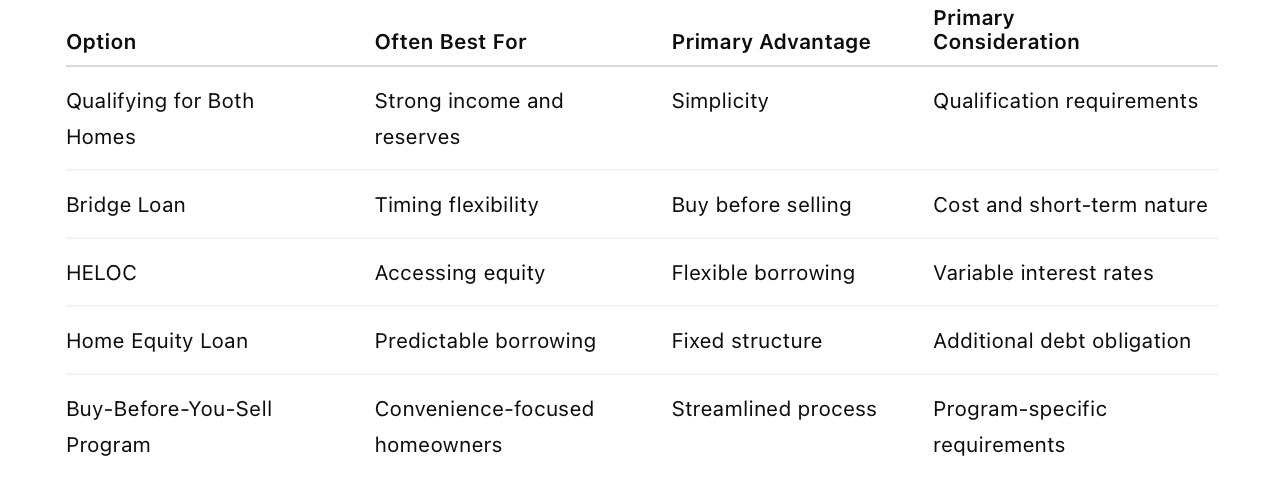
Which Option Fits Your Situation?
If your priority is simplicity, qualifying for both homes may be worth exploring.
If your priority is accessing equity, a HELOC or home equity loan may deserve consideration.
If your priority is securing a specific property before it disappears from the market, bridge financing may provide additional flexibility.
If your priority is convenience and reducing logistical complexity, a buy-before-you-sell program may be attractive.
The best solution depends less on the product itself and more on the problem you are trying to solve.
Can You Access All of Your Equity?
Not necessarily.
Many homeowners assume they can automatically borrow against all available equity.
In reality, lenders typically evaluate:
• Current mortgage balance
• Estimated home value
• Debt-to-income ratio
• Income and employment
• Credit profile
• Available cash reserves
The amount that can be accessed varies significantly from one homeowner to another.
This is why early planning matters.
The goal is understanding your options before you need them.
How This Fits Into Your Overall Moving Plan
Financing is only one piece of the puzzle.
The bigger challenge is coordinating the entire transition.
Understanding bridge loans, HELOCs, home equity loans, and buy-before-you-sell programs becomes far more valuable when paired with a thoughtful strategy for timing the sale and purchase.
Likewise, seeing how other Louisville homeowners have successfully navigated these decisions can provide perspective and confidence.
The goal is not simply finding financing.
The goal is creating a move that feels manageable.
Financing is only one piece of the puzzle. Coordinating timelines, possession dates, and closing schedules is equally important when selling one home and buying another.
Frequently Asked Questions
Can I buy a house before selling my current house?
Yes. Depending on your finances, you may qualify for both homes simultaneously, use a bridge loan, access home equity, or use a specialized buy-before-you-sell program.
How much equity do I need to buy another home?
There is no universal amount. Available equity, lender requirements, debt obligations, and income all influence what options may be available.
What is a bridge loan?
A bridge loan is short-term financing designed to help homeowners purchase a new home before their current home sells.
Is a HELOC better than a bridge loan?
Neither is inherently better. They solve different problems and work best in different situations.
Can I use home equity as a down payment?
In some cases, yes. A lender can help determine what options may be available based on your situation.
Should I buy before selling?
It depends on your finances, risk tolerance, available inventory, and overall moving goals.
Thinking About Moving But Unsure Where to Start?
Most homeowners do not need financing advice first.
They need clarity first.
Understanding your home's value, available equity, likely sale timeline, and potential financing options creates a much stronger foundation for decision-making.
A planning conversation before you begin house hunting can often reveal opportunities you did not realize existed.
The earlier you understand your options, the more flexibility you typically have when the right home appears.
Final Thoughts
Many homeowners assume they cannot move until their current home sells.
That is sometimes true.
But often, there are more options available than they realize.
Bridge loans, HELOCs, home equity loans, and buy-before-you-sell programs all exist because homeowners face this challenge every day.
The goal is not finding the perfect financing product.
The goal is creating enough flexibility that you can make a good housing decision without feeling trapped by timing.
Because moving should be driven by your goals.
Not by fear.
How to Move Without Getting Stuck Between Homes
Thinking about selling your current home while buying another? Learn the three most common ways Louisville homeowners make a move, plus strategies for timing, equity, contingencies, rent-back agreements, and avoiding the stress of getting stuck between homes.
The Louisville Homeowner's Guide to Selling and Buying at the Same Time

Most successful moves begin with a plan long before the first sign goes in the yard.
Most homeowners who contact me about moving have already made the decision emotionally.
They simply have not figured out the logistics yet.
The house may no longer fit their lifestyle. The maintenance may feel heavier than it once did. A growing family may need more space, while an empty nester may be caring for rooms that rarely get used. Sometimes the home still works perfectly well, but life has changed around it.
The challenge is rarely deciding whether a move makes sense.
The challenge is figuring out how to move from one home to another without creating unnecessary stress along the way.
What happens if your home sells before you find another one? What if you find the right home before yours sells? Can you use your equity to buy before selling? Will you have to move twice?
These questions cause many homeowners to delay decisions they may otherwise be ready to make.
The good news is that homeowners successfully navigate this transition every day. The key is understanding your options before making the first move.
Can You Sell and Buy a Home at the Same Time?
Quick Answer
Yes.
Most Louisville homeowners who move are selling one home while purchasing another. Depending on their finances and timeline, the transition may involve coordinated closing dates, sale contingencies, rent-back agreements, bridge financing, or other equity-access strategies.
The key is creating a plan before your current home goes on the market.
How Do You Sell and Buy a Home at the Same Time?
Most Louisville homeowners accomplish this in one of three ways:
• Sell first, then buy
• Buy first, then sell
• Coordinate both transactions through timing strategies such as contingencies, rent-back agreements, or bridge financing
The right approach depends on your available equity, financing options, timeline, and the availability of homes in your target area.
While every situation is different, homeowners who plan the transition before listing their home typically have more flexibility and experience less stress throughout the process.
What This Looks Like in Louisville Right Now
One reason homeowners feel stuck is that today's market does not fit neatly into old assumptions.
Many Louisville homeowners have built significant equity over the last several years. At the same time, inventory remains limited in many popular neighborhoods and price ranges.
As a result, selling may not be the difficult part.
Finding the right next home may be.
A homeowner moving from a larger home in Lake Forest into a patio home faces a different challenge than a growing family trying to move into Middletown, Prospect, Oldham County, Norton Commons, or another highly sought-after area.
In many of these areas, homeowners can sell successfully and still struggle to find the right replacement property simply because available inventory remains limited.
The strongest plans are built around the realities of your specific move, not broad headlines about the market.
Understanding both sides of the transition—your current home's likely sale and your next home's availability—is often where clarity begins.
What If You Have a Low Mortgage Rate?
Quick Answer
A low mortgage rate should be part of the decision.
It should not become the entire decision.
Many homeowners who purchased or refinanced several years ago have mortgage rates that would be difficult to replace today. That reality deserves consideration.
At the same time, a home is more than a financing tool.
It is supposed to support the life being lived inside it.
If your current home still fits your needs, staying may be the right choice.
If your home no longer fits your lifestyle, family needs, maintenance preferences, or long-term goals, then the conversation becomes larger than an interest rate.
The homeowners who gain the most clarity often stop asking, "Can I get this rate again?" and start asking, "What am I gaining by staying, and what am I giving up?"
That is usually where the real answer begins.
If your current mortgage rate is one of the biggest reasons you're reluctant to make a move, I take a closer look at the financial and practical tradeoffs in I Have a Great Mortgage Rate. Does It Still Make Sense to Move?
The Decision Is Usually Easier Than the Process
Most homeowners know whether they want to move long before they know how they want to move.
The decision often becomes clear through everyday life. A home feels too large, too small, too far away, too much work, or simply out of sync with the season of life someone is in.
What creates hesitation is rarely the decision itself.
It is the process.
Once homeowners understand the available paths forward, many discover the move is more manageable than they originally imagined.
Good planning does not eliminate every surprise.
It simply replaces uncertainty with options.
What Most Homeowners Get Wrong About Moving
Many homeowners believe the biggest challenge is selling their current home.
In reality, the bigger challenge is often creating a realistic plan for the next one.
The homeowners who experience the least stress typically spend more time planning the transition than preparing the property for sale.
They understand where their equity stands, how financing may work, what neighborhoods they want to target, and what backup plans exist if timing does not unfold exactly as expected.
The goal is not creating a perfect plan.
The goal is creating enough clarity that decisions become easier when opportunities arise.
The Three Ways Most Homeowners Make a Move
Most homeowners who sell and buy at the same time follow one of three broad paths. Each can work. Each has trade-offs. The best choice depends on your finances, timeline, and priorities.
Sell First, Then Buy
Selling first creates the greatest financial certainty.
You know how much equity you have available, what your proceeds will likely look like, and what budget you can comfortably use for the next purchase.
The trade-off is timing.
If your home sells before you find another one, you may need temporary housing, storage, or additional flexibility.
For homeowners who value financial clarity above all else, this approach often makes the most sense.
Buy First, Then Sell
Buying first allows you to secure the next home before letting go of the current one.
This approach can reduce the pressure of finding a replacement property quickly, especially if your housing needs are very specific.
The challenge is financing.
Depending on your situation, you may need bridge financing, access to home equity, or the ability to qualify while still owning your current home.
For homeowners considering this path, it helps to understand the various buy-before-you-sell programs, bridge financing options, and equity-access strategies that may be available.
For homeowners with strong equity positions and stable finances, this can be an effective option.
Coordinate Both Transactions
This is the approach many homeowners hope to achieve.
The goal is to align the sale and purchase so you can move once, minimize disruption, and create a smoother transition.
This often involves coordinating closing dates, negotiating possession timelines, or using tools such as rent-back agreements.
It typically requires more planning, but it can create the least stressful overall experience.
Thoughtful planning around timelines, possession dates, and contingency periods can often eliminate the need for temporary housing or a double move.
If your biggest concern is timing rather than financing, you may also find our guide on coordinating closing dates and avoiding a double move helpful.
What Happens If My Home Sells Before I Find Another One?
This is one of the most common concerns homeowners have.
The good news is that several options may exist.
Depending on your situation, you may be able to negotiate a longer closing period, use a rent-back agreement, arrange temporary housing, or delay listing until your purchase strategy becomes clearer.
The important thing is discussing these possibilities before they happen.
A strong plan does not assume everything will line up perfectly.
It prepares for multiple outcomes.
What Happens If I Find the Right Home Before Mine Sells?
The opposite concern can feel just as stressful.
Sometimes the right home appears before the current home has sold. When that happens, preparation becomes valuable.
Possible solutions may include a sale contingency, bridge financing, home equity access, a longer closing timeline, or qualifying to purchase before selling.
The right solution depends on your finances, the competitiveness of the home you want to buy, and the likely marketability of your current home.
Planning ahead creates more options than reacting under pressure.
What Is a Sale Contingency?
A sale contingency allows a buyer to purchase a home only if their current home sells successfully.
In practical terms, it provides financial protection.
Rather than being obligated to purchase a new home regardless of what happens with the old one, the contingency creates a safeguard.
The trade-off is that some sellers may prefer offers without contingencies.
Whether a sale contingency makes sense depends on the market, the property, and the strength of the overall offer.
Sale contingencies are often discussed alongside rent-back agreements, but they solve very different problems. A sale contingency helps address a financing concern, while a rent-back agreement helps address a timing concern.
Like many real estate tools, a sale contingency is neither good nor bad. It simply serves a specific purpose.
What Is a Rent-Back Agreement?
A rent-back agreement allows a seller to remain in the home for a period after closing.
If a sale contingency helps solve a financial challenge, a rent-back agreement helps solve a timing challenge.
For homeowners trying to avoid moving twice, this can be one of the most useful tools available.
A properly structured rent-back can provide additional time to purchase the next home, coordinate movers, finish packing, or avoid temporary housing altogether.
The details matter, which is why these agreements should be carefully documented and negotiated.
Can You Use Your Equity Before Selling?
Many homeowners have substantial equity but cannot easily access it until their home sells.
Depending on your financial situation, there may be several options worth discussing with a lender.
One common misconception is that all available equity can automatically be used toward the next purchase. In reality, lenders evaluate factors such as loan-to-value ratios, credit profile, income, existing obligations, and the amount of equity available.
The amount a homeowner can access varies significantly from one situation to another.
This is why conversations with both a lender and real estate professional are often helpful before making decisions about timing.
For homeowners exploring bridge loans, HELOCs, home equity loans, or buy-before-you-sell programs, our guide to buying a new home before selling your current one explores these options in greater detail.
Bridge Loans
Bridge loans provide short-term financing designed to help homeowners purchase a new property before the current home sells.
Home Equity Line of Credit (HELOC)
A HELOC may allow access to available equity before the home is sold, creating additional flexibility during the transition.
Home Equity Loan
A home equity loan provides a lump sum secured by the equity in the home.
Buy-Before-You-Sell Programs
Some lenders offer specialized programs designed to help homeowners purchase before selling.
Every option carries different requirements, costs, and risks. A lender can help determine which solutions may be appropriate for your situation.
The First Conversation to Have Before You List
Most homeowners assume the first step is preparing the house.
Often, it is not.
The first step is understanding the move.
Before listing, it helps to answer several important questions:
• Do I need the proceeds from my current home to purchase the next one?
• Can I qualify before selling?
• How flexible am I on timing?
• What type of home am I hoping to buy?
• What would I do if my home sold in the first week?
• What would I do if it took longer than expected to find the next home?
You do not need perfect answers.
You simply need enough clarity to understand your available options.
That conversation alone often removes much of the uncertainty that causes homeowners to feel stuck.
A Common Louisville Scenario
Imagine a homeowner in Lake Forest who purchased their home when their children were in elementary school.
Twelve years later, one child is in college and another is preparing to leave home. Entire rooms sit unused. The yard requires more maintenance than they enjoy. Travel has become a bigger priority than square footage.
The challenge is not selling the home.
The challenge is deciding how to move into something smaller without creating unnecessary disruption.
Before listing, they review their home's value, estimate their available equity, speak with a lender, and identify the type of home they hope to buy next. They discuss timing, contingency options, and backup plans before the first showing ever takes place.
The result is not a perfect transaction.
It is a predictable one.
And predictable usually feels far better than stressful.
You can also see how these strategies play out in real-world situations in How Louisville Homeowners Successfully Sell and Buy at the Same Time.
Frequently Asked Questions
How do I sell and buy a home at the same time?
By treating both transactions as one coordinated transition and creating a plan before listing or making an offer.
Should I sell before buying?
It depends on whether financial certainty or timing flexibility matters most in your situation.
Can I buy before mine sells?
Possibly. Some homeowners can qualify before selling, while others may need bridge financing or access to home equity.
What is a sale contingency?
A contract provision that makes a purchase dependent on the successful sale of the buyer's current home.
What is a rent-back agreement?
An agreement that allows a seller to remain in the home for a period after closing.
How early should I start planning?
Most homeowners benefit from beginning the planning process 60 to 120 days before they hope to move.
Thinking About Making a Move?
If you're considering selling one home while buying another, the first step is understanding your options before you list.
A planning conversation can help clarify:
• Your available equity
• Potential financing options
• Timing strategies
• Backup plans if the market changes
• What your current home is likely to sell for
• What opportunities may exist in your target area
Every move is different, but the goal is the same: creating a path forward that fits your life, finances, and timeline.
Final Thoughts
Many homeowners believe the hardest part of moving is selling their home.
More often, the hardest part is understanding how all the pieces fit together.
The good news is that you do not have to solve every piece at once.
You simply need a plan.
The homeowners who move with the most confidence are rarely the ones who perfectly time the market. They are the ones who understand their options before making decisions.
If you are considering a move, start there.
Not with packing.
Not with a sign in the yard.
Start with a clearer understanding of your path forward.
The goal is not finding the perfect strategy.
It is finding the strategy that helps you move forward with confidence.
Because your move deserves care, not chaos.
Will Lower Interest Rates Actually Make Buying Easier in Louisville?
Many Louisville buyers are waiting for lower interest rates before making a move. But lower rates do not always create an easier market. In many cases, they increase buyer competition, push prices higher, and create more emotional pressure around buying decisions. This article explores what lower interest rates could actually mean for affordability, competition, and long-term buying strategy in Louisville.

Many Louisville buyers are waiting for lower interest rates, but lower rates do not always mean an easier market.
A lot of buyers are waiting for one thing right now.
Lower interest rates.
I hear it constantly.
“We are just going to wait until rates come down.”
And honestly, I understand why people feel this way.
Higher mortgage rates have changed affordability dramatically for many Louisville buyers.
Monthly payments feel heavier. Budget flexibility feels tighter. And people want to feel confident they are making a smart long-term decision.
But there is an important part of this conversation that many people are not fully considering.
Lower rates do not automatically create an easier market.
In many cases, they create a far more competitive one.
Will lower interest rates make buying a home easier in Louisville?
Possibly, but not always. Lower interest rates can reduce monthly mortgage payments, but they also tend to increase buyer competition, drive up home prices, and create multiple-offer situations in many Louisville neighborhoods. The overall market often becomes more competitive as affordability improves.
Why lower rates often increase competition
When mortgage rates drop, more buyers re-enter the market.
People who were waiting suddenly feel ready to move.
That means:
more buyers competing for homes
more pressure on inventory
more multiple-offer situations
faster-moving listings
stronger pricing pressure
In Louisville, where inventory already remains limited in many areas, this can create an even more aggressive buying environment.
For some buyers, lower monthly payments may quickly be offset by rising home prices and increased competition.
Many buyers are already feeling emotionally exhausted trying to decide whether waiting is helping them or simply keeping them stuck. The Hidden Cost of Waiting to Buy or Sell in Louisville explores why uncertainty itself often becomes emotionally draining over time.
What buyers often misunderstand about affordability
Most people naturally focus on the interest rate itself.
But affordability is more complicated than rates alone.
The overall market matters too.
That includes:
home prices
competition
inventory levels
negotiation power
appraisal pressure
speed of the market
Sometimes buyers secure a lower rate but still end up paying significantly more for the home itself.
Other times, buyers may benefit from less competition in a higher-rate environment.
That is why market timing is rarely as simple as waiting for one number to change.
Many buyers eventually realize the uncertainty itself starts becoming emotionally exhausting. Why So Many Louisville Homeowners Feel Stuck Right Now explores why so many families feel emotionally frozen in today’s market even when they know life may need to change.
What is happening in the Louisville market right now?
Many Louisville buyers are currently caught between affordability concerns and uncertainty about future rates.
Some feel pressure to wait. Some feel pressure to move quickly. Some are afraid of making the wrong financial decision.
At the same time:
inventory remains relatively limited in many neighborhoods
buyers are closely watching Federal Reserve news
homeowners with low rates remain hesitant to sell
affordability concerns continue shaping buyer behavior
This creates emotional hesitation across the market.
But real estate decisions are rarely just financial.
They are deeply connected to lifestyle, timing, family needs, and long-term goals.
A framework for thinking about interest rates more clearly
1. Focus on monthly payment comfort first
The most important question is not: “What is the perfect rate?”
It is: “Does this payment fit comfortably into real life?”
Long-term sustainability matters far more than chasing perfect timing.
2. Understand that rates change over time
Many buyers forget that mortgage rates are not necessarily permanent.
Some buyers choose to refinance later if rates improve.
That does not mean buyers should ignore rates.
But it does mean today’s rate is only one part of a much larger long-term decision.
3. Consider the competition environment
A slightly higher rate in a calmer market can sometimes create better buying opportunities than a lower-rate environment filled with bidding wars.
The overall market dynamic matters.
4. Build decisions around life, not headlines
The strongest housing decisions are usually based on:
long-term goals
family needs
lifestyle fit
stability
timing needs
Not simply trying to predict the market perfectly.
What most buyers get wrong about interest rates
One of the biggest misconceptions is believing lower rates automatically remove stress from the buying process.
In reality, lower rates often increase emotional pressure because competition intensifies quickly.
Homes move faster. Negotiations become harder. Multiple offers return.
The market often becomes emotionally more intense, not less.
The buyers who navigate this best usually focus less on predicting rates and more on understanding what makes sense for their personal situation.
That usually starts by slowing the conversation down enough to separate market fear from real-life needs. How to Make a Real Estate Decision When the Market Feels Uncertain explores how many Louisville buyers are learning to make calmer, more confident decisions without waiting for perfect certainty.
A real-life pattern I see often
I recently spoke with buyers who had delayed purchasing for nearly two years while waiting for rates to improve.
During that time:
home prices increased
competition fluctuated repeatedly
inventory stayed tight
their frustration continued growing
Eventually they realized they were waiting for certainty that was unlikely to fully arrive.
Once we focused less on predicting the market and more on creating a realistic long-term plan, the conversation became much calmer.
Not because the market suddenly became easy.
Because the decision became centered around their life instead of constant market headlines.
Frequently Asked Questions
Will lower interest rates reduce monthly payments?
Usually yes. Lower interest rates can reduce monthly mortgage payments, depending on the loan amount and purchase price.
Could lower rates increase home prices?
Yes. Lower rates often increase buyer demand, which can push prices higher in many Louisville neighborhoods.
Is waiting for lower rates always the best strategy?
Not necessarily. Waiting can sometimes create more competition, fewer negotiation opportunities, and additional emotional stress.
Many homeowners are already discovering that waiting for perfect certainty can quietly become emotionally exhausting over time. The Hidden Cost of Waiting to Buy or Sell in Louisville explores why waiting itself often becomes emotionally heavier than expected.
Should I buy now or wait?
That depends more on your long-term goals, financial comfort, and lifestyle needs than trying to predict the market perfectly.
What matters more than the interest rate itself?
Payment comfort, long-term stability, lifestyle fit, and overall financial sustainability usually matter more than the rate alone.
If you are trying to make sense of today’s market, you are not alone.
A lot of Louisville buyers are carrying the same uncertainty right now.
Not because they are uninformed.
Because the market feels emotionally and financially complicated.
The good news is that you do not need perfect timing to make a thoughtful decision.
Sometimes clarity comes from slowing the conversation down and focusing on what actually matters most for your life long term.
No pressure. No rushed decisions. Just thoughtful guidance built around your goals, finances, and timing.
If you are trying to understand whether waiting or moving forward makes more sense in today’s Louisville market, I am always happy to help you think through the options calmly and clearly.
Because your move deserves care, not chaos.
How to Make a Real Estate Decision When the Market Feels Uncertain
Many Louisville homeowners and buyers are struggling to make confident real estate decisions in a market filled with uncertainty, interest rate concerns, and emotional pressure. This article explores how to move beyond fear and information overload by building thoughtful decisions around lifestyle, long-term goals, financial comfort, and real-life needs instead of trying to predict the market perfectly.

Many Louisville homeowners are not looking for perfect certainty. They are simply trying to make thoughtful decisions in a market that feels emotionally complicated.
Most people are not looking for a perfect market.
They are looking for reassurance that they are not making a mistake.
That is the part I hear most often right now.
Not: “What is the perfect interest rate?”
Not: “What will prices do next year?”
But: “How do we know if this is the right decision?”
And honestly, I understand why this feels so difficult.
The housing market has become emotionally loud.
Every day people hear:
conflicting predictions
recession fears
interest rate headlines
affordability concerns
market crash opinions
pressure to wait
pressure to move quickly
Eventually, many people stop trusting themselves completely.
And when that happens, even thoughtful decisions start feeling emotionally heavy.
How do you make a real estate decision when the market feels uncertain?
The best real estate decisions are usually built around long-term lifestyle needs, financial comfort, timing, and personal goals rather than trying to predict the market perfectly. Many Louisville homeowners and buyers feel overwhelmed by uncertainty, but clarity often comes from slowing down and creating a thoughtful plan instead of reacting emotionally to headlines.
Why uncertainty feels heavier right now
Most real estate decisions already carry emotion.
But today’s market adds another layer: constant information overload.
People are consuming:
market predictions
mortgage updates
social media opinions
national housing headlines
financial fear messaging
And much of it does not reflect what is actually happening in their personal life or even in Louisville specifically.
Over time, this creates decision fatigue.
People stop asking: “What makes sense for our life?”
And start asking: “What if we regret this later?”
Many homeowners first begin feeling emotionally frozen when every housing decision starts feeling heavier than it used to. Why So Many Louisville Homeowners Feel Stuck Right Now explores why emotional hesitation has become such a common experience in today’s market.
The market is only one part of the decision
One of the biggest mistakes people make is believing housing decisions are purely financial.
They are not.
They are deeply connected to:
daily stress
lifestyle
commuting
maintenance
family needs
health
relationships
quality of life
future goals
Sometimes the right decision financially is not the right decision emotionally.
And sometimes the right life decision is worth moving through a less-than-perfect market.
That does not mean people should ignore finances.
It means finances are only one piece of a much larger conversation.
What is happening in Louisville right now?
Many Louisville homeowners and buyers are currently caught between competing pressures.
Some are afraid to move because of higher interest rates. Some are afraid to wait because prices may continue rising. Some feel trapped by low mortgage rates they secured years ago. Some know their current home no longer fits their life but cannot decide what to do next.
At the same time:
inventory remains limited in many areas
affordability pressure remains real
uncertainty around rates continues
buyers and sellers both feel cautious
This creates a market where emotional hesitation becomes extremely common.
But uncertainty itself does not automatically mean a decision is wrong.
A framework for making clearer decisions
1. Separate headlines from your actual life
National housing headlines are designed to grab attention.
But your decision should be built around your:
finances
goals
timing
stress level
family needs
lifestyle
The market is important.
But your life matters more.
2. Focus on long-term sustainability
The best housing decisions are usually not about “winning” the market.
They are about:
stability
comfort
sustainability
alignment with life goals
Long-term clarity matters more than short-term perfection.
3. Understand that uncertainty never disappears completely
Many people are waiting for the market to finally feel obvious.
But real estate has always involved uncertainty.
The goal is not eliminating uncertainty entirely.
It is making thoughtful decisions despite uncertainty.
4. Slow the process down
Most overwhelmed people try to solve everything at once.
That creates paralysis.
Clarity usually comes from slowing the conversation down enough to:
ask better questions
organize priorities
evaluate options carefully
reduce emotional noise
What most people get wrong about market timing
One of the biggest misconceptions is believing confident people somehow “know” what the market will do next.
Most do not.
The people who feel most confident are usually the ones who stopped trying to predict everything perfectly.
Instead, they focused on:
what they needed
what they could comfortably afford
what kind of life they wanted next
what problems they were actually trying to solve
That shift changes everything emotionally.
Many homeowners eventually realize that waiting for certainty can quietly become its own source of stress and emotional exhaustion. The Hidden Cost of Waiting to Buy or Sell in Louisville explores why delaying decisions often creates pressure people do not initially recognize.
A real-life pattern I see often
I recently spoke with homeowners who had spent nearly two years trying to decide whether to move.
Every few months:
rates changed
headlines shifted
new fears appeared
uncertainty increased
So they paused again.
Meanwhile:
the home became harder to maintain
stress increased
life needs continued changing
the emotional weight kept growing
Once we stopped focusing on trying to predict the market perfectly and instead focused on building a realistic plan around their life, the conversation became much calmer.
Not because uncertainty disappeared.
Because clarity finally started replacing fear.
Frequently Asked Questions
How do I know if now is the right time to move?
The best timing usually depends more on your long-term goals, lifestyle needs, financial comfort, and stress level than predicting the market perfectly.
Is waiting safer in an uncertain market?
Not always. Waiting can sometimes create emotional stress, maintenance costs, lifestyle frustration, and missed opportunities.
What if interest rates improve later?
They might. But lower rates can also increase buyer competition and home prices.
Many buyers are discovering that lower interest rates do not always create a calmer or easier market. Will Lower Interest Rates Actually Make Buying Easier in Louisville? explains why lower rates can sometimes increase competition and emotional pressure for buyers.
How do I stop feeling overwhelmed by the market?
Focus less on headlines and more on building a thoughtful plan around your own life, goals, finances, and priorities.
What is the first step toward clarity?
Usually it starts with identifying what problem you are truly trying to solve.
If the market feels emotionally heavy right now, you are not alone.
A lot of Louisville homeowners and buyers are carrying this same uncertainty.
Not because they are uninformed.
Because major life decisions become difficult when the future feels unclear.
The good news is that you do not have to solve everything all at once.
Sometimes clarity starts by slowing the conversation down enough to focus on what actually matters most for your life moving forward.
No pressure. No rushed decisions. Just thoughtful guidance built around your goals, timing, finances, and concerns.
If you are trying to work through a real estate decision in today’s Louisville market, I am always happy to help you think through the options calmly and clearly.
Because your move deserves care, not chaos.
Why So Many Louisville Homeowners Feel Stuck Right Now
Many Louisville homeowners feel stuck right now between higher interest rates, limited inventory, and major life changes. But often the biggest challenge is not the market itself. It is the emotional weight of trying to make the “right” decision in an uncertain time. This article explores why so many people feel frozen in today’s housing market and how thoughtful clarity can help people move forward with more confidence and less overwhelm.

Many Louisville homeowners are feeling caught between life changes and uncertainty in today’s housing market.
Sometimes the hardest part is not deciding to move.
A conversation I hear often starts quietly.
Usually at a kitchen table.
Or while walking through a home someone has loved for years.
It sounds something like this:
“We talk about moving all the time… but we just cannot seem to make a decision.”
And honestly, I understand why.
Right now, many Louisville homeowners feel caught between two realities at the same time.
The house no longer fits life the way it once did.
But the market no longer feels simple enough to move confidently through either.
So people wait.
Not because they are careless.
Not because they are uninformed.
Because every option feels heavy.
And that feeling is becoming more common than most people realize.
Why do people feel stuck in today’s housing market?
Many Louisville homeowners feel stuck because higher interest rates, limited inventory, and fear of making the wrong decision have created both emotional and financial uncertainty around moving. At the same time, life keeps changing, leaving many families caught between staying and moving forward.
Often, this feeling builds slowly over years — sometimes decades — in the same home.
And for many people, it doesn’t happen all at once.
What starts as a quiet feeling of overwhelm gradually becomes harder to ignore:
too much maintenance,
unused rooms,
stairs becoming more difficult,
or simply the realization that life has changed while the house stayed the same.
Why do so many Louisville homeowners feel stuck right now?
Many homeowners in Louisville feel stuck because the housing market feels uncertain while life continues changing underneath them.
Interest rates remain significantly higher than they were a few years ago.
Inventory is still limited in many Louisville neighborhoods and price points.
Homeowners with historically low mortgage rates often feel financially trapped in homes that no longer fully fit their needs.
At the same time, real life keeps moving forward.
Families grow.
Parents age.
Commutes wear people down.
Maintenance becomes exhausting.
Unused rooms become reminders of seasons that have already changed.
The result is a growing number of homeowners who feel emotionally ready for change but psychologically afraid to make the wrong decision.
The emotional tension behind today’s Louisville market
Most real estate conversations focus on numbers.
Rates.
Prices.
Inventory.
Predictions.
But what I see most often is emotional fatigue.
People are tired of trying to time everything perfectly.
They are waiting for:
lower interest rates
more certainty
better inventory
calmer headlines
the “right” moment
Meanwhile, many are quietly living in homes that no longer support the life they actually want.
Some feel overwhelmed by maintenance.
Some are caring for aging parents from too far away.
Some have outgrown the home emotionally long before they outgrew it financially.
Some are staying only because they locked in a 3 percent interest rate years ago.
And over time, uncertainty turns into paralysis.
What is actually happening in the Louisville market right now?
The Louisville market is creating an unusual emotional dynamic for homeowners.
Many people who purchased or refinanced during historically low interest rates now feel anchored to those rates, even if their current home no longer works well for their lifestyle.
At the same time:
inventory remains relatively constrained in many areas
affordability pressures continue affecting buyers
replacement homes feel more expensive
market headlines create conflicting messages daily
This leaves homeowners asking:
“If we move now, are we making a mistake?”
But what often gets missed is this:
Waiting is also a decision.
For many homeowners, the bigger question is whether waiting is actually protecting them or quietly keeping life stuck in place. The Hidden Cost of Waiting to Buy or Sell in Louisville explores why waiting itself can sometimes create emotional, financial, and lifestyle pressure over time.
And sometimes waiting carries its own emotional, financial, and lifestyle costs.
A simple framework for getting unstuck
The families who move through uncertain markets most successfully usually stop asking:
“What is the perfect market timing?”
And start asking:
“What problem are we actually trying to solve?”
That shift changes everything.
1. Identify what is creating stress right now
Is the issue:
maintenance?
stairs?
commuting?
unused space?
caregiving?
financial strain?
isolation?
lack of functionality?
The clearer the real issue becomes, the easier decisions become.
2. Separate market fear from life reality
Headlines are loud.
But most housing decisions are deeply personal.
Sometimes the right move is less about chasing perfect rates and more about improving daily quality of life.
3. Understand all available options
Many homeowners assume they only have two choices:
move immediately or stay stuck.
That is rarely true.
Sometimes there are creative timing solutions, bridge strategies, temporary plans, or gradual transition approaches that reduce pressure significantly.
4. Focus on long-term fit, not short-term noise
A low interest rate does not automatically mean a home is still the right fit for life.
And a higher interest rate does not automatically mean moving is the wrong decision.
The goal is not perfection.
It is alignment between your life and your home.
What most people get wrong about waiting
One of the biggest misconceptions I see is the belief that uncertainty will eventually disappear completely.
Most people are waiting for the market to finally feel safe again.
But real estate has always involved some level of uncertainty.
The difference now is that people are consuming constant market information without enough clarity around their own personal goals.
And when every decision becomes filtered through fear, people often stop moving forward altogether.
The families who feel most confident are rarely the ones who predicted the market perfectly. They are usually the ones who became clear about what mattered most to them personally.
Many homeowners first begin noticing this tension when their current home no longer feels aligned with the life they are trying to live now. How to Make a Real Estate Decision When the Market Feels Uncertain explores why clarity often begins when people stop trying to predict the market perfectly and start focusing on what matters most in real life.
A real-life pattern I see often in Louisville
Recently, I spoke with homeowners who had been discussing a move for nearly three years.
Every few months they revisited the conversation.
Then rates changed.
Or inventory tightened.
Or another scary headline appeared.
So they paused again.
Meanwhile:
the house became harder to maintain
stairs became increasingly difficult
they stopped using half the home
they felt more isolated from family
The market itself was no longer the biggest obstacle.
The fear of making the wrong decision was.
Once we slowed the conversation down and focused less on headlines and more on how life actually felt inside the home, clarity started appearing quickly.
Not because the market became perfect.
Because the decision became personal again instead of theoretical.
Frequently Asked Questions
Should I wait for interest rates to drop before buying in Louisville?
Not always. Lower interest rates often increase buyer competition and can push home prices higher. The better question is whether your current home and lifestyle still fit your needs today.
Many buyers are also quietly wondering whether lower rates will actually improve affordability once competition increases again. Will Lower Interest Rates Actually Make Buying Easier in Louisville? explains why lower rates do not always create a calmer or more affordable market.
Are Louisville home prices expected to decline significantly?
Most Louisville neighborhoods continue experiencing relatively limited inventory, which has helped stabilize pricing. Some areas may soften slightly, but widespread dramatic price declines are not expected in many local markets.
Why do homeowners feel trapped by low mortgage rates?
Many homeowners secured historically low rates in recent years and now feel emotionally tied to keeping those rates, even when the home itself no longer supports their lifestyle well.
Is waiting always the safer financial decision?
Not necessarily. Waiting can sometimes increase maintenance costs, emotional stress, commuting burdens, or delay important life transitions.
What is the best first step if I feel stuck?
Start by identifying what problem you are truly trying to solve. Clarity usually begins there.
Related Louisville Real Estate Topics
If this conversation resonates with you, these may also help:
How to Make a Real Estate Decision When the Market Feels Uncertain
The Hidden Cost of Waiting to Buy or Sell
Will Lower Interest Rates Actually Make Buying Easier in Louisville?
The Signs a Home May No Longer Fit Your Life
If you are feeling stuck, you are not alone.
A lot of Louisville homeowners are quietly carrying this same tension right now.
Not because they are making poor decisions.
Because major life transitions become difficult when the market feels uncertain and every option feels heavy.
The good news is that you do not have to figure it all out at once.
Sometimes clarity starts with a simple conversation about what life actually needs next.
No pressure. No rushed decisions. Just a thoughtful plan built around your goals, timing, and concerns.
If you are trying to decide whether moving makes sense in today’s Louisville market, I am always happy to help you think through the options calmly and clearly.
Because your move deserves care, not chaos.
The Hidden Cost of Waiting to Buy or Sell in Louisville
Waiting to buy or sell a home often feels safer at first. But for many Louisville homeowners, waiting can quietly create emotional, financial, and lifestyle stress that builds over time. This article explores the hidden cost of delaying real estate decisions and how to evaluate whether waiting is truly helping or simply keeping life stuck in place.

Many Louisville homeowners are quietly carrying the emotional weight of delayed housing decisions while waiting for the market to feel safer.
Most people think waiting feels safer.
At first, it usually does.
Waiting can feel responsible. Careful. Smart.
Especially in a market where headlines constantly talk about interest rates, affordability, inventory, and uncertainty.
So people pause.
They tell themselves:
maybe next spring
maybe after rates drop
maybe when inventory improves
maybe when things calm down
But over time, I have noticed something important.
For many Louisville homeowners, the biggest cost of waiting is not always financial.
It is emotional.
Why are Louisville homeowners waiting to move?
Many Louisville homeowners are delaying real estate decisions because higher interest rates, limited inventory, and fear of making the wrong decision have created uncertainty around moving. However, waiting often creates emotional, financial, and lifestyle costs that many families do not initially recognize.
The emotional cost of staying stuck
Most people think market timing is the biggest issue.
But what I often see is people quietly living in situations that no longer fit their lives well.
Some are overwhelmed by maintenance. Some are staying in homes that feel too large. Some are commuting farther than they want. Some are delaying moves closer to family. Some are living in homes that no longer support aging comfortably.
And every few months, they revisit the conversation.
Then another headline appears. Another rate update. Another reason to wait.
Over time, uncertainty slowly becomes emotional exhaustion.
For many homeowners, this feeling of being stuck starts long before they fully recognize how much stress the current home is creating. Why So Many Louisville Homeowners Feel Stuck Right Now explores why emotional hesitation has become so common in today’s Louisville market.
What is actually happening in the Louisville market?
The Louisville market has created a difficult emotional balance for homeowners.
Many people still hold historically low mortgage rates.
At the same time:
replacement homes feel more expensive
affordability pressures remain high
inventory remains limited in many neighborhoods
uncertainty around future rates continues creating hesitation
This causes many homeowners to believe they should wait until conditions feel perfect before making a move.
But major life decisions are rarely made in perfect conditions.
Many homeowners are waiting for the market to finally feel obvious before making a move.
And life does not usually pause while people wait.
A framework for evaluating whether waiting is helping or hurting
1. Look at what waiting is costing emotionally
Ask:
Is the current home creating stress?
Is maintenance becoming exhausting?
Is the layout still working well?
Is staying creating daily frustration?
Sometimes emotional wear matters more than market timing.
2. Look beyond interest rates alone
Mortgage rates matter.
But they are only one piece of a much larger life decision.
The right move is often about:
lifestyle
family needs
health
timing
quality of life
long-term goals
3. Understand that waiting also carries financial risk
Many people focus only on the cost of moving.
But waiting can also increase:
maintenance costs
repair expenses
delayed downsizing costs
commuting costs
future home price pressure
4. Focus on clarity instead of prediction
Most people cannot predict the perfect market.
But they can become clearer about what kind of life they want next.
That is usually where confident decisions begin.
What most people get wrong about waiting
One of the biggest misconceptions is believing that uncertainty will eventually disappear.
Most people are waiting for the market to finally feel obvious.
But housing decisions are deeply personal.
And sometimes the longer people wait, the emotionally heavier the decision quietly becomes.
The families who move through this best usually stop trying to predict the future perfectly.
They focus instead on building a thoughtful plan around their actual life.
That usually begins by understanding what is truly creating the feeling of being stuck in the first place.
Many homeowners eventually realize that clarity usually comes from slowing the conversation down enough to focus on what actually matters most. How to Make a Real Estate Decision When the Market Feels Uncertain explores how thoughtful planning often creates calmer, more confident decisions.
A real-life pattern I see often
I recently spoke with homeowners who had delayed moving for several years.
At first, waiting felt temporary.
But during that time:
maintenance became harder
stress increased
repairs piled up
family needs changed
the home became less functional
The market was not actually improving their situation anymore.
Waiting had simply become more comfortable than making a difficult decision.
Once we slowed the conversation down and focused on what daily life actually looked like, clarity started appearing quickly.
Not because the market became perfect.
Because they finally stopped trying to eliminate uncertainty completely before allowing themselves to move forward.
Frequently Asked Questions
Is waiting to buy or sell always the safer choice?
Not necessarily. Waiting can sometimes create additional emotional, financial, and lifestyle costs that outweigh potential market benefits.
Could interest rates still drop later?
The more important question may be whether lower rates will actually reduce pressure once buyer competition increases again.
Possibly. But lower rates can also increase competition and push prices higher in many Louisville neighborhoods.
Many buyers are also asking whether lower rates will actually improve affordability once competition returns. Will Lower Interest Rates Actually Make Buying Easier in Louisville? explores why lower rates can sometimes create even more pressure for buyers.
What if I move and regret it?
Most homeowners who move confidently do so because they built a thoughtful plan around their long-term needs instead of reacting emotionally to headlines.
How do I know if waiting is hurting more than helping?
If the current home is creating ongoing stress, maintenance exhaustion, isolation, or lifestyle frustration, it may be time to explore options more carefully.
What is the best first step?
Start by identifying what problem you are actually trying to solve. Clarity usually begins there.
If you are trying to decide whether to wait or move, you are not alone.
A lot of Louisville homeowners are carrying this same uncertainty right now.
Not because they are careless.
Because major life decisions feel heavy when the future feels unclear.
The good news is that you do not have to figure everything out immediately.
Sometimes clarity begins with a calm conversation about what life actually needs next.
No pressure. No rushed decisions. Just thoughtful guidance built around your goals, timing, and concerns.
If you are trying to decide whether waiting still makes sense for your situation, I am always happy to help you think through the options clearly and calmly.
Because your move deserves care, not chaos.
What Mistakes Do People Make When Downsizing in Louisville? And How to Avoid Them
Most downsizing mistakes don’t come from bad decisions—they come from starting in the wrong place. Here’s what to avoid and how to move through the process with clarity.

Downsizing can sound fairly straightforward until you begin thinking through everything it involves.
Where will you go next? What is your current home worth? How much space do you really need? What should you take with you? Does the house need work before you sell it? Should you buy first or sell first? What happens to everything that does not move with you?
Those decisions are connected, which is why the order in which you make them matters.
What are the biggest mistakes people make when downsizing? Many happen when homeowners begin making decisions before they have enough information about the bigger picture. They may start emptying the house before knowing where they are going, spend money on improvements that may not help the sale, assume a smaller home will automatically cost less, or choose their next home without considering how well it will work for them over time.
You do not need every detail figured out before you begin. You do need enough information to avoid solving the wrong problem first.
1. Starting With Everything in the House
This is probably the most tempting place to begin because the belongings are right in front of you.
Open a closet and there is plenty to do. The basement has boxes that have not been opened in years. The garage has accumulated tools, holiday decorations, old furniture and things that belonged to the children. Sorting feels productive.
Some of it is. If you already know you no longer want something, there is no reason you cannot begin clearing it out.
The harder decisions are different.
Do you keep the dining table? Which bedroom furniture comes with you? How much kitchenware will fit? Will you need the bookcases? What about the pieces your children might want someday?
Those questions become easier once you have some idea what your next home might look like.
You do not need to know the exact address before you begin sorting. It helps, though, to know whether you are considering a condo, patio home, smaller ranch or something else entirely. Storage, room sizes and the way you expect to live in the next home all affect what is worth taking.
Start with the easy things if you want to make progress. Give the more difficult decisions some context first.
2. Assuming a Smaller Home Will Automatically Cost Less
Sometimes downsizing improves a homeowner's financial picture considerably. Sometimes the next home costs about the same. In other situations, the homeowner knowingly spends more because the new property offers something they value.
A smaller home may be newer, in a more expensive location, or part of a community with association fees. Insurance, taxes, utilities and maintenance responsibilities may also be different.
Then there are the costs associated with selling and moving.
This is why I would not judge the financial side of downsizing by square footage or purchase price alone.
Look at what you may realistically walk away with after selling your current home. Then look at the full cost of owning the type of property you are considering next.
If the move costs more but gives you a home that requires less maintenance, works better for everyday life, or puts you closer to the people and places that matter to you, you may decide the tradeoff is worthwhile.
Or you may run the numbers and decide your current home still makes more sense.
Either way, you are making the decision with real information.
3. Renovating the Current Home Before You Know What Is Worth Doing
This can get expensive quickly.
Once homeowners begin thinking about selling, they often start noticing everything they might change. The kitchen looks dated. The carpet is older. The bathroom could use new fixtures. The paint could be refreshed. The landscaping needs attention.
Some preparation may absolutely help a home sell. Necessary repairs, cleaning, decluttering and certain cosmetic improvements can make a meaningful difference.
That does not mean every dated feature needs to be replaced.
Before spending heavily, I would want to understand the property's condition, likely market position, competition and the expectations of buyers in that price range.
There is also a practical consideration. If you spend months renovating a home you intend to leave, you may invest significant money and energy into choices the next owner would have made differently anyway.
Preparing a home thoughtfully for the market is one thing. Remodeling it for an unknown buyer is another.
Know which one you are doing before you write the checks.
4. Choosing the Next Home Mainly by Square Footage
If you are downsizing, looking for fewer square feet seems logical.
Just don't let that number do too much of the decision-making.
Two homes with similar square footage can function very differently. One may have excellent storage and rooms that work well together. Another may have wasted space, awkward stairs or a layout that makes everyday routines harder.
Think about how you would actually live there.
Where do you enter when you come home with groceries? Where is the laundry? How often would you use the stairs? Is the primary bedroom where you want it? How does the bathroom function? Is the storage useful? Is there space for the things you actually enjoy doing?
My earlier career as a physical therapist still affects what I notice when I walk through a home. I am not practicing physical therapy today, and I am not evaluating anyone's individual medical or mobility needs. That experience did teach me to notice entrances, stairs, bathrooms, lighting, floor transitions and the routes people take through a home.
Those details can have a much bigger effect on daily life than the number beside “square footage” on a listing.
I explore that more fully in What My Physical Therapy Career Taught Me About Home Design and Aging in Place.
5. Thinking Only About What Works Today
No home can be chosen for every possible future circumstance. Trying to anticipate everything would make the decision impossible.
But if you are moving anyway, it is reasonable to look a little further ahead.
Maybe a steep driveway is no concern today. Would you still want it ten years from now? Perhaps several steps from the garage are easy now, but is there another way into the house? Could a room serve a different purpose if your needs changed? Could the bathroom reasonably be modified? Would you still want to maintain the yard if you were traveling more?
These questions are not predictions. They are simply part of looking at how adaptable a home may be.
That does not mean everyone needs a ranch, an elevator or a house without a single step. People have different priorities, abilities and plans.
When individual health, mobility or equipment needs are involved, the appropriate healthcare professionals should be part of those decisions.
From the real estate side, I would rather have someone notice a home's limitations while deciding whether to buy it than after they have moved in.
6. Finding the Right House in the Wrong Location
Downsizing conversations can become so focused on the property itself that location gets pushed into the background.
Think about the places that make up your normal week.
Where are your family and friends? How far are your doctors, grocery store, church, favorite restaurants, hobbies or activities? If you help with grandchildren, how often are you driving to them? If you travel frequently, does access to the airport or major roads matter?
You may find a beautiful home with less maintenance and an ideal floor plan. If it moves you farther from everything you regularly do, everyday life may become less convenient rather than more.
For some homeowners, the real opportunity in downsizing is not simply living in a smaller house. It is choosing a location that fits their life better.
7. Assuming “Maintenance-Free” Means You Will Have Nothing to Maintain
Patio homes, condominiums and communities with homeowners associations can be appealing to people who want fewer exterior responsibilities.
Just make sure you understand exactly what you are buying.
Association responsibilities vary. Before purchasing, find out what the fees cover, which exterior components belong to the homeowner, what the association maintains, and what restrictions may affect how you use the property.
You will also want to understand the documents and financial information available for the particular association.
The presence of an HOA is neither automatically good nor bad. What matters is whether its costs, responsibilities and rules work for you.
“Maintenance-free” sounds simple. The actual documents tell you what that means for a particular property.
8. Waiting Until the Move Is Close to Ask Family About Belongings
If you have lived in a house for decades, there may be things in it that matter to other people.
You might be surprised by which things those are.
A child may have no interest in the china you carefully saved but desperately want an old Christmas ornament. A grandchild might love a piece of furniture you assumed no one would take. Family photographs, recipes, tools, books and ordinary household objects can carry memories that have little relationship to their monetary value.
Ask before making assumptions.
These conversations are especially useful when children or other family members live out of town. People need time to decide what they want and, sometimes, figure out how to get it home.
You do not have to turn the house into a family distribution center the moment you begin thinking about moving. Starting the conversation earlier simply gives everyone more time.
9. Confusing Sentimental Value With Market Value
A longtime home contains different kinds of value.
Some belongings have financial value. Some are useful. Others matter because of the memories attached to them.
Those categories overlap sometimes, but not always.
Something that cost a great deal years ago may have limited resale value today. An object worth very little to a buyer may be priceless to your family.
Knowing the difference can make sorting less frustrating.
If you believe an item may have meaningful financial value, get appropriate professional guidance rather than relying on assumptions. If something matters because of the story attached to it, you do not need a market price to justify keeping it.
Not every decision needs to be made with the same measuring stick.
10. Trying to Solve the Entire Move at Once
There can be a surprising number of moving parts.
You are thinking about the current house, the next house, belongings, repairs, money, timing, movers, family, paperwork and all the ordinary parts of life that continue while you are doing it.
Trying to work on everything simultaneously is exhausting.
Instead, begin with the decisions that affect the others.
Why are you considering moving? What do you want the next home to give you? What is your current home likely worth? What might you net after a sale? What realistic housing options are available to you?
Once those pieces become clearer, decisions about what to keep, what work to do on the house and when to move have something to connect to.
If you already know a move may be ahead and need help putting the pieces in order, my Louisville Downsizing Planning Checklist for Families Helping Aging Parents gives you a practical framework for deciding what to address first and what can wait.
If you are still deciding whether moving makes sense at all, start with How Do You Know It’s Time to Downsize in Louisville, KY?.
11. Letting Help Turn Into Taking Over
This comes up frequently when adult children are involved.
The adult child may see a long list of things that need to happen and naturally want to help get them done. The parent may appreciate the help while also feeling that decisions about their own home and belongings are being made around them.
Both reactions are understandable.
It helps to be specific.
If you are the homeowner, tell people what kind of help would actually be useful. Maybe you want someone to tour homes with you, spend an afternoon sorting the garage, arrange donations, research movers, or simply listen while you work through the options.
If you are helping a parent, ask before assuming responsibility for a task.
A move may involve the whole family, but the person moving should remain involved in the decisions whenever possible.
For families already working through the transition, How to Help Aging Parents Downsize Without Overwhelm in Louisville looks more closely at how to organize the process.
12. Underestimating What It Feels Like to Leave a Longtime Home
Knowing that moving makes sense does not make leaving easy.
A house can hold decades of ordinary life: children growing up, holidays, neighbors, routines, losses, celebrations and thousands of days no one thought to photograph.
Someone can be genuinely excited about the next home and still feel sad while leaving the old one.
That does not mean the decision was wrong.
It means there is more involved than transferring belongings from one address to another.
Give that part of the process some room. If you are helping someone else move, give it room for them too.
The practical work still has to happen, but efficiency does not need to come at the expense of recognizing what the move represents.
13. Waiting Until Circumstances Make Every Decision Urgent
Sometimes families do not get the luxury of time.
An injury, illness, death, financial change or other unexpected event can change plans quickly. When that happens, you work with the choices available.
When you do have time, however, there is an advantage to using it.
You can learn what the current home may be worth without listing it. You can tour different kinds of properties without buying one. You can talk with family about belongings before there is a moving truck in the driveway. You can research movers, donation options, estate-sale resources and contractors before you urgently need them.
Planning does not obligate you to move.
It simply means that if you decide to move, fewer decisions have to be made under pressure.
What Should You Figure Out Before You Start Downsizing?
Before you begin packing or investing heavily in your current home, I would try to answer four questions.
Why are you considering a move? Be specific. Less maintenance? Fewer stairs? A different location? Lower expenses? More freedom to travel? Closer proximity to family?
What do you want the next home to do better? Think beyond bedrooms and square footage. Consider layout, location, maintenance, storage, costs and the way you expect to spend your time.
What is your current home realistically worth, and what might you walk away with after selling? The potential sale price is only part of the financial picture.
What are your realistic alternatives? Look at homes and communities that actually exist in your price range rather than building the decision around an imagined version of downsizing.
Those answers give you a foundation. The rest of the decisions become much easier to organize around them.
Frequently Asked Questions About Downsizing Mistakes
What is the biggest mistake people make when downsizing?
A common mistake is making major decisions without understanding how they affect the rest of the move. Selling, buying, preparing the current home, sorting belongings and choosing a timeline are connected. Understanding your priorities, finances and realistic housing options first can prevent unnecessary work and expense.
Should I declutter before I know where I am moving?
You can begin with things you clearly no longer want. The harder decisions are often easier once you know more about the size, storage and layout of your next home. There is no need to completely empty your current house before exploring where you may go next.
Does downsizing always mean buying a smaller house?
No. Some people want fewer square feet, while others are primarily trying to reduce maintenance, eliminate certain stairs, change locations or find a home that functions better. The better question is whether the next home fits your priorities better than the current one.
Should I update my home before selling it?
Possibly. The answer depends on the condition of the home, likely buyers, competing properties, price range and what the improvement is likely to accomplish. It is worth evaluating the property before committing to major renovations simply because something looks dated.
Are Louisville patio homes and condos maintenance-free?
Not necessarily. Maintenance responsibilities and fees vary by property and association. Review the documents for the specific community so you understand what the association maintains and what remains the homeowner's responsibility.
How long does downsizing usually take?
There is no standard timeline. A straightforward local move can look very different from a move involving decades of belongings, family members in several locations, home preparation and a very specific search for the next property. The timeline should reflect the actual situation rather than an arbitrary number of weeks.
What should I look for when choosing a downsizing home for the long term?
Look beyond square footage. Consider entrances, stairs, bathrooms, laundry, parking, storage, exterior maintenance, location and how adaptable the home may be if your circumstances change. Individual health or mobility needs should be discussed with the appropriate healthcare professionals.
When should I talk with a REALTOR® about downsizing?
You can have that conversation well before you are ready to list. Understanding your current home's likely market value, potential selling expenses, preparation needs and realistic housing choices can help you decide whether moving makes sense before you commit to it.
Make the Big Decisions Before the Small Ones Take Over
A downsizing move involves hundreds of small decisions. They become easier when the larger questions have already been answered.
Know why you are considering the move. Understand what you want from the next home. Get a realistic picture of your current home's value and what selling it would involve. Look at actual housing alternatives. Then decide what preparation, sorting and timing make sense for your situation.
You may ultimately decide that moving is the right next step. You may also learn enough to realize that staying where you are still works well.
The value is in knowing why.
For a broader look at aging in place, housing choices, planning a move and selling a longtime home, visit my Louisville Senior Downsizing and Transition Guide.
If you are considering downsizing in Louisville and want to understand your own options before making decisions, you are welcome to reach out. We can begin with your current home, what you want from the next stage, and the information you still need.
How Do You Know It’s Time to Downsize in Louisville, KY?
Most people don’t decide to downsize all at once. It starts with small shifts—a home that feels harder to manage, rooms that go unused, or a quiet sense that something has changed. This guide walks through how to recognize those signs and think through the decision with clarity, not pressure.

Sometimes people think about downsizing for years. The idea comes and goes as life changes, until eventually they are ready to seriously consider it.
Other times, there is a moment when the question becomes very clear.
An injury makes the stairs suddenly difficult. A spouse dies and the house feels different. The last child moves out and rooms that were once full are rarely used. A major repair comes up just as another season of yard work begins, and maintaining the property no longer feels worth the effort.
The reason can be practical, financial, emotional, or a combination of all three.
So how do you know if it may be time to downsize? Look at whether your home still supports the way you want to live now and in the years ahead. Consider how much of the house you use, what it requires from you, how well the layout works, what it costs to maintain, and what another home might make possible.
None of those questions automatically leads to selling. They simply help you determine whether the home that has served you well for years still fits the life you are living today.
Sometimes the House Changes. Sometimes You Do.
A house can remain essentially the same for decades while the lives inside it change considerably.
The four-bedroom house that once made sense with children at home may feel very different after the last child leaves. A large yard may have been something you loved when gardening was a favorite way to spend a Saturday. Years later, you may still enjoy the yard but no longer want to spend so much time maintaining it.
Retirement can change things too. Maybe you are traveling more, spending winters somewhere warmer, helping with grandchildren, or simply discovering that you would rather use your time differently.
Then there are changes no one planned for. An injury, illness, death of a spouse, divorce, or change in finances can make someone look at a longtime home differently almost overnight.
None of this means the house has become a bad house.
It may simply mean that the reasons you chose it are no longer the reasons that matter most.
How Much of Your Home Do You Actually Use?
One of the simplest ways to look at downsizing is to pay attention to how you live in your house today.
Which rooms are part of your everyday life? Which ones are mostly cleaned, heated, cooled, furnished, and maintained?
You may have bedrooms waiting for occasional guests, a formal dining room used primarily on holidays, or a finished basement that once served an important purpose but is now mostly storage. That extra space may still be valuable to you. You might love having everyone stay at your house during the holidays or having room for grandchildren to visit.
If you use and enjoy the space, there is nothing inherently wrong with having more of it.
The question becomes more useful when you realize that much of the house no longer contributes very much to your life, yet you are still paying for it and taking care of it.
That is information worth considering.
Has Maintaining the House Become More Work Than You Want?
There is a difference between being capable of maintaining a home and wanting to continue doing it.
Think about what repeatedly lands on your list: mowing, landscaping, leaves, gutters, exterior maintenance, cleaning, painting, repairs, appliance replacement, HVAC service, plumbing issues, or coordinating contractors.
For some homeowners, those responsibilities are simply part of owning a house they love. They enjoy the yard and the projects, or they have reliable help that makes the work manageable.
For others, the balance gradually changes. The house begins taking more time, money, or mental energy than they want to give it.
Occasionally, one project makes that clear. A homeowner gets an estimate for a roof, faces another spring of landscaping work, or finishes a repair only to discover the next thing that needs attention. The question becomes less about whether they can keep up with the house and more about whether they still want their life organized around doing so.
That can be an important turning point.
Does the Layout Still Work for Your Everyday Life?
Square footage is only part of how a home functions.
Think about the path from your car to the kitchen with groceries. Where is the laundry? How often do you use the stairs? Where is the primary bedroom? How easy is the shower to enter? Are there rooms you avoid because getting to them is inconvenient?
People can live in a house for years without thinking much about these details because the routines are familiar.
My earlier career as a physical therapist still influences what I notice when I walk through a home. I am not practicing physical therapy today or evaluating anyone's individual medical or mobility needs. That experience did teach me to pay attention to entrances, stairs, bathrooms, lighting, pathways between rooms, and the amount of effort built into ordinary household routines.
Some homes can adapt fairly easily as needs change. Others have structural limitations that would require significant renovation to overcome.
Understanding which kind of home you have can be useful even if you ultimately decide to stay.
I explore this more fully in What My Physical Therapy Career Taught Me About Home Design and Aging in Place.
What Is Your Home Asking From You Financially?
Homeowners often think about the financial side of downsizing by starting with one number: what their current house might sell for.
That number matters, but it does not answer the whole question.
Staying has a cost. So does moving.
If you stay, consider property taxes, insurance, utilities, routine maintenance, lawn care, repairs and major systems that may eventually need replacement. If you move, there will be selling and moving expenses, the cost of the next home, and possibly association fees or different property expenses.
A smaller home is not automatically a less expensive home, particularly if you are moving to a newer property or a location where prices are higher.
At the same time, homeowners who have been in their houses for many years may have substantial equity. That equity can create options, but having equity is not, by itself, a reason to sell.
The better financial question is broader:
If I stay, what will this home likely require from me over the next several years? If I move, what would that cost, and what would I gain in return?
Now you have something meaningful to compare.
What Would You Want Your Next Home to Give You?
People thinking about downsizing often have a very clear picture of what they would lose.
Space. Storage. A familiar neighborhood. A yard. A dining room large enough for Thanksgiving. Bedrooms where children once slept. Neighbors they know.
Those things matter, and they belong in the decision.
But the comparison is incomplete until you ask what another home might give you.
Perhaps you want a first-floor primary bedroom, less exterior maintenance, a smaller yard, easier travel, more convenient parking, or a location closer to family. Maybe you want enough space for guests without maintaining several rooms you rarely use. You might want a home you can lock up and leave more easily.
Some people go through this exercise and realize they would not gain enough to make leaving worthwhile.
That is a perfectly useful answer.
Downsizing makes sense when the tradeoffs work for your life. The goal is not to find reasons to leave a house you still love.
Are You Staying Because You Want to Be There?
This is a harder question.
Longtime homes hold an extraordinary amount of personal history. You may remember bringing babies through the front door, birthday parties in the kitchen, holiday dinners, school mornings, projects completed together, neighbors who became friends, and ordinary moments that became meaningful only in hindsight.
A home can hold decades of your life without being the only place where the next part of your life can happen.
Still, attachment deserves respect. I don't find “it's just a house” particularly helpful because, for many people, it isn't.
If you are struggling with the decision, try separating these questions:
Do I still want to live in this house?
Would leaving this house be emotionally difficult?
You can answer yes to both.
Recognizing that difference can help you understand whether the home itself is still the right fit or whether the difficulty lies primarily in saying goodbye to it.
You do not have to resolve that question quickly.
What If You Want to Stay?
Then it is worth looking seriously at what staying would require.
Perhaps the house works beautifully with a few changes. Lawn care can be hired out. Lighting can be improved. A bathroom could be updated during a renovation you were already considering. A room on the main floor might eventually serve a different purpose. Some maintenance can be delegated instead of becoming a reason to move.
Other homes are harder to adapt. Laundry may be in a basement with no practical alternative. Essential rooms may be separated by stairs. Entrances may be difficult to modify. The property itself may simply require more maintenance than you want.
Individual health, mobility, equipment, or care needs should involve the appropriate healthcare professionals. For the home itself, contractors and other qualified professionals can help determine what changes are actually feasible.
The important thing is to compare a realistic version of staying with a realistic version of moving.
What If You Keep Thinking About Downsizing but Aren’t Ready?
You can investigate downsizing without deciding to sell.
In fact, this is often where I think people should begin.
Find out what your current home might realistically sell for. Estimate what you might walk away with after selling expenses. Look at the types of properties you would actually consider buying. Pay attention to prices, association fees, locations, layouts, and how often suitable homes become available.
Then look back at your current house. What significant maintenance or expenses might be ahead? What would you need to change if you wanted to remain there comfortably? How much of the house do you want to continue maintaining?
You are gathering information, not making a commitment.
Sometimes people discover that moving would solve several problems they had been quietly working around.
Others do the same homework and realize that their current home still makes the most sense.
Either conclusion is progress because the decision is now based on something more substantial than a vague feeling.
Is It Better to Downsize Before You Have To?
There is value in having choices.
If you believe a move may eventually make sense, exploring it before circumstances force a decision can give you more time to think about what you want.
You can visit different types of homes. Compare neighborhoods. Think through finances. Decide what features matter. Work through belongings gradually. Make improvements to your current home on your own timetable.
That does not mean everyone should move before there is a pressing reason.
Some homeowners stay in the same house happily for the rest of their lives. Others eventually encounter a change that makes moving the better choice.
The advantage of thinking ahead is simply that you know more about your options if that moment comes.
What Does Downsizing Actually Mean?
It does not have to mean moving into a tiny home.
For one Louisville homeowner, downsizing might mean moving from a two-story house with a large yard into a smaller ranch. Someone else may consider a patio home, condominium, or townhome because they want less exterior maintenance. Another person may care more about location than square footage and choose a home closer to family or the places they visit regularly.
There are also situations where a move involves more support or services. That is a different decision and should be evaluated based on the individual's circumstances.
The useful question is not, “What kind of home do people my age usually buy?”
It is, “What would I want my next home to make easier?”
Maybe the answer is fewer stairs, less maintenance, easier parking, better storage, space for a hobby, a guest room, proximity to family, or simply a location that fits your daily life better.
If you are considering options for an aging parent whose current home may no longer work, I have a separate guide to housing options Louisville families often consider.
What About Everything You Have Accumulated?
This is where many downsizing conversations stop.
You look around the basement, closets, garage, attic, cabinets and spare bedrooms and cannot imagine dealing with all of it.
That reaction is understandable, especially after decades in the same home.
But deciding whether another home might fit your life better and deciding what happens to every possession you own are not the same decision.
You do not need to empty the basement before you are allowed to explore a patio home.
First learn whether moving makes sense. If it does, then you can develop a plan for what comes with you, what family members may want, what can be sold or donated, and which belongings need more time.
If you try to mentally sort an entire household before you even know whether you want to move, downsizing can feel impossible before you begin.
For a deeper look at organizing the transition itself, see my guide on helping aging parents downsize without overwhelm.
How Do You Know When You Are Ready?
Sometimes you know because something happened.
Other times, readiness develops gradually as the questions become clearer and you gather more information.
You understand what your current home gives you and what it requires from you. You know what staying would probably involve. You have a realistic idea of what another home could cost and what kind of property you would consider. You have thought about what you would gain and what you would miss.
You may still feel emotional about leaving.
Being ready to make a thoughtful decision does not necessarily mean being completely comfortable with every part of it.
Questions Worth Asking Before You Decide to Downsize
When someone tells me they have been thinking about downsizing, these are the kinds of questions I think are worth working through:
How much of my home do I actually use?
What do I still enjoy about maintaining it?
What has started to feel burdensome?
Does the layout work well for the way I live now?
What changes would make staying easier?
What will the house likely require financially over the next several years?
Are there major repairs or replacements I should anticipate?
What would I want another home to make easier?
Where would I want to live?
What would I genuinely miss about this house?
What would I gain by moving?
Am I staying because this is still where I want to live, or because leaving feels difficult?
What information do I still need before I can make a good decision?
You may not answer them all at once. You may even find that answering one changes how you think about several others.
The point is to replace an abstract question, Should I downsize?, with a clearer understanding of the choices actually available to you.
Frequently Asked Questions About Downsizing in Louisville
How do I know if it is time to downsize?
Look at how well your current home fits your life today. Consider how much of the home you use, the time and money required to maintain it, whether the layout works well, and what another home could offer. Sometimes an injury, loss, financial change, or other life event makes the decision more immediate. In other cases, the realization develops gradually.
What age should you downsize your home?
There is no particular age when someone should downsize. A homeowner's priorities, finances, health, home layout, maintenance responsibilities, family situation, and plans for the future are more useful considerations than age alone.
Does downsizing always save money?
No. A smaller home can still have a significant purchase price, and condos, patio homes, and some communities may have association fees. Compare the ongoing costs of your current home with the full cost of moving and owning the next property before assuming downsizing will save money.
Can I explore downsizing without putting my house on the market?
Yes. You can estimate your home's likely market value and potential proceeds, explore available housing, compare costs, and think through what staying would require before making a decision about selling.
Do I need to renovate my Louisville home before selling it?
Not necessarily. What is worthwhile depends on the condition of the property, the likely return on the work, the market, and your own timing. Before beginning a long list of projects, it can be helpful to understand which improvements are likely to matter and which may add unnecessary expense or delay.
Should I find my next home before selling my current one?
The right sequence depends on your finances, housing options, timing, and comfort with carrying or coordinating two properties. Understanding both your current home's likely sale and the realistic choices for your next home can help determine which approach makes sense.
What if I want to downsize but my spouse does not?
Start with what is behind each person's position. One spouse may be focused on the history and comfort of the current home while the other is thinking about maintenance, finances, travel, location, or future needs. Looking at actual options and costs can make the conversation more concrete without requiring either person to agree to a move immediately.
Where should I start if I am thinking about downsizing?
Start with information rather than boxes. Understand what your current home may realistically be worth, what you might net from a sale, what staying is likely to require, and what alternatives are actually available. Once you know those things, you can compare your choices without committing to a move.
If you reach the point where you are ready to organize the practical next steps, my Louisville Downsizing Planning Checklist for Families Helping Aging Parents gives you a clear framework for working through housing decisions, belongings, home preparation and the move itself.
For a broader look at aging in place, housing choices, planning a move, selling a longtime home, and coordinating the transition, visit my Downsizing and Senior Transitions in Louisville, KY.
You Can Explore the Question Before You Know the Answer
Thinking about downsizing does not mean you have decided to move.
You may simply have reached the point where you want to know what your choices are. That is a very reasonable place to begin.
For some people, gathering information confirms that they want to stay exactly where they are. They may decide to make a few changes to the house, hire help with maintenance, and enjoy it for years to come.
For others, seeing the numbers and the housing alternatives makes something click. They realize that the house has served them well, but another home could fit the next part of their life better.
Both are good outcomes because the goal is clarity, not simply a sale.
If you are thinking about downsizing in Louisville, I can help you look at your current home's likely value, what you may realistically walk away with after a sale, and what your next housing options could look like. You are welcome to reach out before you have made any decisions.
Sometimes the first useful step is simply understanding your choices.