

Borrowed Places
(A Reflection)
"A well-loved home doesn't ask us to stay forever. It asks us to live there well while it's ours."
— Beth Green
When Love Changes Shape
When our daughters were little, I couldn't imagine the day they'd leave home. Our days revolved around bedtime stories, soccer games, school projects, and family dinners. The house was full—full of laughter, backpacks by the door, and the ordinary moments that, at the time, hardly seemed worth noticing. Looking back, those are the moments I treasure most.
Of course, life didn't stay that way.
Little by little, things began to change. One daughter left for college, then the other. They started building lives of their own, and the house that had once felt almost too small suddenly seemed much larger than we needed. For a while, their bedrooms stayed just as they had left them, almost as though leaving everything in place could somehow slow the passage of time.
Eventually, though, we learned what every parent does.
Love doesn't disappear.
It simply changes shape.
Looking back now, I can see that moving from our family home was part of that same journey. At first, I thought I was grieving the house. What I was really grieving was the end of a season that had been filled with so much life. The hardest part of leaving a home isn't packing the boxes. It's realizing you're packing a season of your life.
For a while, I resisted that realization. I found myself lingering in rooms for no particular reason, remembering birthday parties, Christmas mornings, homework around the kitchen table, and quiet evenings when nothing remarkable happened at all. Those simple days, the ones we rarely stop to appreciate while we're living them, had quietly become some of the most meaningful memories of my life.
Time has a way of reminding us that life keeps moving forward. Children become adults. Busy homes grow quieter. Families change, not because they're falling apart, but because they're growing in new directions. The same love remains. It simply finds new ways to be expressed.
I've come to believe our homes often follow that same pattern. They shelter us through one season of life, then quietly prepare us for the next. Letting go doesn't diminish what came before. If anything, it reminds us how deeply we were blessed while we were there.
More Than a House
Before becoming a REALTOR®, I spent many years as a physical therapist. It was a profession I loved because it allowed me to walk alongside people during some of life's most vulnerable seasons. We worked on strength, balance, and recovery, but our conversations often reached far beyond therapy.
People would tell me they weren't ready to leave their homes.
At first, I assumed they were talking about the house itself. But the longer I listened, the more I realized they were talking about something much deeper. They weren't worried about drywall, hardwood floors, or kitchen cabinets. They were talking about the place where they had celebrated birthdays, welcomed grandchildren, cared for aging parents, or sat quietly with the person they loved after a long day. They were talking about the backdrop of a life they had built.
Those conversations stayed with me long after I left physical therapy.
Years later, I began hearing many of those same emotions in real estate. Whether someone is helping aging parents downsize, moving after the loss of a spouse, or simply realizing their current home no longer fits this season of life, the feelings are remarkably familiar. The logistics may involve boxes, paperwork, and moving trucks, but beneath all of that is something much more personal.
They're not leaving a house.
They're honoring a life.
That's why I've never believed real estate is simply about buying and selling property. A home is where children take their first steps, where holiday traditions begin without anyone realizing they're becoming traditions, where difficult conversations happen around the kitchen table, and where ordinary Tuesday evenings quietly become the memories we treasure years later. No floor plan or market analysis can ever measure those moments.
Perhaps that's why moving can feel so emotional, even when it's the right decision. We're not simply changing addresses. We're closing one season while stepping into another. Moments like that deserve patience, not pressure. They deserve someone who understands that every move involves practical decisions, but even more importantly, it involves people.
The longer I do this work, the more convinced I become that helping someone move isn't really about helping them leave a house. It's about helping them move forward while honoring everything that made the place they left feel like home.
Eventually, though, we learned what every parent does:
Love doesn't disappear. It simply changes shape.
The Home We Thought We'd Keep
Like so many families, we believed our home would be the one we'd stay in forever. We talked about growing older there, imagined future grandchildren running through the same rooms where our daughters had once played, and rarely gave much thought to what life might look like beyond those walls. It simply felt like home, and home felt permanent.
Life, however, has a gentle way of reminding us that permanence is often an illusion.
As the years passed, our needs began to change. Rooms that had once been full of activity grew quieter. Maintaining a larger house required more time and energy than it once had, and little by little we found ourselves asking a question we never expected to ask: Does this home still fit the life we're living today?
Even after we decided to move, I questioned that decision more than once.
I'd walk through the house and find myself stopping in familiar places. The kitchen where countless family dinners had been shared. The hallway where school pictures had been taken year after year. The living room that had witnessed celebrations, disappointments, laughter, tears, and thousands of ordinary evenings that quietly became the fabric of our family life.
It took me a while to understand what I was feeling.
I wasn't grieving the house.
I was grieving the season it represented.
Then one afternoon, a quiet thought settled over me. The memories weren't waiting inside those rooms. They had become part of us long before we packed the first box. We weren't leaving them behind because they had never belonged to the house in the first place. They belonged to the people who had loved one another there.
That realization didn't make moving easy.
But it made it gentler.
It allowed me to stop seeing the house as something I was losing and begin seeing it for what it truly had been—a gift. It had sheltered our family through one of the most meaningful seasons of our lives. It had given us a place to grow, to celebrate, to grieve, to laugh, and to simply be together. We couldn't ask it to hold that season forever any more than we could ask our daughters to stay little forever.
That was never its purpose.
Its purpose was to hold us while we were there.
And it had done that beautifully.
Entrusted for a Season
Not long after we decided to move, I started going through boxes we hadn't opened in years. One afternoon I climbed onto a step stool, reached up to a shelf in our storage area, and pulled down a worn cardboard box that had been tucked into the corner for as long as I could remember.
Inside were school papers, handmade Mother's Day cards, old photographs, and Christmas ornaments our daughters had made when they were little. Some were carefully labeled in a child's handwriting. Others had faded over the years, but the memories came back as clearly as if they had happened yesterday.
I sat there much longer than I intended. If I'm honest, I spent a good part of the afternoon simply remembering. The tears came when they needed to, and I let them. There was no reason to hurry. Some moments deserve to be felt before they're gently put away again.
At first, I thought I was holding onto those things because I was afraid of forgetting. But as I sorted through them, I realized something unexpected. The memories weren't inside the box. They were already part of me. A simple ornament could remind me of Christmas morning, but it wasn't creating the memory. It was simply opening a door to something that had been living in my heart all along.
That realization changed the way I looked at the house, too. It was no longer something I needed to hold onto. Instead, I began to see it for what it truly was—a place that had faithfully carried our family through one of the most meaningful seasons of our lives.
For years, I had thought of it as our home, something we had built and somehow owned. But the longer I reflected, the more I saw it differently. We had never really possessed it. We had simply been entrusted with it for a season.
For those years, it had given our family exactly what we needed. It sheltered us through childhood, celebrations, disappointments, ordinary routines, and milestones we never saw coming. It quietly held our story while we were busy living it.
Now it was ready to hold someone else's.
Instead of feeling like we were losing something, I began to see that we were passing along a place that had been deeply loved. Another family would gather around the kitchen table. Another child would race down the hallway. Another Christmas tree would stand in the living room. The walls that had witnessed our story would become the backdrop for theirs.
There was something surprisingly comforting about that.
The house wasn't reaching the end of its story.
It was simply beginning a new chapter.
And so were we.
Learning to Let Go
If leaving the house was emotional, downsizing brought a different kind of challenge. Like so many people, I underestimated how much emotion could be attached to ordinary things. There was the chair where one of our daughters loved to curl up with a book, the serving platter that found its way to our Thanksgiving table every year, and boxes of decorations I hadn't unpacked in years but somehow couldn't imagine giving away. None of those things were especially valuable, yet each carried a little piece of our family's story.
For a while, every decision felt heavier than it should have. On the surface, we were simply deciding what to keep, what to donate, and what to pass along. In reality, it felt as though we were deciding which parts of our life deserved to come with us.
Then one afternoon I picked up a Christmas ornament one of our daughters had made in elementary school. The glitter had faded, the glue had yellowed, and it leaned just enough to remind you it had been made by a child's hands. As I held it, I wasn't really thinking about the ornament. I was remembering a little girl sitting at our kitchen table, proud of what she had created and excited to hang it on the tree.
That's when something shifted.
The ornament wasn't the memory.
It simply opened the door to it.
As I continued sorting through the house, I realized the same thing was true of so many of the things I had been struggling to let go of. They had helped tell our family's story, but they weren't the story itself. The laughter, the conversations, the holidays, and the ordinary days that mattered most had never been stored inside those belongings. They had always lived within us.
As the rooms gradually became emptier, something unexpected happened. Instead of feeling only loss, I began to feel a quiet sense of freedom. There was less to organize, less to maintain, and less competing for my attention. Without realizing it, I had spent years caring for things that no longer fit the life we were living.
I didn't stop loving those things. I simply realized they had already given us everything they were meant to give. Some were passed along to family members, some found new homes with friends, and others were donated with the hope that they would become part of someone else's story.
Letting go wasn't about forgetting.
It was about being grateful.
And gratitude has a quiet way of making room for whatever comes next.
What Came With Us
Before we moved, I spent a lot of time thinking about what we were leaving behind. I worried about the house, the neighborhood, and all the little routines that had quietly become part of everyday life. I assumed those would be the things I'd miss the most.
I was wrong.
The first few weeks in our new home felt exactly as I expected. I reached for light switches that weren't where I thought they'd be, opened the wrong cabinet more than once, and occasionally caught myself driving toward the old neighborhood without thinking. Every home has to earn its familiarity, and ours was no different. Little by little, though, it began to happen. We found our favorite chairs. We discovered where the morning sun filled the kitchen. New routines quietly took the place of old ones.
Then one evening our daughters came over for dinner.
The conversation wandered the way it always had. Someone laughed so hard they couldn't finish telling the story. We lingered around the table long after the meal was over because no one seemed ready to leave. As I stood in the kitchen loading the dishwasher, I looked back into the room and realized something that had somehow escaped me until that moment.
The laughter sounded exactly the same.
The stories were exactly the same.
The people I loved most were exactly the same.
Only the address had changed.
Driving home that night, I kept thinking about that moment. Before the move, I had worried we were leaving home behind. Instead, I realized we had carried home with us all along. It had never been built from hardwood floors, familiar windows, or the view from the back porch. Home had always been the life we shared together.
Our new house hadn't replaced the old one.
It had simply become the next place where our story would continue.
That realization brought an unexpected sense of peace. The things I had been afraid of losing had never really been tied to a particular address. They had always lived in our relationships, our traditions, and the love we carried from one season of life into the next.
Home, I realized, isn't where our story stays.
It's where our story keeps growing.
The Next Chapter
Several months after we moved, I found myself driving through our old neighborhood. I hadn't planned to go there. I was nearby for something else, and without thinking much about it, I turned onto the familiar street. The trees looked a little taller than I remembered, and the houses seemed just a little smaller, as places often do when enough time has passed.
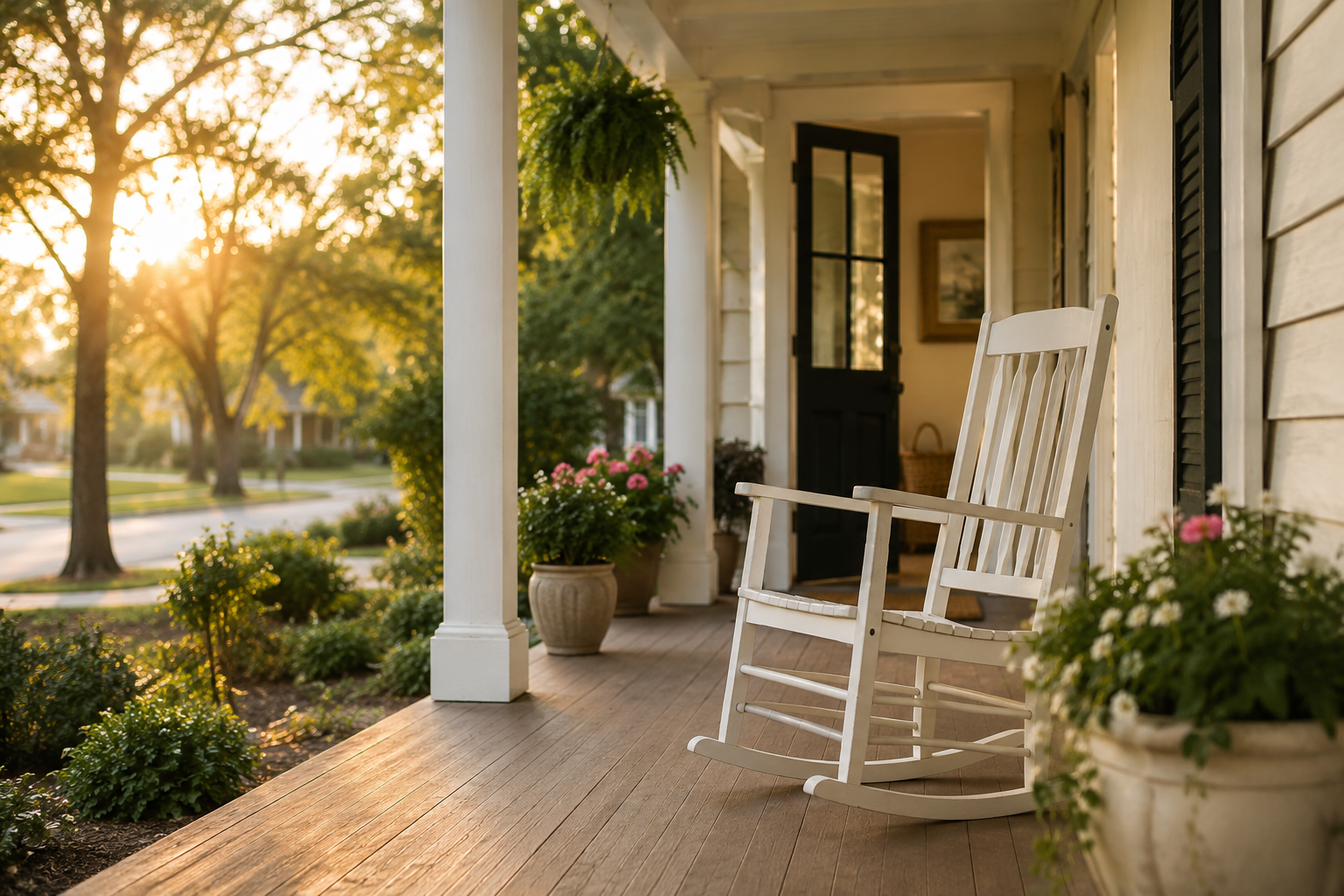
As I approached our old home, I slowed the car. There was a bicycle leaning near the driveway, flowers blooming beside the front porch, and a basketball resting in the yard. It looked like a family was home.
For a moment, I found myself smiling as I imagined the life unfolding inside. Maybe homework was spread across the kitchen table. Maybe someone was asking what was for dinner. Maybe a little girl was running down the hallway while a parent reminded her not to slam the door. It struck me that they were probably living what felt like an ordinary Tuesday, never realizing that one day those simple moments would become the memories they cherished most.
Years ago, I would have looked at that house and thought, That's where we raised our daughters.
This time, a different thought came to me.
I'm so glad another family gets to love this home.
I sat there for another moment before pulling away. Somewhere along the journey, the house had stopped feeling like something I had left behind. It had simply become part of our family's story. It had sheltered us through the years we needed it, witnessed more joy than I could have imagined when we first walked through the front door, and quietly prepared us for the season that came next.
As I drove away, I didn't look back again. I was thinking about home, but not the one in my rearview mirror. I was thinking about the one waiting for me a few miles down the road, where another chapter of our family's story was already unfolding. It looked different than the one before it, but that didn't make it any less beautiful.
Looking back now, I don't believe we ever truly own the places we love most. I think we're simply entrusted with them for a while. We fill them with laughter, tears, traditions, quiet evenings, and ordinary days that slowly become the stories we tell for the rest of our lives. Then, when our season there has come to an end, we leave a little of ourselves behind and carry the rest with us.
As I pulled into our driveway, I turned off the car and sat there for a moment. The house looked different from the one we had left, but the feeling was exactly the same.
I smiled, gathered my things, and walked inside.
If this essay resonates with you, you may also enjoy:
