

How to Buy a Home in Louisville When You’re Moving From Out of State
Buying a Louisville home while living somewhere else takes more than virtual tours. Learn how to choose an area, evaluate homes remotely, handle inspections and plan for closing from a distance..
Buying a home in Louisville while you still live somewhere else is absolutely possible. The harder part is knowing how to make a good decision when you cannot personally be here for every showing, inspection or step along the way.
That changes the way I approach a relocation search.
An out-of-state buyer needs more than listings and video tours. You need context. You need to understand how Louisville is laid out, what your daily routine might look like, what a house feels like beyond the listing photos, and which decisions really require you to be here.
The goal is not to make distance disappear. It is to make sure distance does not leave you making an important decision without enough information.

Can you buy a Louisville home while living in another state?
Yes. Much of the home-buying process can be coordinated from a distance. Buyers can review listings, tour homes by video, communicate with lenders and inspectors, sign many documents electronically and, depending on the transaction and closing arrangements, may be able to complete parts of the closing process remotely.
But I would not begin with the technology.
I would begin by getting very clear about the move.
For an out-of-state buyer, the first question usually should not be “Which house should I buy?” It should be “What does my life in Louisville need to look like?”
Once we know that, the houses become much easier to evaluate.
If you are still deciding whether Louisville itself is the right fit, my Moving to Louisville, Kentucky guide is the better place to begin.
Before we look at houses, I want to understand your life here
Relocation buyers often arrive with a list of home features.
Three bedrooms. Two baths. A certain price range. Maybe a basement, garage or home office.
Those things matter, but they are only part of the search.
I also want to know what is bringing you to Louisville and what your ordinary week will look like once you are here.
Where will you be working? How often will you make that drive? Is being near family important? Do you travel frequently? How much maintenance do you want? Are you looking for something temporary while you learn the city, or a home you expect to keep for years?
Those answers can change the search dramatically.
A beautiful house can become much less appealing when you realize its location makes your everyday life harder.
When you are relocating, you are not really choosing a house from a distance. You are choosing a daily life you have not lived yet.
That is why I want to understand the life first.
How do you choose an area of Louisville when you don’t live here?
Start with geography and routine rather than somebody else's list of the “best” neighborhoods.
Louisville covers a broad area, and two homes that both have a Louisville mailing address can offer very different commutes, housing styles and day-to-day experiences.
I would narrow the search using practical questions:
Where do you need to go regularly?
What commute are you comfortable making?
What home styles fit the way you want to live?
How much yard and exterior maintenance do you want?
Are you interested in an established neighborhood, newer construction, a condo, patio home or something else?
What are you willing to trade for location?
Which matters more if you have to choose: house size, condition, lot, price or proximity?
Those questions give us something useful to work with.
I can explain Louisville geography, housing options, commute considerations and objective property characteristics. I will not tell you where someone “like you” should live or steer you toward or away from an area based on the people who live there.
My Louisville Neighborhood Guide can help you start comparing areas based on the things that actually affect your daily life.
Should you visit Louisville before buying?
If you can, I think an in-person visit is valuable.
There are things you understand differently when you drive an area yourself. You notice traffic, road access, topography, distances, the relationship between homes and how a floor plan actually feels when you walk through it.
But relocation does not always give people that luxury.
Sometimes a new job is starting quickly. Sometimes buyers live too far away to fly in every time a promising property appears. Sometimes the right home becomes available between planned visits.
I have no interest in pretending that a video tour is identical to standing in the house yourself. It isn't.
What I can do is make a remote showing as useful and candid as possible.
What should a virtual home tour actually show you?
A good virtual showing should not feel like another listing video.
Listing photography is designed to present a property well. My job during a virtual showing is different. I want you to understand the property.
That means I may show you:
the drive toward the property
the street and immediate surroundings
driveway and parking
steps and entrances
how rooms connect to one another
storage and closets
views through windows
mechanical areas when accessible
basement access
visible exterior conditions
yard layout and slope
things that look different from the listing photos
anything I notice that I would want you to see if you were standing beside me
Sometimes the most useful part of a virtual showing is something that would never appear in a marketing photograph.
Maybe a room is smaller than the wide-angle image made it seem. Maybe there is a steep step at an entrance. Maybe the backyard slope is difficult to appreciate online. Maybe the road is busier than expected.
I would rather show you something awkward than have you discover it after closing.
A remote buyer does not need a prettier view of the house. A remote buyer needs a more complete one.
How can you evaluate a house you have never personally walked through?
This is where roles matter.
I can observe. I can take additional video and photographs. I can compare the property with others we have seen. I can point out something visible that deserves a closer look. I can help you ask better questions.
What I cannot do is replace the people whose expertise is different from mine.
A REALTOR® is not the home inspector, structural engineer, electrician, plumber, appraiser, lender or attorney.
My background as a physical therapist also makes me naturally attentive to how people move through a space. I tend to notice things such as steps, floor-plan flow, entrances and how a home may function in everyday life. That perspective can be useful, particularly for someone thinking about long-term livability, but it is not a medical or professional home-safety evaluation.
When you are buying from another state, knowing who should answer which question becomes especially important.
How does the home inspection work if you are out of state?
You may not have to be physically present for the inspection, although you should discuss the inspector's process with both the inspector and your REALTOR®.
If you cannot attend, I would ask in advance:
How will the findings be explained?
Will you receive photographs with the report?
Can you speak directly with the inspector afterward?
Is a phone or video conversation available for questions?
Are there findings that warrant evaluation by another qualified professional?
Your inspection rights and deadlines are governed by your contract, so distance does not give us extra time.
That is one reason I pay close attention to deadlines for relocation clients. You may be managing a job, movers, travel and another residence at the same time. The real estate timeline keeps moving anyway.
Should you get preapproved before you come to Louisville?
Yes, I would talk with a lender before beginning a serious home search.
That matters for any buyer, but relocation can add another layer.
If you are changing jobs as part of the move, discuss your employment situation, start date and compensation with your lender early. Do not assume that a job offer or new position will be treated a certain way for mortgage qualification.
That is the lender's area of expertise.
Getting those questions answered before you find a house gives you a much clearer search and reduces the chance of discovering a financing issue while you are trying to write an offer.
The Consumer Financial Protection Bureau also recommends comparing lenders and Loan Estimates as part of the mortgage process rather than assuming every loan offer will have the same costs or terms. Chase
Do you need a Louisville lender?
Not necessarily.
A lender does not have to be based in Louisville simply because you are purchasing here.
What matters to me is whether your lender understands the transaction, communicates well, can meet contract deadlines and is available when questions arise.
Relocation creates enough moving pieces already. Poor communication between the buyer, agent and lender can make a manageable transaction unnecessarily difficult.
Choose the lender based on the financing and service they provide, not simply their ZIP code.
What if you need to sell your current home before buying in Louisville?
Then we need to look at the two transactions together before you make an offer.
The important questions include when funds from the first sale will be available, whether your Louisville purchase depends on that sale, how financing will work, when you need possession, and where you will live if the dates do not line up perfectly.
This is one of those situations where the calendar can matter almost as much as the price.
If the property you need to sell is in Louisville while you already live somewhere else, I have a separate guide on selling a Louisville home when you live out of state.
That is a different problem, and it deserves its own plan.
Can you sign documents and close from another state?
Many documents throughout a real estate transaction can be signed electronically.
Closing deserves a separate conversation.
The exact procedure depends on your lender, title or closing professional, the documents involved and the circumstances of the transaction. Kentucky has a legal framework for online notarization, but that does not mean every document or every closing can automatically be completed remotely.
If you expect to be outside Louisville at closing, bring that up early.
Do not wait until closing week to discover that a particular document needs a different signing or notarization arrangement.
What happens if you cannot attend the final walk-through?
The final walk-through is an important part of the purchase, particularly when you have spent much of the transaction somewhere else.
It is not another home inspection.
It is an opportunity to look at the property's condition close to closing and address the things your contract says should be verified.
If you cannot attend personally, we should decide in advance how the walk-through will be handled and what you need to see.
This is not the moment for a quick, cheerful video call because everyone is excited about closing.
I am still looking at the house.
Closing and possession are not always the same thing
This catches buyers by surprise.
Closing is when the transaction is completed. Possession is when the contract says the buyer gets the property. Those moments are not necessarily identical.
That distinction matters even more when you are relocating.
Before scheduling movers, deliveries or travel around your new house, make sure you understand when possession is actually supposed to occur.
I explain this, the final walk-through and what buyers can expect at the closing table in What Happens at a Real Estate Closing in Louisville, Kentucky?.
Be especially careful with wiring instructions
Relocation buyers often handle nearly everything digitally, which makes this worth saying plainly.
Never rely on emailed wiring instructions without independently verifying them using trusted contact information.
The FBI has repeatedly warned that business email compromise and real-estate transaction fraud can involve criminals impersonating trusted parties and sending fraudulent payment instructions. If wiring money is part of your closing, follow the verification instructions provided by your closing and financial professionals and be suspicious of unexpected changes.
This is one place where slowing down is worth it.
What makes buying from out of state difficult?
Usually it is not one enormous problem.
It is the accumulation of small decisions.
You are learning a city while evaluating houses. You may be starting a new job. Your lender needs documents. An inspection deadline is approaching. Movers want a date. Your current home may be selling. You are deciding whether another flight to Louisville is necessary.
None of those things is unusual.
Together, they can become overwhelming.
The best relocation plan does not eliminate every unknown. It reduces the number of important decisions you have to make at the same time.
That is where preparation pays off.
What should you do before seriously looking at Louisville homes?
If you called me today and said, “Beth, we're moving to Louisville. Where do we start?” this is the order I would suggest:
Clarify your timing. When do you actually need to be in Louisville?
Talk with a lender. Understand your financing and any issues related to employment or relocation.
Map your real life. Identify work, family and other places you expect to visit regularly.
Define your housing priorities. Know what you need, what you want and what you are willing to trade.
Learn Louisville geographically. Do this before trying to choose individual houses.
Plan your visit, if you can make one. Use your time here deliberately.
Decide how remote showings will work. Know what you expect to see beyond listing photographs.
Talk through inspections and contract deadlines. Understand the process before you are under pressure.
Discuss closing and possession early. Especially if travel or movers depend on the dates.
Only then would I want the home search to become the center of the conversation.
Frequently Asked Questions About Buying a Louisville Home From Out of State
Can I buy a house in Louisville without seeing it in person?
Yes. A buyer can make an offer on a property without personally touring it. That does not make an in-person showing and a virtual showing equivalent. If you are considering purchasing remotely, use video, inspections, professional evaluations and additional property information deliberately so you understand what you know and what you do not.
How do I choose where to live in Louisville if I am new to the city?
Start with your routine rather than a list of supposedly “best” neighborhoods. Consider where you need to go regularly, commute preferences, housing style, maintenance, budget and the tradeoffs you are willing to make. Then compare areas that fit those criteria. My Louisville Neighborhood Guide is designed to help with that process.
Should I rent before buying in Louisville?
For some people, renting first makes sense because they want time to experience the city before purchasing. Other buyers have a clear timeline, understand what they need and are comfortable buying as part of the relocation. There is no universal answer. The better question is whether you have enough information to make a purchase decision you are comfortable with.
Do I need to travel to Louisville for the home inspection?
Not necessarily. Ask the inspector how they work with an absent buyer and how findings and questions will be handled. Your contractual inspection deadlines still apply even when you are out of state.
Can I close on a Louisville home without coming to Kentucky?
Sometimes. Electronic signatures are common during a transaction, and remote closing arrangements may be possible depending on your lender, closing professional, documents and circumstances. Ask about this early rather than assuming the entire closing can be completed remotely.
When should I contact a Louisville REALTOR® if I am relocating?
Earlier than many people think. You do not have to wait until you are ready to tour houses. An early conversation can help you understand Louisville geography, determine what information you still need, plan a productive visit and avoid spending weeks looking at homes in areas that do not fit your actual routine.
You Don't Have to Know Louisville Yet
That is the part I wish more relocation buyers understood.
You are allowed to be new here.
You do not need to know every neighborhood, understand every route or arrive with a perfectly defined search. Part of my job is helping you build that context.
What I do want is for you to understand the decisions you are making.
When I work with someone who is buying from another state, I am not trying to make Louisville look perfect on a video call. I am trying to help that person see enough of the real picture to decide whether a particular home and location work for them.
Sometimes that means showing the beautiful kitchen.
Sometimes it means turning the camera around and showing you the thing just outside the frame.
Both matter.
If you are beginning a Louisville relocation, these resources can help you continue:
Moving to Louisville, Kentucky: What It's Really Like
Cost of Living in Louisville, Kentucky
Buying a Home in Louisville, KY
If you are planning a move to Louisville and want to talk through what buying from a distance would actually look like, you can contact me here.
Beth Green, REALTOR® | RE Solutions
Louisville, Kentucky
(502) 836-3027
Beth@REsolutions.realtor
This article provides general real estate information and is not legal, lending, tax, inspection or title advice. Contract terms, financing requirements and closing procedures vary. Consult the appropriate qualified professionals about your particular situation.
What Happens After a Bad Inspection Report? A Louisville Seller’s Guide to Responding Without Losing the Deal
After a bad inspection report, sellers typically negotiate repairs, credits, or price adjustments. The key is separating serious issues from normal maintenance and responding strategically rather than emotionally. Most reports look worse than they are, and how you respond in this moment plays a major role in whether the deal moves forward.

The Moment Every Seller Feels
There is a moment in almost every sale that feels heavier than the rest.
It’s not the listing.
It’s not the showings.
It’s not even the offer.
It’s the inspection.
You’ve done the work.
You’ve accepted an offer.
You’ve started to believe this is moving forward.
Then the report comes in.
And everything feels uncertain again.
Not because you expected perfection.
But because you don’t know what this means yet.
“Are they going to walk?”
“Do we have to fix all of this?”
“Is the deal falling apart?”
That moment matters more than most sellers realize.
Because what happens next isn’t about the house.
It’s about how you respond.
What Happens After a Bad Inspection Report?
After a bad inspection report, the buyer typically requests repairs, a credit, a price adjustment, or a combination of the three. The seller can agree, negotiate, partially accept, or decline based on the seriousness of the issues and the contract terms.
Most inspection reports look worse than they are. The goal is not to fix everything. The goal is to identify what actually matters and respond with strategy.
The Truth Most Sellers Don’t Hear Early Enough
An inspection report is not a verdict.
It is a negotiation tool.
That distinction changes everything.
An inspection report doesn’t tell you what to do. It shows you where the negotiation begins.
Every report combines:
real concerns
aging systems
minor maintenance
and items that simply sound bigger in writing
When everything is listed together, it feels overwhelming.
But not everything carries the same weight.
Why Inspection Reports Feel Bigger Than They Are
This stage hits emotionally before it hits logically.
Sellers often hear:
“My house isn’t as solid as I thought.”
“They’re trying to lower the price.”
“This is about to fall apart.”
But most buyers are not trying to walk away.
They are trying to reduce uncertainty.
Buyers don’t panic because a home is imperfect. They panic when they don’t understand what those imperfections mean.
That’s where this process can either stabilize…
Or escalate.

What Is Actually Happening in the Louisville Market
In today’s Louisville market, inspection negotiations are back.
Buyers are no longer waiving everything just to win
Sellers are seeing more repair requests and credits
Pricing and condition are more connected than they were a few years ago
This doesn’t mean the market is weak.
It means it is more balanced.
In a selective market, condition matters more, not less.
Homes that are:
well-prepared
well-presented
and realistically priced
tend to hold stronger positions during inspection.
Homes that stretch on condition often feel more pressure here.
The Only Way to Stay in Control: A Clear Filter
When a report comes in, everything feels urgent.
It’s not.
You only need to filter it correctly.
Separate “Serious” from “Expected”
Not everything listed is a problem.
Serious issues include:
roof failure or active leaks
electrical hazards
structural concerns
HVAC systems not functioning
moisture or foundation issues
Expected items include:
aging components
minor wear
maintenance items
cosmetic imperfections
A long report is normal. A dangerous report is not.
Ask: Will This Affect Financing or Insurance?
This is where clarity sharpens.
Some items feel stressful but don’t impact closing.
Others can stop a deal entirely.
The only issues that truly control a deal are the ones that affect financing, safety, or insurability.
That’s where attention should go first.
Understand the Buyer’s Ask Is a Starting Point
Most buyers open with a stronger request than they expect to receive.
That’s not conflict.
That’s negotiation.
The first request is rarely the final outcome.
Your job is not to react.
It’s to respond with structure.
Your 5 Real Options as a Seller
There are only five ways this moves forward.
Clarity comes from understanding them.
Option 1: Make the Repairs
Best when:
the issue is real and measurable
it will come up again with the next buyer
it protects the transaction
If the issue will follow the house, solving it now often protects your outcome later.
Option 2: Offer a Credit
Best when:
timing is tight
the buyer wants control
you want to avoid repair coordination
Credits preserve momentum.
Option 3: Adjust the Price
Best when:
multiple issues affect overall value
repairs are not urgent but still relevant
This simplifies negotiation.
Option 4: Split the Difference Strategically
Most deals land here.
You address what matters.
You hold where it doesn’t.
Strong negotiations are rarely all or nothing. They are selective and intentional.
Option 5: Hold Firm and Risk the Deal
Sometimes appropriate.
But only when:
pricing already reflects condition
requests are unreasonable
or you are prepared for the home to return to market
Holding your position is only strong if it is strategic, not emotional.
What Sellers Get Wrong in This Moment
Reacting Instead of Responding
Emotion speeds things up.
Strategy slows things down.
The fastest reactions usually create the weakest outcomes.
Fixing Too Much
Overcorrecting often costs more than negotiating.
Refusing Too Much
If the issue is real, it won’t disappear with the next buyer.
Forgetting the Bigger Picture
The goal is not to “win” the inspection.
The goal is to close the transaction with the best possible outcome.
You don’t get paid for winning negotiations. You get paid at the closing table.
A Simpler Way to Make Decisions
Instead of reacting line by line, ask:
Is this a real safety concern?
Will this affect financing or insurance?
Will the next buyer raise this again?
Is the request reasonable for the issue?
Does this keep the deal moving without overgiving?
That’s the filter.
A Louisville Reality Worth Understanding
Louisville has many homes with history.
That means:
aging systems
older construction
repairs done at different times and standard
This is normal.
Older homes don’t fail inspections. They reflect time.
The goal is not perfection.
It’s confidence.
What a Strong Seller Response Actually Sounds Like
A strong response is calm, specific, and measured.
Not defensive.
Not reactive.
Not over-explained.
Example:
We are willing to address the roof issue due to its impact on insurance.
We are not agreeing to complete all maintenance items listed.
We are offering a credit for the remaining concerns so the buyer can address them after closing.
A strong response acknowledges reality without surrendering position.
The Pattern That Breaks Deals (and How to Avoid It)
Most deals don’t fall apart because of the inspection.
They fall apart because of the reaction.
seller feels attacked
buyer feels unheard
both sides escalate
Deals rarely die from problems. They die from how people respond to them.
Calm structure keeps deals together.
Frequently Asked Questions
Do sellers have to fix everything?
No. Inspection reports are negotiable. Sellers choose how to respond based on the contract and the seriousness of the issues.
What repairs matter most?
Safety, structural, roofing, electrical, plumbing, and anything affecting financing or insurance.
Is a credit better than repairs?
Often, yes. It can simplify the process and give buyers control.
Can buyers walk away?
Yes, depending on the inspection contingency and timing.
Will the next buyer ask for the same things?
If the issue is real, most likely.
Where to Go From Here
If you want to understand what to address before listing so you don’t face this pressure later, start here:
If you want a full breakdown of the selling process in Louisville:
If pricing is part of your concern:
If You’re in This Stage Right Now
Pause before reacting.
This moment always feels bigger before it feels clearer.
You don’t need to:
fix everything
give everything
or assume the deal is over
You need to understand what actually matters.
Clarity doesn’t remove the problem. It removes the panic.
Final Thought
A bad inspection report is not the end of your sale.
It is the moment where experience matters most.
Handled emotionally, it creates friction.
Handled strategically, it creates resolution.
The inspection doesn’t decide the outcome. The response does.
Should You Buy a Home in Louisville Right Now or Wait?
Deciding whether to buy a home in Louisville right now or wait comes down to your timeline, your comfort with the monthly payment, and how stable your situation feels over the next few years. There is no perfect time to buy. Waiting doesn’t remove risk, it simply changes it. When those core pieces are clear, the decision becomes much easier to navigate.

A Moment Most Buyers Don’t Expect
There’s a moment most buyers don’t plan for.
It doesn’t happen at a showing.
It doesn’t happen when you first start looking.
It happens when things start to feel real.
You’ve talked to a lender.
You’ve looked at homes.
You’ve started to picture where you might land.
And then you pause.
Because this isn’t browsing anymore.
It’s a decision.
And the question gets heavier:
“Are we about to make a mistake by buying right now?”
Not because you’re unprepared.
But because the market doesn’t feel clear.
Should You Buy a Home in Louisville Right Now or Wait?
If you’re deciding whether to buy a home in Louisville right now or wait, the right decision depends on your timeline, your financial comfort with today’s monthly payment, and how stable your life is over the next few years.
There is no perfect time to buy. Waiting does not eliminate risk. It simply shifts the type of risk you face.
For many buyers, moving forward with a clear plan is more stable than waiting for a market that may bring more competition, higher prices, or different pressures.
The Real Question Most Buyers Are Actually Asking
Most buyers don’t really want to know:
“Is now a good time to buy?”
What they’re really asking is:
“Will I regret this decision later?”
That’s a different question.
And it requires a different kind of answer.
What Is Actually Happening in the Louisville Market Right Now
Let’s take the emotion out of it for a moment.
Inventory has improved slightly, but it is still below balanced levels
Well-prepared homes continue to attract strong attention
Days on market have increased modestly, but desirable homes still move quickly
Buyers are more cautious, but they are still active
This is not a frozen market.
It is a selective market.
The buyers who feel clear are moving forward.
The buyers who feel uncertain are staying on the sidelines.
A Clear Framework to Decide Whether to Buy Now or Wait
Trying to predict the market creates confusion.
Walking through your situation creates clarity.
Timeline: How Long Do You Plan to Stay?
If you plan to stay in the home for five years or more, short-term market shifts matter less.
If your move is short-term, timing becomes more sensitive.
The longer your timeline, the less pressure there is to “get it perfect.”
Payment: Can You Live Comfortably With This Number?
This is the most important filter.
Not:
the purchase price
the interest rate headline
what someone else says is smart
But this:
“Does this monthly payment fit comfortably into our life?”
If the answer is yes, you have stability.
If the answer is no, waiting is not a failure—it’s a smart decision.
Life Stability: What Else Is Changing?
Buying a home works best when the rest of life is relatively steady.
Consider:
job security
family changes
relocation timing
major financial shifts
If multiple areas feel uncertain, the buying decision will feel heavier than it needs to.
What Happens If You Wait?
Waiting feels like control. It often isn’t.
If rates drop:
more buyers enter the market
competition increases
negotiating power often decreases
If inventory improves:
you may have more options
but not necessarily better pricing
Waiting doesn’t remove uncertainty.
It trades one version of it for another.
The Property Itself: Is This a Long-Term Fit?
Sometimes the home matters more than the market.
If a property fits:
your location needs
your layout preferences
your long-term lifestyle
It may outweigh trying to time the market perfectly.
Not every home is replaceable.
What Most Buyers Get Wrong About Timing the Market
Many buyers believe the goal is to buy at the “right time.”
That mindset leads to:
hesitation
overanalysis
delayed decisions
The truth is simpler:
You don’t need the perfect market.
You need a decision that fits your life.
Markets move.
Your life is what determines whether the decision feels right after you make it.
A Real-World Pattern That Happens More Often Than People Expect
A buyer waits for clarity.
They watch rates. They watch prices. They wait for something to feel obvious.
Months pass.
The market shifts slightly, but not dramatically.
The homes they liked are gone.
When they step back in:
they feel more pressure
they feel less confident
and the process feels harder than before
Not because they made a wrong choice.
But because waiting didn’t give them what they thought it would: certainty.
Frequently Asked Questions About Buying Right Now
Is now a bad time to buy a home in Louisville?
No. It is a more selective market, but buyers who are prepared and financially stable are still finding strong opportunities.
Should I wait for interest rates to drop?
Rates may change, but when they drop, more buyers typically enter the market. That often increases competition and reduces flexibility.
Are home prices going down in Louisville?
Prices have stabilized more than declined. Well-maintained and move-in ready homes continue to hold value.
What matters more: purchase price or monthly payment?
Monthly payment matters more. It directly affects your day-to-day comfort and long-term stability.
What if I buy now and rates improve later?
Many buyers refinance when rates improve. Buying now does not remove your ability to adjust later.
Where to Go From Here
If you want a clear, step-by-step understanding of how the buying process works in Louisville, start here:
If you want to see what your budget looks like in real time, you can explore current homes here:
If You’re Still Unsure, That’s Normal
Most people don’t feel 100 percent certain before making this decision.
And you don’t need to.
What you need is clarity around:
your timeline
your numbers
and what’s actually happening in the market
Once those pieces are clear, the decision usually becomes much quieter.
Final Thought
This isn’t about getting the timing perfect.
It’s about making a decision that feels steady and right for your life.
The market will always move.
But when you understand your position clearly, the noise starts to fade.
And the next step becomes easier to see.
If you are needing more clarity, start here for an honest conversation.
Louisville Neighborhood Guide: How to Choose the Right Area for Your Lifestyle
Trying to decide where to live in Louisville? Compare areas based on commute, walkability, housing style, amenities, space and the way you actually live.
Helping you find the Louisville neighborhood that fits the way you want to live. Rather than ranking neighborhoods from best to worst, this guide is designed to help you identify the communities that best fit the way you want to live.
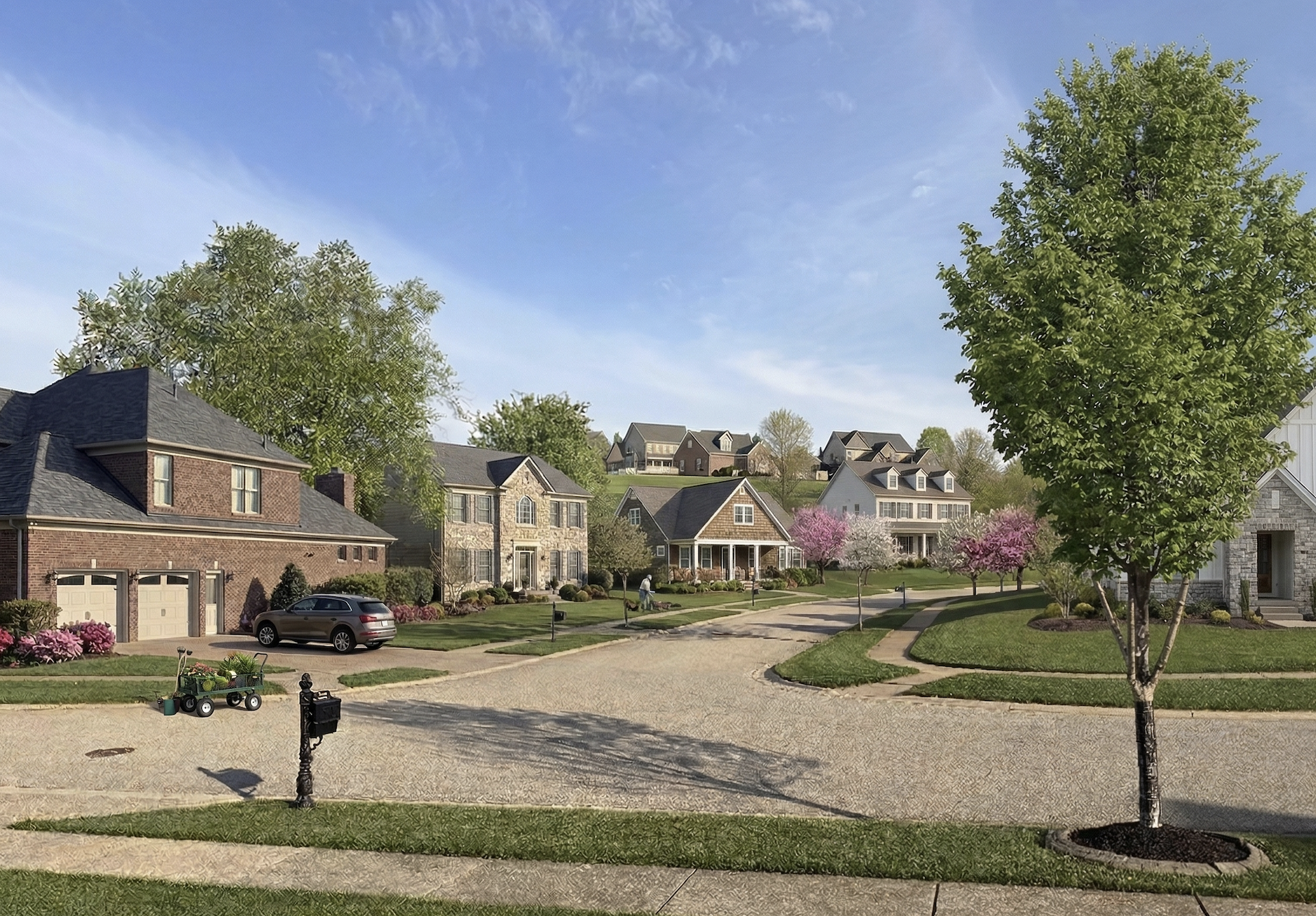
Different areas in Louisville can offer very different living experiences, even within the same price range—making location choice just as important as the home itself.
There’s a question that comes up in almost every relocation conversation:
“Where should we live?”
It sounds like a simple question, but I don't think there's one Louisville neighborhood I could name without knowing quite a bit more about you.
Where will you work? How much driving are you comfortable with? Do you want to be close to restaurants and shopping, or would you rather have more space? Are you drawn to an older home with character, newer construction, a condo or patio home, or something with more land?
Those questions tell me much more than a list of Louisville's “best” neighborhoods ever could.
I work with people who are trying to make these decisions before Louisville feels familiar to them. One thing I've learned is that the house search gets much easier once we have a clearer picture of how you actually want to live here.
If you're still deciding whether Louisville itself is right for you, start with my Moving to Louisville, Kentucky guide.
If you already know you're moving and may need to purchase before you arrive, my guide to buying a home in Louisville from out of state explains how virtual showings, inspections, financing, final walk-throughs and closing can work from a distance.
This guide will help you compare Louisville areas based on the things that will actually affect your everyday life. You'll also find links to more detailed neighborhood resources as you narrow your search.
How to Choose the Right Louisville Neighborhood
I usually start with your routine before we spend much time looking at individual houses.
Where will you work? What other places will you visit regularly? How much driving feels reasonable? Do you want to be able to walk to restaurants or shops, or does “walkable” simply mean having sidewalks and places to take an evening walk?
Then there are the questions about the home itself:
Do you prefer an established home or newer construction?
Would you trade some convenience for more space?
How important are neighborhood amenities?
How much maintenance do you realistically want?
Which home features are true priorities?
You don't need perfect answers to all of these questions. The point is to give the search some direction.
Otherwise, it's surprisingly easy to fall in love with a house online and only later realize that its location doesn't work particularly well for the life you'll be living.
If Walkability and Everyday Convenience Matter to You
First, define what you mean by walkable.
For one buyer, walkability means being able to leave home and walk to a restaurant or coffee shop. Someone else may simply want sidewalks for an evening walk. Another buyer may care less about walking to businesses and more about having convenient access to parks and trails.
Those are different priorities.
When you're comparing Louisville areas, think about the things you would actually use:
sidewalks and walking paths
nearby parks
restaurants and shopping
grocery stores and everyday services
access to major roads
distance to work and other frequent destinations
community amenities, when applicable
A few areas buyers often ask me about include Norton Commons, Glen Oaks, St. Matthews, Springhurst and Lake Forest. They are quite different from one another, which is exactly why I wouldn't group them together as simply the “best” areas.
Norton Commons – This planned community incorporates a mix of housing, restaurants, shops, parks and community spaces within the development. If you're considering Norton Commons, compare the available housing styles, community amenities, costs and location with the way you expect to live day to day.
Glen Oaks – A beautiful golf course community with sidewalks connecting much of the neighborhood to the clubhouse, golf course, tennis courts, pool, and other amenities. Residents are also just minutes from Norton Commons, making it easy to enjoy the restaurants, coffee shops, parks, community events, and local businesses that Norton Commons has to offer. One unique feature of Glen Oaks is that portions of the neighborhood are located in Jefferson County while others are in Oldham County, giving buyers different county and school district options depending on the location of the home. If school assignments are important to you, I always recommend verifying them directly before making a purchase.
St. Matthews– One of Louisville's most established and centrally located neighborhoods, St. Matthews offers convenient access to shopping, restaurants, parks, hospitals, and local businesses while maintaining the character and charm that continue to attract buyers year after year.
Springhurst - Located in Louisville's Northeast corridor, Springhurst combines neighborhood living with exceptional everyday convenience. Residents enjoy easy access to shopping, restaurants, grocery stores, a movie theater, the seasonal farmers market, medical services, and nearby parks, making it a popular choice for buyers who appreciate being able to accomplish many everyday errands close to home.
Lake Forest – A large master-planned community in the East End near the Middletown corridor offering a variety of home styles, neighborhood amenities, walking areas, community events, and convenient access to shopping, dining, and everyday services.
Walking Means Different Things in Louisville
Not every buyer is looking to walk to a coffee shop every morning—and not every great walking neighborhood is built around restaurants and shops.
Many Louisville neighborhoods feature beautiful sidewalks, walking paths, neighborhood pools, and parks that encourage an active lifestyle. Others are just minutes from The Parklands of Floyds Fork, one of the nation's premier urban park systems, offering miles of walking and biking trails, playgrounds, spraygrounds, picnic areas, kayaking, fishing, and year-round outdoor recreation. For many East Louisville residents, easy access to The Parklands has become part of everyday life, whether it's walking the trails, riding bikes, enjoying playgrounds with grandchildren, or simply spending time outdoors.
When you're comparing areas, be specific about what “walkable” means to you. Walking to dinner, taking an evening walk through the neighborhood and having convenient access to a trail system are three different things. Knowing which one matters to you can make the home search much more focused.
Established Neighborhoods vs. Newer Communities
One choice buyers don't always realize they're making is whether they prefer the character and housing styles of an established neighborhood or some of the features that may come with a newer community.
There isn't a better choice across the board. What matters is understanding the differences and deciding which ones matter to you.
Established Neighborhoods
If you appreciate mature trees, distinctive architecture, winding streets, and neighborhoods with a long history, you may enjoy exploring communities such as:
These neighborhoods have developed over decades and offer a sense of character that's difficult to recreate.
Newer Communities
If you're drawn to more modern home designs, neighborhood amenities, and thoughtfully planned communities, you may want to explore:
Many newer communities also feature sidewalks, neighborhood events, pools, walking paths, and convenient access to shopping and dining.
Neighborhood Amenities & Active Lifestyles
For some buyers, the neighborhood itself is an important part of the home-buying decision.
Louisville communities may offer amenities such as pools, golf, tennis or pickleball facilities, walking paths, parks, playgrounds and shared gathering spaces. If those features matter to you, I would go one step further than simply asking whether a neighborhood has them.
Ask yourself which ones you will actually use.
Amenities can add a lot to daily life when they fit the way you live. They may matter much less if you're choosing between a better commute, a house you prefer and a community feature you rarely expect to use.
Communities you may want to explore include:
Each offers a different combination of housing, location and community amenities. When you're considering a particular property, verify which amenities apply to that home and whether there are associated fees, memberships or restrictions.
Looking for More Space?
Some buyers know they want a larger lot, more privacy, or simply a little more room than they're finding closer to Louisville's urban core.
Depending on your budget and other priorities, that may mean expanding the search into areas such as:
The important tradeoff is often distance. More space may be well worth a longer drive for one person and completely wrong for someone else's routine.
If you're considering areas farther out, I recommend driving the routes you'll use regularly before deciding that the location works. A distance that looks reasonable on a map can feel very different when you're making the trip several times a week.
The Biggest Mistake People Make When Choosing Where to Live
One thing I see with relocation buyers is how easy it is to let the house make the location decision.
You find a listing online that checks a lot of boxes. The kitchen looks right, it has the space you wanted, and maybe the price is better than another home you've been considering. Before long, you're trying to convince yourself that the location works too.
I would rather approach it from the other direction.
You don't have to choose one neighborhood before you start looking at homes, but it helps to identify several areas that make sense for your routine, budget and housing priorities. Then we can compare the homes available within those areas.
A home can change over time. Its location can't.
That matters even more when your schedule is demanding or you'll be making the same commute several times a week.
How to Narrow Down Your Louisville Neighborhood Search
If the number of choices feels overwhelming, you don't need to compare every part of Louisville at once. I find it much easier to narrow the search in stages.
Choose your two or three biggest priorities. Commute, space, home style, maintenance, budget and proximity to places you'll visit regularly are good places to start.
Identify several areas that could support those priorities. You don't need to choose one neighborhood yet.
Compare what your budget actually buys in each area. The same price can give you very different housing choices depending on where you're looking.
Visit different types of areas if you can. Spend some of your time experiencing the locations rather than filling every available hour with house showings.
Drive the routes you'll use regularly. A commute on a map doesn't always tell you what it will feel like several times a week.
Pay attention to the tradeoffs. Which ones genuinely bother you, and which ones are easier to accept than you expected?
Once you begin comparing areas this way, the search usually becomes much more manageable. You may even find that where you thought you wanted to live changes as you get to know Louisville better.
Explore Louisville Neighborhoods
East Louisville
Oldham County
Low-Maintenance Living
Frequently Asked Questions About Where to Live in Louisville
What is the best area to live in Louisville, KY?
There isn't one best area to live in Louisville for everyone. The right location depends on your budget, commute, housing preferences, regular destinations and what you want your daily routine to look like. I recommend identifying those priorities first, then comparing several Louisville areas that meet them rather than starting with a generic “best neighborhoods” list.
What Are the Safest Areas in Louisville?
I don't rank Louisville neighborhoods by safety because conditions can vary within an area and change over time. If safety is important to your decision, I recommend reviewing current crime data from official sources and researching the specific locations you're considering. Visiting an area at different times can also help you decide how comfortable you feel there.
Where Should I Live in Louisville if I Work at a Hospital or Medical Facility?
Start with the specific facility or facilities where you'll work and your actual schedule.
Someone working traditional daytime hours may evaluate a commute differently from someone working nights, early mornings, rotating shifts or call. Instead of choosing an area simply because it's described as “close to the hospitals,” compare the actual routes and drive times that would be part of your routine.
Is It Better to Live in Louisville or Outside the City?
It depends on what you want from the location.
Some buyers prioritize shorter drives and convenient access to the places they visit regularly. Others are willing to drive farther for a different type of home, more land or another feature that matters to them.
I would compare the actual housing choices and what your daily routine would look like in each location rather than assuming one is better.
Should I Choose an Established Neighborhood or a Newer Community?
There isn't a right answer for everyone.
Established areas may offer older housing, mature landscaping and distinctive architecture. Newer communities may offer more contemporary construction, different floor plans or planned amenities.
The individual home's condition, location, maintenance needs, applicable fees and your own housing preferences should all be part of the decision.
How Should I Compare Louisville Neighborhoods if Schools Are Important to Me?
Verify school assignments directly for any property you're seriously considering because boundaries and assignments can change.
You can research schools and district information independently while I help you evaluate the real estate side of the decision, including the property, location, commute, housing options and the other priorities you've identified.
Can I Choose a Louisville Neighborhood Before I Visit in Person?
You can narrow your choices considerably before visiting, and some buyers purchase a Louisville home while still living in another state.
The key is getting enough information to make an informed decision. Virtual showings, maps, property information, inspections and careful evaluation of the location can all help.
If you're able to visit before buying, I still think there's real value in experiencing the areas you're seriously considering. Spend some of that visit driving the routes you'll use, looking at the surroundings and getting a sense of how the different locations fit together rather than using every available hour for house showings.
If you won't be able to visit before purchasing, my guide to buying a home in Louisville from out of state explains how I approach the process with remote buyers.
Still Not Sure Which Louisville Neighborhood Fits You?
You don't need to know the answer before we start talking.
If you're still deciding whether Louisville itself is right for you, my Moving to Louisville, Kentucky guide gives you the broader picture of what to consider before relocating.
If you've decided to move and need to figure out how to purchase while you're still somewhere else, read How to Buy a Home in Louisville When You're Moving From Out of State.
And if you want help narrowing the search around your particular routine, work location, budget and housing priorities, you can reach out here.
Sometimes the first useful step isn't finding the house. It's getting clear about where to look.
Moving to Louisville, KY: What It’s Really Like and How to Decide Where to Live
If you’re considering a move to Louisville, the real question isn’t just “Can we afford it?”
It’s “Will this actually work for our life?”
This guide walks through what it’s really like to live here—from cost and lifestyle to where to live and what people often don’t expect—so you can make a clearer, more confident decision.

A typical Louisville neighborhood where daily life feels steady, walkable, and connected.
If you're considering moving to Louisville, Kentucky, the biggest decision usually isn't whether you can find a house you like. It's figuring out where your everyday life will work best once you're here.
Louisville gives buyers a wide range of choices, from older established neighborhoods closer to the center of the city to suburban communities, newer developments and properties with more land farther out. The right choice depends on much more than price.
Your commute, the places you visit regularly, the kind of home you want, how much maintenance you're comfortable with and even how you like to spend an ordinary Tuesday can all change where it makes sense to look.
I work with people who are trying to make those decisions before Louisville feels familiar to them. One thing I've learned is that relocation gets much easier when we stop trying to find the “best” area and start figuring out which area works for the life you're actually going to live here.
If you already know you're moving and expect to purchase before you arrive, my guide to buying a home in Louisville from out of state explains how virtual showings, inspections, financing, final walk-throughs and closing can work when you're still living somewhere else.
What Is It Really Like to Live in Louisville?
Louisville offers a mix that can be difficult to understand from a map.
You can live fairly close to restaurants, parks, hospitals and established commercial areas, or choose a location farther out where homes and lots may offer more space. Housing also varies considerably by area and age. You'll find everything from older homes with distinctive architecture to traditional suburban neighborhoods, condos and patio homes, and newer construction.
The city is also part of a larger regional employment center. Healthcare is particularly significant, alongside logistics, manufacturing, education and business services. Norton Healthcare, UofL Health and Baptist Health are among the region's major healthcare employers, while UPS, Ford, GE Appliances and Humana also have substantial operations here.
But those facts won't tell you whether your life will work here.
That's where I think relocation research often falls short. People learn about attractions, employers, home prices and neighborhoods, but they haven't yet pictured the routine they'll repeat hundreds of times after the moving boxes are gone.
How Much Does It Cost to Live in Louisville?
The cost of living is one reason people consider Louisville, but I wouldn't make a relocation decision from a citywide affordability number.
Housing costs can vary significantly depending on the area, property type, age, size and condition of the home. Purchase price is also only one part of what a house will cost you.
When I'm helping someone relocate, I want them thinking about questions such as:
What does this budget actually buy in the areas we're considering?
How much maintenance comes with the property?
Are we comparing an older home with a newer one?
How will the location affect the drives you'll make regularly?
What compromises would you have to make to stay within budget?
Two people can arrive in Louisville with exactly the same housing budget and make very different choices.
One may decide that being closer to work matters enough to accept a smaller house. Another may happily drive farther for additional space. Someone else may decide that lower maintenance matters more than either one.
That's why I prefer the question, “What will my budget allow me to prioritize?” rather than simply, “How much house can I afford?”
If you're comparing locations, my Louisville Neighborhood Guide gives you a practical framework for doing that.
Where Should You Live in Louisville?
There isn't one answer, and I would be wary of anyone who gives you one without knowing much about you.
I start with the places you will actually need to reach.
Where will you work? Do you have family nearby? Are there medical facilities or other destinations you'll visit regularly? How much driving feels reasonable to you? What kind of house are you hoping to find?
Then we can start comparing areas.
Broadly, Louisville-area buyers will encounter several different kinds of settings.
Established Areas
These often have older housing stock and can put you closer to restaurants, parks, hospitals and other established parts of the city. Homes can have tremendous character, but age and condition deserve careful attention.
Suburban Areas
You'll find a wide range of suburban housing throughout the Louisville area. Depending on location, that can include established subdivisions as well as newer homes and communities.
Newer Developments
For buyers who prefer newer construction, modern floor plans or certain community amenities, newer developments may belong in the search. The tradeoff may be location, lot size, price or commute, depending on the community.
Areas Farther From the Urban Core
Moving farther out can open up different possibilities, including larger lots or more privacy in some locations. The practical question is whether the additional driving works for your routine.
None of those choices is automatically better.
A house can meet every item on your wish list and still be in the wrong place for the life you need to live.
That is one of the most important things I want relocation buyers to understand.
How Should You Choose an Area Before You Know Louisville?
You don't have to know Louisville like a local before you begin looking.
You do need a way to compare your choices.
Before getting attached to individual houses, I would answer these questions:
Where will I need to go most often?
What drive times am I comfortable with?
Which home features are true needs?
What would I trade for a better location?
How much maintenance do I realistically want?
Do I care more about space, condition, convenience or some combination of the three?
How long do I expect this home to fit my life?
Those answers give us something far more useful than a list of popular neighborhoods.
If you're able to visit before buying, use at least part of the trip to drive rather than tour houses.
Drive from the areas you're considering to work. Go at a realistic time of day. Find the grocery store. Notice the roads and surroundings. See whether the distances on the map feel the way you expected them to feel.
I've found that this often tells a relocating buyer more than squeezing one additional showing into the afternoon.
What Surprises People After Moving to Louisville?
Some surprises have nothing to do with real estate.
Louisville summers can be hot and humid. A car is an important part of daily life for many residents. Different parts of the metro can feel surprisingly distinct from one another, which is one reason choosing solely from an online neighborhood list can be misleading.
There is also an adjustment that is harder to quantify.
When you're new to a city, even simple things require thought for a while. You don't automatically know which route you prefer, how long a drive really takes at 5:00, where you like to shop or which part of town makes the most sense for an appointment.
That becomes normal surprisingly quickly, but I think it's worth acknowledging.
Relocation isn't just changing houses. For a while, you're rebuilding all the little routines that normally happen without thinking.
A good housing decision can make that transition considerably easier.
What If You're Relocating to Louisville for Work?
Start with your actual work schedule, not simply the address of your employer.
Louisville has substantial employment in healthcare, logistics, manufacturing and business services.
For someone relocating for a medical position, for example, I would want to know more than which hospital or facility employs you.
Do you work traditional hours? Early mornings? Nights? Are you on call? Will you work at more than one location?
Those details can change how you think about distance.
The same applies to anyone relocating for work. A commute that looks perfectly reasonable on a map may feel different when you make it ten times a week.
Should You Choose the House First or the Location First?
For most relocating buyers, I would narrow the location before becoming serious about individual houses.
That doesn't necessarily mean choosing one neighborhood. Doing that too early can be unnecessarily restrictive.
Instead, identify several areas that work with your routine and housing goals. Then let the available homes help you compare the tradeoffs.
This approach also makes remote searching much easier because you aren't reacting to every attractive listing across the entire Louisville metro.
The house is one decision. The life surrounding it is the bigger one.
Is Louisville the Right Fit for You?
That depends on what you're hoping your move will accomplish.
Someone looking for a dense urban environment where daily life can revolve around public transportation may evaluate Louisville very differently from someone looking for more housing choices, additional space or a different pace of life.
And that's okay.
I don't think a relocation guide should try to convince everyone that Louisville is right for them.
A useful relocation guide should help you recognize whether your priorities and what Louisville offers line up well enough to keep exploring.
If they do, the next step is getting more specific about where and how you would live here.
What Should You Do Before Deciding Where to Live in Louisville?
Before choosing an area or making an offer:
Map your regular destinations. Work is important, but include the other places that will be part of your routine.
Drive the areas you're seriously considering. If you can visit Louisville, experience them at different times rather than only during showings.
Compare what your budget buys in several locations. Don't assume the same amount of money produces the same choices everywhere.
Look beyond listing photographs. Pay attention to the property, street, surroundings and drive.
Decide which compromises you can actually live with. Most buyers make some. The goal is choosing the right ones.
Give yourself permission not to know everything yet. You can narrow the search as you learn more.
The goal isn't to become a Louisville expert before you move.
It's to know enough to make a thoughtful decision about your own life here.
Frequently Asked Questions About Moving to Louisville, KY
Is Louisville, KY a Good Place to Live?
Louisville can be a good fit for people who value a range of housing choices, access to a major regional employment center and the ability to choose among more urban, suburban and lower-density settings. Whether it is a good fit for you depends on your budget, commute, housing preferences and the kind of daily life you want.
Why Do People Relocate to Louisville?
People relocate to Louisville for many reasons, including employment, proximity to family, housing needs and lifestyle changes. The regional economy includes major employers in healthcare, logistics, manufacturing, education and business services.
Is Louisville Affordable?
Affordability depends on what you're comparing Louisville with and where and what you plan to buy. Instead of relying only on a citywide cost-of-living figure, compare actual housing choices, taxes, maintenance, transportation and other recurring expenses that apply to your situation.
Where Should I Live in Louisville?
Start with your routine. Identify where you need to go regularly, the type of home you want, your budget, acceptable drive times and the compromises you're willing to make. Then compare Louisville-area locations that meet those criteria rather than relying on a generic “best neighborhoods” list.
Is Louisville Good for Healthcare Professionals Relocating Here?
Louisville has a significant healthcare sector, including major employers such as Norton Healthcare, UofL Health and Baptist Health. For someone relocating for healthcare work, location should be considered alongside worksite, schedule, commute and whether the position requires travel between facilities.
Planning Your Move to Louisville
If you're in the early stages, you don't need to have every part of the move figured out before asking questions.
My Louisville relocation guide goes deeper into the overall relocation process, including how Louisville is laid out, planning your home search and preparing for the move.
If you already know you're moving and expect to purchase while you're still living somewhere else, start with my guide to buying a Louisville home from out of state.
And if your move involves helping a parent or planning a later-life transition, my Louisville downsizing and senior transitions guide addresses the additional decisions that can come with that kind of move.
You don't have to sort through all of it at once.
If you'd like to talk through where to focus, what to consider or how your particular move might work, you can reach out here. I'll help you figure out a sensible next step.
How Much Money You Actually Need to Buy a Home in Louisville in 2026
Wondering how much money you actually need to buy a home in Louisville? This guide breaks down real numbers—down payment options, closing costs, monthly payments, and what buyers are actually doing right now—so you can move forward with clarity instead of guesswork.
Buying a home starts with excitement for some people.
For others, it starts with a quiet kind of doubt.
They have been scrolling homes for weeks. Maybe longer. They have looked at prices, tried to estimate payments in their head, and started wondering whether they are even close to ready.
Usually, one assumption shuts the whole conversation down before it really begins:
“I probably need 20% down.”
That belief keeps a lot of buyers from taking the first step.
The truth is more nuanced than that.
If you are trying to figure out how much money you actually need to buy a home in Louisville, the answer depends on more than one number. It depends on your price point, financing structure, cash reserves, closing costs, taxes, insurance, and how long you plan to stay.
The good news is this: most buyers do not need perfect conditions. They need a clearer picture.
This guide walks through what homes are costing in Louisville right now, what buyers often need upfront, what monthly payments can look like, and how to think about the buy-versus-rent question in a way that is actually useful.
Most buyers don’t have a money problem—they have a clarity problem.
Important note
The market changes. Mortgage rates move. Taxes and insurance can shift, and inventory can tighten or expand.
The numbers below reflect recent Louisville-area sales data from the last 90 days and March 2026 cost estimates, so this article should be used as a planning guide, not a fixed quote.The short answer
Most buyers in Louisville need to plan for three things:
A down payment
Closing costs
A monthly payment that feels sustainable for real life, not just on paper
And no, 20% down is not the only path.
For many buyers, the better first question is not, “How much do I need to buy a house?”
It is, “What does a healthy buying plan look like for me in this market?”
That is a much better place to begin.
What homes are actually selling for in Louisville right now
If you are trying to estimate what it takes to buy, you need a realistic picture of the market you are stepping into.
Based on the last 90 days of sold properties in the Louisville area from March 26, 2026:
Median sale price: $290,000
Average sale price: $338,424
Average days on market: 46
That matters because buyers are not buying into some vague national headline. They are buying into this local market, with these price ranges, these taxes, and these payment realities.
The sold price segments also help paint a clearer picture of where buyers are actually landing:
Entry range: $200,000 to $275,000
684 sold properties
Mid-range: $275,000 to $400,000
841 sold properties
Upper range: $400,000 and up
631 sold properties
The biggest cluster is that middle range. That is where a lot of Louisville buyers are trying to make the numbers work right now.
If you are coming from a higher-cost market, Louisville may still feel relatively approachable. If you are a first-time buyer already living here, it may feel tighter than you expected. Both experiences can be true at the same time.
If you are relocating, choosing the right area matters just as much as the numbers. You can read more about that here:
Do you really need 20% down to buy a home in Louisville?
In a word, no.
That does not mean 20% down is a bad idea. It can lower your loan amount, reduce your monthly payment, and help you avoid Private Mortgage Insurance or PMI in many cases.
But it is no longer the normal starting point for every buyer.
What I am seeing in Louisville right now is a much wider mix:
Some buyers are putting 20% down
Some are putting less down to preserve cash
Some are putting more down to lower monthly pressure
Some are paying cash entirely
Many are using different lender programs and adjusting strategy based on what best fits their goals
That is why the lender conversation matters so much early on.
The goal is not to chase a mythical “right” number just because that is what people have heard for years. The goal is to understand what buying looks like with your income, your reserves, your comfort level, your timeline, and the financing options actually available to you.
A clean buying strategy almost always starts with a lender first, then ongoing communication between lender, buyer, and agent all the way through offer and closing.
What buyers usually need upfront
This is where many people underestimate the full picture.
Buying is not just about the down payment. It is also about the cash needed to get to the closing table without feeling stretched too thin afterward.
The main categories are:
Down payment
This varies widely depending on loan type, program, and strategy.
Closing costs
In Louisville, buyers should usually budget around 2% to 5% of the purchase price in closing costs, in addition to the down payment.
Here is what that looks like at common price points:
On a $250,000 home:
About $5,000 to $12,500
On a $300,000 home:
About $6,000 to $15,000
On a $400,000 home:
About $8,000 to $20,000
What those costs often include:
- Lender fees
- Appraisal
- Credit report
- Title work
- Recording fees
- Prepaid insurance
- Escrow reserves for taxes and insurance
That last category catches people off guard more often than it should. Prepaids and escrow setup are not glamorous, but they are real. In many cases, they make up a meaningful part of the cash-to-close number.
One more practical point: earnest money is separate from all of this in how buyers think about timing, but it is usually credited back toward the transaction at closing. The exact amount varies by deal, price point, and negotiation strategy.
What your monthly payment can actually look like
One of the most helpful things a buyer can see is a clear example.
Using March 2026 estimates with a 30-year fixed rate around 6.45 percent, 20% down, and a Jefferson County benchmark tax rate of 1.14 percent, here is what common Louisville price points look like when principal, interest, taxes, and insurance are combined.
For a $250,000 home:
Down payment: $50,000
Estimated monthly payment: $1,615
For a $300,000 home:
Down payment: $60,000
Estimated monthly payment: $1,949
For a $400,000 home:
Down payment: $80,000
Estimated monthly payment: $2,577
These examples assume:
A 30-year fixed loan
20% down
Good-to-excellent credit
No PMI
Average local tax and insurance estimates
That means the numbers can move.
A lower down payment can increase the monthly cost.
A lower credit score can increase the rate.
A home in a different tax district can change the tax portion.
Insurance can be materially different on older homes, larger homes, or homes in higher-risk areas.
This is why online mortgage calculators are only useful up to a point. They are fine for getting a rough feel. They are not the same thing as a real buying plan.
Why Louisville property taxes matter more than many buyers expect
Taxes are one of the most overlooked parts of the monthly payment conversation.
In Jefferson County, the total tax bill is made up of multiple layers, including state, metro, school, and in some cases Urban Service District or fire district taxes.
Typical residential ranges look like this:
Outside the Urban Service District:
Approximately 0.941 percent to 1.14 percent
Inside the Urban Service District:
Approximately 1.26 percent
Using the 1.14 percent benchmark, that creates these rough annual tax estimates:
$250,000 home:
About $2,850 per year
About $238 per month
$300,000 home:
About $3,420 per year
About $285 per month
$400,000 home:
About $4,560 per year
About $380 per month
That difference may not seem dramatic when someone is casually scrolling listings, but it can matter a lot when you compare two neighborhoods, two school areas, or two monthly payment scenarios.
This is one reason buyers should not focus only on purchase price. Two homes at the same price can feel very different in monthly ownership cost.
Why two buyers shopping at the same price point may need very different amounts of cash
This is where a lot of generic real estate content falls apart.
Two people can both be looking at a $300,000 home and still need very different strategies.
One buyer may choose to put less down because they want stronger cash reserves after closing.
Another may put more down because monthly comfort matters more than liquidity.
One may negotiate seller concessions.
Another may decide to buy down the rate.
One may be fine stretching a little on payment because their income path is rising.
Another may need a lower fixed monthly number because they value margin and predictability.
In other words, the right plan is not just about affordability. It is about durability.
That is why buyers should be very careful about comparing themselves to someone else’s rule of thumb or someone else’s transaction.
The better question is:
What structure leaves me feeling steady after I buy?
What buyers are actually doing in Louisville right now
This is the section I think matters most, because it reflects what is really happening instead of what people assume should be happening.
Buyers in Louisville are not all doing the same thing.
They are mixing it up.
Some are putting 20% down.
Some are using lower down payment options.
Some are bringing more cash to reduce long-term monthly strain.
Some are using lender programs.
Some are paying cash.
Some are adjusting their target price instead of waiting for a perfect rate environment.
The common denominator is not one specific financing model.
It is strategy.
The smartest buyers are not trying to guess their way through the process. They are talking with a lender first, watching rates, running multiple scenarios, and staying in close communication once they begin shopping seriously.
Then, when it is time to write an offer, the lender and Realtor work together with the buyer to make sure the structure of the deal supports the buyer’s real goals, not just the contract price.
That kind of coordination matters more than people realize.
It is the difference between casually looking at homes and moving forward with a plan that actually holds together.
Renting versus buying in Louisville right now
This is where a lot of people get stuck, and fairly so.
In Louisville right now, renting can still have the lower monthly cost in the short term. Buying often becomes more powerful over time.
As of March 2026, average Louisville rental benchmarks look like this:
Apartments, all types:
Average around $1,250
Typical range $900 to $1,600
Single-family houses:
Average around $1,697
Typical range $1,200 to $2,400+
Townhomes:
Average around $1,317
Typical range $1,100 to $1,700
By unit size, current benchmarks are roughly:
Studio:
$950
1 bedroom:
$1,120
2 bedrooms:
$1,300
3 bedrooms:
$1,650
4+ bedrooms:
$2,000+
Neighborhood affects this a lot.
Premium areas like the Highlands, NuLu, and parts of the East End usually run higher.
Mid-range areas like St. Matthews, Fern Creek, and J-town often land closer to city averages.
Value-oriented areas like Old Louisville, South Louisville, and Shively may offer lower entry rents.
Single-family rental inventory is also tighter than the apartment market, especially in more desirable school districts and higher-demand areas.
Is buying cheaper than renting in Louisville?
In the short term, often no.
In the longer term, often yes.
Using current March 2026 examples:
$250,000 home
Estimated monthly ownership cost: $1,615
Estimated comparable rent: $1,450
Monthly gap: $165
$300,000 home
Estimated monthly ownership cost: $1,949
Estimated comparable rent: $1,697
Monthly gap: $252
$400,000 home
Estimated monthly ownership cost: $2,577
Estimated comparable rent: $2,150
Monthly gap: $427
That monthly gap is exactly why renting can make sense for some people right now.
If you only plan to stay in a home for a short period, or if cash reserves are tight, renting can be the more practical choice.
But monthly cost is not the whole story.
When renting may make more sense
Renting often makes more sense if:
You expect to move within the next two to three years
You do not want repair responsibility
You need maximum flexibility
You are still stabilizing income, job, or life plans
Buying comes with upfront transaction costs. If you sell too early, those costs can overwhelm the equity you had time to build.
That is why shorter stays and homeownership usually do not pair well financially unless appreciation is unusually strong.
When buying starts to pull ahead
In Louisville’s current environment, the breakeven horizon is often around four to six years, although growth does occur faster in some neighborhoods.
That is the point where the long-term benefits of owning start to outweigh the early costs more meaningfully.
Why?
Because your principal and interest stay fixed while rents can rise.
Because part of your monthly payment is reducing your loan balance.
Because modest appreciation compounds over time.
Because you are building equity through both appreciation and principal paydown.
Because there can be tax advantages depending on your situation
Because the longer you hold the property, the more room there is for the numbers to work in your favor.
If your plan is to stay four years or longer, want more payment stability, and are prepared for maintenance and repair costs, buying often starts to become much more compelling.
What a five-year ownership path could look like on a $300,000 home
This is where the conversation gets more interesting.
Using a $300,000 home example, 20% down, a 6.45 percent rate, and a steady 3 percent annual appreciation assumption, here is what a five-year picture can look like. It’s also worth noting that long-term appreciation in Louisville has often trended closer to 4–5%, though it can vary by neighborhood and market cycle.
Starting point:
Home value: $300,000
Loan balance: $240,000
Equity at purchase: $60,000
Estimated year five outcome:
Estimated home value: $347,782
Remaining loan balance: $222,145
Total equity: $125,637
That increase in net worth comes from two places:
About $47,782 from appreciation
About $17,855 from principal paydown
That does not mean all of it is spendable profit if you sell.
If you sold after five years and paid estimated selling costs around 8 percent, the projected net walkaway cash would be around $97,815.
After accounting for the original down payment, that would leave roughly $37,815 in additional profit.
By comparison, renting a similar single-family home at $1,697 per month with 2.5 percent annual rent growth would total around $107,000 in rent paid over five years, with no equity built.
That does not automatically mean buying is always the right call. It does mean the longer-term math often looks very different from the first-year monthly comparison.
These examples are based on a modest 3% annual appreciation assumption, which keeps the projections conservative.
The range of possible outcomes matters too
This is another place where buyers deserve a fuller conversation.
A five-year ownership result can look very different depending on the market.
On a $300,000 home with 20% down, here is how three broad scenarios compare over five years:
Worst case, flat market, 0 percent appreciation:
Home value remains $300,000
You still build equity through principal paydown
But after selling costs, you could still take a net loss if you sell too early
Steady case, around 3 percent annual appreciation:
This is the current balanced-growth assumption
You may end up with meaningful equity growth and a profit after sale
Higher-growth case, around 6 percent annual appreciation:
The upside can become much stronger
That equity could later help fund a move-up purchase or support holding the property as a rental
The main takeaway is simple:
Buying tends to reward time more than timing.
How to know if you may be ready to buy
You do not need every variable solved before you start.
But you do need a few things to be taking shape.
You may be more ready than you think if:
You have a realistic sense of your cash position
You understand your likely monthly comfort range
You have spoken with a lender about real scenarios
You are planning to stay long enough for ownership to make sense
You want more control and stability than renting gives you
You may need a little more time if:
Your timeline is short
Your savings are thin
Your income feels unstable
You are trying to buy at the edge of what feels manageable
There is nothing wrong with either outcome.
Good buying decisions usually come from clarity, not urgency.
Frequently asked questions about buying a home in Louisville
Do I need 20% down to buy a home in Louisville?
No. Many buyers use lower down payment options depending on their financing and overall plan.
How much are closing costs for buyers in Louisville?
A common planning range is about 2% to 5% of the purchase price, in addition to the down payment.
What is a typical monthly mortgage payment in Louisville?
That depends on price, rate, taxes, insurance, and down payment. At March 2026 estimates with 20% down, rough examples are about $1,615 on a $250,000 home, $1,949 on a $300,000 home, and $2,577 on a $400,000 home.
How much are property taxes in Louisville, KY?
A common planning benchmark is about 1.14 percent, though some areas may be lower and some, especially Urban Service District areas, may be higher.
Is renting cheaper than buying in Louisville right now?
Often in the short term, yes. Over a longer time horizon, buying can become more favorable depending on price, rent growth, appreciation, and how long you stay.
How long should I plan to stay if I buy?
In many cases, four to six years is a healthier breakeven target in the current market.
What is the first step if I think I may want to buy?
Talk to a lender before you start touring homes. A real pre-approval and a few scenario conversations create much more clarity than guessing from online calculators.
Final thoughts
A lot of buyers are not as far away as they think.
What they usually need is not more noise. They need better numbers, honest context, and a plan that fits real life.
The Louisville market is still moving. Rates move. Statistics change. Taxes and insurance shift. But buyers who get clear early usually make stronger decisions than buyers who stay stuck in assumptions.
If you want to see what this looks like with your numbers—not a general estimate—I’m happy to walk through it with you.
Rent vs. Buy in Louisville: What Actually Makes Sense Right Now (2026)
Should you rent or buy in Louisville? This guide breaks down real costs, timelines, and when each option actually makes sense.
(Updated for 2026 — Local data, estimates, and real-world scenarios. Numbers may shift based on market conditions, interest rates, and individual situations.)
There’s a point where most people stop asking “Can I buy?” and start asking something more practical:
Should I?
In Louisville right now, this isn’t a simple yes or no.
It’s a timing decision.
And more specifically—it’s a trade-off between flexibility now and stability later.
Quick Snapshot (Louisville, 2026)
• Average rent (single-family): ~$1,697/month
• Example PITI on $300K home (20% down, ~6.45%): ~$1,949/month
• Typical breakeven horizon: ~6–7 years
• Estimated appreciation (baseline): ~3% annually
Use these as orientation points—not exact budgets.
Most people don’t land exactly at the “average”—they fall somewhere within a range based on location, loan structure, and timing.
The Real Question: Timeline vs. Flexibility
Renting gives you flexibility.
Buying gives you stability and equity over time.
The decision isn’t which is “better.”
It’s which fits your timeline—and what you need your next few years to look like.
Monthly Cost Comparison (Real Example)
$300K Home (20% down, ~6.45%)
• Estimated monthly PITI: ~$1,949
Comparable Rent
• Estimated monthly rent: ~$1,697
Monthly gap
• ~$250 more to own (today)
That gap is the cost of entry into ownership—but it’s also what positions you for long-term equity.
In the short term, this is why renting often feels like the easier choice.
What Happens Over Time
Rent tends to rise.
Your principal and interest stay fixed.
Over time, that gap often narrows—or reverses.
5-Year Ownership Snapshot (Illustrative)
This is where the long-term difference begins to show.
Starting price: $300,000
After 5 years (est.):
• Home value: ~$347,782
• Loan balance: ~$222,145
• Total equity: ~$125,637
Estimated selling costs (~8%): ~$27,822
Estimated net after sale: ~$97,815
Net gain above initial $60,000 down payment: ~+$37,815
Estimates based on ~3% annual appreciation and typical amortization. Results vary.
When Renting Makes More Sense
• You expect to move within 1–3 years
• You value flexibility or job mobility
• You’re building savings or stabilizing income
In short timeframes, transaction costs can outweigh equity gains.
When Buying Starts to Work
• You plan to stay 4–6+ years
• You want predictable housing costs
• You’re comfortable with maintenance responsibilities
Time is what allows ownership to work in your favor.
The Breakeven Window (Louisville)
In Louisville’s current market, many scenarios land around a 5–6 year breakeven.
Before that, renting often wins on cost.
After that, buying typically pulls ahead.
Important Note About These Numbers
These figures represent typical scenarios—not guarantees.
Neighborhood, price point, condition, and timing all matter.
Real estate is hyper-local.
If you want clarity for your situation, it needs to be mapped specifically.
The Short Answer
Rent if you need flexibility.
Buy if you have time.
If You’re Trying to Decide
The goal isn’t to “win” the decision.
It’s to choose the path that fits your next few years.
If you want help running your numbers and mapping your timeline, I’m happy to walk through it with you.
Explore Related Topics
How Much Money You Need to Buy a Home in Louisville
Cost of Living in Louisville: What It Actually Looks Like Month to Month
Frequently Asked Questions (Rent vs Buy Louisville)
Is it cheaper to rent or buy in Louisville right now?
In the short term, renting is often cheaper month to month. Over time, buying can become more favorable depending on your timeline and market conditions.
How long should you stay for buying to make sense?
A common guideline is 4–6 years to allow equity growth to offset transaction costs.
What is the breakeven point in Louisville?
Many current scenarios land around 4–6 years, depending on price, rent trends, and appreciation.
If you want to walk through your numbers and see how this plays out based on your timeline, I’m happy to help you think it through.

Afraid to Buy or Sell in Louisville Right Now? Here’s How to Know if It’s a Timing Issue or a Clarity Issue
Afraid to buy or sell in Louisville this February? Here’s a calm, practical decision guide to help you tell the difference between fear and missing information, and choose a plan that fits your life.
February has a particular feeling in real estate.
The holidays are behind us. Spring hasn’t fully started. And a lot of Louisville buyers and sellers are carrying the same quiet question:
Is now a bad time to buy or sell… or am I just nervous?
If you feel hesitant, you’re not alone. And you’re not wrong for pausing.
But here’s the key distinction I see every week: Many people aren’t waiting for the right market. They’re waiting for clarity.
Quick answers (for the people who just want the truth)
Is February a bad time to buy in Louisville?
Not automatically. February can be a calmer window with less competition than peak spring, as long as your payment and plan are solid.
Is February a bad time to sell in Louisville?
Not automatically. Sellers who prepare early often enter spring with better positioning and less stress.
Should I wait for rates to drop?
Waiting can be smart if it’s part of a plan. Waiting without a plan usually creates more pressure later.
The most common fear I hear from Louisville buyers
“I’m afraid I’ll overpay and regret it later.”
That fear is understandable. A home purchase is one of the biggest financial decisions you’ll make.
What I’ve found, though, is this: Regret usually comes from buying stretched and rushed, not from buying at the wrong time.
If you want a cleaner way to think about it, ask these three questions:
Is the monthly payment comfortable enough that you can still live your life?
Would you stay in the home long enough to let normal market shifts matter less?
Do you have a plan for the predictable parts of the process (inspection, appraisal, repairs, timeline)?
If those answers are steady, February can be a very workable time to buy in Louisville.
If you’re in the early stage and want a grounded starting point, here’s what to do first when buying a home in Louisville.
The most common fear I hear from Louisville sellers
“I don’t want to give up my low rate, sell, and then feel stuck.”
This is real. Many homeowners are sitting on rates that feel like a once-in-a-generation advantage.
But a low rate only solves one problem: the cost of borrowing.
It does not solve: A home that no longer fits your body. A home that’s too big to maintain. A layout that makes daily life harder. A location that no longer matches your routine.
If the home isn’t fitting your life anymore, the rate can become a reason you stay longer than you should.
A simple February decision framework (buy, sell, or wait)
This is the decision tool I wish everyone had before they spiral.
If you’re thinking about buying, consider moving forward when: The payment works without stress. You have stable income and savings buffers. You plan to stay put for a while. You’re tired of feeling “in limbo” and want a plan.
If you’re thinking about selling, consider moving forward when: The home no longer fits your life (space, stairs, upkeep, location). You need a timeline you can control (job, family, school, caregiving). You want to prepare calmly instead of rushing into spring. You want real numbers, not guesses.
Waiting may be smarter when: Your job or income is unsettled. You’d be stretching too far financially. You don’t yet know where you’d go next. You’re not avoiding the move, you’re building a plan.
Notice the theme: The best reason to wait is strategy. The hardest reason to wait is fear without information.
The question that matters more than “Is this a good market?”
Try this instead:
Does staying exactly where I am serve the next 2–5 years of my life?
Markets shift. Rates move. But life keeps happening.
Most of the time, the right decision is the one that fits your actual life and your actual numbers, not the one that feels safest in a headline.
Final Thoughts
If you’re afraid to buy or sell right now, that doesn’t mean you’re making a mistake.
It usually means you’re standing near a decision that deserves care.
If you want a calm, numbers-first conversation to figure out whether moving now, later, or not at all makes the most sense, I’m happy to help you map it out.
No pressure. Just clarity.
Beth Green RE Solutions • Louisville Home and Living
Because your move deserves care, not chaos.
FAQs
Is it better to buy before spring in Louisville?
Sometimes. Spring often brings more listings, but it also brings more competition. Buying earlier can feel calmer if the right home shows up.
Will home prices drop if I wait?
Nobody can promise that. Price movement in Louisville depends on the specific neighborhood, condition, and buyer demand.
Should I sell first or buy first?
It depends on your risk tolerance, finances, and housing options. Having a plan reduces stress either way.
What if I buy and rates drop later?
Refinancing may be an option for some borrowers, but your plan should never rely on a future rate guess.
Is February a slow month in Louisville real estate?
It can be quieter than spring, which some buyers and sellers prefer. Quieter doesn’t mean inactive.
If I’m not ready, when should I start planning?
Earlier than you think. Planning doesn’t force action. It removes pressure.
Kentucky’s $12,500 Down Payment AssistanceWhat Louisville Buyers Actually Need to Know (January 2026)

Kentucky’s $12,500 down payment assistance is real — and it can help — but it’s widely misunderstood. The number sounds generous, yet the way the program works matters far more than the headline.
If you’re buying a home in Louisville, here’s what you need to know, clearly and accurately, before deciding whether this program helps or hurts your long-term comfort.
Is Kentucky’s $12,500 down payment assistance free money?
No.
Kentucky’s down payment assistance is not a grant. It is a repayable second mortgage that sits behind your primary home loan.
This means:
The assistance must be paid back
It creates an additional monthly payment
It affects your long-term housing cost, not just your closing day
This is the most important point buyers often miss.
What can the $12,500 be used for?
The funds can be applied toward:
Down payment
Closing costs
Required prepaid expenses such as homeowner’s insurance and property taxes
The funds cannot be used for:
Renovations or repairs
Furniture or appliances
Cash back after closing
The assistance is limited strictly to costs required to complete the purchase.
Do you have to use a specific loan to qualify?
Yes.
To use Kentucky’s down payment assistance, buyers must pair it with a Kentucky Housing Corporation (KHC) first mortgage through a KHC-approved lender.
This matters because:
Not every lender offers these loans
Not every buyer qualifies
Not every home purchase scenario fits the program well
This is not a universal add-on that works with any mortgage.
Does down payment assistance affect your monthly payment?
Yes — always.
Down payment assistance lowers the cash needed at closing, but it adds a second loan payment to your monthly housing costs.
Your true monthly obligation includes:
First mortgage payment
Second mortgage (assistance) payment
Property taxes
Homeowner’s insurance
HOA fees (if applicable)
Because program terms can change, buyers should always review a full payment breakdown from their lender before deciding.
If the combined payment feels tight, the assistance may be solving the wrong problem.
Who is this program a good fit for?
Down payment assistance tends to work best for buyers who:
Have stable income
Qualify comfortably for the primary mortgage on their own
Want to preserve cash reserves after closing
Are buying within, not at the edge of, their budget
In these situations, assistance acts as a cash-flow tool, not a financial stretch.
Who should be cautious about using down payment assistance?
Buyers should slow down and explore alternatives if:
They only qualify for the home because of the assistance
Their debt-to-income ratio is already near limits
They will have little or no savings left after closing
They are competing aggressively in multiple-offer situations
In Louisville’s more competitive neighborhoods, additional loan layers can reduce flexibility during negotiations.
Does down payment assistance make offers weaker?
Not automatically — but sometimes.
Because the program involves:
Additional underwriting steps
Specific loan and lender requirements
Coordination with Kentucky Housing Corporation
Some transactions require more planning and timing precision. This doesn’t mean offers won’t be accepted, but strategy matters.
In some cases, alternatives such as:
Seller-paid closing costs
A slightly lower purchase price
Waiting to strengthen savings
may create a smoother and more competitive path.
Down payment assistance vs. other common strategies
Down payment assistance
Reduces upfront cash
Adds a second monthly payment
Requires specific loan programs
Seller-paid closing costs
No second loan
Negotiated within the contract
Depends on market conditions
Buying below your maximum price
Improves long-term affordability
Preserves flexibility
Often overlooked, but powerful
The best option depends on the buyer’s full financial picture — not just how much cash they have today.
What buyers should do next
Before committing to Kentucky’s down payment assistance:
Ask a KHC-approved lender for two full scenarios
One with assistance
One without assistance
Compare total monthly payments, not just cash-to-close.
Make sure you will still have financial breathing room after you move in.
Bottom line
Kentucky’s $12,500 down payment assistance is a legitimate program — but it is not a shortcut.
It works best when it supports a strong financial position, not when it’s used to force one.
The goal isn’t just getting into a home.
The goal is staying comfortable once you’re there.
Common Questions About Kentucky’s Down Payment Assistance
Is Kentucky’s $12,500 down payment assistance a grant?
No. It is a repayable second mortgage that adds a separate monthly payment in addition to the primary loan.
Does down payment assistance affect my monthly payment?
Yes. While it lowers the amount of cash needed at closing, it increases the total monthly housing payment.
Do I have to use a specific lender or loan?
Yes. The program must be paired with a Kentucky Housing Corporation–approved first mortgage through an approved lender.
Is down payment assistance a good idea in competitive Louisville neighborhoods?
It can be, but buyers should understand that additional loan requirements may reduce flexibility in fast-moving markets.
Is 2026 a Good Time to Buy a Home in Louisville, Kentucky?

Short answer: For many buyers, 2026 may be a good time to buy in Louisville. Mortgage rates are stabilizing and the average home value is around $251,000, up 3.5% from last year. However, your personal finances and timeline should guide your decision.
Longer answer: It depends on who you are, how long you plan to stay, and what kind of certainty you’re actually looking for.
Most Louisville buyers aren’t asking, “Is the market perfect?”
They’re asking something quieter and more honest:
“Will I regret this?”
This guide is written for buyers who want to make a smart, steady decision — not chase headlines or gamble on timing. Especially if you’re buying in Louisville and planning to stay awhile.
Is 2026 a good time to buy a home in Louisville, KY?
Yes — for buyers with stable income, realistic expectations, and a 3–5+ year time horizon. The Louisville housing market in 2026 has shifted away from extreme competition and toward more balanced negotiations, giving prepared buyers more control and clarity than in recent years.
Why So Many People Are Asking This Right Now
January creates a particular kind of pressure for buyers:
Interest rates are still part of everyday conversation
Many buyers are tired of waiting for a “perfect moment” that never seems to arrive
Sellers no longer control every term — but buyers aren’t calling all the shots either
Louisville isn’t a frenzy market anymore, but it isn’t stalled. What’s returned instead is choice, breathing room, and conversation.
That shift may not grab national headlines — but it’s often when thoughtful decisions happen.
When Buying in Louisville in 2026 Makes Sense
Buying may be a strong decision if most of these are true for you:
You plan to stay in the home at least 3–5 years
Your monthly payment fits comfortably into your real budget (not just your max approval)
You’re open to negotiation rather than bidding wars
You’re timing your life — not trying to outguess the market
In Louisville specifically, buyers are benefiting from:
More realistic pricing than peak years
Less pressure to waive inspections or protections
Greater ability to ask for repairs, credits, or rate concessions
This doesn’t mean every listing is a deal.
It means you have options again — and time to evaluate them.
When Waiting Might Be the Better Choice
Waiting can make sense if several of these apply:
You expect to move again within 1–2 years
Your finances feel tight or uncertain
You’re hoping for a dramatic price drop to “time the bottom”
That last point deserves clarity — especially in Louisville.
Louisville has historically experienced steady price growth, not dramatic run-ups followed by sharp declines. Even during national downturns, local values have tended to slow or flatten — not collapse.
Because of this, there has never been a true “bottoming out” moment to wait for. Buyers who delay hoping for a major correction often find that prices simply resume their gradual climb.
In practical terms, Louisville’s market doesn’t reward waiting for a dramatic drop.
It rewards buying when your timing, finances, and life plans align.
Waiting only works when it’s aligned with your life — not with a hope that history hasn’t supported.
“But What If Rates Drop Later?”
This is one of the most common concerns — and it’s a fair one.
Here’s the grounded reality:
You can refinance an interest rate
You cannot renegotiate a purchase price once values move up
In a market like Louisville — where home prices have historically increased steadily — waiting often means paying more for the same home later, even if rates eventually improve.
Many buyers who wait for the “perfect rate” discover that higher prices erase the monthly savings they were hoping to achieve.
This is why you may hear the phrase “rent the rate, buy the house.”
It means securing the home at today’s price, knowing financing is one of the few parts of the transaction that can be adjusted later.
There’s also a cost to waiting that doesn’t show up in spreadsheets: time.
If a move needed to happen anyway, those years of living don’t come back.
For many Louisville buyers, the more practical strategy is buying the right home at the right life moment — understanding that while rates may change, prices here tend to keep moving forward.
The goal isn’t perfection.
It’s flexibility.
If your move involves selling a property in another state before buying here in Louisville, don't let the logistics stall your plans. I maintain an extensive, vetted network of elite partner realtors across the country and can personally connect you with a top-tier agent to handle your out-of-state sale seamlessly
What I’m Seeing on the Ground in Louisville
Without chasing predictions, here’s what’s consistent locally:
Well-priced homes still move
Overpriced homes sit longer
Prepared buyers feel calmer and more in control
Sellers who are open to conversation — not ultimatums — tend to sell quicker and often for more money
Longer days on market are normal in a balanced environment. But stubborn pricing or inflexibility can be costly, leading to missed momentum and weaker negotiating positions later.
This is what a balanced market actually looks like: less noise, more nuance.
So… Is 2026 a Good Time to Buy for You?
A better question than “Is now the right time?” is:
“Does buying now support where my life is headed?”
If the answer is yes, the Louisville market in 2026 is workable, navigable, and far less chaotic than recent years.
And if the answer is no?
That’s clarity — not failure.
Final Takeaway
There is no universal “right time” to buy a home.
But there is a right reason, a right plan, and a right pace.
If you’re weighing your options and want to talk it through — no pressure, no urgency — that conversation is always welcome.
FAQ: Buying a Home in Louisville in 2026
Is Louisville a buyer’s market in 2026?
Louisville is closer to a balanced market than a true buyer’s market, with more negotiation power than recent years but still strong demand in desirable areas.
Will home prices drop in Louisville in 2026?
Most indicators suggest gradual movement rather than sharp declines. Louisville historically avoids extreme swings compared to national markets.
Should first-time buyers buy in 2026?
First-time buyers who plan to stay several years and use available programs may find 2026 a reasonable entry point — especially with less competition than in recent years.
Is Louisville different from the national housing market?
Yes. Louisville tends to move more steadily than national markets. Prices here historically rise gradually rather than swinging sharply up or down, which means decisions are less about timing a “perfect” moment and more about aligning with your life and finances.
If you’re weighing your options and want to talk it through — no pressure, no urgency — that conversation is always welcome. Feel free to explore my full Guide to Buying a Home in Louisville or reach out to me directly.