

What Families Often Overlook When Helping an Aging Parent Move
Helping a parent move can look fairly straightforward from the outside. Find the next place, sort through the belongings, sell the house, schedule the movers.
Then you are the family actually doing it.
That is when people often discover that the physical move is only one part of the transition. There are decisions about housing and possessions, of course, but there are also questions about control, family roles, timing, finances, memories, and what everyday life will look like afterward.
What do families most often overlook when helping an aging parent move? Usually, it is the emotional and practical weight surrounding the move rather than the move itself. Families prepare for boxes and paperwork. They are often less prepared for the sheer number of decisions, the meaning attached to a longtime home, the changing roles within the family, and the adjustment that continues after moving day.
Knowing that ahead of time can change the way you approach the entire transition.
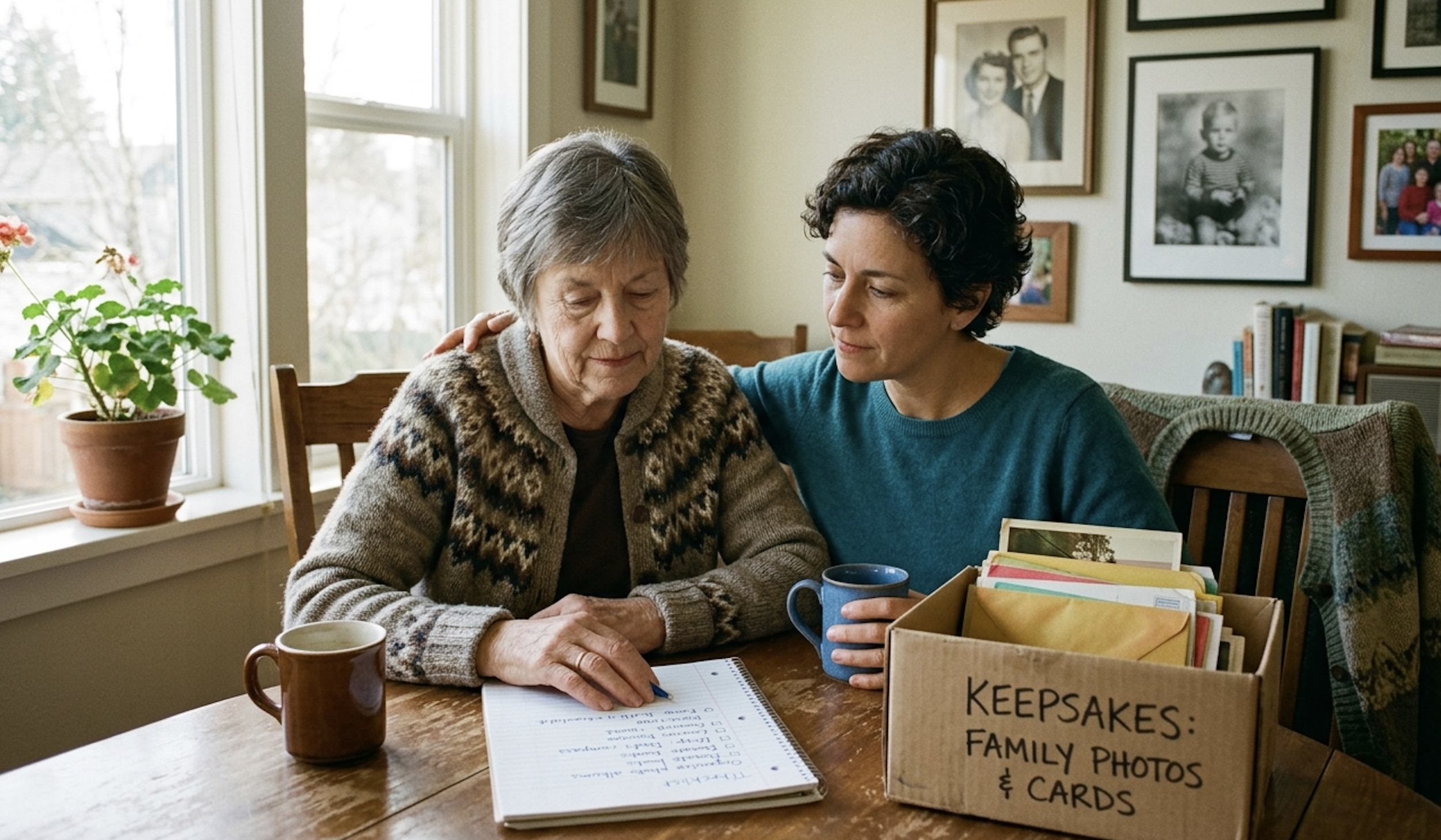
A Parent May Be Experiencing the Move Very Differently Than You Are
Adult children usually step in because they want to help.
Maybe maintaining the house has become difficult. Perhaps there are concerns about stairs, upkeep, transportation, isolation, or simply whether the home still fits the parent's life. You may be looking at the situation and seeing a list of problems that need to be solved.
Your parent may be looking at the same situation and seeing something very different.
Where will I live? What can I take? What happens to my things? Will I still see the same people? Will I have enough space? Who is making these decisions? Am I still in charge of my own life?
When adult children are juggling ten problems at once, efficiency naturally starts to matter. But for the parent, maintaining some sense of control may matter just as much.
That is why seemingly small choices can carry surprising weight. Which furniture comes along? Which belongings go to family? When will the move happen? What will the new bedroom look like? Who gets told about the move, and when?
There are situations in which adult children have to take on significant responsibility. Even then, look for the decisions your parent can still make and the parts of the process where their preferences can lead.
If you are still at the conversation stage, I have a separate guide on how to talk to a parent about moving without causing conflict.
Belongings Are Rarely Just Belongings
One of the easiest things to underestimate is how emotionally difficult sorting can become.
To an adult child, an old chair may simply be an old chair. To a parent, it may be where a spouse sat every evening for 30 years.
A cabinet full of dishes may look like something that should take 20 minutes to sort. Instead, it brings back holidays, children growing up, parents who are gone, and a version of family life that existed in that house.
That does not mean everything needs to be kept. It does mean that sorting possessions can take considerably more emotional energy than families expect.
For that reason, I would not begin by attacking the entire house at once.
Start with easier decisions and smaller areas. Identify the things that clearly need to move and separate those from belongings that require more thought. When possible, give important items a destination.
Sometimes asking, “Who would you like to have this?” leads to a very different conversation than, “Do you want to get rid of this?”
You still need to make progress. You just do not have to make every decision at the same speed.
The Number of Decisions Can Become Exhausting
A senior move can become overwhelming long before anyone packs a box.
There may be decisions about where the parent will live, what furniture will fit, what should move, what will be sold or donated, whether the current house needs repairs, when it should be listed, and how the sale and move should be timed.
Then come utilities, address changes, documents, movers, transportation, cleaners, contractors, organizers, estate-sale companies, and all the small details nobody thought about at the beginning.
Individually, many of these decisions seem manageable. Collectively, they can become a second job.
This is where families sometimes get into trouble. Everyone keeps solving the next problem without stepping back to organize the whole transition.
I like to separate the work into three simple questions:
What needs to happen now?
What can wait?
Who is responsible for each piece?
You do not need an elaborate system. You need a plan that allows everyone to see what is happening and what comes next.
For families who are ready to get into the actual planning process, my guide to helping aging parents downsize without overwhelm goes much further into that stage.
Family Roles Can Change During a Move
A transition can also change the way family members relate to one another.
The parent who always handled everything may suddenly need help. An adult child who has never managed household or financial matters may become the organizer. A sibling who lives nearby may end up carrying much more of the day-to-day workload than siblings who live farther away.
Old family patterns have a way of appearing during stressful transitions too.
One person becomes the project manager. Another wants every detail discussed. Someone else avoids the situation because it feels too difficult. Another family member wants everything completed as quickly as possible.
This is where a little structure can prevent a lot of frustration.
Who will communicate with professionals? Who is handling the house? Who will keep track of documents? Who is coordinating the move? Who will update other family members?
The work does not have to be divided equally to be divided fairly. Geography, schedules, finances, abilities and family relationships all affect what each person can realistically take on. What matters most is that everyone understands who is doing what.
If disagreement itself has become the larger problem, that deserves its own conversation. I wrote a separate guide about what to do when siblings disagree about aging parents.
Plan the Old House and the New Home Together
Families understandably spend a great deal of time figuring out what to do with the current house.
At the same time, someone needs to be thinking carefully about the next one.
What furniture will actually fit? Where will familiar belongings go? Is there room for favorite photographs, artwork, books, or the chair that has always been part of the morning routine? What needs to be in place before the parent arrives?
The new home does not need to reproduce the old one. Still, familiar objects and routines can help a completely new space begin to feel personal.
I also think it is worth considering how the home may function over time.
My years as a physical therapist still influence what I notice when I walk through a house. I am not practicing physical therapy today, and I am not evaluating an individual's medical or mobility needs. That background simply taught me to notice parts of a home people can easily overlook: entrances, stairs, bathrooms, lighting, pathways through rooms, access from the car, and whether a home has some flexibility if circumstances change.
I explore that subject much more fully in What My Physical Therapy Career Taught Me About Home Design and Aging in Place.
When individual health, mobility, equipment, or care needs are involved, the appropriate healthcare professionals should be part of those decisions.
Do Not Get So Focused on Leaving That You Rush the Next Housing Decision
When the current home has become difficult, there can be a strong desire to solve that problem quickly.
But choosing the next home deserves its own thoughtful process.
For one person, a smaller house, condo, or patio home may make sense. Someone else may prefer an independent-living community. Another parent may need a setting where additional services or support are available.
The decision involves much more than square footage.
Location can affect access to family, friends, physicians, shopping, transportation, church, activities and familiar routines. Monthly costs matter. Maintenance matters. Layout matters. So does the kind of everyday life someone will be able to have there.
It is easy to choose a place because it solves today's most obvious problem. A better question is whether it also supports the life your parent wants to continue living.
When staying in the current home may no longer be workable, I walk through the broader choices in When Aging Parents Can't Safely Stay in Their Home: Options Louisville Families Often Face.
The Home Sale Is a Separate Decision, Not Just Another Item on the Moving List
If a parent has lived in a home for many years, preparing it for sale can become a project of its own.
Families may wonder how much work the house needs, whether to sell it as-is, what should be repaired, whether anything should be updated, and how to coordinate the sale with the parent's move.
There is no universal list of things that should be done before selling a longtime home.
Sometimes preparation can make a meaningful difference in how a property shows and sells. In other situations, extensive work adds expense, delays the move, and creates stress without enough benefit to justify it.
This is one reason I prefer to look at the actual property before a family starts creating a long repair or renovation list.
The useful question is not simply, “What could we do to this house?”
It is, “What is actually worth doing given the home's condition, the Louisville market, the family's timing, and everything else happening during the transition?”
Those are very different questions.
Families Often Wait Until They Are Exhausted to Ask for Help
There is a point in many transitions when the family realizes the project has become much larger than expected.
By then, everyone may already be tired.
Depending on the situation, a move can involve a real estate professional, senior move manager, organizer, mover, estate-sale company, attorney, financial professional, healthcare professional, contractor, cleaner, or staff at the new community.
Most families will not need all of those people. The goal is not to assemble a huge team.
It is to recognize which jobs really do require outside expertise and which tasks are consuming so much family time that getting help would make the rest of the transition more manageable.
My role is not to personally perform all of those services. I help with the real estate side, look at how the home sale fits into the larger transition, and, when appropriate, help families identify resources for other pieces of the process.
That broader view matters because the move, the house, and the family are all part of the same transition, even when different professionals are handling different pieces.
Moving Day Is Not the Finish Line
This may be the most overlooked part of the entire process.
Families spend so much time getting to moving day that it starts to feel like the finish line. The movers leave, the boxes are inside, and everyone feels an enormous sense of relief.
For the parent, though, that may be the moment the real adjustment begins.
Even a move that makes excellent practical sense can involve grief, homesickness, uncertainty, or simply the strange feeling of waking up somewhere that does not yet feel like home.
Think about the first few weeks, not just the first few hours.
Which familiar belongings should be unpacked first? Can a favorite chair, photographs, bedding, books, or artwork be in place quickly? Who will visit? Which routines can continue? Are there activities, neighbors, family members, friends, or community connections that can help the new place begin to feel familiar?
You cannot manufacture a sense of home overnight. You can make it easier for one to develop.
A successful transition is about more than getting a person and their belongings from one address to another. It is also about helping everyday life begin to take shape again.
The Family May Need Time to Recover Too
Adult children sometimes overlook their own adjustment.
You may have spent weeks or months making decisions, solving problems, driving back and forth, handling paperwork, worrying about your parent, managing the house, and trying to keep everyone informed.
Then the move happens, and there can be an expectation that life immediately returns to normal.
It may not.
You can feel relieved that the move is complete and sad about the end of an era at the same time. There may still be work at the old house. Your parent may need reassurance. Family members may be tired and less patient with one another after a long stretch of decision-making.
None of that necessarily means the transition went badly. It may simply mean it was a significant change for everyone involved.
When you can, leave some breathing room after the move instead of filling every available day with the next task.
What Should Families Think Through Before Helping an Aging Parent Move?
You will not have every answer before you begin, but these are the questions I would want a family to think through early:
What does our parent want, and which decisions can remain theirs?
What truly needs to happen now?
What are we assuming needs to happen?
Where will our parent live next?
What needs to be ready in the new home before moving day?
Which belongings matter most?
Who is responsible for each part of the transition?
Where might outside help make sense?
What should happen with the current house?
How will the sale and the move be coordinated?
What will the first few weeks after the move look like?
The purpose of asking these questions is not to create a perfect plan. It is to discover the issues that could otherwise surprise the family later.
If your family is ready to turn those questions into an actual plan, my Louisville Downsizing Planning Checklist for Families Helping Aging Parents gives you a practical way to organize what needs attention now, what can wait and what should happen next.
Frequently Asked Questions About Helping an Aging Parent Move
What do families most often overlook when helping a parent move?
The physical move gets most of the attention, but families often underestimate the emotional transition, the number of decisions involved, changing family roles, the meaning attached to possessions, and the adjustment after moving day. Planning for those issues early can make the entire process easier to manage.
Should we start by decluttering the house?
Not always. Before beginning a major cleanout, it helps to know where your parent may be moving, how much space will be available, which belongings matter most, and what the likely timeline will be. Otherwise, families can spend a tremendous amount of energy sorting before they have enough information to make good decisions.
How involved should an aging parent be in the move?
As much as circumstances reasonably allow. Adult children may need to take on substantial responsibility, but preserving meaningful choices about belongings, timing, the new home, and everyday routines can help the parent remain part of the decision-making process.
How should siblings divide the work of helping a parent move?
Start with clear responsibilities rather than trying to make every task equal. One sibling might coordinate paperwork, another might work on the house, and someone else may communicate with professionals or the new community. Availability, geography and individual strengths will affect what each person can realistically do.
When should a family bring in professional help?
Consider outside help when the workload becomes difficult to coordinate, the house requires significant preparation, family members live out of town, the timeline is tight, or a decision requires expertise the family does not have. Bringing in the right person earlier can sometimes prevent a relatively manageable task from becoming a crisis.
How far ahead should we plan the new home?
As early as reasonably possible. Knowing the size, layout and needs of the new space helps determine which furniture and belongings should move. It also gives the family time to prepare the home so that important everyday items are ready when the parent arrives.
What should we plan for after the move?
Think beyond unpacking. Consider familiar routines, family visits, transportation, activities, community connections, important belongings, and the practical details that will help the new place begin to feel like home.
Where should a Louisville family start if the whole transition feels overwhelming?
Start by separating the decisions. You do not need to solve the house, belongings, next home, family responsibilities and move all at once. Identify the decision that needs to be made first, determine what can wait, and decide who can help with each part.
For a broader look at aging in place, downsizing, housing choices, preparing a longtime home for sale and planning the overall transition, visit my Louisville Senior Downsizing and Transition Guide.
The Move Is Only One Part of the Transition
Helping a parent move can begin as a practical project. There is a house to deal with, a new place to arrange, belongings to sort and a move to coordinate.
Then somewhere along the way, most families realize they are also helping someone close one chapter of life and begin another.
That is why I think the best plans leave room for both sides of the transition. The practical work needs structure. The people involved need patience, choices, good information and sometimes help from outside the family.
You do not have to anticipate every difficulty before you begin. You do want to understand the whole picture well enough that moving day is not the only thing everyone is planning toward.
If your family is trying to figure out what should happen first, what to do with a Louisville home, or how the real estate pieces fit into a larger transition, you are welcome to reach out. We can start by looking at the situation in front of you and sorting out what actually needs an answer now.
