

Selling an Inherited House in Louisville, KY: What Should You Do First?
belongings. Learn what Louisville families should address before emptying the house, making repairs or placing it on the market.

Inheriting a house is rarely as simple as receiving an asset. The home often comes with grief, legal questions, family responsibilities and rooms filled with a lifetime of belongings. Even when everyone agrees the property should be sold, deciding where to begin can feel overwhelming.
Should you call an attorney? Empty the house? Hire an estate-sale company? Make repairs? Find out what the home is worth?
All of those questions matter. The order matters more.
What should you do first with an inherited house in Louisville?
First, secure the property and confirm who has legal authority to act. Then speak with a Kentucky estate or probate attorney and a Louisville REALTOR® experienced with inherited and transition properties before removing belongings, making repairs or signing real estate documents.
The attorney addresses ownership, authority and probate. The REALTOR® evaluates the property and helps the family compare its practical selling options. Starting with both perspectives can prevent unnecessary expense, duplicated work and decisions that later have to be reversed.
Why inherited-home sales need more than a checklist
Families handling an inherited home are often given a list of tasks when what they really need is help understanding which decision comes first.
Over time, I have learned that inherited-home sales need a clear starting point, but not a rigid checklist. Every sale I have helped with has been different, and people come to me at very different stages. Some have already begun and feel overwhelmed by what remains. Others have no idea where to start and feel almost paralyzed by the number of decisions in front of them.
With direction and the work divided into manageable pieces, the process begins to feel lighter. This is where my approach is most useful. I can help the family identify what needs attention now, what can wait and which professionals should be involved, then adjust the property plan as the circumstances change.
One family may be selling most of what they own before moving in with an adult child. Another may be facing an unexpected illness and a move to assisted living. A family dealing with a sudden death may need to coordinate with an estate attorney before anyone can determine who has authority to act. If relatives live outside Kentucky, even simple property decisions may require photographs, video walkthroughs, estimates and carefully organized communication.
One woman I helped was living in a small home in the country and had very limited mobility. She wanted to move out of state and live with her sister, but she could not see how to get from where she was to where she wanted to be. The house, the belongings and the move all felt like one enormous problem.
We did not try to solve everything at once. We worked through it one decision at a time. She chose what mattered enough to take with her. The remaining belongings were sorted for sale or donation, and the home was prepared and sold. The proceeds gave her financial support for the move, but just as important, she was able to leave with confidence in what she had chosen and where she was going.
That experience is one reason I do not believe a transition like this can be reduced to a standard checklist. What she needed was not simply a home sale. She needed a practical way to move forward when the whole process felt physically and emotionally beyond her reach.
No two families are the same, so a measured approach matters. We may begin by protecting the home and clarifying the legal questions, then look carefully at the belongings, the property’s condition and its place in the Louisville market. From there, we can decide whether an estate sale makes sense, what should be removed, whether any repairs are worth completing and how the home should be priced and sold.
The plan gives us a place to begin. It is expected to change as we learn more. The value is not in forcing every family through the same steps. It is in keeping the whole situation in view while breaking the work into pieces people can manage.
An inherited home does not need to be solved in a weekend. It needs thoughtful direction, room for the unexpected and someone who can help the family take the next right step without losing sight of the whole picture.
Secure and protect the property
While the family works through the legal questions, the house still needs attention.
Confirm that doors and windows are secure, gather the keys and arrange for someone to check the property regularly. Look for active leaks, plumbing problems, storm damage, pest activity or anything else that could become more serious while the home is unoccupied.
Do not automatically disconnect the utilities. Heat, air conditioning, electricity, water, sump pumps and security systems may still be needed to protect the home.
Contact the insurance company promptly and explain the circumstances accurately. A vacant or unoccupied property may have different coverage requirements from an owner-occupied home. The insurance professional should advise the family about the coverage needed.
Take general photographs of the home and its contents before belongings are removed or work begins. This first step is about documenting and protecting the property, not transforming it.
Confirm who has legal authority to sell the home
Before anyone signs a listing agreement or makes commitments involving the property, an experienced Kentucky estate or probate attorney should review the specific circumstances.
Being named in a will, having served as someone’s power of attorney or being the relative everyone relies on does not, by itself, answer who currently has authority to sell the home. Wills, trusts, powers of attorney, deeds and court appointments serve different purposes. Death, incapacity and the way title is held may also affect what happens next.
The attorney should advise the family about questions such as:
Who owns the property now?
Who may make decisions and sign documents?
Is probate or another court process required?
Must other people or the court approve the sale?
What must happen before title can transfer to a buyer?
Kentucky’s official probate guide explains that settling an estate may include collecting and protecting assets, paying debts and distributing what remains. It also explains that a fiduciary cannot act until the court appointment is complete. The guide is a helpful overview, but it expressly does not replace legal advice. See the Kentucky Court of Justice Guide to Basic Kentucky Probate Procedures.
A REALTOR® should not interpret the family’s legal documents. My role is to recognize when legal guidance is needed, help the family connect with an appropriate attorney and coordinate the property work around that advice.
Can an inherited house be sold before probate is complete?
Possibly, but the answer depends on the estate and the attorney’s guidance.
Some evaluation, maintenance or preparation may be possible while probate is underway. The family should not assume, however, that the home may be listed, placed under contract or transferred before the authorized person and required process are clear.
The legal process and the property process can sometimes move at the same time, but they should not move independently. The attorney guides the legal timeline. The REALTOR® develops the property and sale plan within it.
Can a power of attorney be used to sell the house?
Only an attorney who has reviewed the actual document and circumstances should answer that question.
Families should not assume that every power of attorney grants the same authority or remains effective in every situation. Have the document reviewed before anyone signs a listing agreement, contract or deed.
If the homeowner is still living and able to participate in planning, early conversations with an estate-planning or elder-law attorney may prevent later confusion. A will is important, but families should not assume it avoids probate or gives someone immediate authority to sell a home.
If the larger question is whether an older parent’s home still fits their needs, my article about when it may be time to help a parent downsize offers a gentle place to begin. My Louisville Senior Downsizing and Transition Guide explains the property and moving side of that transition.
Separate legal authority from family involvement
One person may have authority to sign while several relatives want to be consulted about belongings, timing, repairs or price. Those are different roles, and naming them early can prevent a great deal of confusion.
The attorney should determine legal authority. The family can then decide how practical updates and decisions will be shared.
In most cases, it helps to choose one primary contact for the attorney, REALTOR®, title company and property professionals. That person can collect questions, communicate decisions and send consistent updates to the rest of the family.
For some families, a weekly email is enough. Others may need scheduled calls, photographs, estimates or video walkthroughs, especially when relatives live outside Louisville. A simple communication plan reduces conflicting instructions and keeps one person from carrying the entire burden alone.
Call an experienced REALTOR® before emptying the house
Many families assume the REALTOR® comes in after the house has been emptied, cleaned and repaired. With an inherited property, that may be too late.
The first real estate consultation is not about rushing the home onto the market. It is about understanding the property before the family removes its contents or spends money preparing it for sale.
An experienced transition-focused REALTOR® can help answer practical questions:
Who is the likely buyer for this home?
Does its present condition support an as-is sale?
Which problems could affect safety, insurance or buyer confidence?
Would limited preparation improve the likely net proceeds?
Could the contents support an estate sale?
What work is unlikely to return what it costs?
A dated kitchen may not need to be replaced. Worn carpet may be hiding hardwood floors. A home filled with belongings may call for an estate-sale evaluation before a clean-out. Another property may need only a deep cleaning, better lighting and a few visible repairs.
Without a market-informed plan, a family can spend thousands improving things buyers would have changed anyway.
My complete guide to selling a home in Louisville explains how preparation, pricing, marketing, inspections and closing fit together. An inherited property adds legal and family considerations, but the early decisions still shape the result.
Protect documents and belongings before clearing the home
The contents of an inherited home can be harder to manage than the house itself. One person may be ready to begin immediately. Another may need time. Someone sees crowded closets; someone else sees a lifetime of memories.
Before removing anything, look for documents and small items that may be important. Check desks, filing cabinets, safes, drawers, closets and labeled boxes for:
Wills, trusts and other estate-planning documents
Deeds, mortgage papers and insurance information
Tax records and vehicle titles
Family photographs and correspondence
Jewelry, collections and specifically gifted items
Follow the attorney’s guidance about who may authorize the removal or distribution of personal property. When several people are involved, photographs and a simple record of significant items leaving the home may prevent misunderstandings.
After important documents and personal belongings have been addressed, the remaining contents usually fall into four groups: keep, sell, donate and remove. The family does not have to make every decision at once.
Should you call an estate-sale company or a clean-out company first?
If the home may contain marketable furniture, collectibles, tools or household goods, call a reputable estate-sale professional before hiring a clean-out company.
A clean-out company is paid to remove items. An estate-sale company first evaluates whether some of those items can be sold. Reversing that order can mean paying to remove property that might have produced money for the estate.
Not every home has enough marketable property for a formal estate sale. Ask the company to explain its fees, how it decides whether a sale is feasible, what happens to unsold items and whether donation or final clean-out services are included.
The right plan may be an estate sale followed by donation and clean-out. Another property may call for an auction, organizer, consignment service or direct clean-out. The home, its contents and the family’s capacity should determine the answer.
Should you sell an inherited house as-is or make repairs?
The right choice depends on the home’s condition, the likely buyer, the estate’s available time and funds, and whether the expected return justifies the work. Inherited homes are often older or have not been updated recently, but that does not automatically mean they need renovation.
Before hiring contractors, compare the home’s likely value, condition, competition and buyer pool under three possible approaches.
Option 1: Sell the home in its present condition
An as-is sale may make sense when the property needs substantial work, the estate has limited funds or the family values a simpler and faster process.
Selling as-is does not automatically mean accepting the first investor offer. The home can still be professionally presented, priced for its condition and exposed to the broader market. Before accepting a direct cash offer, compare its net proceeds and convenience with the home’s likely as-is result on the open market.
Option 2: Complete limited preparation
For many inherited homes, selected preparation offers the best balance. That might include removing contents, deep cleaning, improving lighting, correcting an active leak or safety concern and completing a few visible repairs.
The goal is not to make the home look new. It is to help buyers see it clearly and reduce avoidable concerns.
Option 3: Complete larger repairs or improvements
More extensive work may make sense when the expected return justifies the cost and the family has the time, funds and legal authority to manage it.
Compare the probable sale price, preparation costs, carrying expenses, timeline and risk. A $25,000 renovation that raises the sale price by $25,000 has not created a $25,000 benefit. The estate also carried the property longer and accepted the risk of delays and cost overruns.
My guide to what to fix before selling a home in Louisville explains why safety concerns, active defects and visible maintenance often matter more than expensive cosmetic updates.
Price the inherited home for its condition and current market
An inherited home should not be priced from an online estimate, tax assessment or one nearby sale considered in isolation.
Pricing should reflect recent comparable sales, current competition, location, condition and how buyers are responding now. This is especially important when the family is comparing an as-is sale, limited preparation and larger improvements.
A useful market analysis should estimate both the probable sale price and the likely net proceeds under the realistic options. The highest sale price is not always the best estate result after preparation costs, carrying expenses, time and risk are considered.
My guide to pricing a home in Louisville explains how condition, comparable sales, competing listings and buyer behavior work together.
Account for carrying costs, title issues and inspections
An inherited house continues to cost money while the family handles legal questions, belongings and preparation. Expenses may include insurance, utilities, taxes, mortgage payments, lawn care, maintenance and cleaning.
Understanding those costs does not mean the family should rush into a poor decision. It means the cost of waiting should be compared with the likely benefit of additional preparation. My guide to the cost of selling a home in Louisville reviews common expenses that may affect sale proceeds.
Open title work early. Inherited properties may reveal an old mortgage, a deceased co-owner still shown on the deed, liens, unpaid taxes or more than one estate. A signed purchase contract does not cure unclear ownership. It merely puts the problem on a deadline.
The family should also expect a buyer’s inspection to uncover items that were not obvious at the beginning. That does not mean every requested repair must be accepted. My article about what happens when a home inspection finds problems explains how buyers and sellers can separate ordinary maintenance from concerns that need further evaluation.
The legally authorized person should make decisions involving repair work, credits or estate funds, with legal guidance when needed.
Build one coordinated professional team
An inherited-home sale may involve an estate or elder-law attorney, title professional, tax adviser, REALTOR®, estate-sale company, organizer, cleaner, contractor, mover and clean-out crew. Each has a separate role.
The attorney handles legal questions. The title professional identifies what is needed to transfer ownership. A qualified tax professional addresses tax matters. The REALTOR® evaluates the market, creates the property plan and coordinates the real estate work.
Some families also benefit from a professional move manager or transition coordinator, especially when the home is large, relatives live far away or the belongings are unusually complicated. Others may already receive much of the needed property coordination from a REALTOR® who regularly handles inherited and life-transition homes.
Ask what the REALTOR® coordinates, which outside services are likely to be needed and what those providers charge separately. The goal is not to avoid qualified help. It is to avoid overlapping services and hiring people before the family understands what the property needs.
How do you choose the right REALTOR® for an inherited-home sale?
Look for an agent who can explain the process before discussing the listing.
Ask:
How often do you work with inherited, estate or life-transition properties?
What should happen before the home goes on the market?
Can you help compare an as-is sale with different levels of preparation?
How do you coordinate estate sales, clean-outs, contractors and other services?
How will you communicate with relatives who live outside Louisville?
How will the property timeline coordinate with the attorney and title company?
Listen for a clear process, realistic boundaries and respect for the family’s pace. The right REALTOR® will not pressure the family to list before the authority, property and decision-makers are ready. The agent will help them get ready.
Frequently asked questions about selling an inherited house in Louisville
Should we empty the house before calling a REALTOR®?
No. Have the home evaluated first. A REALTOR® experienced with inherited properties can help determine whether an estate sale may be appropriate, whether anything should remain temporarily and which preparation is likely to be worthwhile.
Can an inherited home be sold as-is?
Yes, many inherited homes are sold in their present condition. Selling as-is does not require accepting an investor offer or giving up open-market exposure. The right choice depends on the property, the estate’s goals and the legally authorized person’s decision.
Should we repair an inherited home before selling it?
Not until the property has been evaluated. Some work may protect the house or improve buyer confidence. Other projects may cost more than they add to the estate’s net proceeds.
What if family members disagree about the house?
Ask the attorney to clarify ownership and legal authority first. Then create a communication plan for the practical decisions. If the disagreement affects authority, belongings or the ability to sell, return to the attorney rather than trying to resolve a legal dispute through the sale process.
Can one family member buy the inherited home?
Possibly, but the family should obtain legal and tax advice and establish a defensible market value. A REALTOR® or appraiser can help with valuation but should not structure the family’s legal or tax arrangement.
How long does it take to sell an inherited home?
The sale itself may move quickly after the property is ready and the proper person has authority. The complete timeline can be longer when probate, title, belongings, repairs or family decisions remain unresolved. Think of it as three related timelines: legal authority, property preparation, and the real estate sale.
A calmer first step
If you are responsible for an inherited property, you do not need to begin with a dumpster, a contractor or a list of everything that looks outdated.
Begin with the right conversations.
Ask an experienced Kentucky estate or probate attorney to explain the legal situation and confirm who may act. Bring in a Louisville REALTOR® who understands inherited and transition properties before the home is emptied or money is spent.
That early property consultation should help the family understand what the home may be worth, which preparation may be worthwhile, which professionals may be needed and what a realistic path to market could look like. My role is to help the family see the whole situation clearly, place the decisions in a manageable order and coordinate the real estate work around the legal guidance they receive.
Some families will choose an as-is sale. Some will complete limited preparation. Others will need an estate sale, clean-out and more extensive work. You do not have to know which path is right before you call. Finding the right path is part of the process.
If you are handling an inherited home in Louisville, I can help you understand the real estate side, connect you with experienced professionals and create a coordinated property plan around the legal guidance you receive.
You do not have to empty the house or know what needs to be repaired before we talk. We can begin by looking at the property, identifying the questions and putting the next steps in the right order.
Because your move deserves care, not chaos.
This article provides general real estate information only. It is not legal, tax, financial or insurance advice. Questions involving estate planning, probate, ownership, authority or legal documents should be directed to an experienced Kentucky estate, probate or elder-law attorney. Tax and insurance questions should be reviewed with appropriately qualified professionals familiar with the estate and property.
How Do You Know It’s Time to Downsize in Louisville, KY?
Most people don’t decide to downsize all at once. It starts with small shifts—a home that feels harder to manage, rooms that go unused, or a quiet sense that something has changed. This guide walks through how to recognize those signs and think through the decision with clarity, not pressure.

Sometimes people think about downsizing for years. The idea comes and goes as life changes, until eventually they are ready to seriously consider it.
Other times, there is a moment when the question becomes very clear.
An injury makes the stairs suddenly difficult. A spouse dies and the house feels different. The last child moves out and rooms that were once full are rarely used. A major repair comes up just as another season of yard work begins, and maintaining the property no longer feels worth the effort.
The reason can be practical, financial, emotional, or a combination of all three.
So how do you know if it may be time to downsize? Look at whether your home still supports the way you want to live now and in the years ahead. Consider how much of the house you use, what it requires from you, how well the layout works, what it costs to maintain, and what another home might make possible.
None of those questions automatically leads to selling. They simply help you determine whether the home that has served you well for years still fits the life you are living today.
Sometimes the House Changes. Sometimes You Do.
A house can remain essentially the same for decades while the lives inside it change considerably.
The four-bedroom house that once made sense with children at home may feel very different after the last child leaves. A large yard may have been something you loved when gardening was a favorite way to spend a Saturday. Years later, you may still enjoy the yard but no longer want to spend so much time maintaining it.
Retirement can change things too. Maybe you are traveling more, spending winters somewhere warmer, helping with grandchildren, or simply discovering that you would rather use your time differently.
Then there are changes no one planned for. An injury, illness, death of a spouse, divorce, or change in finances can make someone look at a longtime home differently almost overnight.
None of this means the house has become a bad house.
It may simply mean that the reasons you chose it are no longer the reasons that matter most.
How Much of Your Home Do You Actually Use?
One of the simplest ways to look at downsizing is to pay attention to how you live in your house today.
Which rooms are part of your everyday life? Which ones are mostly cleaned, heated, cooled, furnished, and maintained?
You may have bedrooms waiting for occasional guests, a formal dining room used primarily on holidays, or a finished basement that once served an important purpose but is now mostly storage. That extra space may still be valuable to you. You might love having everyone stay at your house during the holidays or having room for grandchildren to visit.
If you use and enjoy the space, there is nothing inherently wrong with having more of it.
The question becomes more useful when you realize that much of the house no longer contributes very much to your life, yet you are still paying for it and taking care of it.
That is information worth considering.
Has Maintaining the House Become More Work Than You Want?
There is a difference between being capable of maintaining a home and wanting to continue doing it.
Think about what repeatedly lands on your list: mowing, landscaping, leaves, gutters, exterior maintenance, cleaning, painting, repairs, appliance replacement, HVAC service, plumbing issues, or coordinating contractors.
For some homeowners, those responsibilities are simply part of owning a house they love. They enjoy the yard and the projects, or they have reliable help that makes the work manageable.
For others, the balance gradually changes. The house begins taking more time, money, or mental energy than they want to give it.
Occasionally, one project makes that clear. A homeowner gets an estimate for a roof, faces another spring of landscaping work, or finishes a repair only to discover the next thing that needs attention. The question becomes less about whether they can keep up with the house and more about whether they still want their life organized around doing so.
That can be an important turning point.
Does the Layout Still Work for Your Everyday Life?
Square footage is only part of how a home functions.
Think about the path from your car to the kitchen with groceries. Where is the laundry? How often do you use the stairs? Where is the primary bedroom? How easy is the shower to enter? Are there rooms you avoid because getting to them is inconvenient?
People can live in a house for years without thinking much about these details because the routines are familiar.
My earlier career as a physical therapist still influences what I notice when I walk through a home. I am not practicing physical therapy today or evaluating anyone's individual medical or mobility needs. That experience did teach me to pay attention to entrances, stairs, bathrooms, lighting, pathways between rooms, and the amount of effort built into ordinary household routines.
Some homes can adapt fairly easily as needs change. Others have structural limitations that would require significant renovation to overcome.
Understanding which kind of home you have can be useful even if you ultimately decide to stay.
I explore this more fully in What My Physical Therapy Career Taught Me About Home Design and Aging in Place.
What Is Your Home Asking From You Financially?
Homeowners often think about the financial side of downsizing by starting with one number: what their current house might sell for.
That number matters, but it does not answer the whole question.
Staying has a cost. So does moving.
If you stay, consider property taxes, insurance, utilities, routine maintenance, lawn care, repairs and major systems that may eventually need replacement. If you move, there will be selling and moving expenses, the cost of the next home, and possibly association fees or different property expenses.
A smaller home is not automatically a less expensive home, particularly if you are moving to a newer property or a location where prices are higher.
At the same time, homeowners who have been in their houses for many years may have substantial equity. That equity can create options, but having equity is not, by itself, a reason to sell.
The better financial question is broader:
If I stay, what will this home likely require from me over the next several years? If I move, what would that cost, and what would I gain in return?
Now you have something meaningful to compare.
What Would You Want Your Next Home to Give You?
People thinking about downsizing often have a very clear picture of what they would lose.
Space. Storage. A familiar neighborhood. A yard. A dining room large enough for Thanksgiving. Bedrooms where children once slept. Neighbors they know.
Those things matter, and they belong in the decision.
But the comparison is incomplete until you ask what another home might give you.
Perhaps you want a first-floor primary bedroom, less exterior maintenance, a smaller yard, easier travel, more convenient parking, or a location closer to family. Maybe you want enough space for guests without maintaining several rooms you rarely use. You might want a home you can lock up and leave more easily.
Some people go through this exercise and realize they would not gain enough to make leaving worthwhile.
That is a perfectly useful answer.
Downsizing makes sense when the tradeoffs work for your life. The goal is not to find reasons to leave a house you still love.
Are You Staying Because You Want to Be There?
This is a harder question.
Longtime homes hold an extraordinary amount of personal history. You may remember bringing babies through the front door, birthday parties in the kitchen, holiday dinners, school mornings, projects completed together, neighbors who became friends, and ordinary moments that became meaningful only in hindsight.
A home can hold decades of your life without being the only place where the next part of your life can happen.
Still, attachment deserves respect. I don't find “it's just a house” particularly helpful because, for many people, it isn't.
If you are struggling with the decision, try separating these questions:
Do I still want to live in this house?
Would leaving this house be emotionally difficult?
You can answer yes to both.
Recognizing that difference can help you understand whether the home itself is still the right fit or whether the difficulty lies primarily in saying goodbye to it.
You do not have to resolve that question quickly.
What If You Want to Stay?
Then it is worth looking seriously at what staying would require.
Perhaps the house works beautifully with a few changes. Lawn care can be hired out. Lighting can be improved. A bathroom could be updated during a renovation you were already considering. A room on the main floor might eventually serve a different purpose. Some maintenance can be delegated instead of becoming a reason to move.
Other homes are harder to adapt. Laundry may be in a basement with no practical alternative. Essential rooms may be separated by stairs. Entrances may be difficult to modify. The property itself may simply require more maintenance than you want.
Individual health, mobility, equipment, or care needs should involve the appropriate healthcare professionals. For the home itself, contractors and other qualified professionals can help determine what changes are actually feasible.
The important thing is to compare a realistic version of staying with a realistic version of moving.
What If You Keep Thinking About Downsizing but Aren’t Ready?
You can investigate downsizing without deciding to sell.
In fact, this is often where I think people should begin.
Find out what your current home might realistically sell for. Estimate what you might walk away with after selling expenses. Look at the types of properties you would actually consider buying. Pay attention to prices, association fees, locations, layouts, and how often suitable homes become available.
Then look back at your current house. What significant maintenance or expenses might be ahead? What would you need to change if you wanted to remain there comfortably? How much of the house do you want to continue maintaining?
You are gathering information, not making a commitment.
Sometimes people discover that moving would solve several problems they had been quietly working around.
Others do the same homework and realize that their current home still makes the most sense.
Either conclusion is progress because the decision is now based on something more substantial than a vague feeling.
Is It Better to Downsize Before You Have To?
There is value in having choices.
If you believe a move may eventually make sense, exploring it before circumstances force a decision can give you more time to think about what you want.
You can visit different types of homes. Compare neighborhoods. Think through finances. Decide what features matter. Work through belongings gradually. Make improvements to your current home on your own timetable.
That does not mean everyone should move before there is a pressing reason.
Some homeowners stay in the same house happily for the rest of their lives. Others eventually encounter a change that makes moving the better choice.
The advantage of thinking ahead is simply that you know more about your options if that moment comes.
What Does Downsizing Actually Mean?
It does not have to mean moving into a tiny home.
For one Louisville homeowner, downsizing might mean moving from a two-story house with a large yard into a smaller ranch. Someone else may consider a patio home, condominium, or townhome because they want less exterior maintenance. Another person may care more about location than square footage and choose a home closer to family or the places they visit regularly.
There are also situations where a move involves more support or services. That is a different decision and should be evaluated based on the individual's circumstances.
The useful question is not, “What kind of home do people my age usually buy?”
It is, “What would I want my next home to make easier?”
Maybe the answer is fewer stairs, less maintenance, easier parking, better storage, space for a hobby, a guest room, proximity to family, or simply a location that fits your daily life better.
If you are considering options for an aging parent whose current home may no longer work, I have a separate guide to housing options Louisville families often consider.
What About Everything You Have Accumulated?
This is where many downsizing conversations stop.
You look around the basement, closets, garage, attic, cabinets and spare bedrooms and cannot imagine dealing with all of it.
That reaction is understandable, especially after decades in the same home.
But deciding whether another home might fit your life better and deciding what happens to every possession you own are not the same decision.
You do not need to empty the basement before you are allowed to explore a patio home.
First learn whether moving makes sense. If it does, then you can develop a plan for what comes with you, what family members may want, what can be sold or donated, and which belongings need more time.
If you try to mentally sort an entire household before you even know whether you want to move, downsizing can feel impossible before you begin.
For a deeper look at organizing the transition itself, see my guide on helping aging parents downsize without overwhelm.
How Do You Know When You Are Ready?
Sometimes you know because something happened.
Other times, readiness develops gradually as the questions become clearer and you gather more information.
You understand what your current home gives you and what it requires from you. You know what staying would probably involve. You have a realistic idea of what another home could cost and what kind of property you would consider. You have thought about what you would gain and what you would miss.
You may still feel emotional about leaving.
Being ready to make a thoughtful decision does not necessarily mean being completely comfortable with every part of it.
Questions Worth Asking Before You Decide to Downsize
When someone tells me they have been thinking about downsizing, these are the kinds of questions I think are worth working through:
How much of my home do I actually use?
What do I still enjoy about maintaining it?
What has started to feel burdensome?
Does the layout work well for the way I live now?
What changes would make staying easier?
What will the house likely require financially over the next several years?
Are there major repairs or replacements I should anticipate?
What would I want another home to make easier?
Where would I want to live?
What would I genuinely miss about this house?
What would I gain by moving?
Am I staying because this is still where I want to live, or because leaving feels difficult?
What information do I still need before I can make a good decision?
You may not answer them all at once. You may even find that answering one changes how you think about several others.
The point is to replace an abstract question, Should I downsize?, with a clearer understanding of the choices actually available to you.
Frequently Asked Questions About Downsizing in Louisville
How do I know if it is time to downsize?
Look at how well your current home fits your life today. Consider how much of the home you use, the time and money required to maintain it, whether the layout works well, and what another home could offer. Sometimes an injury, loss, financial change, or other life event makes the decision more immediate. In other cases, the realization develops gradually.
What age should you downsize your home?
There is no particular age when someone should downsize. A homeowner's priorities, finances, health, home layout, maintenance responsibilities, family situation, and plans for the future are more useful considerations than age alone.
Does downsizing always save money?
No. A smaller home can still have a significant purchase price, and condos, patio homes, and some communities may have association fees. Compare the ongoing costs of your current home with the full cost of moving and owning the next property before assuming downsizing will save money.
Can I explore downsizing without putting my house on the market?
Yes. You can estimate your home's likely market value and potential proceeds, explore available housing, compare costs, and think through what staying would require before making a decision about selling.
Do I need to renovate my Louisville home before selling it?
Not necessarily. What is worthwhile depends on the condition of the property, the likely return on the work, the market, and your own timing. Before beginning a long list of projects, it can be helpful to understand which improvements are likely to matter and which may add unnecessary expense or delay.
Should I find my next home before selling my current one?
The right sequence depends on your finances, housing options, timing, and comfort with carrying or coordinating two properties. Understanding both your current home's likely sale and the realistic choices for your next home can help determine which approach makes sense.
What if I want to downsize but my spouse does not?
Start with what is behind each person's position. One spouse may be focused on the history and comfort of the current home while the other is thinking about maintenance, finances, travel, location, or future needs. Looking at actual options and costs can make the conversation more concrete without requiring either person to agree to a move immediately.
Where should I start if I am thinking about downsizing?
Start with information rather than boxes. Understand what your current home may realistically be worth, what you might net from a sale, what staying is likely to require, and what alternatives are actually available. Once you know those things, you can compare your choices without committing to a move.
If you reach the point where you are ready to organize the practical next steps, my Louisville Downsizing Planning Checklist for Families Helping Aging Parents gives you a clear framework for working through housing decisions, belongings, home preparation and the move itself.
For a broader look at aging in place, housing choices, planning a move, selling a longtime home, and coordinating the transition, visit my Downsizing and Senior Transitions in Louisville, KY.
You Can Explore the Question Before You Know the Answer
Thinking about downsizing does not mean you have decided to move.
You may simply have reached the point where you want to know what your choices are. That is a very reasonable place to begin.
For some people, gathering information confirms that they want to stay exactly where they are. They may decide to make a few changes to the house, hire help with maintenance, and enjoy it for years to come.
For others, seeing the numbers and the housing alternatives makes something click. They realize that the house has served them well, but another home could fit the next part of their life better.
Both are good outcomes because the goal is clarity, not simply a sale.
If you are thinking about downsizing in Louisville, I can help you look at your current home's likely value, what you may realistically walk away with after a sale, and what your next housing options could look like. You are welcome to reach out before you have made any decisions.
Sometimes the first useful step is simply understanding your choices.
How to Talk to a Parent About Moving Without Causing Conflict
Talking to a parent about moving can be difficult when you see the home differently. Learn how to start the conversation, understand what is behind resistance, and explore options without pushing for a decision.

Talking with a parent about moving can be one of those conversations you rehearse in your head long before you ever say the words.
You may have noticed that the stairs seem harder, the yard is becoming more work, or parts of the house are no longer being used. Maybe you find yourself thinking about what could happen after an illness, an injury or another change in circumstances.
Your parent may see the same house very differently.
It is home. It holds familiar routines, neighbors, independence and years of memories. The things you see as responsibilities may be woven into the life they still value.
That difference in perspective is often where the tension begins.
If you are wondering how to talk to a parent about moving without causing conflict, I would not make the goal of the first conversation getting them to agree to move. Start by trying to understand how they feel about the home now, what they want to protect and whether anything about living there has become harder than they want it to be.
The first conversation about moving does not need to end with a decision. It needs to end with a better understanding of what your parent wants.
Why can talking about moving feel so difficult?
For an adult child, the conversation may feel practical. You see a large house, stairs, maintenance, unused rooms or increasing responsibilities and naturally start thinking about solutions.
Your parent may hear something entirely different.
A suggestion about moving can sound like a judgment about their independence or their ability to manage their own life. It can also open the door to questions they may not be ready to answer.
Where would I go? What would happen to everything in this house? Could I afford something else? Would I still see my friends? What would my days look like somewhere new?
Sometimes the resistance is not really about the house at all. It is about everything the idea of leaving the house represents.
That is why curiosity is usually a better starting point than a solution.
When should you start the conversation?
You do not need to wait until everyone agrees that a move is necessary. In many families, that may be much later than the best time to begin talking.
Earlier conversations leave room to explore.
Maybe the yard has become a burden. Perhaps the stairs are still manageable, but your parent dislikes carrying laundry between floors. The house itself may be working reasonably well while the maintenance, cost or responsibility no longer feels worth it.
You may also learn that the things worrying you are not bothering your parent at all.
Both kinds of information matter.
If you are trying to decide whether the changes you are noticing are enough to begin the conversation, I go into that question more deeply in When Is It Time to Help a Parent Downsize in Louisville?.
How do you bring up moving without making your parent defensive?
Begin with what you have noticed rather than what you think should happen.
There is a meaningful difference between saying:
“You need to move somewhere without stairs.”
and asking:
“I've noticed you aren't using the upstairs very much anymore. How are the stairs feeling to you?”
The second version leaves room for an answer you may not expect.
You can approach other concerns the same way.
“The yard seems to take a lot of your time now. Do you still enjoy taking care of it?”
“You've mentioned a few times that the house feels like a lot. What part is bothering you most?”
“If you could make one thing about living here easier, what would it be?”
You are gathering information rather than building a case.
That distinction matters because families sometimes spend months trying to solve the wrong problem. You may be worried about stairs while your parent is worried about the cost of another home. You may think the obstacle is leaving the neighborhood when the real obstacle is the thought of sorting forty years of belongings.
Until you understand the concern underneath the resistance, it is difficult to know what would actually help.
Ask what your parent wants to keep, not only what they are willing to give up
Downsizing conversations can become focused on loss very quickly.
A smaller house. Fewer belongings. No more yard. Leaving a familiar neighborhood.
Try asking about the other side of the decision.
If your parent ever did move, what would they want life to look like afterward?
Maybe they would love less maintenance but still want a small garden. They may want a first-floor bedroom without giving up room for grandchildren to stay. Perhaps being close to friends, church, doctors or familiar stores matters more than square footage.
A move that sounds like “giving things up” feels very different when someone can also see what they might gain.
And if your parent ultimately decides to stay? You have still learned something important about what makes home feel like home to them.
Give the conversation enough room
One of the hardest things for adult children is resisting the urge to solve the problem once the subject is finally on the table.
You may have been thinking about this for six months. Your parent may have been thinking about it for six minutes.
That difference matters.
Silence does not necessarily mean the conversation went badly. Changing the subject does not mean the answer will always be no. A defensive response may simply mean the conversation moved faster than your parent was ready for.
A useful first conversation might end with nothing more than, “I've thought about that too,” or, “I'm not ready to talk about this yet.”
That is still information.
You can come back to it later.
What if your parent says no?
Then you know where they stand for now.
Unless there is an immediate situation requiring involvement from appropriate medical, legal or other professionals, a parent's decision about where to live remains their decision.
That can be difficult when you see concerns they do not see, or when you are worried about what could happen later. Pushing harder, though, can turn a housing question into a struggle over independence.
Instead, try to understand what is behind the no.
Do they genuinely want to remain in the home? Can they simply not imagine where else they would live? Does moving feel financially impossible? Is the thought of dealing with decades of belongings overwhelming? Are they afraid that agreeing to look at options means they have already agreed to leave?
Those are very different problems.
A family can spend weeks debating whether a parent should move when the real obstacle is much more specific: they have no idea where they would go. Until that question has an answer, discussions about selling the house or clearing the basement may be beside the point.
When the concern is really about the home itself
This is where my physical therapy background still influences the way I look at houses.
Before real estate, I worked as a physical therapist. I tend to notice stairs, bathrooms, lighting, entrances, walking paths and whether important rooms are spread across several levels. Those physical features are only part of the picture, but they can help a family understand what the home will continue to require.
I am no longer practicing physical therapy, and I do not evaluate an individual's medical or mobility needs. Those questions belong with the appropriate healthcare professionals. What I can help families look at is the house itself: how it functions, what could reasonably be changed and which limitations are built into the property.
Sometimes a few thoughtful modifications can make staying in the home work much better. Other times the difficult features are part of the home's basic layout.
If that is the question your family is facing, What My Physical Therapy Career Taught Me About Home Design and Aging in Place may help you look at the property with fresh eyes.
Should siblings be involved in the conversation?
Sometimes, but bringing the entire family into the first conversation is not always helpful.
Five concerned people sitting across from one parent can feel less like support and more like an intervention.
If one sibling has the easiest relationship with your parent around difficult subjects, it may make sense for that person to begin. Other family members can become part of the conversation as it develops.
It also helps if siblings talk with one another before involving the parent. If one person thinks Mom should move tomorrow, another thinks she should never leave the house and a third has already found a condominium online, the parent may end up managing the family's disagreement on top of making an already difficult decision.
When siblings are approaching the situation very differently, What to Do When Siblings Disagree About Aging Parents addresses that part of the problem specifically.
When the conversation starts becoming an argument
Pay attention to the moment when you stop listening and start trying to win.
That is usually a good place to stop for the day.
You do not have to resolve the future of a longtime home in one conversation. Trying to do so may make everyone more certain that they need to defend their position.
You can say something as simple as:
“We don't have to figure this out today. I wanted to understand how you're feeling about the house.”
Then give the conversation some room.
There is a practical reason for slowing down too. A housing decision involves more than emotion. Your parent may need to know what the current home is worth, what another home would cost, what choices actually exist and what a move would involve before they can have a meaningful opinion about any of it.
Sometimes what looks like resistance is really a lack of information.
Making the unknowns more concrete can change the conversation without anyone having to win it.
What if staying in the current home may no longer work well?
Eventually, some families need to move from talking about whether a move might happen to understanding what the alternatives would actually look like.
That still does not mean the house is going on the market.
It may mean touring a patio home or condominium. It could mean exploring a smaller house with the important rooms on one level. Some families consider independent living or a setting where more support is available. Others discover that modifications could allow the current home to continue working.
Seeing actual choices often makes the conversation less frightening because “moving” stops being one enormous unknown.
If your family has reached that stage, When Aging Parents Can't Safely Stay in Their Home: Options Louisville Families Often Face walks through some of the housing choices families begin exploring.
What happens once your parent is willing to explore a move?
Do not start with the basement.
One of the quickest ways to make downsizing feel impossible is to confront forty years of belongings before anyone knows where they are going.
Start with the larger questions.
Where might your parent want to live? What kind of home would work better? What can they realistically afford? What might the current home sell for? Is there a timing issue? Would it make more sense to move before selling, sell first, or coordinate the two?
The answers begin to create the boundaries for everything that follows.
If the next home has three bedrooms, the conversation about furniture is different than it would be for a one-bedroom apartment. If your parent plans to stay in the same part of Louisville, the housing search looks different than it would if they want to move closer to a child in another state.
Belongings are easier to sort when you know what life you are making room for.
Once the destination and timing become clearer, decisions about home preparation, possessions and moving logistics have something to connect to.
For a deeper look at the process itself, read How to Help Aging Parents Downsize Without Overwhelm in Louisville.
When your family is ready to start putting the pieces in order, my Louisville Downsizing Planning Checklist for Families Helping Aging Parents gives you one place to work through the housing decisions, belongings, home preparation and moving plan.
Frequently Asked Questions About Talking to a Parent About Moving
How do I tell my elderly parent it may be time to move?
Begin with what you have noticed rather than telling your parent what they need to do. Ask how the home is working for them now and listen to their concerns before discussing solutions. The first conversation does not need to produce a decision.
What if my parent refuses to discuss moving?
Give the conversation some room. Your parent may need time, may not understand the alternatives or may be reacting to what moving represents. Unless there is an immediate concern requiring appropriate professional involvement, you can usually return to the subject later.
Should I take my parent to look at other homes before they agree to move?
Usually it makes sense to have some willingness to explore first. Once your parent becomes curious about alternatives, seeing actual housing choices can turn an abstract idea into something they can evaluate without requiring a commitment.
How do I talk about safety without sounding like I am taking away independence?
Talk about specific things you have observed and ask how your parent experiences them. Health, mobility and medical concerns should be discussed with appropriate healthcare professionals. The housing conversation can focus on how the home functions, what could be changed and what other options exist.
Should all siblings be involved?
Not necessarily in the first conversation. One calm, trusted family member may be a better starting point. If siblings disagree strongly, work through some of those differences before putting the parent in the middle whenever possible.
When should we start sorting belongings?
Usually after you have some idea of what the next step might be. Sorting becomes much easier when you know the approximate size and type of the next home. Beginning with decades of belongings before there is a plan can make the entire idea of moving feel overwhelming.
There is room between staying forever and moving tomorrow
A parent can love a home and still admit that parts of it have become difficult. They can explore another housing option without agreeing to move. They can decide to stay for now and revisit the question later.
There is room between doing nothing and putting the house on the market.
For many families, that middle ground is where the most useful work happens.
You can learn what the current home might be worth. You can understand what it would take to stay. You can look at other housing choices. You can talk about what your parent wants to keep in their life. And you can gather enough information that, when a decision eventually needs to be made, it does not have to begin from a place of panic.
That is very different from pushing someone toward a move.
It is giving a family enough clarity to make a thoughtful decision when the time is right.
For a broader look at aging in place, downsizing, housing choices and selling a longtime home in Louisville, visit my Downsizing and Senior Transitions in Louisville, KY guide.
If you would like help understanding the real estate side of the decision, you can contact me here. We can look at the current home and the available options without assuming that moving is the answer.
Because Your Move Deserves Care, Not Chaos.
What Families Often Overlook When Helping an Aging Parent Move
Helping a parent move is often more than a housing decision—it’s an emotional, practical, and family transition happening all at once. This guide walks through what families often overlook, from safety and decision-making to the adjustment after the move, so you can approach the process with more clarity and less overwhelm.
Helping a parent move can look fairly straightforward from the outside. Find the next place, sort through the belongings, sell the house, schedule the movers.
Then you are the family actually doing it.
That is when people often discover that the physical move is only one part of the transition. There are decisions about housing and possessions, of course, but there are also questions about control, family roles, timing, finances, memories, and what everyday life will look like afterward.
What do families most often overlook when helping an aging parent move? Usually, it is the emotional and practical weight surrounding the move rather than the move itself. Families prepare for boxes and paperwork. They are often less prepared for the sheer number of decisions, the meaning attached to a longtime home, the changing roles within the family, and the adjustment that continues after moving day.
Knowing that ahead of time can change the way you approach the entire transition.

A Parent May Be Experiencing the Move Very Differently Than You Are
Adult children usually step in because they want to help.
Maybe maintaining the house has become difficult. Perhaps there are concerns about stairs, upkeep, transportation, isolation, or simply whether the home still fits the parent's life. You may be looking at the situation and seeing a list of problems that need to be solved.
Your parent may be looking at the same situation and seeing something very different.
Where will I live? What can I take? What happens to my things? Will I still see the same people? Will I have enough space? Who is making these decisions? Am I still in charge of my own life?
When adult children are juggling ten problems at once, efficiency naturally starts to matter. But for the parent, maintaining some sense of control may matter just as much.
That is why seemingly small choices can carry surprising weight. Which furniture comes along? Which belongings go to family? When will the move happen? What will the new bedroom look like? Who gets told about the move, and when?
There are situations in which adult children have to take on significant responsibility. Even then, look for the decisions your parent can still make and the parts of the process where their preferences can lead.
If you are still at the conversation stage, I have a separate guide on how to talk to a parent about moving without causing conflict.
Belongings Are Rarely Just Belongings
One of the easiest things to underestimate is how emotionally difficult sorting can become.
To an adult child, an old chair may simply be an old chair. To a parent, it may be where a spouse sat every evening for 30 years.
A cabinet full of dishes may look like something that should take 20 minutes to sort. Instead, it brings back holidays, children growing up, parents who are gone, and a version of family life that existed in that house.
That does not mean everything needs to be kept. It does mean that sorting possessions can take considerably more emotional energy than families expect.
For that reason, I would not begin by attacking the entire house at once.
Start with easier decisions and smaller areas. Identify the things that clearly need to move and separate those from belongings that require more thought. When possible, give important items a destination.
Sometimes asking, “Who would you like to have this?” leads to a very different conversation than, “Do you want to get rid of this?”
You still need to make progress. You just do not have to make every decision at the same speed.
The Number of Decisions Can Become Exhausting
A senior move can become overwhelming long before anyone packs a box.
There may be decisions about where the parent will live, what furniture will fit, what should move, what will be sold or donated, whether the current house needs repairs, when it should be listed, and how the sale and move should be timed.
Then come utilities, address changes, documents, movers, transportation, cleaners, contractors, organizers, estate-sale companies, and all the small details nobody thought about at the beginning.
Individually, many of these decisions seem manageable. Collectively, they can become a second job.
This is where families sometimes get into trouble. Everyone keeps solving the next problem without stepping back to organize the whole transition.
I like to separate the work into three simple questions:
What needs to happen now?
What can wait?
Who is responsible for each piece?
You do not need an elaborate system. You need a plan that allows everyone to see what is happening and what comes next.
For families who are ready to get into the actual planning process, my guide to helping aging parents downsize without overwhelm goes much further into that stage.
Family Roles Can Change During a Move
A transition can also change the way family members relate to one another.
The parent who always handled everything may suddenly need help. An adult child who has never managed household or financial matters may become the organizer. A sibling who lives nearby may end up carrying much more of the day-to-day workload than siblings who live farther away.
Old family patterns have a way of appearing during stressful transitions too.
One person becomes the project manager. Another wants every detail discussed. Someone else avoids the situation because it feels too difficult. Another family member wants everything completed as quickly as possible.
This is where a little structure can prevent a lot of frustration.
Who will communicate with professionals? Who is handling the house? Who will keep track of documents? Who is coordinating the move? Who will update other family members?
The work does not have to be divided equally to be divided fairly. Geography, schedules, finances, abilities and family relationships all affect what each person can realistically take on. What matters most is that everyone understands who is doing what.
If disagreement itself has become the larger problem, that deserves its own conversation. I wrote a separate guide about what to do when siblings disagree about aging parents.
Plan the Old House and the New Home Together
Families understandably spend a great deal of time figuring out what to do with the current house.
At the same time, someone needs to be thinking carefully about the next one.
What furniture will actually fit? Where will familiar belongings go? Is there room for favorite photographs, artwork, books, or the chair that has always been part of the morning routine? What needs to be in place before the parent arrives?
The new home does not need to reproduce the old one. Still, familiar objects and routines can help a completely new space begin to feel personal.
I also think it is worth considering how the home may function over time.
My years as a physical therapist still influence what I notice when I walk through a house. I am not practicing physical therapy today, and I am not evaluating an individual's medical or mobility needs. That background simply taught me to notice parts of a home people can easily overlook: entrances, stairs, bathrooms, lighting, pathways through rooms, access from the car, and whether a home has some flexibility if circumstances change.
I explore that subject much more fully in What My Physical Therapy Career Taught Me About Home Design and Aging in Place.
When individual health, mobility, equipment, or care needs are involved, the appropriate healthcare professionals should be part of those decisions.
Do Not Get So Focused on Leaving That You Rush the Next Housing Decision
When the current home has become difficult, there can be a strong desire to solve that problem quickly.
But choosing the next home deserves its own thoughtful process.
For one person, a smaller house, condo, or patio home may make sense. Someone else may prefer an independent-living community. Another parent may need a setting where additional services or support are available.
The decision involves much more than square footage.
Location can affect access to family, friends, physicians, shopping, transportation, church, activities and familiar routines. Monthly costs matter. Maintenance matters. Layout matters. So does the kind of everyday life someone will be able to have there.
It is easy to choose a place because it solves today's most obvious problem. A better question is whether it also supports the life your parent wants to continue living.
When staying in the current home may no longer be workable, I walk through the broader choices in When Aging Parents Can't Safely Stay in Their Home: Options Louisville Families Often Face.
The Home Sale Is a Separate Decision, Not Just Another Item on the Moving List
If a parent has lived in a home for many years, preparing it for sale can become a project of its own.
Families may wonder how much work the house needs, whether to sell it as-is, what should be repaired, whether anything should be updated, and how to coordinate the sale with the parent's move.
There is no universal list of things that should be done before selling a longtime home.
Sometimes preparation can make a meaningful difference in how a property shows and sells. In other situations, extensive work adds expense, delays the move, and creates stress without enough benefit to justify it.
This is one reason I prefer to look at the actual property before a family starts creating a long repair or renovation list.
The useful question is not simply, “What could we do to this house?”
It is, “What is actually worth doing given the home's condition, the Louisville market, the family's timing, and everything else happening during the transition?”
Those are very different questions.
Families Often Wait Until They Are Exhausted to Ask for Help
There is a point in many transitions when the family realizes the project has become much larger than expected.
By then, everyone may already be tired.
Depending on the situation, a move can involve a real estate professional, senior move manager, organizer, mover, estate-sale company, attorney, financial professional, healthcare professional, contractor, cleaner, or staff at the new community.
Most families will not need all of those people. The goal is not to assemble a huge team.
It is to recognize which jobs really do require outside expertise and which tasks are consuming so much family time that getting help would make the rest of the transition more manageable.
My role is not to personally perform all of those services. I help with the real estate side, look at how the home sale fits into the larger transition, and, when appropriate, help families identify resources for other pieces of the process.
That broader view matters because the move, the house, and the family are all part of the same transition, even when different professionals are handling different pieces.
Moving Day Is Not the Finish Line
This may be the most overlooked part of the entire process.
Families spend so much time getting to moving day that it starts to feel like the finish line. The movers leave, the boxes are inside, and everyone feels an enormous sense of relief.
For the parent, though, that may be the moment the real adjustment begins.
Even a move that makes excellent practical sense can involve grief, homesickness, uncertainty, or simply the strange feeling of waking up somewhere that does not yet feel like home.
Think about the first few weeks, not just the first few hours.
Which familiar belongings should be unpacked first? Can a favorite chair, photographs, bedding, books, or artwork be in place quickly? Who will visit? Which routines can continue? Are there activities, neighbors, family members, friends, or community connections that can help the new place begin to feel familiar?
You cannot manufacture a sense of home overnight. You can make it easier for one to develop.
A successful transition is about more than getting a person and their belongings from one address to another. It is also about helping everyday life begin to take shape again.
The Family May Need Time to Recover Too
Adult children sometimes overlook their own adjustment.
You may have spent weeks or months making decisions, solving problems, driving back and forth, handling paperwork, worrying about your parent, managing the house, and trying to keep everyone informed.
Then the move happens, and there can be an expectation that life immediately returns to normal.
It may not.
You can feel relieved that the move is complete and sad about the end of an era at the same time. There may still be work at the old house. Your parent may need reassurance. Family members may be tired and less patient with one another after a long stretch of decision-making.
None of that necessarily means the transition went badly. It may simply mean it was a significant change for everyone involved.
When you can, leave some breathing room after the move instead of filling every available day with the next task.
What Should Families Think Through Before Helping an Aging Parent Move?
You will not have every answer before you begin, but these are the questions I would want a family to think through early:
What does our parent want, and which decisions can remain theirs?
What truly needs to happen now?
What are we assuming needs to happen?
Where will our parent live next?
What needs to be ready in the new home before moving day?
Which belongings matter most?
Who is responsible for each part of the transition?
Where might outside help make sense?
What should happen with the current house?
How will the sale and the move be coordinated?
What will the first few weeks after the move look like?
The purpose of asking these questions is not to create a perfect plan. It is to discover the issues that could otherwise surprise the family later.
If your family is ready to turn those questions into an actual plan, my Louisville Downsizing Planning Checklist for Families Helping Aging Parents gives you a practical way to organize what needs attention now, what can wait and what should happen next.
Frequently Asked Questions About Helping an Aging Parent Move
What do families most often overlook when helping a parent move?
The physical move gets most of the attention, but families often underestimate the emotional transition, the number of decisions involved, changing family roles, the meaning attached to possessions, and the adjustment after moving day. Planning for those issues early can make the entire process easier to manage.
Should we start by decluttering the house?
Not always. Before beginning a major cleanout, it helps to know where your parent may be moving, how much space will be available, which belongings matter most, and what the likely timeline will be. Otherwise, families can spend a tremendous amount of energy sorting before they have enough information to make good decisions.
How involved should an aging parent be in the move?
As much as circumstances reasonably allow. Adult children may need to take on substantial responsibility, but preserving meaningful choices about belongings, timing, the new home, and everyday routines can help the parent remain part of the decision-making process.
How should siblings divide the work of helping a parent move?
Start with clear responsibilities rather than trying to make every task equal. One sibling might coordinate paperwork, another might work on the house, and someone else may communicate with professionals or the new community. Availability, geography and individual strengths will affect what each person can realistically do.
When should a family bring in professional help?
Consider outside help when the workload becomes difficult to coordinate, the house requires significant preparation, family members live out of town, the timeline is tight, or a decision requires expertise the family does not have. Bringing in the right person earlier can sometimes prevent a relatively manageable task from becoming a crisis.
How far ahead should we plan the new home?
As early as reasonably possible. Knowing the size, layout and needs of the new space helps determine which furniture and belongings should move. It also gives the family time to prepare the home so that important everyday items are ready when the parent arrives.
What should we plan for after the move?
Think beyond unpacking. Consider familiar routines, family visits, transportation, activities, community connections, important belongings, and the practical details that will help the new place begin to feel like home.
Where should a Louisville family start if the whole transition feels overwhelming?
Start by separating the decisions. You do not need to solve the house, belongings, next home, family responsibilities and move all at once. Identify the decision that needs to be made first, determine what can wait, and decide who can help with each part.
For a broader look at aging in place, downsizing, housing choices, preparing a longtime home for sale and planning the overall transition, visit my Louisville Senior Downsizing and Transition Guide.
The Move Is Only One Part of the Transition
Helping a parent move can begin as a practical project. There is a house to deal with, a new place to arrange, belongings to sort and a move to coordinate.
Then somewhere along the way, most families realize they are also helping someone close one chapter of life and begin another.
That is why I think the best plans leave room for both sides of the transition. The practical work needs structure. The people involved need patience, choices, good information and sometimes help from outside the family.
You do not have to anticipate every difficulty before you begin. You do want to understand the whole picture well enough that moving day is not the only thing everyone is planning toward.
If your family is trying to figure out what should happen first, what to do with a Louisville home, or how the real estate pieces fit into a larger transition, you are welcome to reach out. We can start by looking at the situation in front of you and sorting out what actually needs an answer now.
What to Do When Siblings Disagree About Aging Parents: A Practical Guide for Louisville Families
When siblings see an aging parent's situation differently, even a caring family can become stuck. Learn how to separate observations from conclusions, understand each person's concerns, and agree on the next question that needs answering.

When siblings disagree about what an aging parent needs, the problem is often not that one person cares and another does not. Family members may be seeing different parts of the situation, carrying different responsibilities, or trying to protect different things.
One sibling may want Mom to remain at home as long as possible. Another may be increasingly concerned about stairs, maintenance, or changes in daily routines. A sibling who lives out of town may have a very different picture from the person helping with appointments, groceries, repairs, or other needs each week.
That can turn a difficult family decision into a conflict surprisingly quickly.
Before trying to settle where a parent should live or what should happen to the house, it can help to slow the conversation down and get clear about what has actually changed, what each person is concerned about, and what information the family still needs.
Why Do Siblings Disagree About Aging Parents?
Siblings often disagree because they are experiencing the situation differently.
One person may visit occasionally and see a parent who appears to be doing fairly well. Another may be nearby and noticing small changes that are harder to see during a phone call or weekend visit. Family members may also have different ideas about independence, safety, finances, responsibility, and what their parent would want.
Sometimes old family dynamics enter the conversation too. Questions about who has been helping, who makes decisions, who feels heard, or who has been carrying most of the responsibility can become tangled together with the immediate issue.
Recognizing those differences does not resolve the decision, but it can help everyone understand why reasonable people who care about the same parent may be reaching very different conclusions.
Start With What Is Actually Happening
Before discussing whether a parent should move, sell a home, downsize, or consider another living arrangement, start with the present situation.
Ask each person to describe what they have actually noticed:
What parts of everyday life have changed?
What has become harder to manage?
Is someone already providing regular help?
Are there concerns about stairs, home maintenance, transportation, meals, or other daily routines?
Has your parent expressed frustration or concern about anything?
What is still working well?
Try to separate observations from conclusions.
“There are three exterior steps, and Mom has mentioned that they are becoming difficult” gives the family something specific to discuss.
“Mom cannot live there anymore” jumps immediately to a conclusion that other family members, and Mom herself, may not be ready to accept.
Getting specific can make a difficult conversation much more productive.
Understand What Each Person Is Trying to Protect
Two siblings can argue for completely different solutions while both acting out of genuine concern.
One may be protecting a parent's independence. Another may be worried about avoiding a crisis. Someone may be concerned about finances, while another is thinking about the emotional impact of leaving a longtime home.
Instead of debating only the proposed solution, ask what concern is underneath it.
Questions such as these can help:
What worries you most about the current situation?
What are you most concerned we might lose if things change?
What would make you feel more comfortable with the situation?
What information would help you think about this differently?
Understanding the concern behind someone's position does not mean everyone has to agree with it. It does give the family a better problem to solve.
Talk About Daily Life Before Talking About the House
Families can become focused on the real estate decision too early.
Should the house be sold? Should Dad move? Should Mom downsize? What kind of place should they move into?
Those may eventually be important questions, but they are difficult to answer without first understanding how well the current living situation is working.
Look at daily life instead. What parts of the home are easy to use? What has become more difficult? How much maintenance is involved? What help is already needed? Is the current arrangement likely to remain manageable?
My background as a physical therapist shapes how I look at these questions. I tend to notice how a home functions in everyday life, including stairs, bathroom access, entrances, walking paths, and the amount of upkeep it requires. Sometimes thoughtful changes and additional support can help a current home continue to work. In other situations, the same observations can help a family understand what another home would need to offer.
For more on that perspective, see What My Physical Therapy Career Taught Me About Home Design and Aging in Place.
Use Observation Language Instead of Verdicts
The way a concern is expressed can change the direction of the conversation.
Instead of:
“She cannot stay here anymore.”
Try:
“I've noticed the stairs seem harder lately. Can we talk about what might make everyday life easier?”
Instead of:
“You don't understand because you're never here.”
Try:
“I think we may be seeing different parts of the situation. Let me explain what I've been noticing during the week, and I'd like to hear what you're seeing too.”
Instead of:
“We have to decide this now.”
Try:
“We may not need every answer today, but I think we need a clearer picture of what's happening and what our options are.”
This does not guarantee agreement. It can, however, keep the conversation focused on the situation instead of turning it into a judgment about another family member.
A Practical Framework When Siblings Cannot Agree
When a family feels stuck, breaking the discussion into smaller decisions can help.
Step 1: Compare What Everyone Is Seeing
Give each person a chance to describe what they have observed without immediately debating the solution.
If one sibling lives nearby and another lives out of town, acknowledge that they may genuinely have different information.
Step 2: Identify the Concern Behind Each Position
Is someone primarily worried about independence? Safety? Finances? Isolation? Caregiver strain? The emotional effect of a move?
Naming the concern helps the family understand what a successful solution would need to address.
Step 3: Determine What Information Is Missing
Sometimes disagreement continues because everyone is working with assumptions.
The next step might be learning more about housing choices, understanding what changes could be made to the current home, reviewing finances, touring possible communities, or getting appropriate professional guidance about care or health concerns.
Gathering information is progress even when the family is not ready to make a final decision.
Step 4: Agree on the Next Decision, Not Every Decision
A family does not necessarily need to decide where a parent will live for the rest of their life.
The next step might simply be:
talking with the parent more directly
visiting a few housing options
looking honestly at the current home
identifying what additional help is needed now
gathering information about costs
discussing what the parent wants to preserve in any future living situation
A smaller next step can create momentum without making anyone feel that the entire future has already been decided. If your family is ready to put those next steps in one place, my Louisville Downsizing Planning Checklist for Families Helping Aging Parents can help you organize the housing questions, belongings, home preparation and moving decisions without trying to solve everything at once.
What If One Sibling Is Doing Most of the Helping?
This can be one of the most difficult sources of family tension.
The sibling who is nearby may be seeing problems the others do not see and carrying responsibilities the rest of the family does not fully understand. At the same time, siblings who live farther away may not realize how much support is already being provided.
Rather than arguing about who has done enough, make the current situation more visible.
What tasks are being handled each week? How much time do they require? What has changed over the last several months? What additional help may soon be needed?
Specific information can help the family understand the situation without turning the conversation into a tally of who has contributed the most.
What If Your Parent Disagrees With Everyone?
A family can reach agreement among the siblings and still find that their parent wants something entirely different.
That does not make the parent's perspective a problem to overcome.
Ask what matters most to them. They may be worried about losing independence, leaving neighbors, giving up possessions, spending money, or having other people make decisions for them.
Understanding those concerns can help the family explore choices that preserve as much control and familiarity as possible.
If conversations about moving are becoming tense, How to Talk to a Parent About Moving Without Causing Conflict goes more deeply into how to approach that discussion.
When there are significant medical, cognitive, legal, or care concerns, families may also need guidance from the appropriate healthcare, legal, financial, or senior-care professionals. Those decisions go beyond the role of a real estate professional.
What If the Family Is Not Sure Whether a Move Is Necessary?
You do not have to begin with the assumption that your parent needs to move.
Sometimes the current home can continue to work with modifications, additional support, or changes in how certain parts of the home are used. In other situations, the family may begin noticing that maintaining the home or navigating everyday life there is becoming increasingly difficult.
If your family is still trying to understand whether the timing is changing, see When Is It Time to Help a Parent Downsize in Louisville?
If you have already begun considering a move and are trying to organize all the pieces, How to Help Aging Parents Downsize Without Overwhelm in Louisville walks through the process step by step.
When Staying in the Current Home No Longer Seems Workable
Sometimes the conversation changes because the current living situation no longer appears realistic.
At that point, the family may need to explore a range of possibilities, including a smaller home, condo or patio home, living closer to family, an age-restricted community, independent living, assisted living, or another setting appropriate to the parent's needs.
Real estate is only one part of that decision. Care needs, finances, personal preferences, proximity to support, and guidance from appropriate professionals may all play a role.
For a broader look at those choices, see When Aging Parents Can't Safely Stay in Their Home: Options Louisville Families Often Face.
Frequently Asked Questions About Siblings Disagreeing Over Aging Parents
What should families do when siblings disagree about an aging parent?
Start by separating what each person has actually observed from what they believe should happen next. Then identify the concerns behind the different positions and determine what information is still missing. The first goal does not have to be complete agreement. It can simply be a shared understanding of the current situation and the next decision that needs to be made.
Why do siblings see an aging parent's situation so differently?
They may have different levels of involvement, information, and responsibility. A sibling who visits occasionally may see something very different from the person providing regular help. Family history and different concerns about independence, safety, finances, or timing can also shape how each person sees the situation.
How can siblings discuss an aging parent without creating more conflict?
Use specific observations instead of conclusions about what another person should do. Give each family member an opportunity to explain what they are seeing and what concerns them. Keeping the discussion focused on the parent's current daily life can reduce some of the defensiveness that comes with arguing immediately about a move.
What if one sibling is doing most of the work?
Make the responsibilities visible. Write down what is currently being handled, how often help is needed, and what has changed. This gives other family members a clearer picture of the situation and can make it easier to discuss what additional support may be needed.
Does disagreement mean the family should postpone the decision?
Not necessarily. Some decisions may be able to wait, while others may require more timely attention. Families can often move forward by agreeing on a smaller next step, such as gathering information, touring housing options, discussing the situation with the parent, or seeking appropriate professional guidance.
Related Louisville Senior Transition Resources
If your family is navigating several of these questions at once, my Downsizing & Senior Transitions in Louisville, KY guide provides a broader starting point for aging in place, downsizing, housing options, planning a move, and coordinating the real estate side of a transition.
For specific parts of the decision, you may also find these helpful:
What My Physical Therapy Career Taught Me About Home Design and Aging in Place
How to Help Aging Parents Downsize Without Overwhelm in Louisville
How to Talk to a Parent About Moving Without Causing Conflict
When Aging Parents Can't Safely Stay in Their Home: Options Louisville Families Often Face
A Calm Next Step for Louisville Families
When siblings disagree about an aging parent, agreement does not always have to come first.
Sometimes the better first goal is getting everyone to work from the same information. What has actually changed? What is still working? What does your parent want? What does the family still need to learn?
You do not have to agree about the final answer to agree about the next question that needs answering.
That may mean looking more closely at the current home, learning what other housing choices exist, understanding the financial picture or simply having a better conversation with your parent.
If the home or a possible move becomes part of that discussion, I can help your family understand the real estate side of the decision and how the property itself fits into the choices ahead. My background as both a Louisville REALTOR® and former physical therapist gives me a practical perspective on the home, while medical, care, legal and financial decisions remain with the appropriate professionals.
You can start with a conversation.
Because Your Move Deserves Care, Not Chaos.
The 7 Home Features That Quietly Become Dangerous as We Age
What home features should you reconsider as you age? A Louisville REALTOR® and former physical therapist looks at seven areas of the home that can affect safety, accessibility and long-term livability.
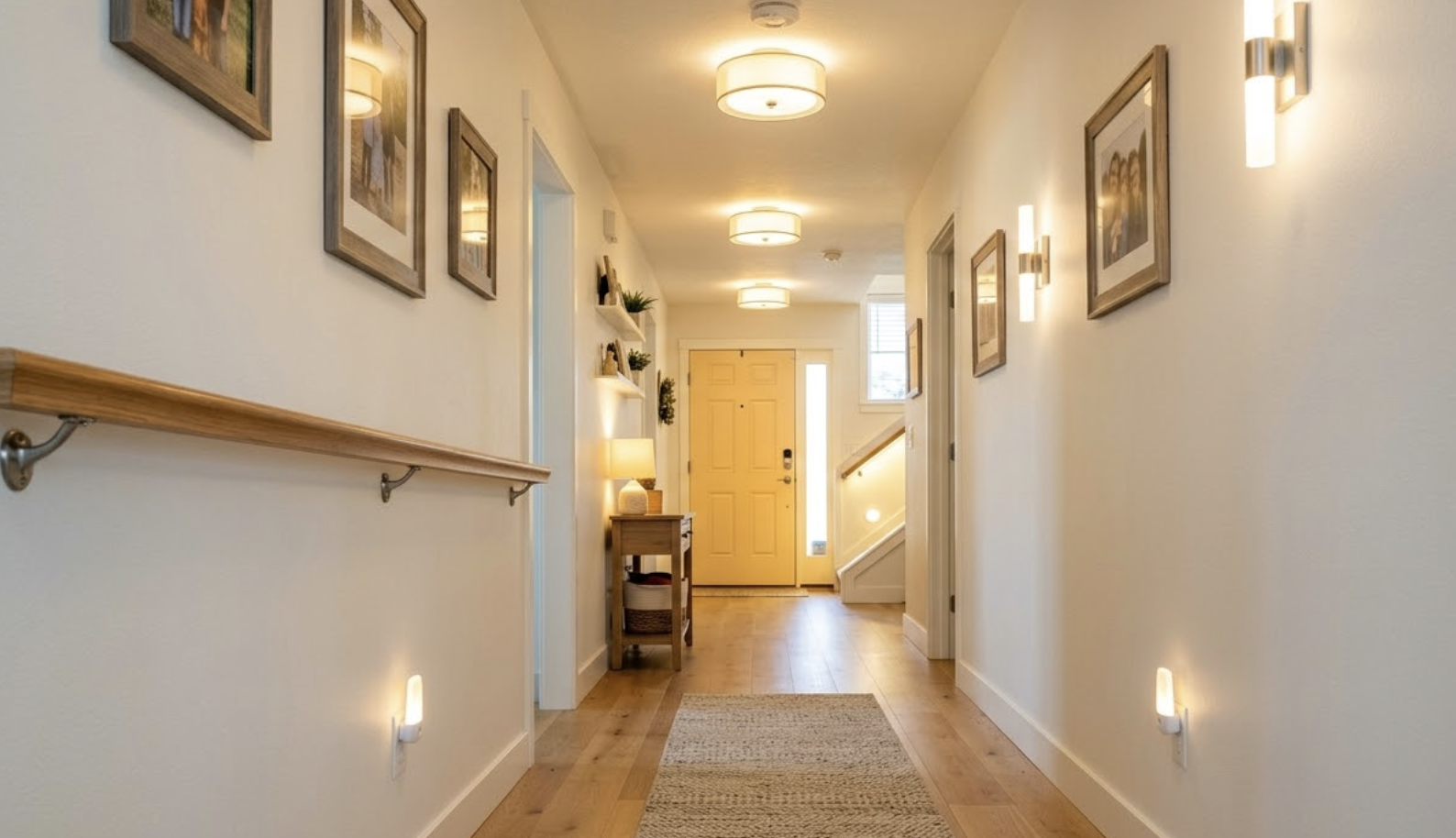
Small details in a home's layout, lighting and everyday pathways can become more important as needs change.
A home can work beautifully for decades and then, little by little, become harder to navigate.
Sometimes the first sign is small. Someone begins holding the railing more carefully on the stairs. A nighttime trip to the bathroom feels less comfortable than it used to. Carrying groceries from the car becomes more difficult. A step that was barely noticed for years suddenly requires more attention.
The house may not have changed at all. But the way someone experiences and moves through it can change over time.
Before real estate, I worked as a physical therapist. That experience still influences what I notice when I walk through a home today. I pay attention to stairs, entrances, bathrooms, lighting, walking paths and the ordinary routes people take through a house.
I am no longer practicing physical therapy, and I do not evaluate an individual's medical or mobility needs. Those questions belong with the appropriate healthcare professionals. But from a real estate and home-function standpoint, there are features worth noticing before they become larger concerns.
That matters whether you are hoping to remain in your home for many years, helping an aging parent think ahead, or considering whether another home might eventually make everyday life easier.
Why does home safety become more important as we age?
Falls are a significant concern for older adults. The CDC reports that falls are the leading cause of injury among adults age 65 and older, and more than 1 in 4 older adults report falling each year.
Fall risk is rarely about one feature of a house alone. Health conditions, medications, vision, strength, balance, footwear and environmental hazards can all play a role. The CDC specifically identifies home hazards such as uneven steps, throw rugs and clutter among the factors that can contribute to falls.
That is why I would not look at a house and declare it “safe” or “unsafe” for a particular person.
Instead, I think it is useful to ask a more practical question:
Where does this home require extra effort, balance, vision or attention during an ordinary day?
Here are seven places I would look.
1. Poor or uneven lighting

Dim hallways and uneven lighting are worth noticing when evaluating how a home may function over time.
Lighting is easy to overlook because we become accustomed to our own homes.
A hallway may seem adequately lit because you have walked through it thousands of times. You know where the step begins, where the furniture sits and how to reach the light switch.
But consider the house at night. Look at stair landings, hallways, entrances, bathrooms and the route from the bedroom to the bathroom. Are there dark stretches? Sudden changes between bright and dim spaces? Light switches that are difficult to reach before entering a room?
The CDC recommends making homes brighter with additional lighting or brighter bulbs as part of fall-prevention efforts.
This does not necessarily require a major renovation. Sometimes the first step is simply noticing where better lighting would make movement through the home easier.
2. Bathrooms without adequate support

Bathroom layout, shower thresholds and available support can affect how easily the space functions over time.
Bathrooms deserve particular attention because everyday activities there can involve stepping over thresholds, changing position, turning in a small space and moving across wet surfaces.
Look at how someone gets into and out of the shower or tub. Is there something sturdy to hold? Is the shower threshold high? Is the floor slippery when wet? Is there enough room to move comfortably around the toilet and vanity?
The CDC recommends grab bars inside and outside the tub or shower and next to the toilet as part of making a home safer from falls.
The right modification for a particular person should be determined with appropriate professionals when individual health or mobility needs are involved. From a home-planning perspective, however, the bathroom is an important room to evaluate before a problem forces the conversation.
3. Entry steps and thresholds

The everyday route into a home deserves attention, including steps, railings, lighting and changes in elevation.
People often think about the stairs inside a house and forget about the steps required simply to get through the front door.
Walk the route someone actually uses every day.
That may not be the front entrance at all. It could be two steps from the garage into the kitchen, a sloped walkway from the driveway, an uneven sidewalk or a back entrance used most often because that is where the car is parked.
Are there railings? Is the surface level? Is the area well lit? Are there awkward thresholds? What happens when someone is carrying groceries at the same time?
A house may have a first-floor bedroom and a beautiful walk-in shower and still require navigating several unsupported steps just to come home.
That is why I consider the everyday entrance part of the home's functional layout.
4. Staircases
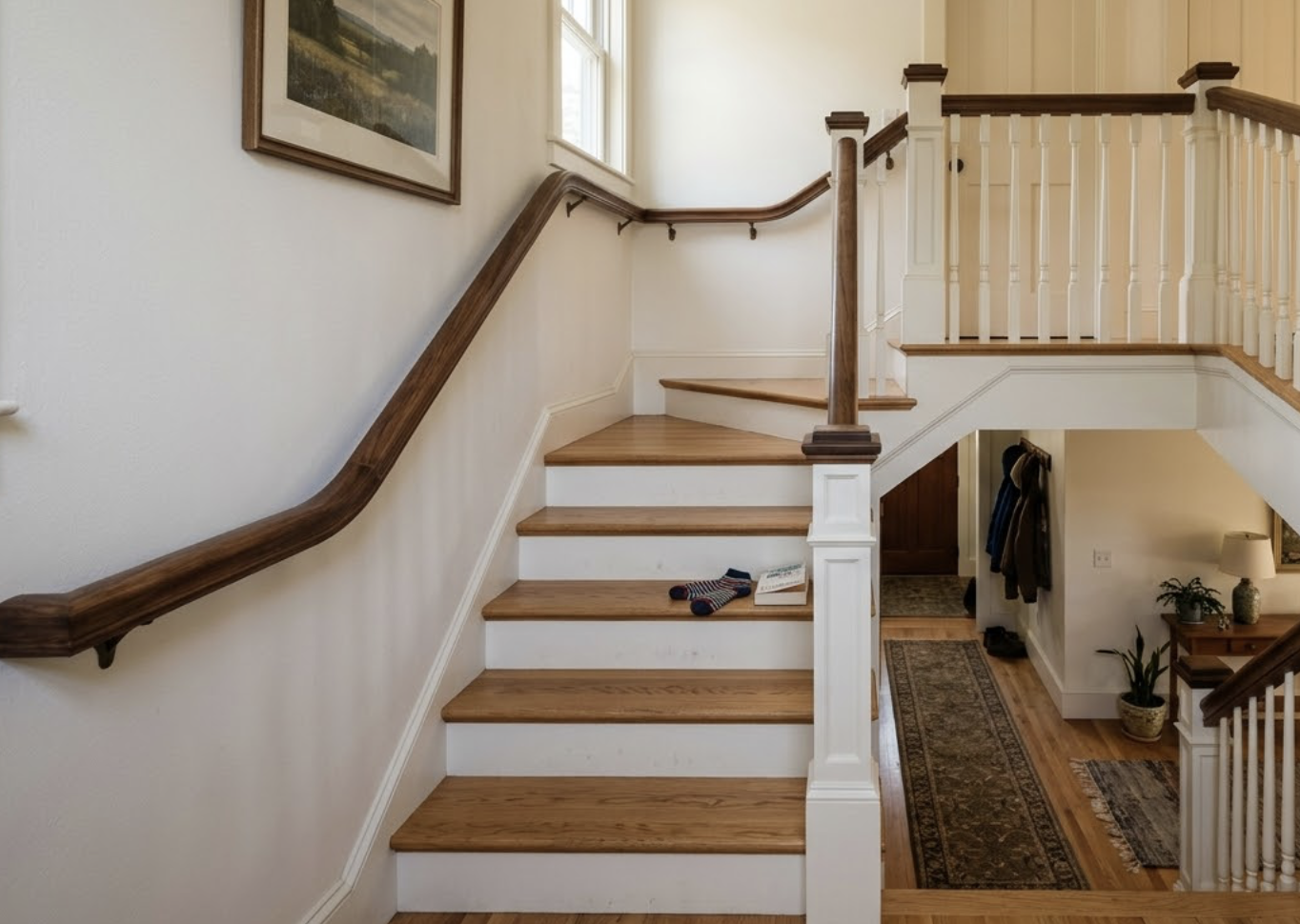
Where stairs lead, how often they are needed and whether secure handrails are available all affect how a home functions.
Stairs are one of the most obvious features families think about when considering aging in place, but simply counting the number of stairs does not tell the whole story.
Where are they, and what do they connect?
If the primary bedroom is upstairs, how many times a day is that staircase necessary? Is the laundry in the basement? Are the stairs narrow or steep? Is there a landing? Are there secure handrails?
The CDC recommends handrails on both sides of staircases as one way to make a home safer.
It is also worth noticing behavior. If someone who once moved easily through the house has begun avoiding a level of the home or seems increasingly cautious on the stairs, that may be useful information to discuss with them and, when appropriate, their healthcare provider.
For a deeper look at how stairs and other structural features affect long-term livability, read What My Physical Therapy Career Taught Me About Home Design and Aging in Place.
5. Loose rugs, clutter and unstable walking surfaces

Throw rugs, clutter and changes between flooring surfaces can create trip hazards along everyday walking paths.
A beautiful rug may have been in the same place for twenty years. That does not mean it deserves a permanent exemption from scrutiny.
Look at curled edges, rugs that slide, electrical cords crossing pathways, clutter near furniture and transitions between different flooring materials. Also look at the places where someone has to maneuver around furniture rather than walking through a clear path.
Current CDC guidance specifically recommends removing trip hazards such as throw rugs and keeping floors free of clutter.
This is one of the reasons looking at the house with fresh eyes can be useful. Familiarity makes it surprisingly easy to stop seeing the obstacles we walk around every day.
6. Essential rooms on different levels

A home's layout matters differently when bedrooms, bathrooms, laundry and everyday living spaces require repeated trips between floors.
A two-story home is not automatically a poor choice as someone gets older.
The more useful question is what the stairs are required for.
If the bedroom and full bathroom are upstairs, laundry is in the basement and the kitchen is on the main floor, an ordinary day may require moving between several levels repeatedly.
Now compare that with a home where the bedroom, bathroom, kitchen and laundry can all be reached without stairs.
That difference can matter even to someone who is perfectly capable of using stairs today. It may also affect how adaptable the home would be after an injury, surgery or future change in mobility.
Sometimes a house has more flexibility than it first appears. A main-floor room may eventually serve another purpose, or laundry might be relocated during a future renovation. Other layouts are much harder or more expensive to change.
Understanding which situation you have is useful whether you decide to stay or move.
7. The route from the car into the house

The everyday route from the car into the house is an important part of how a home functions.
This is one of the areas I think homeowners can easily overlook.
Imagine arriving home with groceries in the rain.
Where do you park? How far do you walk? Is the surface level? Are there steps? Is the route covered? Is there somewhere to set down a bag while opening the door? Once inside, how far is it to the kitchen?
Now think about that same route if someone temporarily needed a walker after surgery or experienced a longer-term change in mobility.
The garage, driveway and entrance are not separate from the function of the home. They are part of the daily living environment.
When people are buying a home they hope to remain in for many years, I think this route deserves just as much attention as the kitchen countertops or bedroom sizes.
Does finding one of these features mean you need to move?
No.
Most homes have something that could work better.
The question is whether the features that create difficulty can reasonably be changed and whether making those changes would allow the home to continue supporting the way you want to live.
Lighting may be relatively simple to improve. A bathroom renovation may be possible. Lawn care or other maintenance can sometimes be delegated. A room may be able to serve a different purpose.
Other limitations are built much more deeply into the property. Moving laundry from a basement may be difficult. A steep lot cannot easily become level. A narrow staircase may be expensive or impossible to change. A home with essential rooms spread across several floors may simply require more daily effort than someone wants.
If you are thinking beyond individual safety features and want to understand the larger question of whether a home can adapt over time, read What My Physical Therapy Career Taught Me About Home Design and Aging in Place.
When should a family start considering another housing option?
You do not have to wait for a crisis to learn what other choices exist.
Sometimes families begin exploring alternatives because the current house has several limitations that would be difficult to change. In other cases, the home could be modified, but the homeowner no longer wants the maintenance, stairs or responsibility that comes with it.
There is also a difference between exploring and deciding.
Looking at ranch homes, patio homes, condominiums or other living arrangements does not commit anyone to moving. It gives the family something concrete to compare with the current home.
If you are helping a parent whose present home may no longer work well, I explain some of those choices in When Aging Parents Can't Safely Stay in Their Home: Options Louisville Families Often Face.
For the broader decision about aging in place, downsizing, selling a longtime home and coordinating a transition, visit Downsizing and Senior Transitions in Louisville, KY.
What should you do if you begin noticing concerns in a parent's home?
Start by observing before you start solving.
Which parts of the house seem to require more effort than they once did? Has your parent changed how they use the home? Are certain rooms or stairs being avoided? Are there maintenance responsibilities they no longer want?
Then talk with your parent rather than making decisions around them.
Individual concerns involving falls, balance, strength, vision, medications, mobility or other health issues should be discussed with the appropriate healthcare professionals. The CDC also recommends that older adults speak with their healthcare providers about fall risk, medication effects, vision and other factors that can contribute to falls.
The housing conversation can happen alongside that medical guidance.
If your family reaches the point where you are ready to organize the practical pieces of a possible move, my Louisville Downsizing Planning Checklist for Families Helping Aging Parents can help you work through the next steps without trying to solve everything at once.
Frequently Asked Questions About Home Safety and Aging in Place
What home features can increase fall risk for older adults?
Home hazards can include uneven or broken steps, throw rugs, clutter, poor lighting, stairs without adequate handrails and bathrooms without appropriate support. A person's overall fall risk can also be affected by factors such as balance, strength, vision, medications and health conditions.
What are some ways to make a home safer for aging in place?
Depending on the home and the person, changes may include improving lighting, removing trip hazards, installing bathroom grab bars and adding handrails to stairs. The CDC includes these among its recommendations for reducing fall risk at home. Individual needs should be discussed with appropriate healthcare and home-modification professionals.
Is a one-story home always better for an older adult?
Not necessarily. A one-story layout can reduce the need to use stairs, but the overall function of the home also matters. Entrances, bathrooms, parking, flooring, lighting, maintenance requirements and proximity to everyday needs can all affect how well a property works for someone.
Should an older homeowner modify the current house or move?
There is no single answer. Consider what would need to change, whether those changes are feasible, what the home will continue to require, what another property could offer and what the homeowner actually wants. Health and mobility questions should involve appropriate healthcare professionals.
When should families start talking about aging in place or downsizing?
Ideally, before a crisis makes the decision urgent. Starting earlier gives the homeowner and family time to understand the current house, explore alternatives, consider finances and decide what changes, if any, make sense.
A home should support the life happening inside it
Longtime homes carry history. They hold ordinary routines, celebrations, difficult seasons and years of memories.
That history matters. So does the way the home works today.
Sometimes a few thoughtful changes make staying in a beloved home easier. Sometimes looking carefully at the property helps someone recognize that another layout would better support the life they want now.
Neither conclusion should be assumed in advance.
The useful first step is simply to look at the home with fresh eyes and ask:
Is this house still working well for the way I want to live?
If you are beginning to think through that question for yourself or an aging parent in Louisville, you can contact me here. We can look at the real estate side of the decision, the current home and the housing alternatives without assuming that moving is the answer.
Because Your Move Deserves Care, Not Chaos.
How to Help Aging Parents Downsize Without Overwhelm in Louisville: A Practical Guide for Families
Helping aging parents downsize can feel emotional and overwhelming for families. This Louisville guide explains how to start the conversation, reduce stress, and plan the transition step by step.
Once a family begins considering downsizing for an aging parent, the number of decisions can grow quickly. There may be belongings to sort, a home to prepare, housing options to compare, family members to coordinate, and a move to plan.
Trying to solve all of those pieces at once is where the process can become overwhelming. A more manageable approach is to first understand what the next living situation needs to accomplish, then work through the practical decisions in a sensible order.
This guide walks through that process step by step, including where to begin, how to approach belongings, when outside help may be useful, and how to keep the real estate decisions from getting ahead of the family decisions.

Helping aging parents downsize often begins with a calm conversation about what the next stage of life should look like.
Not Sure Whether It’s Time to Downsize Yet?
If your family is still trying to determine whether a move is necessary, that decision deserves more attention before you begin planning the downsizing process. Changes in home maintenance, mobility, daily routines, safety, and how well the home still supports your parent can all be part of that conversation.
I cover those signs more fully in When Is It Time to Help a Parent Downsize in Louisville?
Why Downsizing Feels So Overwhelming for Families
Downsizing can feel overwhelming because several decisions often arrive at the same time. A family may be thinking about where a parent will live, what will happen to years of belongings, whether the current home needs work, and how a move and home sale will be coordinated.
There is an emotional side to those decisions, too. A longtime home can hold family history, familiar routines, and belongings with meaning that isn't obvious to anyone else.
The process becomes more manageable when families stop treating downsizing as one enormous project and begin working through the decisions in a practical order.
Start the Conversation Before Decisions Become Urgent
Families have more choices when there is time to explore them. If a health change or another unexpected event suddenly makes the current living situation difficult, decisions about housing, belongings, and the home may all need to happen much faster.
Beginning the conversation earlier does not mean a move has been decided. It simply gives your parent and the rest of the family time to understand the options before circumstances begin making the decisions for you.
Decide What the Next Home Needs to Make Easier
It can be tempting to begin with the closets, basement, or garage because the amount of stuff feels like the most obvious problem. But sorting belongings is much easier once there is some clarity about what the next living situation needs to accomplish.
Start with questions such as:
What parts of the current home have become harder to manage?
Are stairs, yard work, cleaning, or home maintenance becoming more difficult?
What would make everyday routines easier?
Is being closer to family, friends, activities, or other support important?
What features would make a future home easier to live in?
The answers help define what the family is working toward. Once you have a clearer picture of the next home, decisions about what to keep, what to move, and what to let go of often become easier.
Bring in Help Where It Actually Helps
A family does not have to personally handle every part of a downsizing transition. Depending on the situation, outside help might include an organizer, estate sale professional, donation resource, mover, contractor, or other local service provider.
The goal is not to build a large team around every move. It is to identify the parts of the process that are creating the most stress or taking more time and expertise than the family can reasonably manage.
As a REALTOR® and Seniors Real Estate Specialist (SRES®), part of my role is helping families think through the real estate side of the transition and, when needed, connecting them with resources for the other pieces surrounding the move.
A Step-by-Step Plan for Helping a Parent Downsize
Breaking the transition into smaller decisions can make a complicated move much easier to manage. The exact order will vary by family, but this is a practical place to begin. If it would help to have those decisions in one place, my Louisville Downsizing Planning Checklist for Families Helping Aging Parents gives you a practical framework you can save, print or share with other family members.
Step 1: Understand What Needs to Change
Start with the reason you are considering a move. Is the home becoming too difficult to maintain? Are stairs or other parts of the layout becoming harder to navigate? Would being closer to family or having less responsibility make everyday life easier?
You do not need every answer yet. You are simply identifying what a different living situation needs to improve.
Step 2: Explore Where Your Parent Might Live Next
Before making major decisions about belongings or preparing the current home for sale, get a clearer picture of the realistic housing options.
That could mean a smaller home, condo or patio home, an age-restricted community, independent living, assisted living, living with family, or remaining in the current home with appropriate changes and support.
My background as a physical therapist also shapes the way I look at housing during these transitions. I tend to notice how a home works in everyday life, including stairs, bathroom access, entrances, walking paths, and the amount of upkeep it requires. Sometimes the current home can continue to work with thoughtful changes and the right support. Other times, those same considerations can help a family identify features that would make another home easier to live in.
Knowing the likely destination also helps answer practical questions such as how much space will be available and what belongings can reasonably move with your parent.
Step 3: Make a Plan for the Belongings
Avoid trying to empty an entire house at once. Start with manageable categories or areas and separate items into what will move, go to family, be donated, be sold, or be discarded.
Meaningful belongings deserve time. Photographs, letters, heirlooms, and other personal items may involve stories and family decisions that cannot always be rushed.
Step 4: Determine What the Current Home Needs
Once you have a better idea of the timing and next destination, look at the current home separately.
Some homes may benefit from repairs, cleaning, decluttering, or other preparation before selling. In other situations, doing very little may make more sense. The right amount of preparation depends on the home, the local market, the family's priorities, and the time and money involved.
Step 5: Coordinate the Move and Home Sale
The move, home preparation, and sale often overlap, which is where good coordination becomes especially important.
Create a realistic sequence for movers, donations or estate-sale work, home preparation, listing the property, and closing. When outside professionals are needed, bring them in for the specific pieces they can take off the family's plate.
How Do You Start the Downsizing Conversation With a Parent?
Begin with questions rather than a conclusion that your parent needs to move. Ask what feels harder about the home than it used to, what is still working well, and whether there are things they wish were easier.
Listen before moving into solutions. A parent may be concerned about losing independence, leaving familiar routines, giving up belongings, or simply having decisions made for them. Understanding those concerns can help the family figure out what needs to be addressed before talking about specific housing choices.
If starting that conversation feels difficult, I go into it more deeply in How to Talk to a Parent About Moving Without Causing Conflict.
How Long Does Downsizing Usually Take?
There is no standard timeline for downsizing. Some families can make the transition fairly quickly, while others may need several months or longer. The timing depends on the amount of belongings to sort, the next housing choice, preparation needed at the current home, and how the move and home sale will be coordinated.
Starting before there is an urgent need gives families more room to work through those decisions at a pace that feels manageable.
What Is the Hardest Part of Helping a Parent Downsize?
For many families, the hardest part is making practical decisions while respecting the emotional meaning of the home and belongings. A house may represent decades of routines, memories, relationships, and independence, so decisions that look simple on a checklist may not feel simple to the person making them.
It can help to separate decisions that truly need to be made now from those that can wait. Not every belonging has to be sorted in one weekend, and not every question about the home has to be answered at the same time. Giving the process some room can make it easier for your parent to remain involved in the decisions that affect them.
It can also help to know where families tend to get stuck before you are in the middle of it. What Mistakes Do People Make When Downsizing in Louisville? covers some of the practical decisions that can create extra work, expense or stress during a move.
Frequently Asked Questions About Helping Aging Parents Downsize
When should families start discussing downsizing?
It can help to begin the conversation before a decision becomes urgent. Changes in how well the home supports everyday life, increasing maintenance demands, or difficulty with parts of the home may be reasons to start exploring options.
For a deeper look at the signs families often notice, see When Is It Time to Help a Parent Downsize in Louisville?
How long does the downsizing process usually take?
There is no standard timeline. Some families can make the transition fairly quickly, while others may need several months or longer. The timing depends on the belongings to sort, where the parent will live next, preparation needed at the current home, and how the move and home sale will be coordinated.
Do families have to handle downsizing alone?
No. Depending on what the family needs, outside help may include professional organizers, estate sale professionals, movers, donation resources, contractors, and real estate guidance. The goal is to bring in help for the parts of the transition that would otherwise create unnecessary stress or require specialized expertise.
What if siblings disagree about downsizing?
Start by identifying what each person is concerned about and what decisions actually need to be made. One sibling may be focused on safety, another on independence, and another on finances or the family home. Getting specific about those concerns can make the conversation more productive.
For families dealing with this situation, see What to Do When Siblings Disagree About Aging Parents: A Practical Guide for Louisville Families.
What should families do first when helping a parent downsize?
Start with the living situation rather than the belongings. Identify what has become difficult in the current home and what a better living situation would need to make easier. Once there is some clarity about the destination and the goal of the move, decisions about belongings, home preparation, and timing become easier to organize.
Related Louisville Senior Transition Resources
Every family reaches this decision from a different place. If you are still exploring whether the current home can continue to work, What My Physical Therapy Career Taught Me About Home Design and Aging in Place looks at home function and aging through the perspective of my years as a physical therapist.
If you're noticing changes but aren't sure whether they point toward a move, When Is It Time to Help a Parent Downsize in Louisville? covers the signs families often begin noticing and how to think about the decision before it becomes urgent.
When remaining in the current home no longer seems realistic, When Aging Parents Can’t Safely Stay in Their Home: Options Louisville Families Often Face walks through some of the housing paths families may need to consider.
A Final Thought for Families Navigating This Decision
Helping a parent downsize can involve far more than deciding where they will live next. There may be a home full of belongings, family opinions, financial considerations, repairs, movers, timelines, and emotions all competing for attention.
You do not have to solve all of it at once.
Start with what your parent needs from their living situation now and in the years ahead. From there, the belongings, the current home, and the logistics can be handled in a more thoughtful order.
If your family is trying to sort through those decisions in Louisville, I’m happy to be a starting point. As a REALTOR®, Seniors Real Estate Specialist (SRES®), and former physical therapist, I can help you think through the housing and real estate pieces, identify practical next steps, and connect you with additional resources when they are needed.
You can start with a conversation.
Because your move deserves care, not chaos.
When Is It Time to Help a Parent Downsize in Louisville?
When a parent’s home begins requiring more effort, maintenance or support, families may wonder whether it is time to discuss downsizing. Beth Green explains the signs to notice, how to begin without pressure and which options Louisville families can consider.
A thoughtful guide for families noticing that a parent’s home may no longer fit as well as it once did

Most families do not wake up one morning and suddenly decide it is time for a parent to move.
The question usually arrives more quietly. The yard is not being kept up the way it once was. A repair has gone untouched for months. Your parent has stopped using the upstairs rooms, or you notice that getting into the bathtub takes more effort. Perhaps nothing is clearly wrong, but each visit leaves you with a little more concern than the last.
That can be a difficult place to stand. You do not want to overreact or take away your parent’s independence. You also do not want to wait until a fall, illness or urgent repair makes the decision for everyone.
So how do you know when ordinary concern has become a reason to begin the conversation?
What are the signs that it may be time for a parent to downsize?
The short answer is that it may be time to discuss downsizing when the home is requiring more physical effort, money or ongoing help than your parent can comfortably manage, or when its layout begins interfering with safe daily life.
No single sign automatically means a move is necessary. What matters is the pattern: changes in mobility, maintenance, safety, isolation, finances or the amount of family support required to keep the household functioning.
The first step is not putting the house on the market. It is paying attention to what has changed and talking with your parent before the situation becomes urgent.
For a broader look at the decisions families may face, including aging in place, housing options, timing, belongings, and coordinating a move, see my Louisville Senior Downsizing and Transition Guide.
Look at how your parent is living, not simply how the house looks
An adult child may walk into a parent’s home and immediately notice worn carpet, an overgrown yard or a room full of belongings. Those things may need attention, but they do not tell the whole story.
A more useful question is: How well is this home supporting daily life now?
Consider what happens during an ordinary week. Is your parent able to prepare meals, manage laundry, reach the rooms they need and enter and leave the home comfortably? Are they avoiding the basement, second floor or shower? Have simple household tasks begun taking more energy than they used to?
Sometimes the house remains safe and manageable even if it looks dated. In another home, everything may appear tidy while the person living there is quietly changing routines to avoid stairs, difficult bathrooms or long walks between important rooms.
That distinction matters. Downsizing should not begin because someone else thinks the house is too large or old-fashioned. It should begin as a conversation when the home itself is making everyday life harder.
Maintenance is becoming more than an inconvenience
Home maintenance can be one of the first visible signs that something has shifted. You may notice:
Repairs being delayed because arranging them feels difficult
Lawn care, snow removal or exterior upkeep becoming unreliable
Unopened mail or household paperwork accumulating
Rooms being closed off because cleaning the whole house is too demanding
Utilities, taxes, insurance or routine bills becoming harder to organize
Family members spending increasing amounts of time keeping the property functioning
One unfinished repair is not proof that someone should move. Many homeowners postpone projects at every age. The concern grows when deferred maintenance becomes a pattern, creates a safety or financial risk, or depends on relatives repeatedly stepping in.
It is also worth separating the condition of the house from your parent’s ability to manage it. A reliable lawn service, housekeeper, handyman or family schedule may make remaining at home realistic for years. If those supports are unavailable, unaffordable or no longer enough, a lower-maintenance home may deserve consideration.
The layout is beginning to limit daily life
Before real estate, I spent many years working as a physical therapist. That experience still shapes the way I look at homes. I notice the step at the entrance, the route from the bedroom to the bathroom, the lighting on the stairs and whether daily living can happen on one level.
The important question is not whether a home contains stairs or an older bathroom. It is whether those features are changing how your parent lives.
Watch for signs such as:
Sleeping in a chair or another room to avoid stairs
Holding onto furniture or walls while walking
Difficulty stepping into the bathtub or shower
Avoiding laundry because it is on another floor
Trouble carrying groceries into the house
Poor lighting along hallways, entrances or stairs
A new reluctance to leave home because entering and exiting feels difficult
The CDC’s guidance on preventing falls recommends practical home measures such as removing trip hazards, improving lighting, installing grab bars and adding railings on both sides of stairs. Those changes can make a meaningful difference. A physician, physical therapist, occupational therapist or other qualified health professional can help evaluate personal mobility and safety needs.
Some homes can continue working well with thoughtful modifications and outside support. Others have structural limitations that are difficult or expensive to change. My article about how home design affects aging in place explains why layout, lighting, bathrooms and entry steps often matter more over time than families initially expect.
The home is contributing to isolation
Safety is not only about falls or physical access. A home can become isolating when it is far from family, friends, medical care or the places that make daily life feel connected.
Perhaps your parent no longer drives at night, avoids bad weather or has stopped attending activities because transportation has become complicated. Maybe a spouse has died and the house now feels too quiet. The property may still be physically manageable, but life within it has narrowed.
A move does not automatically solve loneliness, and remaining in a familiar neighborhood may provide valuable connection. The question is whether the current location supports the relationships, routines and services your parent needs now.
This is one reason the next home should not be chosen by square footage alone. A smaller property that creates more driving and less connection may not improve daily life. A patio home, condominium, apartment, independent-living community or home near family could each offer something different. The right fit depends on how your parent wants to live, not simply how much space they want to maintain.
Your parent has begun talking about change
Sometimes parents open the door themselves, but the comment is easy to miss.
They may say the house feels like too much work, wonder aloud what their home is worth or mention a friend who moved into a patio home. They may ask what you would want from the house someday or say they would like to live closer to family.
These comments are not always a request to list the property. Often they are a way of testing whether the subject is safe to discuss.
Instead of answering with a complete moving plan, stay curious. Ask what has started feeling different. Ask what they would miss most and what they would be relieved to leave behind. Ask what they would want life to feel like if the house required less of them.
A conversation can remain a conversation. Exploring options does not obligate anyone to move.
How do you start the downsizing conversation without creating conflict?
Begin with what you have observed, not with the conclusion you have reached.
“I noticed the stairs seemed harder for you this weekend. How have they been feeling lately?” will usually lead to a better conversation than “You cannot keep living here.”
You might ask:
What parts of the house are easiest for you right now?
What has become more tiring or frustrating?
Is there anything you have stopped doing because the house makes it difficult?
What kind of help would make staying here easier?
If you ever did move, what would matter most about the next place?
Then listen. Your parent may be protecting independence, privacy, memories, familiar routines or the feeling of still being in control of their own life. Those concerns do not disappear because the family has identified a practical problem.
If several siblings are involved, agree on the purpose of the first conversation before anyone begins it. A group arriving with a fully formed plan can feel less like support and more like an intervention. One trusted person may be better positioned to begin, with the rest of the family included as the discussion develops.

What options should families consider before deciding to move?
The early conversation should consider more than one path.
Stay in the current home with changes
The home may continue to work with repairs, improved lighting, bathroom modifications, railings, a first-floor living arrangement, household help or transportation support. The National Institute on Aging’s aging-in-place resources discuss the services and planning that can help older adults remain at home.
Move to a smaller or lower-maintenance home
A one-level house, patio home or condominium may reduce upkeep while allowing your parent to retain a familiar style of independent living. The financial picture, association responsibilities, accessibility and proximity to support should all be considered.
Move closer to family
For some people, the most important change is location rather than property type. That might mean moving into a separate home nearby, joining a family household or relocating to another state. The belongings, timing and sale of the current home may need to be coordinated around a longer-distance move.
Consider independent or assisted living
Some families need more built-in community, meals, transportation or personal support than a traditional home provides. Senior living communities vary considerably in services, costs and levels of care. Families should evaluate those choices with the appropriate health, financial and legal professionals.
My Louisville Senior Downsizing and Transition Guide provides a broader look at these housing paths and the practical work that may accompany a move.
What if your parent is not ready?
Unless there is an immediate safety or capacity concern requiring professional intervention, the first conversation does not need to produce a decision.
It may take time for your parent to consider what life could look like elsewhere. They may need to visit a few communities, look at a smaller home, understand what their present house might be worth or learn what modifications would cost before they can compare the choices realistically.
You can still make useful progress without packing a box. Gather information. Identify maintenance that cannot wait. Talk with appropriate health professionals about safety concerns. Learn about housing options. Discuss legal and financial planning with qualified advisers.
Giving your parent reliable information about the choices can make the situation feel more manageable and allow them to participate meaningfully in the decision.
What if a health event has made the decision urgent?
A fall, hospitalization or sudden change in mobility can compress a conversation that should have taken months into a matter of days. In that situation, separate the immediate decision from the permanent one whenever possible.
The first question may be where your parent can live safely after discharge, not whether the house should be sold. Medical and care professionals should guide decisions involving health, supervision and functional ability. An elder-law attorney, financial adviser or other qualified professional may also be needed, depending on authority, finances and long-term-care considerations.
The real estate decision can then be coordinated around that guidance. If remaining at home is no longer realistic, my article about housing options when an aging parent cannot safely stay at home explains several paths Louisville families often consider.
What happens to the house and all the belongings?
Figuring out what to do with a lifetime of belongings can be one of the hardest parts of a possible move. At the same time, the family may be coordinating repairs, donations, an estate sale, movers, a new residence, and the eventual sale of the home. Trying to solve all of that at once can quickly become overwhelming.
Begin with what the next home can hold and what your parent most wants to keep. Important documents, medications, personal records, photographs, jewelry and irreplaceable items deserve early attention. The remaining belongings can later be considered for family distribution, sale, donation or removal.
Bring in an experienced REALTOR® before automatically emptying or renovating the house. An early property evaluation can help the family understand what preparation may be worthwhile, whether an estate sale could make sense and how the property fits into the current Louisville market.
If the homeowner has died and the property is part of an estate, the order changes. Legal authority and ownership should be clarified before belongings are distributed or real estate documents are signed. My guide to selling an inherited house in Louisville explains those first steps in more detail.
Frequently asked questions about helping a parent downsize
What is the first step when helping a parent downsize?
Begin by asking what has become harder about living in the current home. Do not start with packing or a demand to move. Understanding the concern helps the family determine whether the next step is a home modification, additional support, further evaluation or exploring a different place to live.
How do you know whether a parent should age in place or move?
Compare the parent’s mobility, safety, maintenance needs, finances, social connections and available support with what the current home requires. Aging in place may work well with appropriate changes and services. Moving may be more practical when the home’s layout, location or upkeep continues to limit daily life.
Should the family start clearing the house before a decision is made?
Usually not. Small, voluntary sorting projects may be helpful, but clearing the entire home before the destination, timing and property plan are understood can create unnecessary stress. If a sale is possible, have the property evaluated before removing everything or beginning major work.
What if siblings disagree about whether a parent should move?
Return to observable facts: how the parent is functioning, what the home requires, what support is available and what the parent wants. Separate health, legal, financial and real estate questions so each can be addressed by the appropriate person. When disagreements involve capacity or legal authority, seek qualified legal guidance.
How long does downsizing usually take?
There is no standard timeline. A planned move may unfold over several months, while a health event can create urgency. The process generally includes evaluating options, choosing the next living arrangement, sorting belongings, preparing the current home and coordinating the move and sale.
When should we call a REALTOR®?
Call before the home is emptied or expensive improvements begin. The purpose of an early conversation is not to pressure anyone to list. It is to understand the property, likely value, preparation choices and realistic timing so the family can make decisions with better information.
You do not need a final decision to begin
If you are concerned that a parent’s home may no longer be working as well for them, you do not need to arrive with a moving date or a complete solution. Begin with a conversation about what has changed, what is still working well, and what has become more difficult.
Sometimes the answer will be a safer way to remain at home. Sometimes it will be a smaller property, a move closer to family or a living environment with more support. Often the family will need time and more information before the right direction becomes clear.
If your family has reached the point where you are ready to start organizing those decisions, my Louisville Downsizing Planning Checklist for Families Helping Aging Parents gives you a practical place to begin without trying to solve the entire move at once.
As a former physical therapist, a Seniors Real Estate Specialist® and a Louisville REALTOR®, I help families look at both the person and the property. We can talk through what the home requires, what choices may be available and which questions belong with other qualified professionals before anyone is asked to make a final decision.
Because your move deserves care, not chaos.
This article provides general real estate information and is not medical, legal, financial or tax advice. Health and safety concerns should be discussed with appropriately qualified healthcare professionals. Legal and financial questions should be directed to qualified advisers familiar with the family’s circumstances.
What My Physical Therapy Career Taught Me About Home Design and Aging in Place
What makes a home work well for the long term? Beth Green shares how her background in physical therapy shapes the way she notices stairs, bathrooms, entrances, lighting, adaptability and the everyday routes people take through a home.
A Louisville Realtor and former Physical Therapist explains how home design quietly affects safety, mobility, and aging in place.

Years before I became a Louisville REALTOR®, I worked as a physical therapist. I don’t practice physical therapy today, but that experience has never really left the way I look at a home.
When I walk through a house, I notice the things any buyer notices: the kitchen, condition, room sizes, natural light and how the house feels. At the same time, I find myself noticing other things almost automatically. How many steps are there from the garage into the house? Where is the laundry? How do you get from the bedroom to the bathroom? Is there enough room beside the car in the garage to open the door fully? Could that bathroom doorway be widened someday? If stairs became difficult, could most of daily life happen on one floor?
Those questions come from years of watching people move through their environments, and they are also useful real estate questions, especially for someone who hopes to stay in a home for a long time.
A home does not have to be fully accessible today to be a good long-term choice. I want to understand how well it functions now, what could reasonably be adapted later, and whether the things that are difficult to change are likely to become a problem.
That is a much bigger picture than simply looking for a ranch.
What Does Aging in Place Mean When You’re Looking at the Home?
Aging in place generally means being able to remain in your own home and community as you get older. Whether that works well depends on the person, the house and the support available. Health, finances, transportation, family, services and personal preference may all become part of the decision.
The home itself deserves a close look because sometimes it is the house creating the difficulty, and sometimes it isn’t. If yard work has become too much, hiring someone to maintain the yard may solve the problem. If driving has become difficult, transportation may be the bigger issue. If the only bedroom and full bathroom are upstairs and stairs have become increasingly difficult, the structure of the home may play a much larger role.
So when someone tells me they want to stay in their home, I don’t immediately start thinking about moving. I want to know what is making it harder to stay. Once we understand that, we have a much better idea of what kinds of solutions are worth exploring.
If You’re Buying a Home, Think About Accessibility Before You Need It
This is something I wish more buyers considered. Most of us naturally buy for the life we are living right now, but if you are hoping your next home will be the place you stay for many years, it makes sense to think about how that house could work if your needs changed.
You don’t have to search for a perfectly accessible home. In fact, you may pass over some very good houses if you do. I would rather look at adaptability.
A home may not seem exactly right at first glance, but perhaps the location is excellent and the basic layout gives us something to work with. A bathroom doorway may be narrower than you would want for someone using a wheelchair or another assistive device, but the surrounding wall may allow that opening to be widened during a future renovation. Another house may have a gorgeous new bathroom that would be extremely difficult to alter because of its size or configuration.
This is why I don’t want buyers looking only at what a house is today. Sometimes we need to consider what it could reasonably become. If the location and bones of the house are good, a property with a few workable limitations may offer better long-term possibilities than one that looks perfect on the surface but gives you very little flexibility.
Accessibility Actually Starts at the Car
This is one of those details people often don’t think about until they have a reason to. A garage may be advertised as a two-car garage, but what happens after two cars are actually parked in it?
Can you open the vehicle doors fully? Is there enough space beside the car for someone who needs more room getting in and out? What if that person uses a walker, wheelchair or another assistive device? Then look at what happens next. How do you get from the car into the house? Are there steps? Is there a railing? Is there room to maneuver around the entrance? Where could equipment be stored? If you are carrying groceries, what does that trip into the kitchen look like?
The same thinking applies when there isn’t a garage. I look at the driveway or parking area, walkway and entrance together.
My physical therapy background makes me notice this very quickly because moving around a home begins before you are standing in the living room. You have to arrive, get out of the vehicle, reach the house, enter it and then move through the spaces you use every day. When those pieces work together, a home can be much easier to live in.
How Much Do Stairs Really Matter?
Stairs deserve attention, but I don’t automatically see them as a reason to rule out a house. Louisville has wonderful two-story homes, homes with basements and older houses where stairs are simply part of the architecture.
What matters more to me is what you have to use the stairs for.
If every bedroom is upstairs, laundry is in the basement and there is no full bathroom on the main floor, everyday life depends heavily on moving between levels. Compare that with another two-story house that has a first-floor office or flex room, a full bathroom nearby and laundry on the main level. That house may offer considerably more flexibility even though the listing still says “two story.”
I look for possibilities like that when long-term livability matters to a buyer. Could a room be used differently later? Could laundry move to another area? If stairs became difficult for a period of time, could the household still function? Those questions tell me more than the architectural label attached to the house.
Don’t Assume a Room Has to Keep the Same Purpose Forever
Floor plans aren’t as fixed as we sometimes treat them. A room being used as an office today may not always need to be an office, and a formal dining room may have possibilities that aren’t obvious when there is a dining table sitting in the middle of it.
If there is a first-floor room near a full bathroom, for example, I may wonder whether that space gives the homeowner some flexibility later. Not every room can simply be converted to another use, of course, and renovations or changes need to be evaluated properly. But when I’m helping someone think long term, I don’t want today’s furniture to keep us from seeing tomorrow’s possibilities.
Bathrooms Are About Much More Than the Finishes
Bathrooms are one of the first places my physical therapy background tends to show up. Most buyers walk in and notice whether the bathroom has been updated. They see the tile, vanity, countertops and fixtures. I’m looking at those things too, but I’m also looking at the doorway.
How much room is there to enter? How do you get into the shower? Is there a tub wall to step over? How tight is the space around the toilet? Could the room potentially accommodate changes later?
A narrow doorway is a good example of why I don’t like dismissing a house too quickly. Depending on the wall and surrounding layout, widening that opening may be something a qualified contractor could address during a future renovation. That could make the bathroom much more usable for someone using a wheelchair, walker or other assistive equipment.
In another house, the bathroom may be so small or the surrounding structure so limiting that meaningful changes would be far more involved. You can’t tell the whole story by looking at whether the bathroom is pretty.
Some Changes May Be Fairly Simple. Others Need a Professional.
People sometimes hear “aging in place” or “accessibility” and immediately picture a major renovation. Depending on the home and the person, however, there may be smaller changes worth considering before getting anywhere near a major remodel.
Lighting is one example. In some situations, hardware, flooring transitions, railings or the way a particular space is arranged may also deserve attention. Other changes are more involved and need a qualified vendor. A doorway may need to be widened, a bathroom reconfigured or an entrance altered.
There are also situations where a home modification or piece of equipment relates directly to someone’s mobility, physical abilities or health. That is where an appropriate healthcare professional needs to be part of the discussion.
Because of my physical therapy background, I have quite a bit of familiarity with assistive and adaptive equipment and with the kinds of home modifications families may encounter. Over the years, I have also developed contacts and resources I can turn to when someone needs specialized help.
In my role as a REALTOR®, I’m not prescribing equipment or determining what modification is medically appropriate for someone. I can help clients notice things they may not have considered, ask better questions about how a property could function, and connect them with qualified professionals and vendors when we need another level of expertise. For a family already juggling several decisions, simply knowing who to call next can make the process much easier.
If You’re Renovating Anyway, Look a Little Further Ahead
I don’t think people need to remodel their homes today around every possible thing that could happen 15 years from now. But if you are already renovating, it makes sense to think ahead.
Suppose you’re completely redoing a bathroom. Before putting everything back exactly where it was, it may be worth asking whether a different layout would give you more usable space. If a doorway is already being changed, could its width matter later? If you’re redesigning part of the first floor, could the new plan give the house more flexibility?
You may decide not to make any additional changes at all. The value is in asking while you still have options, particularly when walls are already open and money is already being spent on the space.
Kitchens and Laundry Rooms Tell You a Lot About Daily Life
Kitchens receive a lot of attention in real estate, usually because people care about finishes, storage and entertaining. I also think about the work that happens there every day.
Where are the things you use most often? How much reaching or bending is involved? Is there enough room to move comfortably when an appliance or cabinet door is open? How far do groceries have to travel from the car to the kitchen?
Laundry is another good example. A basement laundry room may be perfectly fine for someone today, but doing laundry isn’t just standing at the washer. It means carrying clothes to the machine and bringing them back again. If that requires a flight of stairs every single time, it is worth noticing.
These aren’t necessarily reasons to reject a house. They are simply part of understanding how the house functions in real life.
Sometimes the Route Between Rooms Matters More Than the Rooms
One of the things I learned as a physical therapist was to pay attention to the whole activity rather than one isolated moment. That carries over into how I look at homes.
Think about getting up in the middle of the night and walking from the bedroom to the bathroom. Think about bringing groceries in from the car, taking laundry from the bedroom to the washer, or getting outside to pick up the mail or take out the trash.
When we’re healthy and moving easily, we rarely think about these routines. We just do them. A change in mobility can make you see the same house very differently.
That is why sometimes a smaller, less impressive house can function beautifully, while a larger home with gorgeous individual rooms may ask much more of the person living there.
Lighting Is Easy to Overlook
Lighting tends to fade into the background until it isn’t adequate. I pay particular attention to entrances, stairs, hallways, bathrooms and the route between a bedroom and bathroom.
Natural light is wonderful during the day, but it doesn’t help much when someone gets up during the night. Fortunately, lighting is also one of the features that may be relatively manageable to improve. Depending on the home, additional fixtures, better placement, improved switches or other changes may be worth considering.
This is a good example of why it helps to separate the things that may be fairly easy to change from the characteristics that are built into the house.
What Can Be Changed, and What Is Built Into the House?
This may be one of the most useful questions to ask when thinking about long-term livability.
Paint can change. Lighting can often change. Flooring can change. Bathrooms may be remodeled. A doorway may sometimes be widened, and an existing room may be able to serve another purpose.
Other things are harder. Moving a second-floor primary bedroom downstairs requires space the house may simply not have. Eliminating a steep staircase may not be realistic. Changing the slope of a lot is a very different undertaking from changing a light fixture.
There is also a large middle ground where something may be possible but needs to be evaluated by a qualified contractor or other professional.
I don’t expect a house to anticipate every possible future need. What I want to understand is how many reasonable options the property gives us.
Is a Ranch Always Better for Aging in Place?
No. A ranch can be a very good option because it reduces the need for interior stairs, but I would never assume a home works well for long-term living simply because it is one level.
I have seen one-level homes with difficult entrances, awkward bathrooms, inconvenient laundry arrangements and large properties that require a tremendous amount of upkeep. At the same time, a two-story home may have an easy entrance, a full bathroom on the first floor and enough flexible space that most daily living could happen downstairs if needed.
This is another reason I look at the entire property rather than one feature.
The Yard and Exterior Are Part of the House Too
Sometimes the interior of the home is working just fine. The property surrounding it is what has become difficult.
How much grass has to be cut? Is the driveway steep? Are there exterior steps? Is there a long walk to the mailbox? Who handles snow removal? What about gutters, landscaping and all the other maintenance that comes with owning the property?
A homeowner may still love the house while being completely tired of taking care of everything around it. Before deciding that means moving, it may be worth looking at what could be outsourced. Lawn services, snow removal, handyman help and other resources may take enough responsibility off the homeowner to make staying more manageable.
For some people, that makes a meaningful difference.
Location Matters More Than People Sometimes Realize
This is an area where my real estate experience becomes just as important as my physical therapy background. You can renovate a bathroom, but you can’t move the house to another part of Louisville.
When someone is buying for the long term, I want them to think about location in practical terms. How far are the places you regularly go? Where are the people who would realistically help you if you needed something? How dependent is your everyday routine on driving? Would the location still work if driving became more difficult someday?
Those answers will be different for everyone. Someone may want to be close to family. Someone else may care more about convenient access to the places they visit regularly. Another person may value a particular community or familiar area enough that it outweighs other considerations.
Location belongs in the long-term picture because it is one of the few things about a home you truly cannot change.
What Should You Look for When Buying a Home for the Long Term?
If you hope your next home will serve you for many years, I would look at more than bedrooms, updates and square footage. Some of the questions I think are worth asking are:
How do we get from the car into the house?
Is there enough room around the vehicle to get in and out comfortably?
How many steps are required at the entrances?
Could the main parts of daily life happen on one level if necessary?
Is there a full bathroom on the main floor?
Is there a first-floor room that could potentially serve another purpose?
Where is the laundry?
What does the route from the bedroom to the bathroom look like?
How do you get into the shower or bathtub?
Are entrances, stairs and important walkways well lit?
Are there narrow spaces that could become difficult with assistive equipment?
Which features could reasonably be modified?
Which limitations are part of the basic structure?
How much exterior maintenance comes with the property?
Does the location still make sense if life changes?
I don’t expect a house to get a perfect score on every question. I want buyers to understand what they’re buying, where the flexibility is and where it isn’t. That gives them better information for deciding what matters to them.
Try Walking Through Your Own Home With Fresh Eyes
If you’re wondering how well your current home might work over time, try starting where you normally park. Get out of the car and walk into the house the way you usually do. Notice how much room there is around the vehicle, then pay attention to the entrance, the steps, the lighting and what it is like to open the door while carrying something.
Once you are inside, go through an ordinary day. Walk from your bedroom to the bathroom. Go to the kitchen. Take something to the laundry room. Imagine bringing in several bags of groceries. Walk outside to where you take the trash or get the mail.
You may begin noticing things you have walked past for years.
Ask yourself which parts of the house make daily life easier, which require more effort than you usually notice, and what would become difficult first if your mobility changed, even temporarily. You don’t need to make a decision after that walk. Sometimes simply seeing the house differently gives you a better place to begin.
A Temporary Change Can Tell You a Lot About a Home
People don’t always start thinking about accessibility because they are getting older. Sometimes surgery, an injury or another temporary mobility change suddenly makes someone aware of how their house works.
The stairs that barely registered before become a major part of the day. The bathroom seems smaller. Getting groceries from the car to the kitchen takes more effort.
That experience doesn’t necessarily mean the house is wrong for the person. It may show where the limitations are and where adaptations could be useful if circumstances changed again later.
Questions about an individual’s health, mobility or specific safety needs belong with the appropriate healthcare professional. From a housing standpoint, though, these experiences can teach us quite a bit about the property.
What If Someone Wants to Stay in Their Home?
Then I think we should take that seriously.
For many people, the house is much more than a structure. It may be where they raised their children, know their neighbors, celebrated holidays and built decades of memories. Before assuming that moving is the solution, I want to understand what is actually making staying difficult.
There may be more possibilities than the family realizes. Home modifications are one possibility, and equipment may be another. Outside services can also make a tremendous difference for some older adults.
Depending on someone’s circumstances and what is available locally, families may explore help with lawn care, home maintenance, housekeeping, transportation, meals, personal care, home health services or other day-to-day needs. Those services don’t make every home appropriate for every person, and health or personal-care decisions need to involve the professionals qualified to address them.
Still, a homeowner who needs help maintaining the yard is facing a very different situation from someone whose home itself has become extremely difficult to navigate. Understanding what is actually causing the problem helps families explore the right options.
If you are starting to wonder whether a parent’s home still works as well as it once did, When Is It Time to Help a Parent Downsize in Louisville? goes more deeply into the early signs families often notice.
How Do You Decide Between Adapting the Home and Moving?
There isn’t one formula I would use for every family. I would start with the reasons the current home has become difficult and separate the issues that may have reasonable solutions from those that are much harder to overcome.
If the homeowner loves the location, has support nearby and the biggest problems can realistically be addressed, adapting the current house may deserve serious consideration. If the basic layout remains difficult even after possible renovations, the property requires more upkeep than the homeowner wants, or the location itself has become part of the problem, it may be useful to see what other housing choices look like.
Cost matters, but so does disruption. Renovating can be disruptive, and moving brings an entirely different kind of disruption. There is also an emotional side that shouldn’t be dismissed simply because it doesn’t fit neatly on a spreadsheet. Leaving a home after 30 or 40 years can be a very big decision.
Families deserve enough information to compare their choices without being rushed toward one of them.
What If the Current Home Really Doesn’t Work Anymore?
There are times when a family explores modifications, services and support and still concludes that the home is no longer a good fit. At that point, it helps to understand the choices before making assumptions about where someone should go next.
A smaller house may be one possibility. A patio home or condominium may be another. Some people want to live closer to family, while others begin exploring independent living or settings that offer more support.
I’ve gone through those choices more fully in When Aging Parents Can’t Safely Stay in Their Home: Options Louisville Families Often Face.
If your family is at the beginning of the process and needs the larger picture, my Downsizing & Senior Transitions in Louisville, KY guide brings together the housing, planning and transition questions in one place.
Frequently Asked Questions About Home Design and Aging in Place
What should I look for when buying a home for aging in place?
Look at how the entire property functions. Consider the path from the car into the house, necessary stair use, bedroom and bathroom locations, laundry, bathroom configuration, lighting, exterior maintenance and whether important areas could reasonably be modified later.
A home doesn’t have to be fully accessible today to offer good long-term possibilities. Its adaptability can be just as important as the features already there.
Is a ranch always the best home for aging in place?
No. One-level living can be helpful, but entrances, bathrooms, laundry, garage access, property maintenance and the overall layout still matter. Some multi-level homes also have enough first-floor living space to provide considerable flexibility.
Can an existing home be modified to make it more accessible?
Many homes can be modified to some degree. Some improvements may be fairly straightforward, while others require significant renovation. The structure of the house and the needs of the individual determine what is practical.
When a modification or piece of equipment is being considered for a person’s specific health or mobility needs, an appropriate healthcare professional and qualified vendor should be involved.
Should I think about accessibility even if I don’t need it now?
If you hope to stay in a home for many years, it is worth considering how adaptable the property is. You don’t need to plan for every possible future circumstance. Knowing which parts of the house could reasonably change and which could not can help you make a more informed purchase.
Can services help an older adult stay at home longer?
For some people, they can. Depending on the person’s needs and the services available, help with transportation, meals, housekeeping, home maintenance, lawn care, personal care or home health may make remaining at home more manageable.
The appropriate services vary from person to person, and medical or personal-care needs should be discussed with qualified professionals.
How do I know whether it makes more sense to modify the house or move?
Start with what is making the current home difficult. Then look at whether those problems could reasonably be addressed through modifications, equipment, outside services or additional support. If the home’s structure, maintenance demands or location would continue to create significant difficulties, comparing other housing options may be worthwhile.
Why My Physical Therapy Background Still Matters in Real Estate
After years in real estate, I understand how important price, condition, location and resale are when someone is evaluating a house. I just happen to bring another set of eyes with me.
I notice whether there is enough room beside the car and the step everyone else walks over without thinking. I notice the narrow bathroom doorway and wonder what is on the other side of that wall. I notice the basement laundry, the first-floor room that might give a homeowner options later, and sometimes I notice that a house a buyer was ready to dismiss actually has very good bones and a few problems that may have workable solutions.
I’m not there to turn every showing into an accessibility evaluation, and I’m not practicing physical therapy when I work with my real estate clients. Those years did teach me to pay attention to how people actually live in a space, and I still do that.
For a buyer, that perspective can help us look beyond today’s floor plan and consider whether a home has room to adapt. For an older homeowner, it can help us identify the specific things that have become difficult before assuming a move is necessary. And for a family helping a parent, it can give us a much better place to begin the conversation.
Sometimes the question really is whether it is time to move. Other times, the more useful question is, “What would make this home work better?”
If you are thinking about your own home, helping a parent consider their options, or buying a Louisville home with long-term livability in mind, you are welcome to contact me.
Because Your Move Deserves Care, Not Chaos.
This article provides general real estate information and is not medical, legal, financial or tax advice. Individual health, mobility, accessibility and safety needs should be evaluated by appropriately qualified professionals.
When Aging Parents Can’t Safely Stay in Their Home: Options Louisville Families Often Face
When an aging parent's current home may no longer work well, what comes next? Explore Louisville housing options and the questions that can help families compare staying, downsizing, moving closer to family and additional support.

There can be a difficult point in helping an aging parent when the question begins to change.
Instead of asking, “Can we make this house work a little longer?” the family begins asking, “What would be a better living situation now?”
Sometimes that shift follows a fall, hospitalization, or change in mobility. Other times it develops gradually as stairs, maintenance, transportation, isolation, or everyday routines become harder to manage.
Reaching this point does not automatically tell you where your parent should live next. It means the family may need to compare the current home with other realistic options and understand what each one would provide.
For Louisville families, those options might include remaining in the current home with additional support, moving to a smaller or lower-maintenance home, living closer to family, choosing an independent-living community, or considering a setting that provides more assistance.
The right starting point is understanding what your parent needs the next living situation to make easier.
What Should Families Consider Before Choosing Another Living Situation?
Before looking at homes or communities, identify what is driving the conversation.
Ask:
What has become difficult in the current home?
Which daily routines are requiring more help?
Is the home's layout part of the problem?
Is maintaining the property becoming too demanding?
Would being closer to family or other support make everyday life easier?
Is transportation becoming more important?
Does your parent want more social connection?
Is additional personal or medical support needed?
What does your parent most want to preserve about their current life?
Those answers help separate the housing question from the larger health, care, financial, and family questions that may also be involved.
A REALTOR® can help a family understand housing and real estate choices. Decisions involving medical needs, cognitive changes, personal care, legal authority, or long-term financial planning should involve the appropriate qualified professionals.
If your family is still trying to determine whether a move needs to be considered at all, start with When Is It Time to Help a Parent Downsize in Louisville?
Option 1: Stay in the Current Home With Changes or Additional Support
Before assuming that moving is necessary, consider whether the current home can continue to work.
The answer may depend on both the house and the support available around your parent.
Families sometimes explore changes such as improved lighting, railings, bathroom modifications, easier access at entrances, moving important daily activities onto one level, or reducing the amount of home and yard maintenance the parent personally handles.
Outside services may also change the picture. Housekeeping, lawn care, transportation, meal assistance, home maintenance, or other support may reduce some of the demands that have made living at home more difficult.
My background as a physical therapist influences how I look at homes during these conversations. I tend to notice how someone moves through a space, including stairs, entrances, bathrooms, walking paths, and whether important daily activities can happen without navigating difficult parts of the house.
That perspective does not replace an individual evaluation by an appropriate healthcare professional. It does help me ask practical questions about how a home functions in everyday life and what features a family may want to consider if they begin looking elsewhere.
I discuss this more fully in What My Physical Therapy Career Taught Me About Home Design and Aging in Place.
Option 2: Move to a Smaller or Lower-Maintenance Home
For some parents, the problem is not living independently. It is the amount of house they are responsible for.
A smaller home may reduce cleaning, repairs, yard work, stairs, or unused space while allowing someone to maintain a familiar independent lifestyle.
Louisville-area families may consider options such as:
a one-level house
a patio home
a condominium
a townhome with an appropriate layout
an age-restricted community
another lower-maintenance property
Property type alone does not determine whether a home will be a good long-term fit.
Look beyond square footage.
Consider entrances, stairs, bathroom access, parking, laundry location, association responsibilities, maintenance requirements, distance from family, transportation, and proximity to the places your parent regularly uses.
A smaller house that creates new difficulties may not be an improvement. The goal is to find a living situation that addresses the reasons the current home has become harder to manage.
Option 3: Move Closer to Family
Sometimes the most important change is location rather than the type of home.
A parent may be managing fairly well independently but living far enough from adult children that routine help requires significant travel. Another parent may want more regular contact with children, grandchildren, friends, or other support.
Moving closer could mean finding another home in the Louisville area, moving into a nearby condo or patio home, joining a family household, or relocating to another city or state.
Before making that decision, think about what “closer” is intended to accomplish.
Is the goal easier transportation? More frequent visits? Help with appointments or household needs? Less isolation? Access to particular services?
Being specific about the goal makes it easier to evaluate whether a particular location will actually improve everyday life.
If the move involves bringing a parent to Louisville or relocating them to another part of the country, the sale of the current home and purchase or selection of the next residence may also need to be coordinated across two locations.
Option 4: Consider Independent Living
Independent-living communities can be worth exploring when someone wants fewer household responsibilities and more built-in convenience or social opportunities but does not necessarily need substantial assistance with everyday personal care.
Communities differ considerably, but some may offer features such as meals, transportation, housekeeping, activities, maintenance, or shared amenities.
Families should look carefully at what is actually included, what costs extra, what services are available if needs change, and whether the location fits the parent's routines and relationships.
The decision should not be based simply on whether a community looks appealing during a tour. Think about how your parent actually spends an ordinary day and whether the environment supports the life they want to continue living.
Option 5: Explore Assisted Living or Other Supportive Settings
When a parent needs more help with everyday activities, the housing decision may extend beyond traditional real estate.
Assisted living and other supportive living arrangements vary in the services and levels of care they provide. At that point, healthcare needs, finances, personal preferences, and the availability of appropriate care become important parts of the decision.
This is where the family should rely on qualified healthcare, senior-care, financial, and legal professionals as appropriate.
My role as a REALTOR® is not to determine what level of care someone needs. I can help the family understand the real estate side of the transition, including what may happen with the current home, how the timing of a sale could fit with the move, and what needs to be coordinated around those decisions.

How Do You Compare Staying With Moving?
It can help to put the current home and the alternatives through the same set of questions.
For each option, consider:
How well does it support everyday routines?
How much maintenance will your parent be responsible for?
Are important areas easy to access?
How close will your parent be to family, friends, healthcare, activities, and other support?
What transportation will be available?
What will the living arrangement cost?
What services are included?
How much independence and privacy does it provide?
What happens if your parent's needs change?
How does your parent feel about living there?
This can turn a vague discussion about “moving somewhere easier” into a more useful comparison.
The best choice may not be the smallest home or the place with the most services. It is the option that most appropriately addresses the reasons the current living situation is being reconsidered.
What If Your Parent Does Not Want to Move?
Do not assume resistance means your parent does not understand the situation.
They may be thinking about what a move could mean for their independence, routines, friendships, belongings, memories, or control over their own decisions.
Before discussing properties or communities, find out what they are worried about losing.
If the conversation itself has become difficult, How to Talk to a Parent About Moving Without Causing Conflict focuses specifically on how to approach that discussion without beginning with a predetermined conclusion.
Unless circumstances require an urgent decision, your parent may need time to understand the alternatives before they can meaningfully compare them.
What If Siblings Disagree About the Best Option?
One sibling may believe staying at home is important. Another may be worried about the amount of help already being provided. Someone living out of town may see the situation very differently from the sibling who visits several times a week.
Before arguing about which option is best, make sure everyone is working from the same information.
What has actually changed? What help is currently being provided? What is your parent saying they want? Which concerns involve the house, and which involve health, care, finances, or family responsibilities?
My guide What to Do When Siblings Disagree About Aging Parents walks through that family decision-making process in more detail.
What Happens to the Current Home?
Once a family begins seriously considering another living arrangement, attention often turns quickly to the house.
Try not to get ahead of the housing decision.
Before emptying the property or beginning expensive improvements, it can be useful to understand the home's likely market position and what preparation may actually be worthwhile.
Some homes benefit from repairs, cleaning, decluttering, or other preparation. In other situations, doing less may make more sense.
An early real estate conversation can help answer questions such as:
What might the home realistically sell for?
What preparation is likely to matter?
Which projects may not provide enough benefit to justify the cost or effort?
Could the home be sold with minimal preparation?
How could the sale be timed around the parent's move?
Does the family need vendors or other resources to help prepare the property?
The purpose of that conversation is not to rush the house onto the market. It is to give the family better information before decisions are made.
If your family is beginning to organize the practical pieces of a possible move, my Louisville Downsizing Planning Checklist for Families Helping Aging Parents can help you work through the housing decisions, belongings, home preparation and moving plan without trying to handle everything at once.
Should Your Parent Move Before the Home Is Sold?
There is no single sequence that works for every family.
Some parents move first and sell the home afterward. That can make preparing and showing the property easier and allow the parent to settle into the next living situation before dealing with the sale.
Other families need proceeds from the current home as part of the next move, which can make timing more complicated.
The right sequence depends on finances, the next housing arrangement, the condition of the current property, the local real estate market, and how much transition the parent can comfortably manage at once.
This is one reason it helps to understand both the next destination and the current home's likely sale before creating the timeline.
What If the Move Needs to Happen Quickly?
A fall, hospitalization, sudden change in mobility, or another event can compress decisions that families expected to make gradually.
When that happens, try to separate the immediate decision from the permanent one whenever circumstances allow.
The immediate question may be where your parent can appropriately live after leaving a hospital or rehabilitation setting. Healthcare and care professionals should guide those decisions.
The permanent questions about the house, belongings, and long-term living arrangement may be able to follow once the immediate situation is clearer.
If the family eventually decides that downsizing is the next step, How to Help Aging Parents Downsize Without Overwhelm in Louisville provides a practical sequence for working through the belongings, current home, move, and sale.
Frequently Asked Questions About Housing Options for Aging Parents
What housing options are available when an aging parent can no longer remain in their current home?
Depending on the parent's needs, possibilities may include a smaller or lower-maintenance home, a condo or patio home, moving closer to family, living with family, an independent-living community, assisted living, or another supportive setting. Some families also find that changes to the current home and additional services allow a parent to remain there longer.
How do we know which option is right?
Start with what has become difficult in the current living situation and what the next one needs to improve. Consider daily routines, home maintenance, location, transportation, family support, finances, social connection, and any health or care needs that should be evaluated by qualified professionals.
Is a patio home or condo always easier for an older adult?
No. Lower maintenance can be helpful, but the individual property still matters. Consider stairs, entrances, bathroom access, laundry location, parking, association responsibilities, costs, and proximity to the people and places that are important to your parent.
Should we sell the current home before choosing where a parent will live next?
Usually it is helpful to have a clearer understanding of the next living arrangement before making major decisions about the current home. The actual timing of a sale depends on finances, the housing choice, the property's condition, and the family's circumstances.
When should a REALTOR® become involved?
A real estate conversation can be useful before the home is emptied or expensive work begins. Understanding the property's likely value, preparation needs, and possible sale timeline gives the family information they can use while considering the larger transition. An early conversation does not require the homeowner to list the property.
Related Louisville Senior Transition Resources
For the broader picture, including aging in place, housing options, family conversations, downsizing and coordinating a move, start with my Downsizing & Senior Transitions in Louisville, KY guide.
You may also find these resources helpful:
How to Talk to a Parent About Moving Without Causing Conflict
How to Help Aging Parents Downsize Without Overwhelm in Louisville
What My Physical Therapy Career Taught Me About Home Design and Aging in Place
A Practical Next Step for Louisville Families
When the current home may no longer be the best fit for an aging parent, you do not need to know immediately where they should move.
Start with a more manageable question: What does the next living situation need to make easier?
That answer may point toward changes to the current home, a smaller or lower-maintenance property, living closer to family, or a setting with additional support. It may also reveal that the family needs more information before making any decision at all.
A good housing decision begins with understanding what needs to change, not simply choosing a new address.
If the current home is part of that decision, I can help you understand its likely market position, what preparation may or may not be worthwhile, and how a possible sale could fit with the larger transition. My background in both real estate and physical therapy also shapes the practical questions I ask about how a home functions, while medical, care, legal and financial decisions remain with the appropriate professionals.
You can start with a conversation.
Because Your Move Deserves Care, Not Chaos.