

How Do You Find a Trusted REALTOR® in Another State? Start With Someone You Already Know
You don’t have to know a REALTOR® in every city. You just need to know someone who does. Whether you're relocating, helping an aging parent downsize, or assisting a friend with an inherited home, Beth Green can help connect you with experienced real estate professionals across the country. Learn how her nationwide REALTOR® referral service works, why it’s completely free to you, and how one phone call can make finding the right agent a little easier.
Whether you're moving across the country, helping an aging parent, or trying to find a good real estate agent for someone you care about, you don't have to figure it out alone.

Your daughter just accepted a job in a city where she doesn't know anyone.
She's excited, but there's a lot to figure out. Where should she live? Should she rent first or consider buying? How does she know which areas might fit her budget and daily routine?
You want to help, but you've never lived there either.
Or maybe a friend has inherited a home in Florida. They live in Ohio, have a demanding job, and can't keep traveling back and forth to figure out what to do with the property.
They need someone local who understands the market and can explain the next steps.
Where do they begin?
Most people would start searching online, reading reviews, and hoping they choose the right person.
But there's another option that many people don't realize exists.
You don't have to know a REALTOR® in every city. You just need to know someone who does.
And that someone can be me.
Although I work with buyers and sellers in Louisville, Kentucky, my professional relationships extend throughout the country. Through those connections, I can often help you find an experienced real estate agent in another city or state.
You don't have to be my client. You don't have to live in Kentucky. And you don't even have to be the person buying or selling.
Sometimes you're simply trying to help someone you care about.
And my help finding and connecting you with a REALTOR® is completely free to you.
Is There a Cost to Have Me Find a REALTOR® for You?
No. My real estate referral service is FREE to you.
If you call me because you need a real estate agent in another city, I don't charge you to help find someone or make the introduction.
You may be wondering how that works.
It's actually pretty simple.
When I refer someone to another real estate agent and that introduction results in a completed transaction, the receiving agent pays a referral fee from their commission through our respective brokerages.
You don't pay me for the referral. The receiving agent compensates me.
There's no separate charge to you for my referral assistance.
The agent I introduce you to will discuss your real estate needs, explain how they work, and help you understand the process and any costs involved in buying or selling.
And what if you speak with that agent and don't feel comfortable?
Call me back.
We'll talk about what wasn't working and look for someone else.
You're not obligated to hire someone simply because I recommended them.
I want the introduction to be helpful, not another decision that makes you feel pressured.
It costs you nothing to ask for my help, and there's no charge from me to you for making the connection.
Why is Finding a REALTOR® in an Unfamiliar City So Difficult?
When you're buying or selling close to home, you may already know several real estate agents. You might have worked with someone before or have friends who can share their experiences.
But what happens when the property is 500 miles away?
You can search online, of course.
You'll find agents with attractive websites, excellent reviews, impressive sales numbers, and plenty of promises about their service.
The challenge isn't necessarily finding an agent.
It's knowing which agent is right for your particular situation.
An agent who does an excellent job helping buyers purchase homes in a competitive market may not have much experience selling inherited properties.
Someone who specializes in luxury homes may not be the best fit for a first-time buyer trying to understand an unfamiliar city.
And an agent who knows the broader metropolitan area may not work regularly in the particular community where you're considering a purchase.
Those differences matter.
There are also questions you may not think to ask until you're already working together.
Will the agent explain unfamiliar local practices?
Can they accommodate the fact that you're several states away?
Will they communicate regularly without making you chase them for information?
Do they understand the circumstances behind the move?
These are the kinds of considerations I think about when someone asks me to help find a real estate professional.
How Can a REALTOR® Help You Find Another Agent?
A real estate referral is a professional introduction between someone who needs real estate assistance and an agent who works in the appropriate market.
Rather than choosing an unfamiliar agent entirely on your own, you begin with someone you already know.
For example, you might call me and say:
"My son is moving to Charlotte for work. He doesn't know anything about the housing market there. Do you know someone who could help him?"
Or:
"My mother has a house in Nevada that we need to sell, but none of us live nearby. I'm not sure where to start."
We would begin by talking about the situation.
I'd want to understand where help is needed, what kind of property or transaction is involved, and whether there are circumstances that require particular experience.
Then I can use my nationwide professional relationships to help identify an agent who may be a good fit.
I've invested considerable time in professional training and building relationships with real estate professionals across the country. I'm also a member of a White Hat professional network, which provides another avenue for connecting with agents outside my local market.
Those relationships can help me look beyond an online profile when considering whom to recommend.
But my involvement doesn't end with giving you a name.
I help facilitate the introduction so you and the receiving agent can begin the conversation.
That agent can then explain the local market, discuss your needs, and guide you through the decisions ahead.
I won't be representing you in a transaction outside my licensed market. My role is to help you connect with an appropriately licensed professional who can.
And if the first introduction doesn't work out, you can come back to me.
What If You're Trying to Help Someone Else?
This may be the most important part of the article.
You don't have to be the person buying or selling to call me.
Maybe you're a parent trying to help your adult child get established in a new city.
Maybe your sister is going through a divorce and needs to sell a home in another state.
Perhaps your friend has inherited property and doesn't know whether to sell it, keep it, or make repairs before listing.
Or someone you work with is relocating because of a new job.
You may want to help, but you don't know the market, the local real estate practices, or anyone who works there.
You also don't want to recommend a stranger and later discover that the person wasn't a good fit.
That's understandable.
A personal referral gives you another place to begin.
You can tell me what's happening, and I'll see whether I can connect the person with an experienced agent in the appropriate location.
Of course, the person buying or selling will ultimately decide whom to work with. But you may be able to help them get past one of the first obstacles: figuring out whom to call.
Sometimes that's a meaningful way to support someone, especially when they're already managing a difficult situation.
When an Aging Parent Needs to Move, the Real Estate Decisions Can Become Complicated
Consider a situation involving an aging parent who lives in another state.
A mother in North Carolina has decided it's time to move into assisted living.
Her daughter lives elsewhere and wants to move closer so she can help.
Now there may be several decisions happening at once.
The mother's home may need to be sold. The daughter may need to sell her current home. She may also need to purchase another property near her mother.
And all of this is happening while the family is working through an emotional transition.
The daughter may be wondering:
Who can help sell Mom's home?
How do we handle the sale when we don't live nearby?
Should I sell my home before buying another?
What if the timing doesn't work out?
Who can help us understand the real estate process in each location?
These are reasonable concerns. There may be multiple markets, different timelines, and several professionals involved.
Sometimes the first question isn't how to sell a home, but whether a move is necessary. I've written more about when it may be time to help a parent downsize in Louisville for families beginning that conversation.
You shouldn't have to become an expert in three different housing markets just to help someone you love.
In a situation like this, I can often help connect the family with experienced real estate professionals in the locations where assistance is needed.
The agents can explain their respective markets, help the family evaluate real estate options, and guide the transactions they handle.
Other professionals may be needed for legal, financial, or senior-living decisions, depending on the circumstances.
I wouldn't be managing every part of the transition. But I can help with an important piece of it by identifying real estate professionals and making those introductions.
Having someone knowledgeable to call in each location can make the decisions ahead feel more manageable.
And for families already carrying a lot, that matters.
Selling an Inherited Home From Another State? Start With Local Guidance
An inherited property can present a different set of challenges.
Perhaps you've inherited a home in a city you haven't visited in years.
You don't know what homes are selling for in that neighborhood.
You aren't sure whether the property needs repairs before listing.
Maybe it's full of belongings, and you don't know whom to contact about clearing it out.
You may also be trying to coordinate decisions with siblings or other family members.
Meanwhile, you have your own responsibilities at home.
It's a lot.
An experienced local real estate agent can help you understand the property's market position, discuss its condition, and explain what may be involved in preparing it for sale.
They may also be able to suggest local service providers when appropriate.
If the property is part of an estate, legal questions about ownership or authority to sell should be addressed with the appropriate attorney or estate professional.
If you're working through a similar situation here in Kentucky, my article on what to do with an inherited home in Louisville explains some of the decisions families may face.
But you don't have to solve every issue before finding an agent.
Sometimes the first helpful step is simply speaking with someone who knows the local market and can explain what information is needed.
If you don't know whom to call, I can help look for that person.
What If You're Relocating for Work and Don't Know the Area?
A job relocation brings its own uncertainties.
You may have a start date approaching, but you're still trying to understand the city.
You might be wondering whether to rent first, how long a home search could take, or how to evaluate neighborhoods when you've never lived there.
And if you're moving with a spouse or partner, you're probably balancing more than one person's needs.
Online listings can tell you about bedrooms, bathrooms, square footage, and asking prices. But they can't always help you understand what day-to-day life in a particular location might look like.
If Louisville happens to be your destination, I've also written about how to buy a home in Louisville when you're moving from out of state, including the questions and decisions that matter when you can't be here for every step.
A knowledgeable local agent can help you explore the housing options available, understand market conditions, and think through practical considerations such as commute times, property characteristics, and your budget.
That doesn't mean you have to make a buying decision immediately.
Sometimes the most useful first conversation is about whether buying makes sense at all.
If you're moving to a new city and aren't sure whom to contact, I can help you look for an agent who can begin answering those questions.
What Should You Look for in a REALTOR® Referral?
Even when an agent comes recommended, you should feel comfortable asking questions.
I encourage people to pay attention to a few things.
Experience with your particular situation
If you're selling an inherited property, ask whether the agent has handled similar transactions.
If you're relocating, ask how they work with buyers who can't attend every showing in person.
If you're helping an aging parent, ask how they approach situations where several people may be involved in the decision-making.
Knowledge of the specific market
Real estate is local.
An agent should be familiar with the community where you're buying or selling and be able to explain the market conditions affecting your decisions.
Communication
Ask how the agent prefers to communicate and what you can expect throughout the process.
If you're managing a transaction from another state, consistent communication may be especially important.
A willingness to explain
You shouldn't feel embarrassed asking questions about a process you haven't experienced before.
A good working relationship allows room for questions, explanations, and thoughtful decisions.
Personal fit
Experience matters, but so does the way someone works with you.
Do you feel heard?
Does the agent understand your priorities?
Are they giving you information you can use to make decisions?
A referral is a starting point, not a requirement.
If the person I introduce you to doesn't feel like the right fit, tell me. We'll look for another option.
What Happens After You Contact Me?
You don't need to prepare anything elaborate before reaching out.
A phone call, text, or email is enough to begin.
Here's how I generally approach it.
First, we'll talk about what you need.
Tell me where the property is located or where someone is planning to move. Let me know whether the situation involves buying, selling, an inherited home, downsizing, or something else.
If you're calling on behalf of someone else, that's fine too.
Next, I'll look for an appropriate professional.
I'll use my professional relationships and available referral networks to see whom I can connect you with.
I won't always have an established relationship in every town, but I can often find a promising connection.
Then I'll help make the introduction.
The receiving agent can learn more about the situation, answer questions, and explain how they would approach the work.
Finally, you decide whether it's a good fit.
You're free to ask questions and determine whether you want to move forward.
And if you'd prefer to speak with someone else, you can contact me again.
There's no separate charge from me for this assistance.
The purpose is simple: to help you find a knowledgeable person in the right location without having to start entirely on your own.
Frequently Asked Questions About REALTOR® Referrals
Can my REALTOR® in Louisville help me find an agent anywhere in the United States?
Often, yes. Through nationwide professional relationships and referral networks, I can help look for experienced real estate agents in many markets across the country. Availability depends on the location and the type of assistance needed.
Do I have to live in Louisville to ask Beth Green for a REALTOR® referral?
No. You don't have to live in Louisville, Kentucky, or even be an existing client. If you need help finding a real estate professional in another market, you're welcome to contact me.
Is your real estate referral service really free?
Yes. I don't charge you to help find an agent or make the introduction. If the referral leads to a completed transaction, I receive compensation through a referral arrangement with the receiving agent's brokerage. The agent you choose will explain their services and how they are compensated, just as they would in any other real estate transaction.
Do I have to use the agent you recommend?
No. You're under no obligation to hire an agent simply because I introduced you. If the agent doesn't feel like a good fit, let me know and we can explore another connection.
Can you help my adult child find a REALTOR® in another state?
Yes. This is a great reason to call. Whether your child is relocating for work, considering a first home, or trying to understand a new housing market, I can often help connect them with a local agent.
Can you help me find a REALTOR® to sell an inherited property?
Often, yes. I can help look for an agent who understands the local market and has relevant experience. If estate or probate issues are involved, an attorney or other appropriate professional may also be needed.
Can you help us find real estate agents in two different states?
Yes. If a transition involves selling in one market and buying in another, I can often help facilitate introductions in both locations.
What if I don't know exactly what kind of help I need?
That's okay. You can start by telling me what's happening. We can talk through the situation and identify what kind of real estate professional may be helpful.
You Don't Have to Know Someone Everywhere
Over the years, I've learned that helping someone doesn't always mean being the person who handles the transaction.
Sometimes it means knowing whom to call.
It might be a young adult moving away for a first job.
A friend dealing with an inherited home.
A family trying to make thoughtful decisions about an aging parent's next move.
Or someone relocating to a city they've never visited.
These situations can involve uncertainty, difficult decisions, and a lot of moving parts.
I can't promise to remove every complication.
But I can help take one important piece off your plate by connecting you with someone who has the local knowledge and experience to guide you.
And I want you to remember something:
You don't have to know a REALTOR® in every city. You just need to know someone who does.
If you or someone you care about needs real estate help somewhere outside Louisville, call me.
Tell me what's going on and where help is needed. I'll see who I can connect you with and help you take that first step.
There's absolutely no charge to you for my referral assistance.
Sometimes knowing whom to call is the hardest part. I'm happy to help with that.
Beth Green, REALTOR®
RE Solutions LLC
The Louisville Transitions Specialist
Because Your Move Deserves Care, Not Chaos.
Phone: (502) 836-3027
Email: Beth@REsolutions.realtor
Selling an Inherited House in Louisville, KY: What Should You Do First?
belongings. Learn what Louisville families should address before emptying the house, making repairs or placing it on the market.

Inheriting a house is rarely as simple as receiving an asset. The home often comes with grief, legal questions, family responsibilities and rooms filled with a lifetime of belongings. Even when everyone agrees the property should be sold, deciding where to begin can feel overwhelming.
Should you call an attorney? Empty the house? Hire an estate-sale company? Make repairs? Find out what the home is worth?
All of those questions matter. The order matters more.
What should you do first with an inherited house in Louisville?
First, secure the property and confirm who has legal authority to act. Then speak with a Kentucky estate or probate attorney and a Louisville REALTOR® experienced with inherited and transition properties before removing belongings, making repairs or signing real estate documents.
The attorney addresses ownership, authority and probate. The REALTOR® evaluates the property and helps the family compare its practical selling options. Starting with both perspectives can prevent unnecessary expense, duplicated work and decisions that later have to be reversed.
Why inherited-home sales need more than a checklist
Families handling an inherited home are often given a list of tasks when what they really need is help understanding which decision comes first.
Over time, I have learned that inherited-home sales need a clear starting point, but not a rigid checklist. Every sale I have helped with has been different, and people come to me at very different stages. Some have already begun and feel overwhelmed by what remains. Others have no idea where to start and feel almost paralyzed by the number of decisions in front of them.
With direction and the work divided into manageable pieces, the process begins to feel lighter. This is where my approach is most useful. I can help the family identify what needs attention now, what can wait and which professionals should be involved, then adjust the property plan as the circumstances change.
One family may be selling most of what they own before moving in with an adult child. Another may be facing an unexpected illness and a move to assisted living. A family dealing with a sudden death may need to coordinate with an estate attorney before anyone can determine who has authority to act. If relatives live outside Kentucky, even simple property decisions may require photographs, video walkthroughs, estimates and carefully organized communication.
One woman I helped was living in a small home in the country and had very limited mobility. She wanted to move out of state and live with her sister, but she could not see how to get from where she was to where she wanted to be. The house, the belongings and the move all felt like one enormous problem.
We did not try to solve everything at once. We worked through it one decision at a time. She chose what mattered enough to take with her. The remaining belongings were sorted for sale or donation, and the home was prepared and sold. The proceeds gave her financial support for the move, but just as important, she was able to leave with confidence in what she had chosen and where she was going.
That experience is one reason I do not believe a transition like this can be reduced to a standard checklist. What she needed was not simply a home sale. She needed a practical way to move forward when the whole process felt physically and emotionally beyond her reach.
No two families are the same, so a measured approach matters. We may begin by protecting the home and clarifying the legal questions, then look carefully at the belongings, the property’s condition and its place in the Louisville market. From there, we can decide whether an estate sale makes sense, what should be removed, whether any repairs are worth completing and how the home should be priced and sold.
The plan gives us a place to begin. It is expected to change as we learn more. The value is not in forcing every family through the same steps. It is in keeping the whole situation in view while breaking the work into pieces people can manage.
An inherited home does not need to be solved in a weekend. It needs thoughtful direction, room for the unexpected and someone who can help the family take the next right step without losing sight of the whole picture.
Secure and protect the property
While the family works through the legal questions, the house still needs attention.
Confirm that doors and windows are secure, gather the keys and arrange for someone to check the property regularly. Look for active leaks, plumbing problems, storm damage, pest activity or anything else that could become more serious while the home is unoccupied.
Do not automatically disconnect the utilities. Heat, air conditioning, electricity, water, sump pumps and security systems may still be needed to protect the home.
Contact the insurance company promptly and explain the circumstances accurately. A vacant or unoccupied property may have different coverage requirements from an owner-occupied home. The insurance professional should advise the family about the coverage needed.
Take general photographs of the home and its contents before belongings are removed or work begins. This first step is about documenting and protecting the property, not transforming it.
Confirm who has legal authority to sell the home
Before anyone signs a listing agreement or makes commitments involving the property, an experienced Kentucky estate or probate attorney should review the specific circumstances.
Being named in a will, having served as someone’s power of attorney or being the relative everyone relies on does not, by itself, answer who currently has authority to sell the home. Wills, trusts, powers of attorney, deeds and court appointments serve different purposes. Death, incapacity and the way title is held may also affect what happens next.
The attorney should advise the family about questions such as:
Who owns the property now?
Who may make decisions and sign documents?
Is probate or another court process required?
Must other people or the court approve the sale?
What must happen before title can transfer to a buyer?
Kentucky’s official probate guide explains that settling an estate may include collecting and protecting assets, paying debts and distributing what remains. It also explains that a fiduciary cannot act until the court appointment is complete. The guide is a helpful overview, but it expressly does not replace legal advice. See the Kentucky Court of Justice Guide to Basic Kentucky Probate Procedures.
A REALTOR® should not interpret the family’s legal documents. My role is to recognize when legal guidance is needed, help the family connect with an appropriate attorney and coordinate the property work around that advice.
Can an inherited house be sold before probate is complete?
Possibly, but the answer depends on the estate and the attorney’s guidance.
Some evaluation, maintenance or preparation may be possible while probate is underway. The family should not assume, however, that the home may be listed, placed under contract or transferred before the authorized person and required process are clear.
The legal process and the property process can sometimes move at the same time, but they should not move independently. The attorney guides the legal timeline. The REALTOR® develops the property and sale plan within it.
Can a power of attorney be used to sell the house?
Only an attorney who has reviewed the actual document and circumstances should answer that question.
Families should not assume that every power of attorney grants the same authority or remains effective in every situation. Have the document reviewed before anyone signs a listing agreement, contract or deed.
If the homeowner is still living and able to participate in planning, early conversations with an estate-planning or elder-law attorney may prevent later confusion. A will is important, but families should not assume it avoids probate or gives someone immediate authority to sell a home.
If the larger question is whether an older parent’s home still fits their needs, my article about when it may be time to help a parent downsize offers a gentle place to begin. My Louisville Senior Downsizing and Transition Guide explains the property and moving side of that transition.
Separate legal authority from family involvement
One person may have authority to sign while several relatives want to be consulted about belongings, timing, repairs or price. Those are different roles, and naming them early can prevent a great deal of confusion.
The attorney should determine legal authority. The family can then decide how practical updates and decisions will be shared.
In most cases, it helps to choose one primary contact for the attorney, REALTOR®, title company and property professionals. That person can collect questions, communicate decisions and send consistent updates to the rest of the family.
For some families, a weekly email is enough. Others may need scheduled calls, photographs, estimates or video walkthroughs, especially when relatives live outside Louisville. A simple communication plan reduces conflicting instructions and keeps one person from carrying the entire burden alone.
Call an experienced REALTOR® before emptying the house
Many families assume the REALTOR® comes in after the house has been emptied, cleaned and repaired. With an inherited property, that may be too late.
The first real estate consultation is not about rushing the home onto the market. It is about understanding the property before the family removes its contents or spends money preparing it for sale.
An experienced transition-focused REALTOR® can help answer practical questions:
Who is the likely buyer for this home?
Does its present condition support an as-is sale?
Which problems could affect safety, insurance or buyer confidence?
Would limited preparation improve the likely net proceeds?
Could the contents support an estate sale?
What work is unlikely to return what it costs?
A dated kitchen may not need to be replaced. Worn carpet may be hiding hardwood floors. A home filled with belongings may call for an estate-sale evaluation before a clean-out. Another property may need only a deep cleaning, better lighting and a few visible repairs.
Without a market-informed plan, a family can spend thousands improving things buyers would have changed anyway.
My complete guide to selling a home in Louisville explains how preparation, pricing, marketing, inspections and closing fit together. An inherited property adds legal and family considerations, but the early decisions still shape the result.
Protect documents and belongings before clearing the home
The contents of an inherited home can be harder to manage than the house itself. One person may be ready to begin immediately. Another may need time. Someone sees crowded closets; someone else sees a lifetime of memories.
Before removing anything, look for documents and small items that may be important. Check desks, filing cabinets, safes, drawers, closets and labeled boxes for:
Wills, trusts and other estate-planning documents
Deeds, mortgage papers and insurance information
Tax records and vehicle titles
Family photographs and correspondence
Jewelry, collections and specifically gifted items
Follow the attorney’s guidance about who may authorize the removal or distribution of personal property. When several people are involved, photographs and a simple record of significant items leaving the home may prevent misunderstandings.
After important documents and personal belongings have been addressed, the remaining contents usually fall into four groups: keep, sell, donate and remove. The family does not have to make every decision at once.
Should you call an estate-sale company or a clean-out company first?
If the home may contain marketable furniture, collectibles, tools or household goods, call a reputable estate-sale professional before hiring a clean-out company.
A clean-out company is paid to remove items. An estate-sale company first evaluates whether some of those items can be sold. Reversing that order can mean paying to remove property that might have produced money for the estate.
Not every home has enough marketable property for a formal estate sale. Ask the company to explain its fees, how it decides whether a sale is feasible, what happens to unsold items and whether donation or final clean-out services are included.
The right plan may be an estate sale followed by donation and clean-out. Another property may call for an auction, organizer, consignment service or direct clean-out. The home, its contents and the family’s capacity should determine the answer.
Should you sell an inherited house as-is or make repairs?
The right choice depends on the home’s condition, the likely buyer, the estate’s available time and funds, and whether the expected return justifies the work. Inherited homes are often older or have not been updated recently, but that does not automatically mean they need renovation.
Before hiring contractors, compare the home’s likely value, condition, competition and buyer pool under three possible approaches.
Option 1: Sell the home in its present condition
An as-is sale may make sense when the property needs substantial work, the estate has limited funds or the family values a simpler and faster process.
Selling as-is does not automatically mean accepting the first investor offer. The home can still be professionally presented, priced for its condition and exposed to the broader market. Before accepting a direct cash offer, compare its net proceeds and convenience with the home’s likely as-is result on the open market.
Option 2: Complete limited preparation
For many inherited homes, selected preparation offers the best balance. That might include removing contents, deep cleaning, improving lighting, correcting an active leak or safety concern and completing a few visible repairs.
The goal is not to make the home look new. It is to help buyers see it clearly and reduce avoidable concerns.
Option 3: Complete larger repairs or improvements
More extensive work may make sense when the expected return justifies the cost and the family has the time, funds and legal authority to manage it.
Compare the probable sale price, preparation costs, carrying expenses, timeline and risk. A $25,000 renovation that raises the sale price by $25,000 has not created a $25,000 benefit. The estate also carried the property longer and accepted the risk of delays and cost overruns.
My guide to what to fix before selling a home in Louisville explains why safety concerns, active defects and visible maintenance often matter more than expensive cosmetic updates.
Price the inherited home for its condition and current market
An inherited home should not be priced from an online estimate, tax assessment or one nearby sale considered in isolation.
Pricing should reflect recent comparable sales, current competition, location, condition and how buyers are responding now. This is especially important when the family is comparing an as-is sale, limited preparation and larger improvements.
A useful market analysis should estimate both the probable sale price and the likely net proceeds under the realistic options. The highest sale price is not always the best estate result after preparation costs, carrying expenses, time and risk are considered.
My guide to pricing a home in Louisville explains how condition, comparable sales, competing listings and buyer behavior work together.
Account for carrying costs, title issues and inspections
An inherited house continues to cost money while the family handles legal questions, belongings and preparation. Expenses may include insurance, utilities, taxes, mortgage payments, lawn care, maintenance and cleaning.
Understanding those costs does not mean the family should rush into a poor decision. It means the cost of waiting should be compared with the likely benefit of additional preparation. My guide to the cost of selling a home in Louisville reviews common expenses that may affect sale proceeds.
Open title work early. Inherited properties may reveal an old mortgage, a deceased co-owner still shown on the deed, liens, unpaid taxes or more than one estate. A signed purchase contract does not cure unclear ownership. It merely puts the problem on a deadline.
The family should also expect a buyer’s inspection to uncover items that were not obvious at the beginning. That does not mean every requested repair must be accepted. My article about what happens when a home inspection finds problems explains how buyers and sellers can separate ordinary maintenance from concerns that need further evaluation.
The legally authorized person should make decisions involving repair work, credits or estate funds, with legal guidance when needed.
Build one coordinated professional team
An inherited-home sale may involve an estate or elder-law attorney, title professional, tax adviser, REALTOR®, estate-sale company, organizer, cleaner, contractor, mover and clean-out crew. Each has a separate role.
The attorney handles legal questions. The title professional identifies what is needed to transfer ownership. A qualified tax professional addresses tax matters. The REALTOR® evaluates the market, creates the property plan and coordinates the real estate work.
Some families also benefit from a professional move manager or transition coordinator, especially when the home is large, relatives live far away or the belongings are unusually complicated. Others may already receive much of the needed property coordination from a REALTOR® who regularly handles inherited and life-transition homes.
Ask what the REALTOR® coordinates, which outside services are likely to be needed and what those providers charge separately. The goal is not to avoid qualified help. It is to avoid overlapping services and hiring people before the family understands what the property needs.
How do you choose the right REALTOR® for an inherited-home sale?
Look for an agent who can explain the process before discussing the listing.
Ask:
How often do you work with inherited, estate or life-transition properties?
What should happen before the home goes on the market?
Can you help compare an as-is sale with different levels of preparation?
How do you coordinate estate sales, clean-outs, contractors and other services?
How will you communicate with relatives who live outside Louisville?
How will the property timeline coordinate with the attorney and title company?
Listen for a clear process, realistic boundaries and respect for the family’s pace. The right REALTOR® will not pressure the family to list before the authority, property and decision-makers are ready. The agent will help them get ready.
Frequently asked questions about selling an inherited house in Louisville
Should we empty the house before calling a REALTOR®?
No. Have the home evaluated first. A REALTOR® experienced with inherited properties can help determine whether an estate sale may be appropriate, whether anything should remain temporarily and which preparation is likely to be worthwhile.
Can an inherited home be sold as-is?
Yes, many inherited homes are sold in their present condition. Selling as-is does not require accepting an investor offer or giving up open-market exposure. The right choice depends on the property, the estate’s goals and the legally authorized person’s decision.
Should we repair an inherited home before selling it?
Not until the property has been evaluated. Some work may protect the house or improve buyer confidence. Other projects may cost more than they add to the estate’s net proceeds.
What if family members disagree about the house?
Ask the attorney to clarify ownership and legal authority first. Then create a communication plan for the practical decisions. If the disagreement affects authority, belongings or the ability to sell, return to the attorney rather than trying to resolve a legal dispute through the sale process.
Can one family member buy the inherited home?
Possibly, but the family should obtain legal and tax advice and establish a defensible market value. A REALTOR® or appraiser can help with valuation but should not structure the family’s legal or tax arrangement.
How long does it take to sell an inherited home?
The sale itself may move quickly after the property is ready and the proper person has authority. The complete timeline can be longer when probate, title, belongings, repairs or family decisions remain unresolved. Think of it as three related timelines: legal authority, property preparation, and the real estate sale.
A calmer first step
If you are responsible for an inherited property, you do not need to begin with a dumpster, a contractor or a list of everything that looks outdated.
Begin with the right conversations.
Ask an experienced Kentucky estate or probate attorney to explain the legal situation and confirm who may act. Bring in a Louisville REALTOR® who understands inherited and transition properties before the home is emptied or money is spent.
That early property consultation should help the family understand what the home may be worth, which preparation may be worthwhile, which professionals may be needed and what a realistic path to market could look like. My role is to help the family see the whole situation clearly, place the decisions in a manageable order and coordinate the real estate work around the legal guidance they receive.
Some families will choose an as-is sale. Some will complete limited preparation. Others will need an estate sale, clean-out and more extensive work. You do not have to know which path is right before you call. Finding the right path is part of the process.
If you are handling an inherited home in Louisville, I can help you understand the real estate side, connect you with experienced professionals and create a coordinated property plan around the legal guidance you receive.
You do not have to empty the house or know what needs to be repaired before we talk. We can begin by looking at the property, identifying the questions and putting the next steps in the right order.
Because your move deserves care, not chaos.
This article provides general real estate information only. It is not legal, tax, financial or insurance advice. Questions involving estate planning, probate, ownership, authority or legal documents should be directed to an experienced Kentucky estate, probate or elder-law attorney. Tax and insurance questions should be reviewed with appropriately qualified professionals familiar with the estate and property.
How Louisville Homeowners Successfully Sell and Buy at the Same Time
See how Louisville homeowners navigate real-world moving challenges using coordinated closings, rent-back agreements, financing strategies, and flexible timelines to move with confidence.
Real-Life Moving Scenarios, Timing Strategies, and What These Transitions Actually Look Like

The best moves are rarely perfect. They are simply planned well enough to move forward with confidence.
Most homeowners want to know if it is possible.
Can you really sell one home and buy another without everything falling apart?
Can the closings line up?
Can you avoid moving twice?
Can you make a strong offer before your current home is fully behind you?
The answer is yes.
It can happen.
But it does not happen because everyone gets lucky.
It happens because the move is planned as one connected transition instead of two separate transactions.
I understand how important these decisions can feel because I have had to navigate similar moving logistics in my own life. As a parent of four young children, I know firsthand that a move affects far more than a house. It affects routines, schedules, work, school, childcare, and the people depending on you.
That is one reason I believe so strongly in planning.
The goal is not perfect timing.
The goal is creating enough clarity that your next step feels manageable.
Sometimes closings line up beautifully, even back to back. Sometimes the better solution is a rent-back agreement, bridge financing, a flexible closing date, or a short-term backup plan.
The important thing to understand is this:
There is not one right way to sell and buy at the same time.
There is only the right strategy for the homeowner, the property, the financing, the market, and the timing.
The examples below are based on common situations Louisville homeowners face. They are not intended to identify specific clients. They are meant to show what this process can look like when the pieces are handled thoughtfully.
Can You Sell and Buy a Home at the Same Time in Louisville?
Quick Answer
Yes.
Many Louisville homeowners sell their current home and buy their next home during the same overall transition.
Some homeowners close both transactions on the same day. Others close a few days apart, negotiate post-closing possession, use a rent-back agreement, or buy first with financing support.
The right structure depends on your equity, financing, risk tolerance, target neighborhood, and how much flexibility exists on both sides of the move.
The goal is not always perfect timing.
The goal is a plan that protects your next step.
If you're looking for a complete overview of the process, start with our guide on moving without getting stuck between homes.
What Successful Sell-and-Buy Transitions Have in Common
The smoothest moves usually begin before a sign ever goes in the yard.
That may sound simple, but it is often the difference between a stressful move and a manageable one.
Successful homeowners usually understand their likely equity position, have spoken with a lender early, know where they want to move, and have talked through what happens if timing does not unfold perfectly.
They do not assume the sale and purchase will magically align.
They prepare for several possible outcomes.
That preparation creates confidence long before the first showing or offer.
What Most Homeowners Get Wrong About Coordinated Closings
Many homeowners assume the ideal outcome is closing on the sale and purchase at the exact same time.
Sometimes that is possible.
I have seen closings line up back to back, with one sale funding the next purchase in a way that feels almost seamless.
But that is not always possible.
And it is not always the only successful outcome.
A successful move may involve closing on the sale first and remaining in the home briefly through a negotiated possession agreement. It may involve buying first and selling shortly afterward. It may involve adjusting closing dates to create breathing room for everyone involved.
The mistake is believing there is only one version of success.
There are often several
Understanding how timelines, possession dates, and closing schedules work together can often make these decisions much easier.
The Move Everyone Hopes For
Most homeowners imagine the same outcome.
The proceeds from one home fund the purchase of the next.
The sale closes.
The purchase closes.
The move happens.
Life moves forward.
And sometimes that is exactly what happens.
A homeowner prepares their current property carefully, identifies the next home early, and works through inspections, financing, and contract deadlines with a clear plan. The timing aligns. The sale funds the purchase. The transition feels remarkably smooth.
From the outside, it can look effortless.
It rarely is.
What appears seamless is usually the result of weeks of planning, communication, lender coordination, title work, inspections, and contingency preparation happening behind the scenes.
When back-to-back closings work, they are often the result of preparation rather than luck.
When Selling First Felt Safer
Another common situation involves a homeowner who feels confident selling but uncertain about what comes next.
Maybe inventory is limited.
Maybe the next move is highly specific.
Maybe they need proceeds from the sale but do not want to rush into the wrong purchase.
In these situations, selling first often creates financial clarity.
The challenge is creating enough time to find the next home without feeling pressured.
Sometimes a negotiated possession period or rent-back agreement becomes the bridge between those two goals.
Instead of moving out immediately after closing, the seller remains in the home for an agreed period while completing the next step.
When structured correctly, this approach can provide valuable breathing room and reduce the pressure that often leads to rushed decisions.
When the Perfect House Appeared Too Soon
Sometimes the next home shows up before the current home is sold.
This is often where anxiety spikes.
The homeowner knows the house is right.
The location works.
The layout works.
The timing suddenly feels urgent.
The challenge is that the current home has not yet sold.
This is where preparation matters most.
Some homeowners can qualify while still owning their current home. Others may explore bridge loans, home equity solutions, or buy-before-you-sell programs.
The specific solution matters less than the lesson.
The best time to understand your options is before the perfect house appears.
Once emotions are high and deadlines are short, decision-making becomes much harder.
Homeowners in this situation often explore bridge loans, HELOCs, home equity loans, and buy-before-you-sell programs before deciding on their next step.
When Flexibility Became the Better Plan
Not every successful move is perfectly synchronized.
Sometimes the best strategy is not precision.
Sometimes the best strategy is flexibility.
A few extra days between closings may make the transition smoother. A possession agreement may create breathing room. Temporary housing, while not always ideal, may protect a homeowner from rushing into a purchase that is not quite right.
This is particularly true when the next home search is highly specific.
A homeowner searching for a patio home, acreage, a first-floor primary suite, a particular school district, or a specific Louisville neighborhood may benefit more from flexibility than from forcing a rigid timeline.
The goal is not perfection.
The goal is protecting the decision.
The Pattern Beneath Every Successful Move
Although the details change, the pattern rarely does.
The homeowners who move most successfully are not necessarily the wealthiest.
They are not always the luckiest.
They are rarely the ones with perfect market conditions.
They are usually the ones who begin planning before pressure arrives.
They understand their equity.
They understand their financing.
They understand the realities of the neighborhoods where they hope to buy.
Most importantly, they understand that a successful move is not created by perfect timing.
It is created by having options when timing changes.
Why Local Market Conditions Matter
A coordinated move in Louisville is not only about your home.
It is also about the home you hope to buy next.
A homeowner selling in a neighborhood with strong demand may be able to negotiate more favorable timing than someone selling in a slower segment of the market.
A buyer searching in areas such as Prospect, Anchorage, Norton Commons, Lake Forest, Middletown, or Oldham County may face limited inventory depending on price point and property type.
That changes the strategy.
If your current home is likely to sell quickly but your next home may take time to find, the plan needs to account for that.
If the next home is available but your current home is not yet ready, the plan needs to account for that too.
The strongest strategy is never based on one side of the move.
It is based on both.
The Four Things That Shape Every Moving Strategy
Before deciding whether to sell first, buy first, or coordinate both transactions, homeowners usually need clarity in four areas.
Money.
Timing.
Inventory.
Flexibility.
Do you need proceeds from your current home to purchase the next one?
Can you qualify before selling?
How difficult will the next home be to find?
How much flexibility exists if timelines shift unexpectedly?
Most moving decisions eventually come back to those four things.
Once those questions are answered, the path forward often becomes much clearer.
How to Avoid Moving Twice
Quick Answer
The best way to avoid moving twice is to plan the sale and purchase together before listing or making an offer.
Common strategies include coordinated closing dates, rent-back agreements, post-closing possession, flexible contract timelines, bridge financing, and buy-before-you-sell programs.
Not every strategy works for every homeowner.
The right option depends on financing, equity, market conditions, and the willingness of all parties to negotiate timing.
What Can Go Wrong If There Is No Plan?
Without a plan, homeowners often find themselves making decisions under pressure.
They may accept an offer without thinking through possession.
They may list before understanding financing options.
They may find the right home but not know whether they can act.
They may assume temporary housing is the only solution.
They may attempt to align two closings without accounting for delays.
None of these situations means the move cannot work.
But they can make the process feel far more stressful than it needs to be.
Planning does not eliminate every challenge.
It simply creates more options when challenges appear.
Frequently Asked Questions
Can you close on selling and buying a house on the same day?
Yes. Same-day or back-to-back closings are possible, but they require careful coordination between all parties involved.
What happens if my sale closing is delayed?
A delay can affect the purchase closing, moving schedule, or possession timeline. This is why contingency planning is important.
Can I stay in my house after selling it?
Sometimes. A rent-back or post-closing possession agreement may allow a seller to remain in the home for a limited period after closing.
Is it better to sell first or buy first?
It depends on your finances, equity, target market, and risk tolerance. There is no universal answer.
How do I avoid temporary housing?
Common strategies include coordinated closings, rent-back agreements, flexible possession terms, bridge financing, or buying before selling.
Can a Realtor help coordinate both closings?
Yes. An experienced agent can help structure timelines, communicate with lenders and title companies, negotiate possession terms, and keep both transactions moving together.
Thinking About Selling and Buying at the Same Time?
If you are considering a move, the first conversation should not only be about what your home is worth.
It should also be about where you are going next.
A thoughtful planning conversation can help clarify your equity, timing, financing options, target neighborhoods, and backup plans before pressure enters the picture.
Every move is different.
But the homeowners who feel most confident are usually the ones who understand their options before they need them.
That clarity can make all the difference.
Final Thoughts
Coordinating a sale and purchase is possible.
I have seen closings line up beautifully, even back to back.
I have also seen situations where the better solution was a rent-back agreement, a flexible closing date, or a different timing strategy altogether.
The point is not to force every move into the same shape.
The point is to create a plan that fits the real life around it.
Because a successful move is not always the one that looks perfect on paper.
It is the one that gets you from where you are to where you are going with as much clarity, care, and steadiness as possible.
How to Coordinate Selling and Buying a Home at the Same Time
Learn how Louisville homeowners coordinate selling one home while buying another. Discover timeline strategies, closing date planning, rent-back agreements, and practical ways to reduce stress and avoid a double move.
The Louisville Homeowner's Guide to Timelines, Closing Dates, and Avoiding a Double Move

The smoothest moves usually begin with a plan long before closing day arrives.
Most homeowners think the biggest challenge is finding the next house.
It usually isn't.
The biggest challenge is timing.
The right home appears.
Your current home receives an offer.
Inspections are scheduled.
Lenders begin working.
Moving companies need dates.
Suddenly, what seemed like one decision becomes dozens.
Will your home sell before the next one is ready?
What happens if both closings don't line up?
Should you close on the purchase first?
Should you close on the sale first?
Will you need temporary housing?
Will you have to move twice?
These are the questions that create stress.
Not because something is wrong.
Because moving involves multiple events that rarely happen on the exact same timeline.
The good news is that homeowners successfully coordinate these transitions every day.
The key is understanding how the process works before the deadlines arrive.
If you're still deciding whether to sell first, buy first, or coordinate both transactions, start with our guide on How to Move Without Getting Stuck Between Homes.
How Do You Sell and Buy a Home at the Same Time Without Moving Twice?
Quick Answer
Most successful transitions involve three things:
• Planning before listing
• Building flexibility into contracts
• Creating backup plans before they are needed
The homeowners who experience the least stress are rarely the ones whose transactions unfold perfectly.
They are the ones who prepare for multiple outcomes.
Whether your goal is buying before selling, selling before buying, or coordinating both closings, the most important step is creating a realistic timeline before major decisions are made.
The Three Questions That Determine Your Timeline
Before deciding when to buy or sell, most homeowners need answers to three questions.
Do I need proceeds from my current home to purchase the next one?
How quickly are homes selling in the area where I want to buy?
How flexible am I if timelines do not align perfectly?
Those three answers often determine everything that follows.
A homeowner who can qualify before selling may have far more flexibility than someone who needs proceeds from their current home. Likewise, someone searching in a neighborhood with limited inventory may face a different challenge than someone moving into an area with more available options.
Most timeline decisions become much clearer once these questions are answered.
Why Timing Creates More Stress Than Selling
Most homeowners spend significant time thinking about pricing, repairs, staging, and negotiations.
Few spend enough time thinking about logistics.
Yet logistics are often what create the greatest anxiety.
The concern usually sounds something like this:
"What if my house sells too fast?"
Or:
"What if I find the perfect house too soon?"
Or:
"What if everything happens at the same time?"
These concerns are understandable.
When people think about moving, they often imagine a straight line.
In reality, most moves involve multiple overlapping timelines. Preparing a home for sale, searching for the next property, inspections, financing, appraisals, packing, utility transfers, and closing coordination are all moving simultaneously.
The goal is not making every timeline identical.
The goal is creating enough flexibility that they can work together.
What Most Homeowners Get Wrong About Timing
Many homeowners believe success means making the sale and purchase close on the exact same day.
While that can happen, it is rarely the true goal.
The goal is reducing stress.
Sometimes that means a same-day closing.
Sometimes it means a rent-back agreement.
Sometimes it means a few extra days between transactions.
Sometimes it means temporary housing.
The homeowners who struggle most are often pursuing perfection.
The homeowners who move most confidently are usually pursuing flexibility.
That distinction changes everything.
What Causes Most Moving Timelines to Change?
Most delays are not caused by major problems.
They are caused by ordinary events that occur in real estate transactions every day.
An inspection uncovers an issue that requires additional discussion. An appraiser needs more time. A lender requests documentation. Title work reveals a question that needs clarification. A contractor's schedule shifts. A moving company is booked further out than expected.
These situations are common.
Understanding that reality helps homeowners prepare realistically rather than assuming every delay signals a failing transaction.
In many cases, a timeline adjustment is simply part of the normal process.
A Common Louisville Scenario
The stress did not begin when the family listed their Middletown home.
It began when they found the next one.
The neighborhood felt right. The house felt right. The timing suddenly felt urgent.
At first, their focus was entirely on securing the property.
Then the questions started.
What if their current home sold immediately?
What if inspections created delays?
What if the seller requested a longer closing?
What if they needed possession before their sale closed?
The challenge was not finding the home.
The challenge was understanding the timeline.
What ultimately helped was not finding a perfect solution.
It was creating several workable ones.
That experience is common across Louisville.
A homeowner moving from Lake Forest into a patio home faces a different challenge than a buyer searching for limited inventory in Prospect, Anchorage, Norton Commons, Middletown, or Oldham County.
The strongest timeline plans account for both sides of the move.
Understanding your current home's likely marketability is important.
Understanding the realities of your target market is equally important.
This is one example of a challenge Louisville homeowners face. Other successful transitions often follow different paths depending on timing, financing, and inventory.
The Three Most Common Timing Strategies
Most homeowners follow one of three paths.
Each can work.
Each has trade-offs.
Sell First, Then Buy
Selling first creates the greatest financial certainty.
You know your proceeds. You understand your available equity. You know exactly what budget you can comfortably use for the next purchase.
The trade-off is timing.
If the right home has not appeared yet, temporary housing or additional flexibility may be necessary.
For homeowners who value certainty above convenience, this approach often makes the most sense.
Buy First, Then Sell
Buying first allows homeowners to secure the next property before letting go of the current one.
This can reduce pressure during the home search and may create a smoother overall transition.
The challenge is financing.
Some homeowners qualify carrying both properties. Others explore bridge loans, HELOCs, home equity loans, or buy-before-you-sell programs.
The right solution depends on the homeowner's finances, available equity, and overall goals.
Many homeowners pursuing this strategy explore bridge loans, HELOCs, home equity loans, or buy-before-you-sell programs before making a move.
Coordinate Both Transactions
This is the approach many homeowners hope to achieve.
The goal is aligning the sale and purchase closely enough to create a seamless transition.
When successful, this can minimize disruption and reduce the likelihood of moving twice.
It typically requires more coordination, but it can also create one of the smoothest overall experiences.
The Planning Timeline Most Homeowners Should Follow
One of the easiest ways to reduce stress is starting earlier than you think necessary.
Approximately three to four months before moving, homeowners should begin evaluating their home's value, understanding their equity position, discussing financing if necessary, and identifying both preferred neighborhoods and realistic backup options.
Roughly two to three months before moving, attention shifts toward preparation. This is often when repairs, decluttering, staging discussions, and contractor work begin taking shape.
As the move approaches, timelines begin to overlap. Listing preparation, active home searching, financing updates, and vendor coordination often happen simultaneously.
Once contracts are involved, communication becomes the priority. Inspections, appraisals, financing milestones, utility transfers, and moving logistics all begin working together.
The homeowners who remain calm during this phase are usually the ones who planned before reaching it.
Stress-Test Your Plan Before You List
One of the most valuable exercises homeowners can complete is testing their plan before it is needed.
What if your home sells during the first weekend?
What if it takes sixty days to find the next property?
What if your preferred neighborhood has no available inventory?
What if inspections create delays?
What if closing dates do not align?
What if temporary housing becomes necessary?
If you have answers before these situations occur, you are already ahead of most homeowners.
The goal is not predicting the future.
The goal is reducing the number of surprises that can create stress later.
Tools That Help Avoid a Double Move
Many homeowners fear moving twice more than almost any other part of the process.
Fortunately, several tools may help reduce that risk.
A rent-back agreement may allow a seller to remain in the home after closing, creating additional time to secure the next property.
Flexible closing dates can sometimes create breathing room between transactions.
Some homeowners use bridge financing or equity-access solutions to purchase before selling.
Others discover that short-term housing, while not ideal, provides more flexibility and less pressure than forcing two transactions to align perfectly.
The best solution depends on the circumstances.
The common thread is flexibility.
Which Timing Strategy Fits Your Situation?
If your primary concern is financial certainty, selling first may deserve consideration.
If your primary concern is securing a specific property, buying first may create flexibility.
If your primary concern is avoiding multiple moves, coordinated closings and possession planning may be worth exploring.
The best timing strategy is not necessarily the most efficient one.
It is the one that creates the most manageable transition for your situation.
The Homeowner's Timeline Checklist
Before listing, understand your likely proceeds, financing options, preferred neighborhoods, and acceptable backup plans.
Before accepting an offer, think through possession needs, replacement housing options, and how much flexibility exists if timelines shift unexpectedly.
Once under contract, communication becomes the priority. Inspections, financing, moving schedules, utility transfers, and closing coordination all begin working together.
The homeowners who experience the least stress are usually the ones who make decisions early rather than waiting until deadlines force them to.
How This Fits Into Your Overall Moving Plan
Timing is only one piece of a successful transition.
Understanding financing options may expand flexibility.
Understanding how other Louisville homeowners have navigated these same challenges often provides perspective and confidence.
Most importantly, understanding the entire sell-and-buy process creates clarity.
The goal is not controlling every variable.
The goal is preparing for the variables you cannot control.
Frequently Asked Questions
How do I avoid moving twice?
Many homeowners use rent-back agreements, coordinated closings, flexible possession periods, or buy-before-you-sell strategies to reduce the likelihood of moving twice.
Should I buy first or sell first?
It depends on your finances, risk tolerance, available inventory, and overall goals.
What happens if my home sells before I find another one?
Potential solutions may include rent-back agreements, temporary housing, delayed closings, or alternative financing options.
How far apart should closing dates be?
There is no universal answer. The ideal timing depends on your goals, financing, and flexibility needs.
What is a rent-back agreement?
A rent-back agreement allows a seller to remain in the property for a period after closing.
How early should I start planning?
Most homeowners benefit from beginning the planning process at least sixty to one hundred twenty days before they hope to move.
Thinking About Moving?
Most homeowners do not need a perfect timeline.
They need a realistic one.
Understanding your home's likely marketability, your financing options, your target neighborhoods, and your flexibility points can dramatically reduce stress later.
The best time to create a moving plan is before you need one.
Because options are usually greatest before deadlines appear.
Final Thoughts
Most homeowners believe successful moves happen because everything unfolds perfectly.
More often, they happen because homeowners prepare thoughtfully before the pressure arrives.
Closing dates shift.
Inspections uncover surprises.
Inventory changes.
Lenders request additional documentation.
That is normal.
The goal is not creating a timeline that never changes.
The goal is creating enough flexibility that a change in timing does not change the decision.
Because moving should feel intentional.
Not rushed.
Can You Buy a New Home Before Selling Your Current One?
Found the right house before selling your current one? Learn how Louisville homeowners use bridge loans, HELOCs, home equity loans, and buy-before-you-sell programs to create more flexibility when moving.
The Louisville Homeowner's Guide to Bridge Loans, Equity Access, and Buy-Before-You-Sell Programs

Sometimes the right home appears before you're ready to sell the one you have.
Sometimes the call starts with excitement.
"We found the house."
Then comes the pause.
"But we haven't sold ours yet."
For many homeowners, this is the moment moving starts to feel impossible.
They finally find the right house. The neighborhood is right. The layout is right. The timing feels right.
But the equity they need for the next purchase is still locked inside their current home.
Suddenly the excitement of moving is replaced by a question:
Are we going to lose this house because we haven't sold ours yet?
This is one of the most common challenges homeowners face when trying to move from one home to another.
The good news is that selling first is not always the only option.
Depending on your finances, available equity, and lending qualifications, there may be several ways to purchase your next home before selling your current one.
Understanding those options can help you make decisions from a position of confidence rather than pressure.
If you're still trying to understand the overall process of selling and buying at the same time, start with our guide to moving without getting stuck between homes.
If you're still evaluating your overall moving strategy, start with our guide on How to Move Without Getting Stuck Between Homes.
Can You Buy a House Before Selling Yours?
Quick Answer
Yes.
Many homeowners purchase their next home before selling their current one.
The strategy typically involves one of four approaches:
• Qualifying for both homes simultaneously
• Using a bridge loan
• Accessing equity through a HELOC or home equity loan
• Using a specialized buy-before-you-sell program
The right solution depends on your financial situation, available equity, debt obligations, income, and lending qualifications.
The first step is understanding which options may be available before beginning the home search.
Why Homeowners Feel Stuck
The challenge is rarely a lack of equity.
The challenge is access.
Many Louisville homeowners have built significant equity over the past decade. In some cases, homeowners have hundreds of thousands of dollars available on paper.
The problem is that equity is not the same thing as cash.
Until the home is sold—or until financing is arranged against that equity—it can be difficult to use those funds toward another purchase.
This creates a frustrating situation.
A homeowner may have enough wealth to purchase the next home but not enough liquid funds to make it happen immediately.
That gap is where bridge financing and equity-access solutions enter the conversation.
What Most Homeowners Get Wrong About Buying Before Selling
Most homeowners assume there are only two choices:
• Sell first
• Stay where they are
In reality, the question is rarely whether a homeowner can move.
The question is whether they understand the financing tools available to support the move.
This is where many people unintentionally limit their options.
They spend months worrying about timing without first understanding what solutions may already be available.
The homeowners who experience the least stress are often not the ones with the most equity.
They are the ones who understand their choices before the perfect house appears.
A Common Louisville Scenario
Imagine a homeowner in Prospect who has lived in their home for more than a decade.
Their children are grown. They have built substantial equity. They have begun looking for a smaller home that better fits this next chapter of life.
Then they find it.
The problem is that their current home has not been listed yet.
They immediately assume they have two choices: rush to sell or let the opportunity go.
In reality, there may be other possibilities.
A conversation with a lender could reveal the ability to qualify for both homes, access equity through a HELOC, explore bridge financing, or investigate a buy-before-you-sell program.
The result is not necessarily purchasing before selling.
The result is understanding what is possible before making a decision.
That clarity often changes everything.
If you'd like to see additional examples of how Louisville homeowners navigate these decisions, read How Louisville Homeowners Successfully Sell and Buy at the Same Time.
Why This Matters More in Louisville's Competitive Neighborhoods
Buy-before-you-sell conversations become especially important when inventory is limited.
Homeowners targeting areas such as Prospect, Norton Commons, Anchorage, Lake Forest, Oldham County, and portions of Middletown often discover that suitable homes do not become available every day.
When opportunities are limited, flexibility can become valuable.
The ability to act when the right property appears may create options that would not otherwise exist.
This does not mean every homeowner should buy before selling.
It simply means understanding the available tools before timing becomes critical.
The Four Most Common Buy-Before-You-Sell Strategies
Most homeowners who purchase before selling use one of four approaches.
Each solves a different problem.
Each comes with different costs, risks, and advantages.
Option 1: Qualify for Both Homes
The simplest solution is often the least discussed.
Some homeowners can simply qualify for the new mortgage while still owning the current home.
This eliminates the need for bridge loans, special financing, or equity-access products.
Potential advantages include:
• Fewer moving parts
• Greater negotiating flexibility
• Ability to move before listing
• No pressure to sell immediately
Potential considerations include:
• Income requirements
• Debt-to-income ratios
• Reserve requirements
• Carrying two housing payments temporarily
This option generally works best for homeowners with strong income, manageable debt obligations, and sufficient reserves.
Option 2: Bridge Loans
Bridge loans are specifically designed to help homeowners purchase a new property before selling the current one.
As the name suggests, the financing creates a bridge between the purchase and the eventual sale.
Rather than waiting for the current home to close, homeowners may be able to use bridge financing to access funds needed for the next purchase.
Potential advantages include:
• Buying before selling
• Stronger purchase offers
• Reduced pressure during the transition
• More time to prepare the current home for market
Potential considerations include:
• Higher costs than traditional financing
• Additional qualification requirements
• Short-term repayment expectations
Bridge loans can be valuable tools when used appropriately, but they are not one-size-fits-all solutions.
They are often most effective when paired with a thoughtful timeline strategy for coordinating both transactions.
Option 3: Home Equity Lines of Credit (HELOCs)
A HELOC allows homeowners to borrow against available equity through a revolving line of credit.
Unlike a lump-sum loan, funds can often be accessed as needed during the approved draw period.
Potential advantages include:
• Flexible access to equity
• Interest paid only on amounts used
• Potential down payment source
• May remain available after the move
Potential considerations include:
• Qualification requirements
• Variable interest rates
• Additional monthly obligations
Many homeowners explore HELOCs before listing because approval can become more complicated once the property is actively being marketed for sale.
Option 4: Home Equity Loans
A home equity loan provides a lump sum secured by available equity.
Unlike a HELOC, the amount is received upfront and repaid according to the loan terms.
Some homeowners prefer the predictability of a fixed payment structure.
Others prefer the flexibility of a line of credit.
The right choice depends on how the funds will be used and the homeowner's broader financial goals.
What Is a Bridge Loan?
A bridge loan is a short-term financing product designed to provide temporary access to funds while a homeowner transitions between properties.
The loan is typically repaid when the current home sells.
Think of it as temporary access to equity that has not yet been converted into cash through a sale.
For some homeowners, a bridge loan creates flexibility.
For others, alternative solutions may be more practical.
The best approach depends on the overall financial picture.
What Are Buy-Before-You-Sell Programs?
In recent years, several lenders have introduced specialized programs designed specifically for homeowners caught between transactions.
These programs vary significantly by lender.
Depending on the provider, they may offer:
• Temporary financing
• Equity advances
• Cash-offer programs
• Delayed sale options
• Bridge-style lending structures
The goal is generally the same:
Allow homeowners to secure the next home before finalizing the sale of the current one.
Availability, costs, requirements, and risks vary widely, which is why lender-specific conversations are essential.
Comparing Buy-Before-You-Sell Options
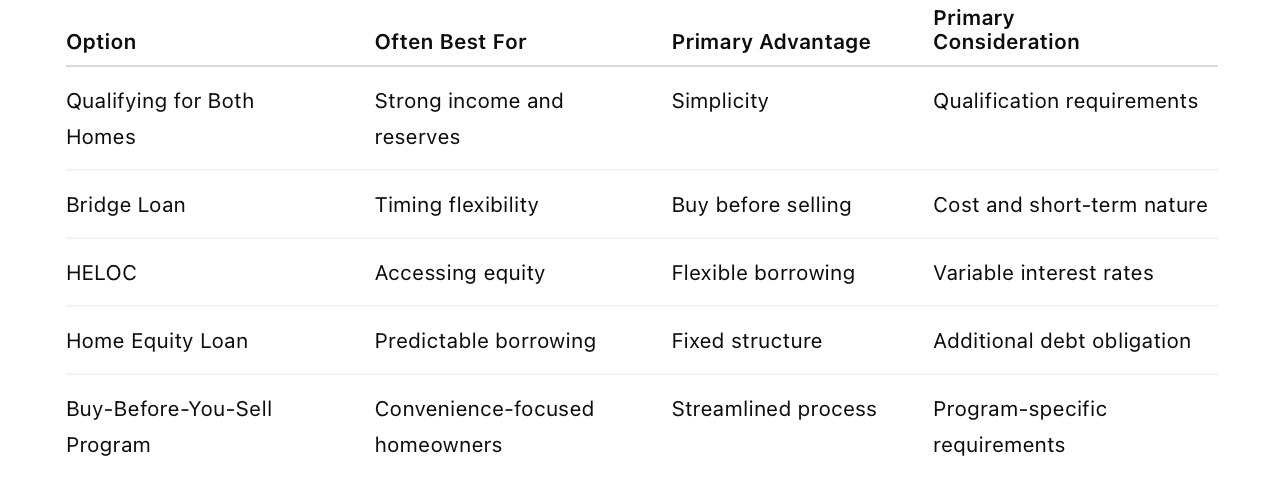
Which Option Fits Your Situation?
If your priority is simplicity, qualifying for both homes may be worth exploring.
If your priority is accessing equity, a HELOC or home equity loan may deserve consideration.
If your priority is securing a specific property before it disappears from the market, bridge financing may provide additional flexibility.
If your priority is convenience and reducing logistical complexity, a buy-before-you-sell program may be attractive.
The best solution depends less on the product itself and more on the problem you are trying to solve.
Can You Access All of Your Equity?
Not necessarily.
Many homeowners assume they can automatically borrow against all available equity.
In reality, lenders typically evaluate:
• Current mortgage balance
• Estimated home value
• Debt-to-income ratio
• Income and employment
• Credit profile
• Available cash reserves
The amount that can be accessed varies significantly from one homeowner to another.
This is why early planning matters.
The goal is understanding your options before you need them.
How This Fits Into Your Overall Moving Plan
Financing is only one piece of the puzzle.
The bigger challenge is coordinating the entire transition.
Understanding bridge loans, HELOCs, home equity loans, and buy-before-you-sell programs becomes far more valuable when paired with a thoughtful strategy for timing the sale and purchase.
Likewise, seeing how other Louisville homeowners have successfully navigated these decisions can provide perspective and confidence.
The goal is not simply finding financing.
The goal is creating a move that feels manageable.
Financing is only one piece of the puzzle. Coordinating timelines, possession dates, and closing schedules is equally important when selling one home and buying another.
Frequently Asked Questions
Can I buy a house before selling my current house?
Yes. Depending on your finances, you may qualify for both homes simultaneously, use a bridge loan, access home equity, or use a specialized buy-before-you-sell program.
How much equity do I need to buy another home?
There is no universal amount. Available equity, lender requirements, debt obligations, and income all influence what options may be available.
What is a bridge loan?
A bridge loan is short-term financing designed to help homeowners purchase a new home before their current home sells.
Is a HELOC better than a bridge loan?
Neither is inherently better. They solve different problems and work best in different situations.
Can I use home equity as a down payment?
In some cases, yes. A lender can help determine what options may be available based on your situation.
Should I buy before selling?
It depends on your finances, risk tolerance, available inventory, and overall moving goals.
Thinking About Moving But Unsure Where to Start?
Most homeowners do not need financing advice first.
They need clarity first.
Understanding your home's value, available equity, likely sale timeline, and potential financing options creates a much stronger foundation for decision-making.
A planning conversation before you begin house hunting can often reveal opportunities you did not realize existed.
The earlier you understand your options, the more flexibility you typically have when the right home appears.
Final Thoughts
Many homeowners assume they cannot move until their current home sells.
That is sometimes true.
But often, there are more options available than they realize.
Bridge loans, HELOCs, home equity loans, and buy-before-you-sell programs all exist because homeowners face this challenge every day.
The goal is not finding the perfect financing product.
The goal is creating enough flexibility that you can make a good housing decision without feeling trapped by timing.
Because moving should be driven by your goals.
Not by fear.
How to Move Without Getting Stuck Between Homes
Thinking about selling your current home while buying another? Learn the three most common ways Louisville homeowners make a move, plus strategies for timing, equity, contingencies, rent-back agreements, and avoiding the stress of getting stuck between homes.
The Louisville Homeowner's Guide to Selling and Buying at the Same Time

Most successful moves begin with a plan long before the first sign goes in the yard.
Most homeowners who contact me about moving have already made the decision emotionally.
They simply have not figured out the logistics yet.
The house may no longer fit their lifestyle. The maintenance may feel heavier than it once did. A growing family may need more space, while an empty nester may be caring for rooms that rarely get used. Sometimes the home still works perfectly well, but life has changed around it.
The challenge is rarely deciding whether a move makes sense.
The challenge is figuring out how to move from one home to another without creating unnecessary stress along the way.
What happens if your home sells before you find another one? What if you find the right home before yours sells? Can you use your equity to buy before selling? Will you have to move twice?
These questions cause many homeowners to delay decisions they may otherwise be ready to make.
The good news is that homeowners successfully navigate this transition every day. The key is understanding your options before making the first move.
Can You Sell and Buy a Home at the Same Time?
Quick Answer
Yes.
Most Louisville homeowners who move are selling one home while purchasing another. Depending on their finances and timeline, the transition may involve coordinated closing dates, sale contingencies, rent-back agreements, bridge financing, or other equity-access strategies.
The key is creating a plan before your current home goes on the market.
How Do You Sell and Buy a Home at the Same Time?
Most Louisville homeowners accomplish this in one of three ways:
• Sell first, then buy
• Buy first, then sell
• Coordinate both transactions through timing strategies such as contingencies, rent-back agreements, or bridge financing
The right approach depends on your available equity, financing options, timeline, and the availability of homes in your target area.
While every situation is different, homeowners who plan the transition before listing their home typically have more flexibility and experience less stress throughout the process.
What This Looks Like in Louisville Right Now
One reason homeowners feel stuck is that today's market does not fit neatly into old assumptions.
Many Louisville homeowners have built significant equity over the last several years. At the same time, inventory remains limited in many popular neighborhoods and price ranges.
As a result, selling may not be the difficult part.
Finding the right next home may be.
A homeowner moving from a larger home in Lake Forest into a patio home faces a different challenge than a growing family trying to move into Middletown, Prospect, Oldham County, Norton Commons, or another highly sought-after area.
In many of these areas, homeowners can sell successfully and still struggle to find the right replacement property simply because available inventory remains limited.
The strongest plans are built around the realities of your specific move, not broad headlines about the market.
Understanding both sides of the transition—your current home's likely sale and your next home's availability—is often where clarity begins.
What If You Have a Low Mortgage Rate?
Quick Answer
A low mortgage rate should be part of the decision.
It should not become the entire decision.
Many homeowners who purchased or refinanced several years ago have mortgage rates that would be difficult to replace today. That reality deserves consideration.
At the same time, a home is more than a financing tool.
It is supposed to support the life being lived inside it.
If your current home still fits your needs, staying may be the right choice.
If your home no longer fits your lifestyle, family needs, maintenance preferences, or long-term goals, then the conversation becomes larger than an interest rate.
The homeowners who gain the most clarity often stop asking, "Can I get this rate again?" and start asking, "What am I gaining by staying, and what am I giving up?"
That is usually where the real answer begins.
If your current mortgage rate is one of the biggest reasons you're reluctant to make a move, I take a closer look at the financial and practical tradeoffs in I Have a Great Mortgage Rate. Does It Still Make Sense to Move?
The Decision Is Usually Easier Than the Process
Most homeowners know whether they want to move long before they know how they want to move.
The decision often becomes clear through everyday life. A home feels too large, too small, too far away, too much work, or simply out of sync with the season of life someone is in.
What creates hesitation is rarely the decision itself.
It is the process.
Once homeowners understand the available paths forward, many discover the move is more manageable than they originally imagined.
Good planning does not eliminate every surprise.
It simply replaces uncertainty with options.
What Most Homeowners Get Wrong About Moving
Many homeowners believe the biggest challenge is selling their current home.
In reality, the bigger challenge is often creating a realistic plan for the next one.
The homeowners who experience the least stress typically spend more time planning the transition than preparing the property for sale.
They understand where their equity stands, how financing may work, what neighborhoods they want to target, and what backup plans exist if timing does not unfold exactly as expected.
The goal is not creating a perfect plan.
The goal is creating enough clarity that decisions become easier when opportunities arise.
The Three Ways Most Homeowners Make a Move
Most homeowners who sell and buy at the same time follow one of three broad paths. Each can work. Each has trade-offs. The best choice depends on your finances, timeline, and priorities.
Sell First, Then Buy
Selling first creates the greatest financial certainty.
You know how much equity you have available, what your proceeds will likely look like, and what budget you can comfortably use for the next purchase.
The trade-off is timing.
If your home sells before you find another one, you may need temporary housing, storage, or additional flexibility.
For homeowners who value financial clarity above all else, this approach often makes the most sense.
Buy First, Then Sell
Buying first allows you to secure the next home before letting go of the current one.
This approach can reduce the pressure of finding a replacement property quickly, especially if your housing needs are very specific.
The challenge is financing.
Depending on your situation, you may need bridge financing, access to home equity, or the ability to qualify while still owning your current home.
For homeowners considering this path, it helps to understand the various buy-before-you-sell programs, bridge financing options, and equity-access strategies that may be available.
For homeowners with strong equity positions and stable finances, this can be an effective option.
Coordinate Both Transactions
This is the approach many homeowners hope to achieve.
The goal is to align the sale and purchase so you can move once, minimize disruption, and create a smoother transition.
This often involves coordinating closing dates, negotiating possession timelines, or using tools such as rent-back agreements.
It typically requires more planning, but it can create the least stressful overall experience.
Thoughtful planning around timelines, possession dates, and contingency periods can often eliminate the need for temporary housing or a double move.
If your biggest concern is timing rather than financing, you may also find our guide on coordinating closing dates and avoiding a double move helpful.
What Happens If My Home Sells Before I Find Another One?
This is one of the most common concerns homeowners have.
The good news is that several options may exist.
Depending on your situation, you may be able to negotiate a longer closing period, use a rent-back agreement, arrange temporary housing, or delay listing until your purchase strategy becomes clearer.
The important thing is discussing these possibilities before they happen.
A strong plan does not assume everything will line up perfectly.
It prepares for multiple outcomes.
What Happens If I Find the Right Home Before Mine Sells?
The opposite concern can feel just as stressful.
Sometimes the right home appears before the current home has sold. When that happens, preparation becomes valuable.
Possible solutions may include a sale contingency, bridge financing, home equity access, a longer closing timeline, or qualifying to purchase before selling.
The right solution depends on your finances, the competitiveness of the home you want to buy, and the likely marketability of your current home.
Planning ahead creates more options than reacting under pressure.
What Is a Sale Contingency?
A sale contingency allows a buyer to purchase a home only if their current home sells successfully.
In practical terms, it provides financial protection.
Rather than being obligated to purchase a new home regardless of what happens with the old one, the contingency creates a safeguard.
The trade-off is that some sellers may prefer offers without contingencies.
Whether a sale contingency makes sense depends on the market, the property, and the strength of the overall offer.
Sale contingencies are often discussed alongside rent-back agreements, but they solve very different problems. A sale contingency helps address a financing concern, while a rent-back agreement helps address a timing concern.
Like many real estate tools, a sale contingency is neither good nor bad. It simply serves a specific purpose.
What Is a Rent-Back Agreement?
A rent-back agreement allows a seller to remain in the home for a period after closing.
If a sale contingency helps solve a financial challenge, a rent-back agreement helps solve a timing challenge.
For homeowners trying to avoid moving twice, this can be one of the most useful tools available.
A properly structured rent-back can provide additional time to purchase the next home, coordinate movers, finish packing, or avoid temporary housing altogether.
The details matter, which is why these agreements should be carefully documented and negotiated.
Can You Use Your Equity Before Selling?
Many homeowners have substantial equity but cannot easily access it until their home sells.
Depending on your financial situation, there may be several options worth discussing with a lender.
One common misconception is that all available equity can automatically be used toward the next purchase. In reality, lenders evaluate factors such as loan-to-value ratios, credit profile, income, existing obligations, and the amount of equity available.
The amount a homeowner can access varies significantly from one situation to another.
This is why conversations with both a lender and real estate professional are often helpful before making decisions about timing.
For homeowners exploring bridge loans, HELOCs, home equity loans, or buy-before-you-sell programs, our guide to buying a new home before selling your current one explores these options in greater detail.
Bridge Loans
Bridge loans provide short-term financing designed to help homeowners purchase a new property before the current home sells.
Home Equity Line of Credit (HELOC)
A HELOC may allow access to available equity before the home is sold, creating additional flexibility during the transition.
Home Equity Loan
A home equity loan provides a lump sum secured by the equity in the home.
Buy-Before-You-Sell Programs
Some lenders offer specialized programs designed to help homeowners purchase before selling.
Every option carries different requirements, costs, and risks. A lender can help determine which solutions may be appropriate for your situation.
The First Conversation to Have Before You List
Most homeowners assume the first step is preparing the house.
Often, it is not.
The first step is understanding the move.
Before listing, it helps to answer several important questions:
• Do I need the proceeds from my current home to purchase the next one?
• Can I qualify before selling?
• How flexible am I on timing?
• What type of home am I hoping to buy?
• What would I do if my home sold in the first week?
• What would I do if it took longer than expected to find the next home?
You do not need perfect answers.
You simply need enough clarity to understand your available options.
That conversation alone often removes much of the uncertainty that causes homeowners to feel stuck.
A Common Louisville Scenario
Imagine a homeowner in Lake Forest who purchased their home when their children were in elementary school.
Twelve years later, one child is in college and another is preparing to leave home. Entire rooms sit unused. The yard requires more maintenance than they enjoy. Travel has become a bigger priority than square footage.
The challenge is not selling the home.
The challenge is deciding how to move into something smaller without creating unnecessary disruption.
Before listing, they review their home's value, estimate their available equity, speak with a lender, and identify the type of home they hope to buy next. They discuss timing, contingency options, and backup plans before the first showing ever takes place.
The result is not a perfect transaction.
It is a predictable one.
And predictable usually feels far better than stressful.
You can also see how these strategies play out in real-world situations in How Louisville Homeowners Successfully Sell and Buy at the Same Time.
Frequently Asked Questions
How do I sell and buy a home at the same time?
By treating both transactions as one coordinated transition and creating a plan before listing or making an offer.
Should I sell before buying?
It depends on whether financial certainty or timing flexibility matters most in your situation.
Can I buy before mine sells?
Possibly. Some homeowners can qualify before selling, while others may need bridge financing or access to home equity.
What is a sale contingency?
A contract provision that makes a purchase dependent on the successful sale of the buyer's current home.
What is a rent-back agreement?
An agreement that allows a seller to remain in the home for a period after closing.
How early should I start planning?
Most homeowners benefit from beginning the planning process 60 to 120 days before they hope to move.
Thinking About Making a Move?
If you're considering selling one home while buying another, the first step is understanding your options before you list.
A planning conversation can help clarify:
• Your available equity
• Potential financing options
• Timing strategies
• Backup plans if the market changes
• What your current home is likely to sell for
• What opportunities may exist in your target area
Every move is different, but the goal is the same: creating a path forward that fits your life, finances, and timeline.
Final Thoughts
Many homeowners believe the hardest part of moving is selling their home.
More often, the hardest part is understanding how all the pieces fit together.
The good news is that you do not have to solve every piece at once.
You simply need a plan.
The homeowners who move with the most confidence are rarely the ones who perfectly time the market. They are the ones who understand their options before making decisions.
If you are considering a move, start there.
Not with packing.
Not with a sign in the yard.
Start with a clearer understanding of your path forward.
The goal is not finding the perfect strategy.
It is finding the strategy that helps you move forward with confidence.
Because your move deserves care, not chaos.
Will Lower Interest Rates Actually Make Buying Easier in Louisville?
Many Louisville buyers are waiting for lower interest rates before making a move. But lower rates do not always create an easier market. In many cases, they increase buyer competition, push prices higher, and create more emotional pressure around buying decisions. This article explores what lower interest rates could actually mean for affordability, competition, and long-term buying strategy in Louisville.

Many Louisville buyers are waiting for lower interest rates, but lower rates do not always mean an easier market.
A lot of buyers are waiting for one thing right now.
Lower interest rates.
I hear it constantly.
“We are just going to wait until rates come down.”
And honestly, I understand why people feel this way.
Higher mortgage rates have changed affordability dramatically for many Louisville buyers.
Monthly payments feel heavier. Budget flexibility feels tighter. And people want to feel confident they are making a smart long-term decision.
But there is an important part of this conversation that many people are not fully considering.
Lower rates do not automatically create an easier market.
In many cases, they create a far more competitive one.
Will lower interest rates make buying a home easier in Louisville?
Possibly, but not always. Lower interest rates can reduce monthly mortgage payments, but they also tend to increase buyer competition, drive up home prices, and create multiple-offer situations in many Louisville neighborhoods. The overall market often becomes more competitive as affordability improves.
Why lower rates often increase competition
When mortgage rates drop, more buyers re-enter the market.
People who were waiting suddenly feel ready to move.
That means:
more buyers competing for homes
more pressure on inventory
more multiple-offer situations
faster-moving listings
stronger pricing pressure
In Louisville, where inventory already remains limited in many areas, this can create an even more aggressive buying environment.
For some buyers, lower monthly payments may quickly be offset by rising home prices and increased competition.
Many buyers are already feeling emotionally exhausted trying to decide whether waiting is helping them or simply keeping them stuck. The Hidden Cost of Waiting to Buy or Sell in Louisville explores why uncertainty itself often becomes emotionally draining over time.
What buyers often misunderstand about affordability
Most people naturally focus on the interest rate itself.
But affordability is more complicated than rates alone.
The overall market matters too.
That includes:
home prices
competition
inventory levels
negotiation power
appraisal pressure
speed of the market
Sometimes buyers secure a lower rate but still end up paying significantly more for the home itself.
Other times, buyers may benefit from less competition in a higher-rate environment.
That is why market timing is rarely as simple as waiting for one number to change.
Many buyers eventually realize the uncertainty itself starts becoming emotionally exhausting. Why So Many Louisville Homeowners Feel Stuck Right Now explores why so many families feel emotionally frozen in today’s market even when they know life may need to change.
What is happening in the Louisville market right now?
Many Louisville buyers are currently caught between affordability concerns and uncertainty about future rates.
Some feel pressure to wait. Some feel pressure to move quickly. Some are afraid of making the wrong financial decision.
At the same time:
inventory remains relatively limited in many neighborhoods
buyers are closely watching Federal Reserve news
homeowners with low rates remain hesitant to sell
affordability concerns continue shaping buyer behavior
This creates emotional hesitation across the market.
But real estate decisions are rarely just financial.
They are deeply connected to lifestyle, timing, family needs, and long-term goals.
A framework for thinking about interest rates more clearly
1. Focus on monthly payment comfort first
The most important question is not: “What is the perfect rate?”
It is: “Does this payment fit comfortably into real life?”
Long-term sustainability matters far more than chasing perfect timing.
2. Understand that rates change over time
Many buyers forget that mortgage rates are not necessarily permanent.
Some buyers choose to refinance later if rates improve.
That does not mean buyers should ignore rates.
But it does mean today’s rate is only one part of a much larger long-term decision.
3. Consider the competition environment
A slightly higher rate in a calmer market can sometimes create better buying opportunities than a lower-rate environment filled with bidding wars.
The overall market dynamic matters.
4. Build decisions around life, not headlines
The strongest housing decisions are usually based on:
long-term goals
family needs
lifestyle fit
stability
timing needs
Not simply trying to predict the market perfectly.
What most buyers get wrong about interest rates
One of the biggest misconceptions is believing lower rates automatically remove stress from the buying process.
In reality, lower rates often increase emotional pressure because competition intensifies quickly.
Homes move faster. Negotiations become harder. Multiple offers return.
The market often becomes emotionally more intense, not less.
The buyers who navigate this best usually focus less on predicting rates and more on understanding what makes sense for their personal situation.
That usually starts by slowing the conversation down enough to separate market fear from real-life needs. How to Make a Real Estate Decision When the Market Feels Uncertain explores how many Louisville buyers are learning to make calmer, more confident decisions without waiting for perfect certainty.
A real-life pattern I see often
I recently spoke with buyers who had delayed purchasing for nearly two years while waiting for rates to improve.
During that time:
home prices increased
competition fluctuated repeatedly
inventory stayed tight
their frustration continued growing
Eventually they realized they were waiting for certainty that was unlikely to fully arrive.
Once we focused less on predicting the market and more on creating a realistic long-term plan, the conversation became much calmer.
Not because the market suddenly became easy.
Because the decision became centered around their life instead of constant market headlines.
Frequently Asked Questions
Will lower interest rates reduce monthly payments?
Usually yes. Lower interest rates can reduce monthly mortgage payments, depending on the loan amount and purchase price.
Could lower rates increase home prices?
Yes. Lower rates often increase buyer demand, which can push prices higher in many Louisville neighborhoods.
Is waiting for lower rates always the best strategy?
Not necessarily. Waiting can sometimes create more competition, fewer negotiation opportunities, and additional emotional stress.
Many homeowners are already discovering that waiting for perfect certainty can quietly become emotionally exhausting over time. The Hidden Cost of Waiting to Buy or Sell in Louisville explores why waiting itself often becomes emotionally heavier than expected.
Should I buy now or wait?
That depends more on your long-term goals, financial comfort, and lifestyle needs than trying to predict the market perfectly.
What matters more than the interest rate itself?
Payment comfort, long-term stability, lifestyle fit, and overall financial sustainability usually matter more than the rate alone.
If you are trying to make sense of today’s market, you are not alone.
A lot of Louisville buyers are carrying the same uncertainty right now.
Not because they are uninformed.
Because the market feels emotionally and financially complicated.
The good news is that you do not need perfect timing to make a thoughtful decision.
Sometimes clarity comes from slowing the conversation down and focusing on what actually matters most for your life long term.
No pressure. No rushed decisions. Just thoughtful guidance built around your goals, finances, and timing.
If you are trying to understand whether waiting or moving forward makes more sense in today’s Louisville market, I am always happy to help you think through the options calmly and clearly.
Because your move deserves care, not chaos.
How to Make a Real Estate Decision When the Market Feels Uncertain
Many Louisville homeowners and buyers are struggling to make confident real estate decisions in a market filled with uncertainty, interest rate concerns, and emotional pressure. This article explores how to move beyond fear and information overload by building thoughtful decisions around lifestyle, long-term goals, financial comfort, and real-life needs instead of trying to predict the market perfectly.

Many Louisville homeowners are not looking for perfect certainty. They are simply trying to make thoughtful decisions in a market that feels emotionally complicated.
Most people are not looking for a perfect market.
They are looking for reassurance that they are not making a mistake.
That is the part I hear most often right now.
Not: “What is the perfect interest rate?”
Not: “What will prices do next year?”
But: “How do we know if this is the right decision?”
And honestly, I understand why this feels so difficult.
The housing market has become emotionally loud.
Every day people hear:
conflicting predictions
recession fears
interest rate headlines
affordability concerns
market crash opinions
pressure to wait
pressure to move quickly
Eventually, many people stop trusting themselves completely.
And when that happens, even thoughtful decisions start feeling emotionally heavy.
How do you make a real estate decision when the market feels uncertain?
The best real estate decisions are usually built around long-term lifestyle needs, financial comfort, timing, and personal goals rather than trying to predict the market perfectly. Many Louisville homeowners and buyers feel overwhelmed by uncertainty, but clarity often comes from slowing down and creating a thoughtful plan instead of reacting emotionally to headlines.
Why uncertainty feels heavier right now
Most real estate decisions already carry emotion.
But today’s market adds another layer: constant information overload.
People are consuming:
market predictions
mortgage updates
social media opinions
national housing headlines
financial fear messaging
And much of it does not reflect what is actually happening in their personal life or even in Louisville specifically.
Over time, this creates decision fatigue.
People stop asking: “What makes sense for our life?”
And start asking: “What if we regret this later?”
Many homeowners first begin feeling emotionally frozen when every housing decision starts feeling heavier than it used to. Why So Many Louisville Homeowners Feel Stuck Right Now explores why emotional hesitation has become such a common experience in today’s market.
The market is only one part of the decision
One of the biggest mistakes people make is believing housing decisions are purely financial.
They are not.
They are deeply connected to:
daily stress
lifestyle
commuting
maintenance
family needs
health
relationships
quality of life
future goals
Sometimes the right decision financially is not the right decision emotionally.
And sometimes the right life decision is worth moving through a less-than-perfect market.
That does not mean people should ignore finances.
It means finances are only one piece of a much larger conversation.
What is happening in Louisville right now?
Many Louisville homeowners and buyers are currently caught between competing pressures.
Some are afraid to move because of higher interest rates. Some are afraid to wait because prices may continue rising. Some feel trapped by low mortgage rates they secured years ago. Some know their current home no longer fits their life but cannot decide what to do next.
At the same time:
inventory remains limited in many areas
affordability pressure remains real
uncertainty around rates continues
buyers and sellers both feel cautious
This creates a market where emotional hesitation becomes extremely common.
But uncertainty itself does not automatically mean a decision is wrong.
A framework for making clearer decisions
1. Separate headlines from your actual life
National housing headlines are designed to grab attention.
But your decision should be built around your:
finances
goals
timing
stress level
family needs
lifestyle
The market is important.
But your life matters more.
2. Focus on long-term sustainability
The best housing decisions are usually not about “winning” the market.
They are about:
stability
comfort
sustainability
alignment with life goals
Long-term clarity matters more than short-term perfection.
3. Understand that uncertainty never disappears completely
Many people are waiting for the market to finally feel obvious.
But real estate has always involved uncertainty.
The goal is not eliminating uncertainty entirely.
It is making thoughtful decisions despite uncertainty.
4. Slow the process down
Most overwhelmed people try to solve everything at once.
That creates paralysis.
Clarity usually comes from slowing the conversation down enough to:
ask better questions
organize priorities
evaluate options carefully
reduce emotional noise
What most people get wrong about market timing
One of the biggest misconceptions is believing confident people somehow “know” what the market will do next.
Most do not.
The people who feel most confident are usually the ones who stopped trying to predict everything perfectly.
Instead, they focused on:
what they needed
what they could comfortably afford
what kind of life they wanted next
what problems they were actually trying to solve
That shift changes everything emotionally.
Many homeowners eventually realize that waiting for certainty can quietly become its own source of stress and emotional exhaustion. The Hidden Cost of Waiting to Buy or Sell in Louisville explores why delaying decisions often creates pressure people do not initially recognize.
A real-life pattern I see often
I recently spoke with homeowners who had spent nearly two years trying to decide whether to move.
Every few months:
rates changed
headlines shifted
new fears appeared
uncertainty increased
So they paused again.
Meanwhile:
the home became harder to maintain
stress increased
life needs continued changing
the emotional weight kept growing
Once we stopped focusing on trying to predict the market perfectly and instead focused on building a realistic plan around their life, the conversation became much calmer.
Not because uncertainty disappeared.
Because clarity finally started replacing fear.
Frequently Asked Questions
How do I know if now is the right time to move?
The best timing usually depends more on your long-term goals, lifestyle needs, financial comfort, and stress level than predicting the market perfectly.
Is waiting safer in an uncertain market?
Not always. Waiting can sometimes create emotional stress, maintenance costs, lifestyle frustration, and missed opportunities.
What if interest rates improve later?
They might. But lower rates can also increase buyer competition and home prices.
Many buyers are discovering that lower interest rates do not always create a calmer or easier market. Will Lower Interest Rates Actually Make Buying Easier in Louisville? explains why lower rates can sometimes increase competition and emotional pressure for buyers.
How do I stop feeling overwhelmed by the market?
Focus less on headlines and more on building a thoughtful plan around your own life, goals, finances, and priorities.
What is the first step toward clarity?
Usually it starts with identifying what problem you are truly trying to solve.
If the market feels emotionally heavy right now, you are not alone.
A lot of Louisville homeowners and buyers are carrying this same uncertainty.
Not because they are uninformed.
Because major life decisions become difficult when the future feels unclear.
The good news is that you do not have to solve everything all at once.
Sometimes clarity starts by slowing the conversation down enough to focus on what actually matters most for your life moving forward.
No pressure. No rushed decisions. Just thoughtful guidance built around your goals, timing, finances, and concerns.
If you are trying to work through a real estate decision in today’s Louisville market, I am always happy to help you think through the options calmly and clearly.
Because your move deserves care, not chaos.
Why So Many Louisville Homeowners Feel Stuck Right Now
Many Louisville homeowners feel stuck right now between higher interest rates, limited inventory, and major life changes. But often the biggest challenge is not the market itself. It is the emotional weight of trying to make the “right” decision in an uncertain time. This article explores why so many people feel frozen in today’s housing market and how thoughtful clarity can help people move forward with more confidence and less overwhelm.

Many Louisville homeowners are feeling caught between life changes and uncertainty in today’s housing market.
Sometimes the hardest part is not deciding to move.
A conversation I hear often starts quietly.
Usually at a kitchen table.
Or while walking through a home someone has loved for years.
It sounds something like this:
“We talk about moving all the time… but we just cannot seem to make a decision.”
And honestly, I understand why.
Right now, many Louisville homeowners feel caught between two realities at the same time.
The house no longer fits life the way it once did.
But the market no longer feels simple enough to move confidently through either.
So people wait.
Not because they are careless.
Not because they are uninformed.
Because every option feels heavy.
And that feeling is becoming more common than most people realize.
Why do people feel stuck in today’s housing market?
Many Louisville homeowners feel stuck because higher interest rates, limited inventory, and fear of making the wrong decision have created both emotional and financial uncertainty around moving. At the same time, life keeps changing, leaving many families caught between staying and moving forward.
Often, this feeling builds slowly over years — sometimes decades — in the same home.
And for many people, it doesn’t happen all at once.
What starts as a quiet feeling of overwhelm gradually becomes harder to ignore:
too much maintenance,
unused rooms,
stairs becoming more difficult,
or simply the realization that life has changed while the house stayed the same.
Why do so many Louisville homeowners feel stuck right now?
Many homeowners in Louisville feel stuck because the housing market feels uncertain while life continues changing underneath them.
Interest rates remain significantly higher than they were a few years ago.
Inventory is still limited in many Louisville neighborhoods and price points.
Homeowners with historically low mortgage rates often feel financially trapped in homes that no longer fully fit their needs.
At the same time, real life keeps moving forward.
Families grow.
Parents age.
Commutes wear people down.
Maintenance becomes exhausting.
Unused rooms become reminders of seasons that have already changed.
The result is a growing number of homeowners who feel emotionally ready for change but psychologically afraid to make the wrong decision.
The emotional tension behind today’s Louisville market
Most real estate conversations focus on numbers.
Rates.
Prices.
Inventory.
Predictions.
But what I see most often is emotional fatigue.
People are tired of trying to time everything perfectly.
They are waiting for:
lower interest rates
more certainty
better inventory
calmer headlines
the “right” moment
Meanwhile, many are quietly living in homes that no longer support the life they actually want.
Some feel overwhelmed by maintenance.
Some are caring for aging parents from too far away.
Some have outgrown the home emotionally long before they outgrew it financially.
Some are staying only because they locked in a 3 percent interest rate years ago.
And over time, uncertainty turns into paralysis.
What is actually happening in the Louisville market right now?
The Louisville market is creating an unusual emotional dynamic for homeowners.
Many people who purchased or refinanced during historically low interest rates now feel anchored to those rates, even if their current home no longer works well for their lifestyle.
At the same time:
inventory remains relatively constrained in many areas
affordability pressures continue affecting buyers
replacement homes feel more expensive
market headlines create conflicting messages daily
This leaves homeowners asking:
“If we move now, are we making a mistake?”
But what often gets missed is this:
Waiting is also a decision.
For many homeowners, the bigger question is whether waiting is actually protecting them or quietly keeping life stuck in place. The Hidden Cost of Waiting to Buy or Sell in Louisville explores why waiting itself can sometimes create emotional, financial, and lifestyle pressure over time.
And sometimes waiting carries its own emotional, financial, and lifestyle costs.
A simple framework for getting unstuck
The families who move through uncertain markets most successfully usually stop asking:
“What is the perfect market timing?”
And start asking:
“What problem are we actually trying to solve?”
That shift changes everything.
1. Identify what is creating stress right now
Is the issue:
maintenance?
stairs?
commuting?
unused space?
caregiving?
financial strain?
isolation?
lack of functionality?
The clearer the real issue becomes, the easier decisions become.
2. Separate market fear from life reality
Headlines are loud.
But most housing decisions are deeply personal.
Sometimes the right move is less about chasing perfect rates and more about improving daily quality of life.
3. Understand all available options
Many homeowners assume they only have two choices:
move immediately or stay stuck.
That is rarely true.
Sometimes there are creative timing solutions, bridge strategies, temporary plans, or gradual transition approaches that reduce pressure significantly.
4. Focus on long-term fit, not short-term noise
A low interest rate does not automatically mean a home is still the right fit for life.
And a higher interest rate does not automatically mean moving is the wrong decision.
The goal is not perfection.
It is alignment between your life and your home.
What most people get wrong about waiting
One of the biggest misconceptions I see is the belief that uncertainty will eventually disappear completely.
Most people are waiting for the market to finally feel safe again.
But real estate has always involved some level of uncertainty.
The difference now is that people are consuming constant market information without enough clarity around their own personal goals.
And when every decision becomes filtered through fear, people often stop moving forward altogether.
The families who feel most confident are rarely the ones who predicted the market perfectly. They are usually the ones who became clear about what mattered most to them personally.
Many homeowners first begin noticing this tension when their current home no longer feels aligned with the life they are trying to live now. How to Make a Real Estate Decision When the Market Feels Uncertain explores why clarity often begins when people stop trying to predict the market perfectly and start focusing on what matters most in real life.
A real-life pattern I see often in Louisville
Recently, I spoke with homeowners who had been discussing a move for nearly three years.
Every few months they revisited the conversation.
Then rates changed.
Or inventory tightened.
Or another scary headline appeared.
So they paused again.
Meanwhile:
the house became harder to maintain
stairs became increasingly difficult
they stopped using half the home
they felt more isolated from family
The market itself was no longer the biggest obstacle.
The fear of making the wrong decision was.
Once we slowed the conversation down and focused less on headlines and more on how life actually felt inside the home, clarity started appearing quickly.
Not because the market became perfect.
Because the decision became personal again instead of theoretical.
Frequently Asked Questions
Should I wait for interest rates to drop before buying in Louisville?
Not always. Lower interest rates often increase buyer competition and can push home prices higher. The better question is whether your current home and lifestyle still fit your needs today.
Many buyers are also quietly wondering whether lower rates will actually improve affordability once competition increases again. Will Lower Interest Rates Actually Make Buying Easier in Louisville? explains why lower rates do not always create a calmer or more affordable market.
Are Louisville home prices expected to decline significantly?
Most Louisville neighborhoods continue experiencing relatively limited inventory, which has helped stabilize pricing. Some areas may soften slightly, but widespread dramatic price declines are not expected in many local markets.
Why do homeowners feel trapped by low mortgage rates?
Many homeowners secured historically low rates in recent years and now feel emotionally tied to keeping those rates, even when the home itself no longer supports their lifestyle well.
Is waiting always the safer financial decision?
Not necessarily. Waiting can sometimes increase maintenance costs, emotional stress, commuting burdens, or delay important life transitions.
What is the best first step if I feel stuck?
Start by identifying what problem you are truly trying to solve. Clarity usually begins there.
Related Louisville Real Estate Topics
If this conversation resonates with you, these may also help:
How to Make a Real Estate Decision When the Market Feels Uncertain
The Hidden Cost of Waiting to Buy or Sell
Will Lower Interest Rates Actually Make Buying Easier in Louisville?
The Signs a Home May No Longer Fit Your Life
If you are feeling stuck, you are not alone.
A lot of Louisville homeowners are quietly carrying this same tension right now.
Not because they are making poor decisions.
Because major life transitions become difficult when the market feels uncertain and every option feels heavy.
The good news is that you do not have to figure it all out at once.
Sometimes clarity starts with a simple conversation about what life actually needs next.
No pressure. No rushed decisions. Just a thoughtful plan built around your goals, timing, and concerns.
If you are trying to decide whether moving makes sense in today’s Louisville market, I am always happy to help you think through the options calmly and clearly.
Because your move deserves care, not chaos.
The Hidden Cost of Waiting to Buy or Sell in Louisville
Waiting to buy or sell a home often feels safer at first. But for many Louisville homeowners, waiting can quietly create emotional, financial, and lifestyle stress that builds over time. This article explores the hidden cost of delaying real estate decisions and how to evaluate whether waiting is truly helping or simply keeping life stuck in place.

Many Louisville homeowners are quietly carrying the emotional weight of delayed housing decisions while waiting for the market to feel safer.
Most people think waiting feels safer.
At first, it usually does.
Waiting can feel responsible. Careful. Smart.
Especially in a market where headlines constantly talk about interest rates, affordability, inventory, and uncertainty.
So people pause.
They tell themselves:
maybe next spring
maybe after rates drop
maybe when inventory improves
maybe when things calm down
But over time, I have noticed something important.
For many Louisville homeowners, the biggest cost of waiting is not always financial.
It is emotional.
Why are Louisville homeowners waiting to move?
Many Louisville homeowners are delaying real estate decisions because higher interest rates, limited inventory, and fear of making the wrong decision have created uncertainty around moving. However, waiting often creates emotional, financial, and lifestyle costs that many families do not initially recognize.
The emotional cost of staying stuck
Most people think market timing is the biggest issue.
But what I often see is people quietly living in situations that no longer fit their lives well.
Some are overwhelmed by maintenance. Some are staying in homes that feel too large. Some are commuting farther than they want. Some are delaying moves closer to family. Some are living in homes that no longer support aging comfortably.
And every few months, they revisit the conversation.
Then another headline appears. Another rate update. Another reason to wait.
Over time, uncertainty slowly becomes emotional exhaustion.
For many homeowners, this feeling of being stuck starts long before they fully recognize how much stress the current home is creating. Why So Many Louisville Homeowners Feel Stuck Right Now explores why emotional hesitation has become so common in today’s Louisville market.
What is actually happening in the Louisville market?
The Louisville market has created a difficult emotional balance for homeowners.
Many people still hold historically low mortgage rates.
At the same time:
replacement homes feel more expensive
affordability pressures remain high
inventory remains limited in many neighborhoods
uncertainty around future rates continues creating hesitation
This causes many homeowners to believe they should wait until conditions feel perfect before making a move.
But major life decisions are rarely made in perfect conditions.
Many homeowners are waiting for the market to finally feel obvious before making a move.
And life does not usually pause while people wait.
A framework for evaluating whether waiting is helping or hurting
1. Look at what waiting is costing emotionally
Ask:
Is the current home creating stress?
Is maintenance becoming exhausting?
Is the layout still working well?
Is staying creating daily frustration?
Sometimes emotional wear matters more than market timing.
2. Look beyond interest rates alone
Mortgage rates matter.
But they are only one piece of a much larger life decision.
The right move is often about:
lifestyle
family needs
health
timing
quality of life
long-term goals
3. Understand that waiting also carries financial risk
Many people focus only on the cost of moving.
But waiting can also increase:
maintenance costs
repair expenses
delayed downsizing costs
commuting costs
future home price pressure
4. Focus on clarity instead of prediction
Most people cannot predict the perfect market.
But they can become clearer about what kind of life they want next.
That is usually where confident decisions begin.
What most people get wrong about waiting
One of the biggest misconceptions is believing that uncertainty will eventually disappear.
Most people are waiting for the market to finally feel obvious.
But housing decisions are deeply personal.
And sometimes the longer people wait, the emotionally heavier the decision quietly becomes.
The families who move through this best usually stop trying to predict the future perfectly.
They focus instead on building a thoughtful plan around their actual life.
That usually begins by understanding what is truly creating the feeling of being stuck in the first place.
Many homeowners eventually realize that clarity usually comes from slowing the conversation down enough to focus on what actually matters most. How to Make a Real Estate Decision When the Market Feels Uncertain explores how thoughtful planning often creates calmer, more confident decisions.
A real-life pattern I see often
I recently spoke with homeowners who had delayed moving for several years.
At first, waiting felt temporary.
But during that time:
maintenance became harder
stress increased
repairs piled up
family needs changed
the home became less functional
The market was not actually improving their situation anymore.
Waiting had simply become more comfortable than making a difficult decision.
Once we slowed the conversation down and focused on what daily life actually looked like, clarity started appearing quickly.
Not because the market became perfect.
Because they finally stopped trying to eliminate uncertainty completely before allowing themselves to move forward.
Frequently Asked Questions
Is waiting to buy or sell always the safer choice?
Not necessarily. Waiting can sometimes create additional emotional, financial, and lifestyle costs that outweigh potential market benefits.
Could interest rates still drop later?
The more important question may be whether lower rates will actually reduce pressure once buyer competition increases again.
Possibly. But lower rates can also increase competition and push prices higher in many Louisville neighborhoods.
Many buyers are also asking whether lower rates will actually improve affordability once competition returns. Will Lower Interest Rates Actually Make Buying Easier in Louisville? explores why lower rates can sometimes create even more pressure for buyers.
What if I move and regret it?
Most homeowners who move confidently do so because they built a thoughtful plan around their long-term needs instead of reacting emotionally to headlines.
How do I know if waiting is hurting more than helping?
If the current home is creating ongoing stress, maintenance exhaustion, isolation, or lifestyle frustration, it may be time to explore options more carefully.
What is the best first step?
Start by identifying what problem you are actually trying to solve. Clarity usually begins there.
If you are trying to decide whether to wait or move, you are not alone.
A lot of Louisville homeowners are carrying this same uncertainty right now.
Not because they are careless.
Because major life decisions feel heavy when the future feels unclear.
The good news is that you do not have to figure everything out immediately.
Sometimes clarity begins with a calm conversation about what life actually needs next.
No pressure. No rushed decisions. Just thoughtful guidance built around your goals, timing, and concerns.
If you are trying to decide whether waiting still makes sense for your situation, I am always happy to help you think through the options clearly and calmly.
Because your move deserves care, not chaos.
What Happens After a Bad Inspection Report? A Louisville Seller’s Guide to Responding Without Losing the Deal
After a bad inspection report, sellers typically negotiate repairs, credits, or price adjustments. The key is separating serious issues from normal maintenance and responding strategically rather than emotionally. Most reports look worse than they are, and how you respond in this moment plays a major role in whether the deal moves forward.

The Moment Every Seller Feels
There is a moment in almost every sale that feels heavier than the rest.
It’s not the listing.
It’s not the showings.
It’s not even the offer.
It’s the inspection.
You’ve done the work.
You’ve accepted an offer.
You’ve started to believe this is moving forward.
Then the report comes in.
And everything feels uncertain again.
Not because you expected perfection.
But because you don’t know what this means yet.
“Are they going to walk?”
“Do we have to fix all of this?”
“Is the deal falling apart?”
That moment matters more than most sellers realize.
Because what happens next isn’t about the house.
It’s about how you respond.
What Happens After a Bad Inspection Report?
After a bad inspection report, the buyer typically requests repairs, a credit, a price adjustment, or a combination of the three. The seller can agree, negotiate, partially accept, or decline based on the seriousness of the issues and the contract terms.
Most inspection reports look worse than they are. The goal is not to fix everything. The goal is to identify what actually matters and respond with strategy.
The Truth Most Sellers Don’t Hear Early Enough
An inspection report is not a verdict.
It is a negotiation tool.
That distinction changes everything.
An inspection report doesn’t tell you what to do. It shows you where the negotiation begins.
Every report combines:
real concerns
aging systems
minor maintenance
and items that simply sound bigger in writing
When everything is listed together, it feels overwhelming.
But not everything carries the same weight.
Why Inspection Reports Feel Bigger Than They Are
This stage hits emotionally before it hits logically.
Sellers often hear:
“My house isn’t as solid as I thought.”
“They’re trying to lower the price.”
“This is about to fall apart.”
But most buyers are not trying to walk away.
They are trying to reduce uncertainty.
Buyers don’t panic because a home is imperfect. They panic when they don’t understand what those imperfections mean.
That’s where this process can either stabilize…
Or escalate.

What Is Actually Happening in the Louisville Market
In today’s Louisville market, inspection negotiations are back.
Buyers are no longer waiving everything just to win
Sellers are seeing more repair requests and credits
Pricing and condition are more connected than they were a few years ago
This doesn’t mean the market is weak.
It means it is more balanced.
In a selective market, condition matters more, not less.
Homes that are:
well-prepared
well-presented
and realistically priced
tend to hold stronger positions during inspection.
Homes that stretch on condition often feel more pressure here.
The Only Way to Stay in Control: A Clear Filter
When a report comes in, everything feels urgent.
It’s not.
You only need to filter it correctly.
Separate “Serious” from “Expected”
Not everything listed is a problem.
Serious issues include:
roof failure or active leaks
electrical hazards
structural concerns
HVAC systems not functioning
moisture or foundation issues
Expected items include:
aging components
minor wear
maintenance items
cosmetic imperfections
A long report is normal. A dangerous report is not.
Ask: Will This Affect Financing or Insurance?
This is where clarity sharpens.
Some items feel stressful but don’t impact closing.
Others can stop a deal entirely.
The only issues that truly control a deal are the ones that affect financing, safety, or insurability.
That’s where attention should go first.
Understand the Buyer’s Ask Is a Starting Point
Most buyers open with a stronger request than they expect to receive.
That’s not conflict.
That’s negotiation.
The first request is rarely the final outcome.
Your job is not to react.
It’s to respond with structure.
Your 5 Real Options as a Seller
There are only five ways this moves forward.
Clarity comes from understanding them.
Option 1: Make the Repairs
Best when:
the issue is real and measurable
it will come up again with the next buyer
it protects the transaction
If the issue will follow the house, solving it now often protects your outcome later.
Option 2: Offer a Credit
Best when:
timing is tight
the buyer wants control
you want to avoid repair coordination
Credits preserve momentum.
Option 3: Adjust the Price
Best when:
multiple issues affect overall value
repairs are not urgent but still relevant
This simplifies negotiation.
Option 4: Split the Difference Strategically
Most deals land here.
You address what matters.
You hold where it doesn’t.
Strong negotiations are rarely all or nothing. They are selective and intentional.
Option 5: Hold Firm and Risk the Deal
Sometimes appropriate.
But only when:
pricing already reflects condition
requests are unreasonable
or you are prepared for the home to return to market
Holding your position is only strong if it is strategic, not emotional.
What Sellers Get Wrong in This Moment
Reacting Instead of Responding
Emotion speeds things up.
Strategy slows things down.
The fastest reactions usually create the weakest outcomes.
Fixing Too Much
Overcorrecting often costs more than negotiating.
Refusing Too Much
If the issue is real, it won’t disappear with the next buyer.
Forgetting the Bigger Picture
The goal is not to “win” the inspection.
The goal is to close the transaction with the best possible outcome.
You don’t get paid for winning negotiations. You get paid at the closing table.
A Simpler Way to Make Decisions
Instead of reacting line by line, ask:
Is this a real safety concern?
Will this affect financing or insurance?
Will the next buyer raise this again?
Is the request reasonable for the issue?
Does this keep the deal moving without overgiving?
That’s the filter.
A Louisville Reality Worth Understanding
Louisville has many homes with history.
That means:
aging systems
older construction
repairs done at different times and standard
This is normal.
Older homes don’t fail inspections. They reflect time.
The goal is not perfection.
It’s confidence.
What a Strong Seller Response Actually Sounds Like
A strong response is calm, specific, and measured.
Not defensive.
Not reactive.
Not over-explained.
Example:
We are willing to address the roof issue due to its impact on insurance.
We are not agreeing to complete all maintenance items listed.
We are offering a credit for the remaining concerns so the buyer can address them after closing.
A strong response acknowledges reality without surrendering position.
The Pattern That Breaks Deals (and How to Avoid It)
Most deals don’t fall apart because of the inspection.
They fall apart because of the reaction.
seller feels attacked
buyer feels unheard
both sides escalate
Deals rarely die from problems. They die from how people respond to them.
Calm structure keeps deals together.
Frequently Asked Questions
Do sellers have to fix everything?
No. Inspection reports are negotiable. Sellers choose how to respond based on the contract and the seriousness of the issues.
What repairs matter most?
Safety, structural, roofing, electrical, plumbing, and anything affecting financing or insurance.
Is a credit better than repairs?
Often, yes. It can simplify the process and give buyers control.
Can buyers walk away?
Yes, depending on the inspection contingency and timing.
Will the next buyer ask for the same things?
If the issue is real, most likely.
Where to Go From Here
If you want to understand what to address before listing so you don’t face this pressure later, start here:
If you want a full breakdown of the selling process in Louisville:
If pricing is part of your concern:
If You’re in This Stage Right Now
Pause before reacting.
This moment always feels bigger before it feels clearer.
You don’t need to:
fix everything
give everything
or assume the deal is over
You need to understand what actually matters.
Clarity doesn’t remove the problem. It removes the panic.
Final Thought
A bad inspection report is not the end of your sale.
It is the moment where experience matters most.
Handled emotionally, it creates friction.
Handled strategically, it creates resolution.
The inspection doesn’t decide the outcome. The response does.
Louisville Neighborhood Guide: How to Choose the Right Area for Your Lifestyle
Trying to decide where to live in Louisville? Compare areas based on commute, walkability, housing style, amenities, space and the way you actually live.
Helping you find the Louisville neighborhood that fits the way you want to live. Rather than ranking neighborhoods from best to worst, this guide is designed to help you identify the communities that best fit the way you want to live.

Different areas in Louisville can offer very different living experiences, even within the same price range—making location choice just as important as the home itself.
There’s a question that comes up in almost every relocation conversation:
“Where should we live?”
It sounds like a simple question, but I don't think there's one Louisville neighborhood I could name without knowing quite a bit more about you.
Where will you work? How much driving are you comfortable with? Do you want to be close to restaurants and shopping, or would you rather have more space? Are you drawn to an older home with character, newer construction, a condo or patio home, or something with more land?
Those questions tell me much more than a list of Louisville's “best” neighborhoods ever could.
I work with people who are trying to make these decisions before Louisville feels familiar to them. One thing I've learned is that the house search gets much easier once we have a clearer picture of how you actually want to live here.
If you're still deciding whether Louisville itself is right for you, start with my Moving to Louisville, Kentucky guide.
If you already know you're moving and may need to purchase before you arrive, my guide to buying a home in Louisville from out of state explains how virtual showings, inspections, financing, final walk-throughs and closing can work from a distance.
This guide will help you compare Louisville areas based on the things that will actually affect your everyday life. You'll also find links to more detailed neighborhood resources as you narrow your search.
How to Choose the Right Louisville Neighborhood
I usually start with your routine before we spend much time looking at individual houses.
Where will you work? What other places will you visit regularly? How much driving feels reasonable? Do you want to be able to walk to restaurants or shops, or does “walkable” simply mean having sidewalks and places to take an evening walk?
Then there are the questions about the home itself:
Do you prefer an established home or newer construction?
Would you trade some convenience for more space?
How important are neighborhood amenities?
How much maintenance do you realistically want?
Which home features are true priorities?
You don't need perfect answers to all of these questions. The point is to give the search some direction.
Otherwise, it's surprisingly easy to fall in love with a house online and only later realize that its location doesn't work particularly well for the life you'll be living.
If Walkability and Everyday Convenience Matter to You
First, define what you mean by walkable.
For one buyer, walkability means being able to leave home and walk to a restaurant or coffee shop. Someone else may simply want sidewalks for an evening walk. Another buyer may care less about walking to businesses and more about having convenient access to parks and trails.
Those are different priorities.
When you're comparing Louisville areas, think about the things you would actually use:
sidewalks and walking paths
nearby parks
restaurants and shopping
grocery stores and everyday services
access to major roads
distance to work and other frequent destinations
community amenities, when applicable
A few areas buyers often ask me about include Norton Commons, Glen Oaks, St. Matthews, Springhurst and Lake Forest. They are quite different from one another, which is exactly why I wouldn't group them together as simply the “best” areas.
Norton Commons – This planned community incorporates a mix of housing, restaurants, shops, parks and community spaces within the development. If you're considering Norton Commons, compare the available housing styles, community amenities, costs and location with the way you expect to live day to day.
Glen Oaks – A beautiful golf course community with sidewalks connecting much of the neighborhood to the clubhouse, golf course, tennis courts, pool, and other amenities. Residents are also just minutes from Norton Commons, making it easy to enjoy the restaurants, coffee shops, parks, community events, and local businesses that Norton Commons has to offer. One unique feature of Glen Oaks is that portions of the neighborhood are located in Jefferson County while others are in Oldham County, giving buyers different county and school district options depending on the location of the home. If school assignments are important to you, I always recommend verifying them directly before making a purchase.
St. Matthews– One of Louisville's most established and centrally located neighborhoods, St. Matthews offers convenient access to shopping, restaurants, parks, hospitals, and local businesses while maintaining the character and charm that continue to attract buyers year after year.
Springhurst - Located in Louisville's Northeast corridor, Springhurst combines neighborhood living with exceptional everyday convenience. Residents enjoy easy access to shopping, restaurants, grocery stores, a movie theater, the seasonal farmers market, medical services, and nearby parks, making it a popular choice for buyers who appreciate being able to accomplish many everyday errands close to home.
Lake Forest – A large master-planned community in the East End near the Middletown corridor offering a variety of home styles, neighborhood amenities, walking areas, community events, and convenient access to shopping, dining, and everyday services.
Walking Means Different Things in Louisville
Not every buyer is looking to walk to a coffee shop every morning—and not every great walking neighborhood is built around restaurants and shops.
Many Louisville neighborhoods feature beautiful sidewalks, walking paths, neighborhood pools, and parks that encourage an active lifestyle. Others are just minutes from The Parklands of Floyds Fork, one of the nation's premier urban park systems, offering miles of walking and biking trails, playgrounds, spraygrounds, picnic areas, kayaking, fishing, and year-round outdoor recreation. For many East Louisville residents, easy access to The Parklands has become part of everyday life, whether it's walking the trails, riding bikes, enjoying playgrounds with grandchildren, or simply spending time outdoors.
When you're comparing areas, be specific about what “walkable” means to you. Walking to dinner, taking an evening walk through the neighborhood and having convenient access to a trail system are three different things. Knowing which one matters to you can make the home search much more focused.
Established Neighborhoods vs. Newer Communities
One choice buyers don't always realize they're making is whether they prefer the character and housing styles of an established neighborhood or some of the features that may come with a newer community.
There isn't a better choice across the board. What matters is understanding the differences and deciding which ones matter to you.
Established Neighborhoods
If you appreciate mature trees, distinctive architecture, winding streets, and neighborhoods with a long history, you may enjoy exploring communities such as:
These neighborhoods have developed over decades and offer a sense of character that's difficult to recreate.
Newer Communities
If you're drawn to more modern home designs, neighborhood amenities, and thoughtfully planned communities, you may want to explore:
Many newer communities also feature sidewalks, neighborhood events, pools, walking paths, and convenient access to shopping and dining.
Neighborhood Amenities & Active Lifestyles
For some buyers, the neighborhood itself is an important part of the home-buying decision.
Louisville communities may offer amenities such as pools, golf, tennis or pickleball facilities, walking paths, parks, playgrounds and shared gathering spaces. If those features matter to you, I would go one step further than simply asking whether a neighborhood has them.
Ask yourself which ones you will actually use.
Amenities can add a lot to daily life when they fit the way you live. They may matter much less if you're choosing between a better commute, a house you prefer and a community feature you rarely expect to use.
Communities you may want to explore include:
Each offers a different combination of housing, location and community amenities. When you're considering a particular property, verify which amenities apply to that home and whether there are associated fees, memberships or restrictions.
Looking for More Space?
Some buyers know they want a larger lot, more privacy, or simply a little more room than they're finding closer to Louisville's urban core.
Depending on your budget and other priorities, that may mean expanding the search into areas such as:
The important tradeoff is often distance. More space may be well worth a longer drive for one person and completely wrong for someone else's routine.
If you're considering areas farther out, I recommend driving the routes you'll use regularly before deciding that the location works. A distance that looks reasonable on a map can feel very different when you're making the trip several times a week.
The Biggest Mistake People Make When Choosing Where to Live
One thing I see with relocation buyers is how easy it is to let the house make the location decision.
You find a listing online that checks a lot of boxes. The kitchen looks right, it has the space you wanted, and maybe the price is better than another home you've been considering. Before long, you're trying to convince yourself that the location works too.
I would rather approach it from the other direction.
You don't have to choose one neighborhood before you start looking at homes, but it helps to identify several areas that make sense for your routine, budget and housing priorities. Then we can compare the homes available within those areas.
A home can change over time. Its location can't.
That matters even more when your schedule is demanding or you'll be making the same commute several times a week.
How to Narrow Down Your Louisville Neighborhood Search
If the number of choices feels overwhelming, you don't need to compare every part of Louisville at once. I find it much easier to narrow the search in stages.
Choose your two or three biggest priorities. Commute, space, home style, maintenance, budget and proximity to places you'll visit regularly are good places to start.
Identify several areas that could support those priorities. You don't need to choose one neighborhood yet.
Compare what your budget actually buys in each area. The same price can give you very different housing choices depending on where you're looking.
Visit different types of areas if you can. Spend some of your time experiencing the locations rather than filling every available hour with house showings.
Drive the routes you'll use regularly. A commute on a map doesn't always tell you what it will feel like several times a week.
Pay attention to the tradeoffs. Which ones genuinely bother you, and which ones are easier to accept than you expected?
Once you begin comparing areas this way, the search usually becomes much more manageable. You may even find that where you thought you wanted to live changes as you get to know Louisville better.
Explore Louisville Neighborhoods
East Louisville
Oldham County
Low-Maintenance Living
Frequently Asked Questions About Where to Live in Louisville
What is the best area to live in Louisville, KY?
There isn't one best area to live in Louisville for everyone. The right location depends on your budget, commute, housing preferences, regular destinations and what you want your daily routine to look like. I recommend identifying those priorities first, then comparing several Louisville areas that meet them rather than starting with a generic “best neighborhoods” list.
What Are the Safest Areas in Louisville?
I don't rank Louisville neighborhoods by safety because conditions can vary within an area and change over time. If safety is important to your decision, I recommend reviewing current crime data from official sources and researching the specific locations you're considering. Visiting an area at different times can also help you decide how comfortable you feel there.
Where Should I Live in Louisville if I Work at a Hospital or Medical Facility?
Start with the specific facility or facilities where you'll work and your actual schedule.
Someone working traditional daytime hours may evaluate a commute differently from someone working nights, early mornings, rotating shifts or call. Instead of choosing an area simply because it's described as “close to the hospitals,” compare the actual routes and drive times that would be part of your routine.
Is It Better to Live in Louisville or Outside the City?
It depends on what you want from the location.
Some buyers prioritize shorter drives and convenient access to the places they visit regularly. Others are willing to drive farther for a different type of home, more land or another feature that matters to them.
I would compare the actual housing choices and what your daily routine would look like in each location rather than assuming one is better.
Should I Choose an Established Neighborhood or a Newer Community?
There isn't a right answer for everyone.
Established areas may offer older housing, mature landscaping and distinctive architecture. Newer communities may offer more contemporary construction, different floor plans or planned amenities.
The individual home's condition, location, maintenance needs, applicable fees and your own housing preferences should all be part of the decision.
How Should I Compare Louisville Neighborhoods if Schools Are Important to Me?
Verify school assignments directly for any property you're seriously considering because boundaries and assignments can change.
You can research schools and district information independently while I help you evaluate the real estate side of the decision, including the property, location, commute, housing options and the other priorities you've identified.
Can I Choose a Louisville Neighborhood Before I Visit in Person?
You can narrow your choices considerably before visiting, and some buyers purchase a Louisville home while still living in another state.
The key is getting enough information to make an informed decision. Virtual showings, maps, property information, inspections and careful evaluation of the location can all help.
If you're able to visit before buying, I still think there's real value in experiencing the areas you're seriously considering. Spend some of that visit driving the routes you'll use, looking at the surroundings and getting a sense of how the different locations fit together rather than using every available hour for house showings.
If you won't be able to visit before purchasing, my guide to buying a home in Louisville from out of state explains how I approach the process with remote buyers.
Still Not Sure Which Louisville Neighborhood Fits You?
You don't need to know the answer before we start talking.
If you're still deciding whether Louisville itself is right for you, my Moving to Louisville, Kentucky guide gives you the broader picture of what to consider before relocating.
If you've decided to move and need to figure out how to purchase while you're still somewhere else, read How to Buy a Home in Louisville When You're Moving From Out of State.
And if you want help narrowing the search around your particular routine, work location, budget and housing priorities, you can reach out here.
Sometimes the first useful step isn't finding the house. It's getting clear about where to look.
Moving to Louisville for a Life Change: How to Choose the Right Area When You Need More Than a Pretty House
Relocating to Louisville during a life change requires more than choosing the right house. This guide explains how to choose the right area based on daily life, support systems, and what this next chapter truly needs.

When life changes, the move isn’t just about the house—it’s about finding a place that supports what comes next.
Some moves begin with excitement.
Others begin with necessity.
A new job.
A divorce.
A parent who needs support.
A desire to be closer to family.
A chapter that ended and a different one that now needs to begin.
When people move to Louisville during a life change, they are not just looking for a house.
They are trying to rebuild rhythm, stability, and a sense of what daily life will feel like next.
That is why choosing where to live requires more than scrolling listings or asking which neighborhood is “best.”
The better question is usually this:
What kind of daily life do you need this next chapter to support?
The Short Answer: How Do You Choose the Right Area in Louisville During a Life Transition?
When you are moving to Louisville during a major life change, the right area is the one that makes everyday life simpler, steadier, and easier to maintain.
That often means:
Being closer to work or reducing commute time
Living near family or a support system
Simplifying school or childcare logistics
Having access to medical care or essential services
Choosing a lower-maintenance home that fits your current capacity
The best move is usually not about finding the most impressive house.
It is about finding a life that works.
Why Relocation Feels Harder During a Transition
Relocating to a new city already requires fast decisions.
You are learning Louisville neighborhoods, comparing home options, and making financial choices—often on a tight timeline.
When that move is layered with a life change, the pressure increases.
You may be:
Navigating uncertainty
Emotionally tired
Carrying family responsibilities
Making decisions without the time you would normally want
That is when people start looking for certainty in the wrong places.
They focus on square footage.
They get pulled toward the prettiest listing.
They rely on surface-level impressions of neighborhoods.
But transitions do not get easier because a home photographs well.
They get easier when the move supports real life.
Mistake 1: Choosing Based on Image Instead of Daily Rhythm
A neighborhood can look great online and still feel wrong once you are living in it.
Two homes in Louisville at similar price points can create completely different weeks.
One may reduce stress and keep you close to what matters.
Another may add driving, friction, and daily fatigue.
During a transition, daily rhythm matters more than image.
Ask yourself:
How much driving do I realistically want each week?
What errands will happen regularly?
How important is proximity to work, school, family, or healthcare?
Do I need energy around me right now—or more quiet?
These answers often matter more than anything you will see in listing photos.
Mistake 2: Trying to Choose the “Best Area” in Louisville
Many people relocating ask: “What is the best area in Louisville?”
It is a reasonable question—but not a useful one.
Louisville is not one experience.
It is a collection of very different daily-life patterns.
Instead of trying to choose the whole city, narrow by fit:
What pace of life feels right right now?
What level of home maintenance feels manageable?
What type of access matters most (work, family, airport, schools)?
Once those answers are clear, the city becomes much easier to navigate.
Mistake 3: Underestimating How Much Support Matters
During a life transition, support is not a small detail. It changes everything.
Support can look like:
Living closer to adult children or aging parents
Shortening a commute
Reducing the mental load of home upkeep
Being near familiar routines or trusted people
Many people feel pressure to make a “forever” decision immediately.
In reality, you often do not need to.
Sometimes the right move is choosing the right house for this season of life.
A Practical Way to Narrow Your Louisville Search
If you are relocating because life changed, use this framework:
What needs to feel easier after this move?
Focus on real relief, not ideal scenarios.
What kind of home supports that?
Single-level, lower maintenance, walkable, private, or close-in?
What part of Louisville helps that life work?
This is where neighborhood fit becomes clear.
What problems are you trying not to recreate?
Long drives, too much house, isolation, or constant decision fatigue?
This approach usually leads to better decisions than searching by price alone.
What People Moving to Louisville Often Need Most
Most people do not need more opinions.
They need someone to help translate the city into real life.
Not:
“This neighborhood is popular.”
But:
“This area may work better if you need quick access to the airport.”
“This part of town may make more sense if your family is in the northeast.”
“This type of home may feel easier if you are coming out of a heavy season.”
That kind of clarity reduces second-guessing.
And during a transition, that matters more than anything.
Why People Move to Louisville During Life Changes
People relocate to Louisville for many reasons:
Job opportunities
Family proximity
More manageable cost of living
A need for a fresh start
A desire to be closer to what matters most
There is no single right reason.
What matters is whether the move supports the life you are trying to build now.
Explore More About Moving in Louisville
If you’re trying to understand how different areas of Louisville actually feel to live in, these resources can help.
If you’re still early in the process, my Relocating to Louisville guide walks through how the city is laid out, what relocating actually involves, and how to begin narrowing your home search.
If you’re comparing specific areas, exploring neighborhoods like Anchorage, Oldham County, or St. Matthews can give you a clearer sense of how lifestyle differs across the area.
If your move is connected to downsizing or helping a parent, my Downsizing and Senior Transitions guide walks through aging in place, housing options, family conversations, and how to begin planning the transition.
Key Takeaways
The right area in Louisville is usually not the one that looks best online.
It is the one that makes daily life work more smoothly.
Transitions increase decision pressure.
That is why structure matters.
Neighborhood fit is about routine, access, support, and pace—not just popularity.
You do not need the perfect forever house.
You need the right next fit.
Frequently Asked Questions
How do I choose where to live in Louisville after a major life change?
Start with your daily routine, support needs, and what needs to feel easier. Then narrow neighborhoods based on fit, not just listing appeal.
Is Louisville a good city for relocation during a transition?
For many people, yes. Louisville offers a range of neighborhood styles, price points, and daily-life options. The key is choosing the part of the city that fits your season of life.
Should I rent or buy when moving to Louisville during a life change?
That depends on your timeline, confidence, and how much clarity you already have. Some people benefit from buying immediately with strong local guidance. Others prefer to rent first while they get their footing.
What matters more: house or location?
During a transition, location usually matters more than people expect because it shapes your daily routine, support system, and how heavy life feels day to day.
What are the best areas in Louisville for relocation?
The best areas depend on your lifestyle needs. The East End is popular for families and newer homes, the Highlands offers walkability and character, and areas like Middletown and Jeffersontown provide convenience and accessibility. The right choice depends on your daily routine, commute, and support system.
A Final Thought
When people move during a major life transition, they are not just choosing a home.
They are trying to create steadiness.
That is why the right move is rarely about the prettiest house or the trendiest area.
It is about choosing a place that helps life feel more manageable from the inside out.
And when that part gets clearer, the move usually does too.
If you are moving to Louisville because life changed and you want help sorting through the city in a way that actually fits your next chapter, you can reach out to me here:
If you are moving to Louisville because life changed and want help sorting through the city in a way that fits your next chapter, we can talk through your situation together.
Sometimes it just helps to talk it through with someone who knows the city and can help you make sense of it.

What Happens If Your Louisville Home Doesn’t Sell in the First 10 Days?
What does it mean if your Louisville home doesn’t sell in the first 10 days? Here’s what early days on market really signal — and how to respond strategically.

If your Louisville home doesn’t sell in the first 10 days, it doesn’t automatically mean something is wrong.
But it does mean the market is giving you information.
In a selective market, the first 7–10 days are when your home receives its highest level of attention. Buyers are watching closely. Agents are previewing. Serious shoppers are moving quickly.
If you don’t see strong activity during that window, the issue is usually one of three things: price, positioning, or preparation. In most cases, it is fixable — especially if adjustments are made early.
Why the First 10 Days Matter in Louisville
In most Louisville price ranges, the first 7–10 days on market generate the highest visibility your home will receive.
Buyers who have been waiting are notified immediately. Agents who have active clients schedule showings quickly. Online activity spikes during this initial window.
If strong interest doesn’t materialize early, it usually isn’t because demand disappeared overnight. It’s because buyers compared your home to other available options — and made a decision.
This early window is when your home has the highest chance of attracting its strongest offer.
Why?
• Direct value statement.
• Matches search intent.
• Strong snippet possibility.
If Your Home Doesn’t Sell in 10 Days, Here’s What It Usually Means
The Price Is Slightly Ahead of the Market
In a selective market, buyers are analytical. They compare square footage, updates, lot size, and location quickly. Even a small pricing gap can reduce urgency and slow early offers.
The Positioning Isn’t Clear
If buyers can’t immediately see who the home is for — move-up family, downsizer, first-time buyer — they hesitate. Confusion reduces action.
Preparation Didn’t Maximize First Impressions
Photos, staging, lighting, repairs, and presentation matter most during the first 10 days. That’s when buyers are forming their strongest opinions.
What To Do If Your Louisville Home Doesn’t Sell Quickly
First, don’t panic.
A slow first 10 days is not a verdict — it’s feedback.
Start by reviewing the data objectively:
• How many showings occurred?
• How many online saves or views did the listing receive?
• Were there private comments from agents about price or condition?
• How does your home compare to the most recent pending properties — not just active competition?
If traffic was low, pricing is usually the primary issue.
If traffic was strong but offers didn’t materialize, positioning or preparation may need adjustment.
Small, strategic corrections made early protect your negotiating strength far more than waiting several weeks and reacting later.
Is 10 Days on Market Too Long in Louisville?
Not necessarily.
In some Louisville neighborhoods and price ranges, homes go under contract within days. In others, 14–21 days is still considered healthy activity.
What matters most isn’t the number alone. It’s the quality of the activity behind it.
Are serious buyers touring?
Are comparable homes going pending?
Are showings increasing or slowing?
Ten days is an early checkpoint — not a failure point.
Frequently Asked Questions About Days on Market in Louisville
How many days on market is normal in Louisville?
It depends on price range and neighborhood. In many mid-range areas, 7–14 days is common for well-priced homes. Higher price points may take longer.
Should I reduce the price after 10 days?
Not automatically. Pricing decisions should be based on showing activity, buyer feedback, and comparable pending sales — not the calendar alone.
Does a price reduction hurt negotiating power?
Early, strategic adjustments can actually protect leverage. Waiting too long often creates more concern than a small, proactive correction.
Do buyers avoid homes that sit on the market?
Buyers notice days on market, but they respond more strongly to value. If price and condition align, activity returns.
If your home has been on the market for 10 days without strong movement, it’s not time for panic.
It’s time for precision.
A calm review of pricing, positioning, and preparation usually reveals the next strategic step quickly.
If you’re preparing to list — or currently watching those early days closely — I’m happy to review your pricing, positioning, and local absorption data privately and outline what I would adjust.
No pressure. Just clarity and strategy.
Most stalled listings come back to three variables: price, positioning, and preparation.
What Louisville Sellers Are Really Asking This Spring — And How to Tell If This Is Your Moment
Is spring a good time to sell in Louisville? Here’s what local sellers are really asking — and how to tell if this season aligns with your goals, timing, and financial picture.

Is spring a good time to sell in Louisville?
Short answer: Spring is historically one of the strongest listing seasons in Louisville. But whether it’s the right time for you depends less on the calendar — and more on your position, your goals, and your level of readiness.
Every year around this time, I start hearing the same quiet questions. Not from people who are “definitely listing.” From people who are watching. Thinking. Wondering if this is their moment.
What Sellers Are Really Asking (Even If They Don’t Say It Out Loud)
Am I too late to catch the best price?
What if interest rates drop after I sell?
What if I sell quickly and can’t find something to buy?
Are buyers still competitive — or is the market slowing down?
Most sellers don’t start by saying, “I’m ready to list.”
They start by asking these questions quietly. Watching the market. Wondering if waiting feels safer than acting.
The truth is, spring doesn’t create opportunity — it reveals it. The real question isn’t whether it’s a strong season. It’s whether your situation aligns with it.
What Actually Changes in Louisville During Spring?
Every spring in Louisville, a few consistent shifts happen.
More homeowners list their properties.
More buyers resume active searches after winter.
Homes tend to show better with longer daylight and improved curb appeal.
And competition increases in popular price ranges.
That doesn’t automatically mean prices spike overnight. But it does mean activity rises — and well-prepared homes tend to benefit from that momentum.
The key isn’t just that more homes hit the market. It’s how your home compares when it does. In a stronger spring season, buyers have more options — which means pricing, preparation, and positioning matter even more.
Spring rewards readiness. It doesn’t fix uncertainty.
Three Situations — Which One Feels Like You?
1. You’re Emotionally Ready and Financially Ready
You’ve been thinking about moving for a while. The space feels tight, or too large, or simply no longer aligned with your life. You’ve run the numbers loosely. You know a move makes sense.
For you, spring often provides momentum. More buyers. Stronger activity. A clearer path forward.
2. You’re Emotionally Ready, But Financially Unsure
You want to move. But you don’t feel clear on the numbers. You’re not sure what your home would realistically sell for. You’re unsure how the next purchase fits into the picture.
For you, spring isn’t about urgency. It’s about clarity. Before listing, you need a side-by-side plan — what selling first looks like, what buying first looks like, and what your real margins are.
3. You’re Watching the Market, But Not Quite Ready
You check listings. You read headlines. You tell yourself maybe later this year. Nothing is urgent — but something is shifting.
For you, the right next step isn’t listing. It’s planning. Understanding your timing window. Knowing what would need to change for this to feel right.
The Biggest Spring Mistake Sellers Make
It’s not listing too early.
It’s not missing the peak weekend.
It’s not trying to time interest rates perfectly.
The biggest mistake is making a rushed decision based on noise instead of a plan.
Spring energy can make everything feel urgent. But real confidence comes from clarity — knowing your numbers, your timing, and your options before you ever put a sign in the yard.
Frequently Asked Questions About Selling in Spring
Is spring always the highest-priced season in Louisville?
Not always. Spring typically brings stronger activity and more buyers, but pricing depends on preparation, condition, and positioning — not just the calendar.
Do homes sell faster in spring?
In many cases, yes. Increased buyer activity often shortens days on market for well-priced homes.
Should I wait for interest rates to drop before selling?
Waiting for perfect rate conditions can delay progress. The more important question is how your move fits your overall financial picture.
What if my home doesn’t sell quickly?
A clear pricing strategy and preparation plan reduce that risk significantly. And having a plan before listing helps you respond calmly if adjustments are needed.
If you’re somewhere between curious and ready, the right next step isn’t pressure — it’s clarity.
I can prepare a simple spring strategy outline for your specific home. What your likely price band looks like. What timing scenarios make sense. What buying or selling first would realistically involve.
No obligation to list. Just a calm look at your options.

Afraid to Buy or Sell in Louisville Right Now? Here’s How to Know if It’s a Timing Issue or a Clarity Issue
Afraid to buy or sell in Louisville this February? Here’s a calm, practical decision guide to help you tell the difference between fear and missing information, and choose a plan that fits your life.
February has a particular feeling in real estate.
The holidays are behind us. Spring hasn’t fully started. And a lot of Louisville buyers and sellers are carrying the same quiet question:
Is now a bad time to buy or sell… or am I just nervous?
If you feel hesitant, you’re not alone. And you’re not wrong for pausing.
But here’s the key distinction I see every week: Many people aren’t waiting for the right market. They’re waiting for clarity.
Quick answers (for the people who just want the truth)
Is February a bad time to buy in Louisville?
Not automatically. February can be a calmer window with less competition than peak spring, as long as your payment and plan are solid.
Is February a bad time to sell in Louisville?
Not automatically. Sellers who prepare early often enter spring with better positioning and less stress.
Should I wait for rates to drop?
Waiting can be smart if it’s part of a plan. Waiting without a plan usually creates more pressure later.
The most common fear I hear from Louisville buyers
“I’m afraid I’ll overpay and regret it later.”
That fear is understandable. A home purchase is one of the biggest financial decisions you’ll make.
What I’ve found, though, is this: Regret usually comes from buying stretched and rushed, not from buying at the wrong time.
If you want a cleaner way to think about it, ask these three questions:
Is the monthly payment comfortable enough that you can still live your life?
Would you stay in the home long enough to let normal market shifts matter less?
Do you have a plan for the predictable parts of the process (inspection, appraisal, repairs, timeline)?
If those answers are steady, February can be a very workable time to buy in Louisville.
If you’re in the early stage and want a grounded starting point, here’s what to do first when buying a home in Louisville.
The most common fear I hear from Louisville sellers
“I don’t want to give up my low rate, sell, and then feel stuck.”
This is real. Many homeowners are sitting on rates that feel like a once-in-a-generation advantage.
But a low rate only solves one problem: the cost of borrowing.
It does not solve: A home that no longer fits your body. A home that’s too big to maintain. A layout that makes daily life harder. A location that no longer matches your routine.
If the home isn’t fitting your life anymore, the rate can become a reason you stay longer than you should.
A simple February decision framework (buy, sell, or wait)
This is the decision tool I wish everyone had before they spiral.
If you’re thinking about buying, consider moving forward when: The payment works without stress. You have stable income and savings buffers. You plan to stay put for a while. You’re tired of feeling “in limbo” and want a plan.
If you’re thinking about selling, consider moving forward when: The home no longer fits your life (space, stairs, upkeep, location). You need a timeline you can control (job, family, school, caregiving). You want to prepare calmly instead of rushing into spring. You want real numbers, not guesses.
Waiting may be smarter when: Your job or income is unsettled. You’d be stretching too far financially. You don’t yet know where you’d go next. You’re not avoiding the move, you’re building a plan.
Notice the theme: The best reason to wait is strategy. The hardest reason to wait is fear without information.
The question that matters more than “Is this a good market?”
Try this instead:
Does staying exactly where I am serve the next 2–5 years of my life?
Markets shift. Rates move. But life keeps happening.
Most of the time, the right decision is the one that fits your actual life and your actual numbers, not the one that feels safest in a headline.
Final Thoughts
If you’re afraid to buy or sell right now, that doesn’t mean you’re making a mistake.
It usually means you’re standing near a decision that deserves care.
If you want a calm, numbers-first conversation to figure out whether moving now, later, or not at all makes the most sense, I’m happy to help you map it out.
No pressure. Just clarity.
Beth Green RE Solutions • Louisville Home and Living
Because your move deserves care, not chaos.
FAQs
Is it better to buy before spring in Louisville?
Sometimes. Spring often brings more listings, but it also brings more competition. Buying earlier can feel calmer if the right home shows up.
Will home prices drop if I wait?
Nobody can promise that. Price movement in Louisville depends on the specific neighborhood, condition, and buyer demand.
Should I sell first or buy first?
It depends on your risk tolerance, finances, and housing options. Having a plan reduces stress either way.
What if I buy and rates drop later?
Refinancing may be an option for some borrowers, but your plan should never rely on a future rate guess.
Is February a slow month in Louisville real estate?
It can be quieter than spring, which some buyers and sellers prefer. Quieter doesn’t mean inactive.
If I’m not ready, when should I start planning?
Earlier than you think. Planning doesn’t force action. It removes pressure.
Relocating to Louisville: What People Are Asking Right Now

If you’re thinking about moving to Louisville, chances are you didn’t start by looking at houses.
You probably started with questions.
Is Louisville actually more affordable than where we live now?
Which neighborhoods fit real life, not just a budget?
Can we buy from out of state without making a mistake?
Is it smarter to rent first or buy right away?
Those questions usually come before timelines, before tours, before decisions. And they deserve clear answers before anything else happens.
This post is meant to help you get oriented before the pressure starts.
What Most People Don’t Expect About Relocating to Louisville
Louisville is often described in broad terms: affordable, friendly, easy to navigate.
Those things can be true. What surprises most people isn’t the city itself, but how different daily life can feel depending on where you land.
Two homes with similar price points can offer very different experiences when it comes to:
• commute patterns
• walkability and errands
• neighborhood pace
• how much driving your week actually requires
Relocation tends to go better when decisions are based on how you live day to day, not just what looks good online.
Is Louisville Affordable Compared to Other Cities?
This is one of the most common relocation questions, and the honest answer is that it often is — but it depends.
Many people moving from larger metro areas find their housing budget stretches further here. That might mean more space, a quieter setting, or simply more monthly breathing room.
Affordability, however, is not just about purchase price. It also includes:
• interest rates
• taxes and insurance
• commuting costs
• how long you plan to stay
Looking at the full picture early helps avoid surprises later.
Choosing the Right Louisville Neighborhood Without Guesswork
There is no single “best” neighborhood in Louisville.
There are neighborhoods that work well for specific lifestyles.
Some people prioritize:
• shorter commutes
• established streets and mature trees
• newer construction with lower maintenance
• proximity to schools, parks, or daily errands
One of the most common relocation missteps is choosing an area based on reputation instead of rhythm.
Online research is helpful, but it should not be the final decision-maker.
Buying a Home in Louisville From Out of State
Yes, people buy homes in Louisville from out of state every day, and it can work well when it is done intentionally.
What tends to help most:
• clear priorities before touring
• video walkthroughs that show more than staged photos
• honest conversations about trade-offs
• a plan that respects your timeline without rushing decisions
Some buyers benefit from renting first. Others do not need to. The right approach depends on flexibility, work schedules, and comfort making decisions from a distance.
Speed is not the goal. Confidence is.
A Calmer Way to Start Your Move
If you are relocating to Louisville, whether you are actively planning or simply gathering information, the best first step is not touring homes.
It is understanding how the city actually works for people living here day to day.
Once that picture is clear, the rest tends to feel more manageable.
If you are moving for work, family, or a life change and want to talk through options at your own pace, I am always happy to help when the timing feels right.
Frequently Asked Questions About Relocating to Louisville
Is Louisville a good place to move to?
Louisville works well for people who want a mid-sized city with distinct neighborhoods and a manageable pace. The experience depends heavily on where and how you live within the metro area.
What should I know before moving to Louisville?
Louisville is neighborhood-driven. Daily convenience, commute time, and lifestyle vary significantly by area, so fit matters more than price alone.
Is it better to rent or buy when relocating to Louisville?
That depends on your timeline and flexibility. Some people rent first to learn the city, while others buy immediately with the right preparation.
Can you buy a home in Louisville without visiting in person?
Yes. Many people do. It works best with thorough virtual tours, local guidance, and clear expectations.
What are the best neighborhoods in Louisville for relocation?
There is no single best neighborhood. The right choice depends on lifestyle, commute, and priorities.
Relocating to a new city comes with a lot of moving pieces, and it’s normal to want clarity before taking the next step.
If Louisville is on your radar and you’re still gathering information, taking the time to understand how the city works day to day can make the entire process feel more manageable.
Whenever you’re ready to talk through options or timing, I’m here to help.
How to Start Planning Your 2026 Move (Without the Stress)

The holidays are winding down, a new year is on the horizon, and you might be quietly thinking about a big change: moving in 2026. It’s natural to feel a mix of excitement and overwhelm at the idea. The good news? With some early planning, you can take control of the process and greatly reduce the stress.
Moving doesn’t have to be chaotic. In fact, my entire approach as a REALTOR® is “Care, Not Chaos,” meaning I focus on thoughtful preparation and support so your move feels manageable every step of the way. Here’s a strategic plan to start gearing up for a 2026 move in Louisville (or anywhere) right now, while things are still calm. Each step is designed to make your transition smoother and more confident:
1. Get Familiar with the 2026 Market Outlook (No Surprises)
Knowledge is power when you’re planning a move. Take a little time to understand where the real estate market is headed so you can make informed decisions rather than last-minute scrambles. The overall housing market in 2026 is expected to be steady and more balanced than the rollercoaster of recent years.. No one is predicting extreme swings – for example, Zillow forecasts home prices will rise only about 0.4% nationwide over the next year.. That means we’re likely in for a period of stability, not a sudden boom or bust.
For Louisville specifically, a balanced market is welcome news. A “balanced market” means neither buyers nor sellers have a heavy advantage – homes are still selling, but maybe without the frantic bidding wars we saw before. What does this mean for you? If you’re selling, you may need to prep and price your home thoughtfully (more on that below) rather than expecting it to sell overnight. If you’re buying, you’ll probably have a bit more breathing room to shop around than buyers did at the peak of the frenzy. Industry experts are cautiously optimistic that home sales will pick up in 2026 as conditions normalize. In fact, some forecasts suggest we could even see a double-digit percentage jump in sales activity ifmortgage interest rates ease off their recent highs. (More buyers jump in when loans become more affordable – no surprise there.) As of late 2025, rates are hovering around 7%. Should they dip into the mid-6% range, a lot of would-be buyers on the sidelines will likely re-enter the market. . The takeaway: keep an eye on interest rate trends and local housing news. Being aware of these shifts will help you time your move wisely – for example, deciding whether to list your home in spring vs. summer, or when to lock in a mortgage rate for your new purchase.
2. Know Your Home’s Value and Equity (If You’re a Homeowner)
If you own your current home, one of the smartest early moves is to get a realistic picture of its value. Many Louisville homeowners have gained equity in recent years, even with the market leveling off. Understanding roughly what your home could sell for today and how much money you’d walk away with will frame a lot of your decisions. It will tell you your budget for a next home, whether you need to save more, or if you could potentially pay off debts with the proceeds.
Start simple: use an online home value estimator or request a comparative market analysis (CMA) from a local real estate professional. (I’m happy to provide a free home value report – no obligation.) This isn’t about putting your house on the market right now, it’s about planning. For instance, you might discover you have enough equity to make a 20% down payment on your next house (avoiding PMI), or conversely, that you’ll need to budget for moving costs because your profit margin will be tight. If you’re a homeowner in Louisville, note that the median sale price here is around the high $200s to low $300s at the moment, but every neighborhood is different. By knowing your number, you can make decisions like: Will you buy first then sell, or sell first and rent temporarily? Will you need financing for a new purchase, or can you buy with cash from the sale? These are big questions that are much easier to answer when you have a clear sense of your home’s value and equity well in advance of your move.
What if you’re planning to rent instead of buy next? It still helps to research what similar homes in your area are renting for, or what your current home might rent for if you’re considering keeping it as an investment. And if you’re a renter now looking to buy in 2026, start watching Louisville home prices in the neighborhoods you like. The goal in all cases is to go into 2026 with eyes wide open about the money side of a potential sale or purchase, so nothing catches you off guard.
3. Declutter and Simplify Your Belongings Now (Yes, Now)
One guaranteed truth about moving is that stuff accumulates over time – and dealing with years’ worth of belongings is one of the biggest stressors in any move. It’s amazing how much easier and calmer your future move will be if you start decluttering gradually, long before you actually relocate. Since you likely have some quiet winter weekends ahead, take them as opportunities to chip away at clutter in your home. Go through that overflowing closet, tackle the attic or basement, sort through the kitchen junk drawer – all those tucked-away areas where things pile up.
Why start so early? Because doing a little at a time now will spare you a frantic purge later. When you eventually list your house or start packing, you’ll be so glad you already pared down to the essentials. As a bonus, a decluttered home not only makes moving easier, it can also make your home more valuable if you’ll be selling. Clean, spacious interiors photograph better and feel more welcoming to buyers. In fact, 29% of real estate agents say that staging (which starts with decluttering) raises the offers on a home by 1% to 10% on averagenar.realtor. Imagine getting thousands more just because you spent a few weekends donating old furniture and organizing your shelves – it truly makes a difference.
For those who’ve lived in the same home for decades or are downsizing from a longtime family house, this step is especially important. You might also involve family in identifying what items to keep, what to pass down, and what to let go. The emotional aspect of sorting through possessions can be heavy, so giving yourself months to do it means you can take it at a comfortable pace. Consider making three piles – Keep, Donate, Sell – and chip away week by week. By the time you’re ready to pack, you’ll only be boxing up the things that matter and belong in your next chapter. Less clutter = less chaos.
4. Tackle Minor Repairs and Home Maintenance Early
If you’re a homeowner planning to sell in 2026, a proactive home maintenance plan will be your secret weapon against last-minute stress. We’ve all heard stories of sellers rushing to fix a list of issues the week before listing or scrambling to address repair requests from a buyer. By identifying and addressing maintenance items now, you can avoid that frantic scenario and boost your home’s appeal at the same time.
Take a critical look at your home’s condition through a buyer’s eyes. Are there deferred maintenance tasks you’ve been putting off? Common ones in Louisville homes might include servicing the HVAC, cleaning out gutters, fixing leaky faucets, replacing burnt-out exterior lights, touching up peeling paint, or trimming overgrown landscaping. It’s much easier (and often cheaper) to handle these one by one over the next few months than to face a big to-do list right before you move. You might even consider getting a pre-listing home inspection for insight – it can reveal hidden issues (like an aging water heater or minor electrical fixes) that you can take care of on your own timeline.
By doing this, you’ll also have plenty of time to gather quotes or schedule the best contractors, instead of paying a premium for rush jobs later. Importantly, a well-maintained home signals care to buyers. If you end up selling, buyers will see that your home has been lovingly looked after, which can lead to stronger offers and smoother negotiations. And even if you’re not selling (say you’re renting out your place or leaving a rental), taking care of maintenance means you aren’t surprised by a big issue right when you’re trying to move out. Bottom line: an ounce of prevention now will save you a pound of headaches in the future. It’s all part of keeping the moving process calm and under control.
5. Organize Your Finances and Budget for the Move
Moving can have significant financial implications, so it’s wise to get your financial ducks in a row early on. This step is about reducing money-related stress by the time 2026 rolls around. Start by taking a clear look at your overall budget and what a move might entail. Some questions to ask yourself now:
How is my credit score? If you’ll need a mortgage for your next home, pull your credit report now (you can do it for free) and see if anything needs cleaning up. Improving your credit can take a few months, so early action gives you time to raise that score and potentially secure a better interest rate on your loan.
How much can I save toward moving costs or a down payment? Create a dedicated “moving fund” and set aside savings each month. Consider that you’ll have expenses like mover fees, closing costs, new furniture, possibly temporary storage, etc. The more cushion you build, the less you’ll worry about bills during the move.
Talk to a lender (informally). Even if you’re not ready to get pre-approved yet, having an initial conversation with a mortgage lender can be immensely helpful. They can give you a ballpark of how much home you could afford, what monthly payment to expect, and what loan programs might suit you. There’s no commitment to do this – it’s about gathering information. If there are any red flags (maybe your debt-to-income ratio is a bit high, or you’d benefit from paying off a credit card), you’ll have ample time to act.
Keep an eye on interest rate trends here as well. As mentioned earlier, rates may ease slightly in 2026, but plan conservatively. If you can comfortably afford the payment at today’s rates, you’ll be in great shape if they drop. And if you’re selling a home, talk to your financial advisor or accountant about any tax implications (for example, capital gains if it’s not your primary residence, or how selling might factor into your retirement plans for downsizers). Planning these details now, in a low-pressure environment, means fewer financial surprises later. You’ll enter your move knowing exactly where you stand and confident that your new home will be a blessing, not a burden, on your budget.
6. Research Neighborhoods and Lifestyles for Your Next Chapter
This step is the fun part: imagining your life in your new home and doing the research to make it a reality. Whether you’re relocating within Louisville, moving here from elsewhere, or leaving the area, it pays to start exploring your next destination early. Think about what you want and need in the next phase of your life. Are you looking for bustling city energy or a quiet suburban street? Do you need a certain school district or proximity to work? Maybe you’re eyeing a downsized lifestyle – a condo or townhouse with less upkeep – or the opposite, a bigger home for a growing family.
If you’re staying in the Louisville area, use the coming weeks to scout neighborhoods. Drive around different parts of town on weekends, visit open houses just to get a feel (even if you’re not ready to buy yet), and take notes on what resonates with you. Louisville has a wonderful variety of communities – from historic neighborhoods like the Highlands, to family-friendly areas in Oldham County, to trendy condos downtown. Exploring now, without the pressure of an immediate move, lets you discover hidden gems and rule out areas that aren’t the right fit. Pay attention to commute times, local parks and amenities, and even things like where the nearest grocery store is. These everyday details matter when you actually live there.
If you’re relocating to a new city or state in 2026, start learning about that area as soon as possible. Research online, of course – there are likely community forums, city data, and YouTube driving tours for just about everywhere. But also consider planning a visit if you can, or tapping into your network for anyone who knows the area. For example, if you’re moving to Louisville from out of town, I can provide a “virtual welcome” with info on neighborhoods that match your interests (and I love giving newcomers the scoop on the best restaurants and local spots!). If you’re moving out of Louisville, I can connect you with a trusted agent wherever you’re headed, who can be your on-the-ground guide. The key point is, don’t wait until the last minute to figure out where you’ll land. The sooner you narrow down your preferred areas, the sooner you can target your home search when the time comes. It also makes the move feel more real and exciting – picturing yourself in that new community, with favorite coffee shops and a route for evening walks. This motivation can even make the less fun parts of moving (like the decluttering in Step 3) easier, because you know what you’re working toward.
If you are moving out of Louisville, you don't have to vet out-of-state agents blindly. I maintain an extensive, nationwide network of high-performing partner realtors. I can personally introduce you to a top-tier, trusted professional in your destination city who shares my 'care, not chaos' philosophy to ensure your transition is seamless.
7. Meet with a Real Estate Professional Early (Plan Together, No Pressure)
You might think it’s too early to loop in a real estate agent if you’re not moving until later in 2026, but trust me on this: the earlier you have a professional in your corner, the smoother your move will go. A great agent will not pressure you to list your home or start house-hunting before you’re ready. Instead, we serve as planners, advisors, and problem-solvers long before any for-sale sign goes up. I often meet with clients months (even a year) in advance of their intended move just to help map out a game plan. It’s a totally free, no-obligation consultation – more like a brainstorming session for your move.
Here’s what an early planning chat can do for you: we’ll discuss your ideal timeline, and I can offer insights on the best timing for the market (for instance, if you’re selling, I might suggest prepping in winter to list in spring when buyers are most active, or if buying, I might alert you to a typical lull in inventory vs. a surge). We’ll go over your to-do list and figure out which improvements or repairs will give you a return on investment and which you can skip. I can also connect you with trusted vendors and services now – like a great moving company, a painter or handyman, a loan officer, or a senior move manager if you’re helping an elderly parent relocate. Having those contacts lined up removes a huge burden from you trying to find help later.
Critically, involving a Realtor early means you have someone to answer all the random questions that will pop up during your planning. Wondering if you should refinance or hold off? Not sure how to coordinate selling one home and buying another? Overwhelmed by the very idea of showing your house while living in it? I can share strategies and reassure you on all of these points well ahead of time. Sometimes just hearing “I’ve got a plan for that, and I’ll help you through it” brings immediate peace of mind to clients. Remember, my philosophy is care, not chaos – that means I’m here to shoulder the hard stuff so you can focus on the excitement of your next chapter. By the time the move date gets closer, you’ll feel prepared and supported, rather than panicked. There’s zero downside to an early conversation – you’ll walk away with clarity and a checklist, and you won’t be on your own in this process.
Final Thoughts: Less Stress and More Control
Planning ahead is the ultimate stress-buster when it comes to moving. By starting now, you’re giving yourself and your family the gift of time – time to make thoughtful decisions, time to get your home and finances in order, and time to get excited about the change rather than dread it. A 2026 move might have felt far off during the busy holiday season, but as we turn the page to the new year, you’ll be glad to have a roadmap in hand. Each of the steps above is about reducing uncertainty: when the road ahead is clearer, the anxiety goes way down.
As a Louisville real estate professional (and neighbor) who has guided many folks through big life transitions, I truly believe that moving can be a positive, even empowering experience with the right preparation. You deserve a move where you feel calm, cared for, and confident – and that’s absolutely possible. If a 2026 move is on your mind, feel free to reach out to me anytime in the coming weeks or months. Whether you need an answer to a quick question or you’d like to sit down and create a personalized moving game plan, I’m here to help. Let’s make your next move with care, not chaos – and start 2026 off on the right foot.
January 2026
Relocating to Louisville: What Most People Wish They’d Known Before the Move

Relocation is often described as an adventure. In real life, it usually feels like a deadline with boxes.
One day you’re imagining new routines and fresh starts. The next day you’re trying to choose a neighborhood, a home, a commute, and a lifestyle—while still living somewhere else.
If you feel pressure, uncertainty, or decision fatigue, you’re not doing it wrong. You’re doing something complex in a short window.
This post is for people relocating to Louisville who want fewer opinions and more clarity—especially when you can’t “just drive around” and get a feel for the city.
The Hard Part Isn’t Finding a House. It’s Making Too Many Decisions at Once.
Relocation compresses everything:
You’re choosing a home without lived-in context.
You’re predicting daily life before you’ve had a daily life here.
You’re deciding quickly because a job start date, a lease, or a school calendar won’t wait.
This is why relocation stress spikes even for confident buyers. It’s not just a purchase. It’s a life design problem.
The first principle I believe in—especially with out-of-town moves—is this:
A fast decision can be smart. A rushed decision is expensive.
Your goal isn’t to “pick the perfect house.” Your goal is to pick a location and home that can carry your real life without constant friction.
Louisville Is Not One Experience. Treating It Like One Creates Regret.
Louisville isn’t best understood as a single market or vibe. It’s a patchwork city where daily life changes dramatically across neighborhoods.
That matters because relocation buyers often make one of two mistakes:
They choose based on a list of features (beds/baths/price), then discover the area doesn’t fit their rhythm.
They choose based on a reputation (“everyone says ___”), then realize it doesn’t fit their stage of life.
A better approach is to choose by function:
How much driving do you tolerate on a normal week?
Do you want quiet evenings or active sidewalks?
Do you prefer established trees and older homes, or newer builds with simpler maintenance?
Do you need a commute that behaves predictably at real hours?
Online listings can show you finishes. They can’t show you friction.
Louisville is a strong relocation city for people who want a manageable scale, strong community identity, and access to both urban and suburban living within a relatively short radius. A lot of my relocation clients also appreciate that housing costs, in many comparisons, land below national averages—particularly on housing itself. Salary.com
That said: Louisville won’t feel “right” everywhere. The fit is neighborhood-specific. That’s the point.
A Reality Check on the Market: It’s Competitive in Pockets, Not Chaos Everywhere.
If you’re relocating, you’ll hear two stories at once:
“The market is still competitive.”
“It’s cooling.”
Both can be true—depending on price point, condition, and location.
Recent Greater Louisville data shows a market that’s steadier than the frenzy years but not sleepy: in September 2025, the median sale price was reported at $285,000 and inventory around 3.1 months of supply—still below what most people consider a balanced market. Lane Report
What that means for a relocation buyer:
Good homes in desirable pockets can still move quickly.
“Average” homes in “average” locations may give you more breathing room.
Your preparation matters more than perfect timing.
Trying to out-guess the market from afar usually adds stress without improving results. A clearer plan beats a better prediction.
Buying From Out of State: What Works (and What I Won’t Pretend Works)
Yes, you can buy in Louisville without being here. Some of my clients do it. But it works best when you’re honest about what distance does and doesn’t allow.
What works
A clear priority list before you tour anything (needs, strong preferences, and true deal-breakers).
Video walkthroughs that show the “unpretty” parts (street view, neighboring homes, traffic noise, sight lines, basements, mechanicals).
A decision framework that reduces emotion-driven whiplash (“We love it!” → “Wait, do we?”).
Contingencies and timelines that protect your reality, not someone else’s urgency.
What doesn’t work
Buying based on photos alone.
Choosing a neighborhood from a “best of” list without understanding your daily rhythm.
Expecting one weekend visit to answer every question.
If renting first is an option for you, it can be useful—not as a delay tactic, but as a way to buy with lived-in confidence. If renting first isn’t practical, you can still buy wisely. The method just needs to be tighter.
The Three-Part Relocation Plan That Reduces Regret
If you’re relocating to Louisville, here’s the most defensible approach I know:
1) Choose your “non-negotiable” life constraints first
Commute tolerance. Budget comfort. Daily convenience. School considerations if relevant. These define your map more than aesthetics.
2) Narrow to a small set of neighborhoods that match your rhythm
Not “best.” Not “popular.” The ones that fit how you actually live.
3) Evaluate homes for function, not fantasy
Does the layout support your routines? Do you have the storage you need? Is the maintenance profile realistic for your schedule? Is the home’s condition aligned with your bandwidth?
Relocation becomes manageable when decisions are made in the right order.
Louisville’s Economy: Why So Many Moves Happen Here
Many relocations to Louisville are work-driven—logistics, healthcare, manufacturing, and corporate roles are major feeders. UPS’s Worldport operation is frequently cited as a key anchor in the region and UPS describes itself as the city’s largest employer with 20,000+ employees in the greater Louisville region. Jobs UPS+1
You don’t need to move here for work to enjoy Louisville. But understanding why people arrive can help you make sense of where housing demand tends to concentrate and why commute patterns matter.
Final Thought: Calm Is a Strategy, Not a Personality Trait
Relocation is full of pressure points: timelines, uncertainty, and the fear of choosing wrong.
The best moves I’ve seen weren’t the ones where people “found the perfect house.” They were the ones where people made a clear plan, asked better questions, and kept decisions grounded in real life.
If you’re relocating to Louisville, you don’t need to sprint. You need a sequence.
FAQ’s About Relocating to Louisville
Is Louisville a good place to move to?
Louisville is a strong fit for people who want a mid-size city with distinct neighborhoods, a manageable scale, and access to both urban and suburban lifestyles. The “good place” question is less about the city in general and more about whether your neighborhood fit is right.
What should I know before moving to Louisville?
Louisville is neighborhood-driven. Daily convenience, commute patterns, home styles, and community feel vary widely across the metro. Choosing based on lifestyle rhythm (not just price and photos) reduces second-guessing later.
Is Louisville affordable compared to other cities?
In many comparisons, Louisville comes in below national averages—especially on housing costs. Salary.comAffordability still depends on interest rates, your target area, and how you define “affordable” in your monthly budget.
Should I rent or buy when relocating to Louisville?
Renting first can help if you need time to learn the city, but it isn’t required for a smart purchase. If you buy immediately, the key is stronger structure: clear priorities, tight neighborhood selection, and walkthroughs that show more than staged photos.
What are the best neighborhoods in Louisville for relocation?
There isn’t one “best.” The best neighborhood depends on your commute needs, lifestyle preferences, and whether you want walkability, quiet, newer construction, historic character, or proximity to specific corridors. A short list built around your rhythm is more useful than a ranking.
Can you buy a home in Louisville without visiting in person?
Yes. It works best when you treat distance as a risk factor to manage: thorough video walkthroughs, clear expectations, and contract terms that support your reality—not urgency.
Where can I find a full relocation guide for moving to Louisville?
At Louisville Homes and Living, I created a relocation guide to provide a comprehensive resource. It was designed to break down the true day-to-day lifestyle of different neighborhoods, school clusters, and community dynamics.
Furthermore, because a major move often involves multiple moving parts, I maintain an extensive, vetted network of high-performing partner realtors across the nation. Whether you need an elite agent to help sell your current home so you can transition to Louisville, or you are moving to a completely different part of the country and need a trusted, top-tier professional in your destination city, I can personally connect you with the right expert.
When you are ready, let’s have a conversation about making your move to you next home.